
Did you know that over 1.1 million Australians are currently exposed to hazardous noise levels at work, yet noise-induced hearing loss remains one of the most preventable occupational diseases? For manufacturing managers, ensuring every employee receives their mandatory hearing checks often feels like a choice between legal compliance and maintaining the day’s production targets. We understand that coordinating transport for large shifts to off-site clinics is a logistical headache that your factory floor simply cannot afford.
The good news is that meeting your Victorian OHS requirements doesn’t have to result in costly downtime. By implementing on-site audiometry testing for factory workers Dandenong businesses can satisfy WorkSafe Victoria’s biennial testing cycles while keeping their teams right where they are needed most. At Persona Health, we believe that health surveillance should be a supportive, individualised experience rather than a disruptive chore. We focus on providing a professional, clinical service that respects the unique rhythm of your workplace.
In this 2026 guide, you will discover how to achieve full compliance with AS/NZS 1269.4 through streamlined mobile assessments tailored for the industrial sector. We will walk you through the latest regulatory timelines, the benefits of modern digital health reporting, and practical ways to protect your workforce’s long term wellbeing without missing a single beat on the assembly line.
Key Takeaways
- Understand your legal obligations under the Victorian OHS Regulations 2017, including the mandatory requirement for biennial hearing assessments for staff in high-noise environments.
- Learn how on-site audiometry testing for factory workers Dandenong wide can eliminate production downtime by bringing clinical-grade equipment directly to your facility.
- Discover the step-by-step journey of a mobile audiometric screening, from sound-attenuated booth testing to the seamless management of individual hearing health records.
- Identify ‘standard threshold shifts’ early to prevent permanent hearing damage and maintain strict compliance with AS/NZS 1269.4 through modern digital reporting.
- Explore how proactive health surveillance and integrated triage tools can reduce Lost Time Injuries and strengthen the safety culture across your manufacturing site.
Understanding Mandatory Hearing Tests in Dandenong’s Industrial Sector
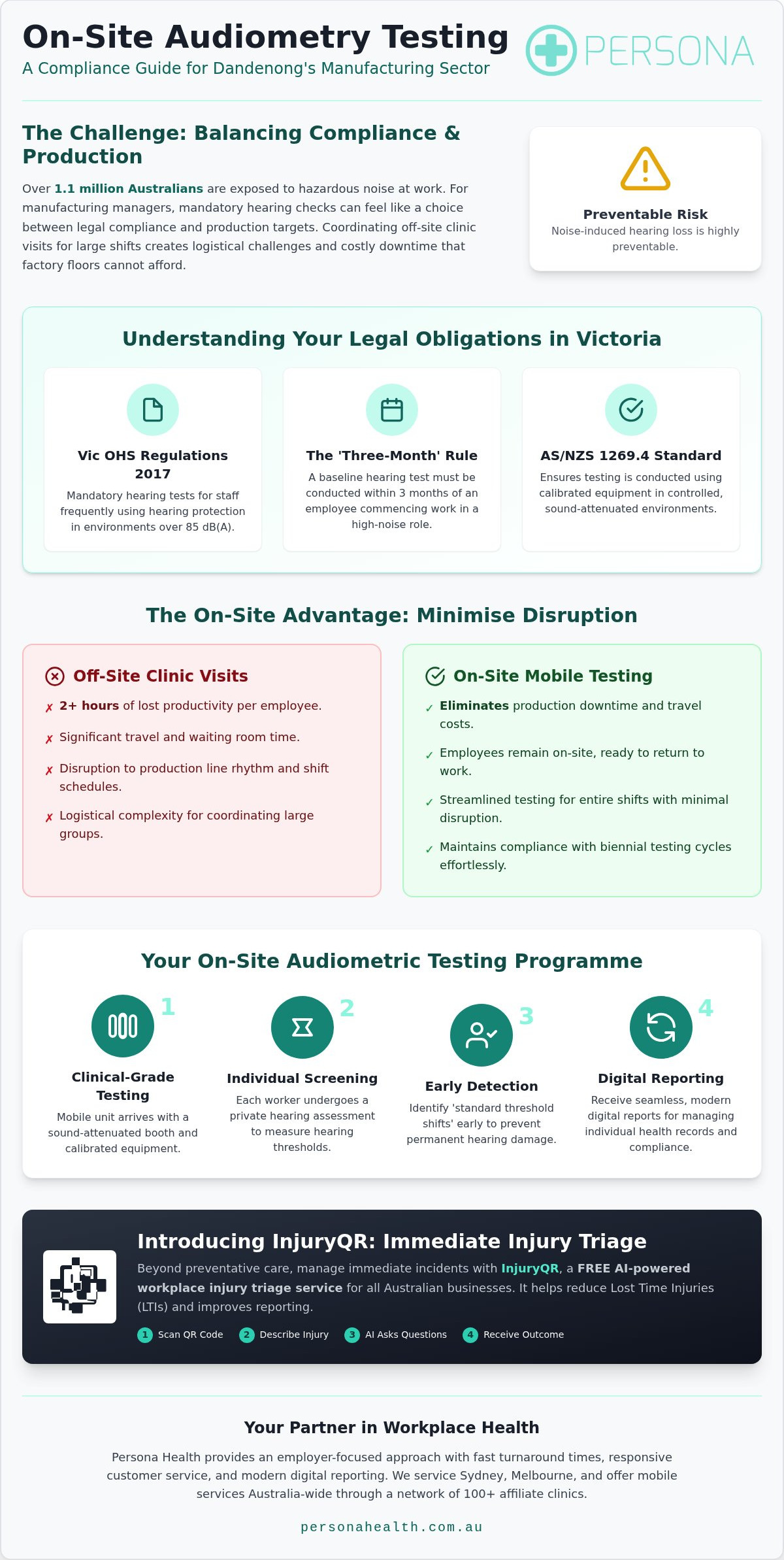
Audiometric testing is the clinical measurement of a worker’s hearing threshold, identifying the quietest sounds an individual can hear across a range of frequencies. It is a vital component of health surveillance that helps detect early signs of damage before it becomes a permanent disability. Under the Occupational Health and Safety Regulations 2017 in Victoria, employers have a strict legal obligation to provide these tests to any employee who is frequently required to wear hearing protection. In Dandenong’s bustling industrial landscape, particularly within metal fabrication and food processing plants, noise levels often exceed the 85 dB(A) exposure standard, making these assessments a non-negotiable safety requirement.
One of the most critical compliance hurdles for local businesses is the ‘three-month rule’. WorkSafe Victoria requires that a baseline hearing test be conducted within three months of an employee commencing work in a role where hearing protection is required. This baseline provides a reference point for all future assessments, ensuring that any subsequent hearing loss is accurately tracked and managed. Failing to capture this early data can leave businesses vulnerable to complex workers’ compensation claims later on, as there’s no clinical proof of the worker’s hearing health upon entry.
The Legal Framework: WorkSafe Victoria and AS/NZS 1269.4
The benchmark for all hearing assessments in Australia is AS/NZS 1269.4. This standard ensures that testing is conducted in controlled environments, such as sound-attenuated booths, using calibrated equipment. As an employer, your duty of care involves more than just providing earplugs; you must actively monitor the effectiveness of your noise control measures through regular health surveillance. Non-compliance with these standards can result in significant WorkSafe fines, Improvement Notices, or costly common law claims if a worker develops preventable Occupational hearing loss. For managing any immediate workplace injuries or safety incidents, Australian businesses can also utilise InjuryQR. This is a free AI-powered triage service that allows workers to scan a QR code and report injuries instantly, helping to reduce Lost Time Injuries (LTIs) through immediate self-care advice or telehealth connections.
Why Dandenong Factories Face Unique Noise Challenges
The Dandenong South industrial zone is one of Australia’s most dense manufacturing hubs. The constant hum of heavy machinery, combined with intermittent high-impact noises from presses and cutters, creates a complex acoustic environment. Over time, this ambient factory noise leads to cumulative hearing degradation that often goes unnoticed by the worker until it’s too late. To manage this effectively, many local firms are moving away from off-site clinics and opting for on-site health surveillance. Utilising on-site audiometry testing for factory workers Dandenong ensures that your compliance is handled efficiently, with minimal disruption to your production schedules and shift rotations.
The Practical Advantages of Mobile Audiometry for Manufacturing Hubs
Managing a high-output facility in Dandenong South requires clinical precision, yet many businesses still struggle with the ‘hidden costs’ of traditional off-site medical appointments. When you send a worker to an external clinic, you aren’t just losing the 15 minutes they spend in the testing booth. You’re paying for travel time, the inevitable waiting room delays, and the total disruption of their production line rhythm. For a typical Dandenong factory, a single off-site test can easily result in two hours of lost productivity per employee. When multiplied across a large shift, these gaps in the roster become a significant drain on your operational efficiency.
Implementing on-site audiometry testing for factory workers Dandenong wide transforms this logistical burden into a streamlined part of your workday. By bringing the clinic to your doorstep, you eliminate the need for coordinated transport and complex roster adjustments. Our mobile units allow for shift-by-shift scheduling that respects your output targets, ensuring that health surveillance happens in parallel with your factory’s natural flow rather than against it. It’s a pragmatic approach that satisfies the Victorian OHS Regulations without forcing a line closure.
Minimising Production Downtime in Dandenong
The efficiency of mobile testing is most evident in the time saved. A professional mobile unit can process workers in short, 15-minute windows, allowing them to return to their stations almost immediately. We often coordinate these sessions during lunch breaks or shift changeovers to further reduce impact. For large-scale operations, this means your entire workforce can be cleared for compliance in a fraction of the time it would take to cycle them through an off-site facility. It’s about making safety simple and sustainable for the long term.
Enhanced Privacy and Worker Engagement
Testing workers in their actual work environment also provides a unique opportunity for education. When a health professional is present on the factory floor, it improves worker buy-in for PPE usage, as they can see the direct link between their daily habits and their clinical results. We maintain a professional, clinical environment within our mobile units, ensuring that all data is handled with the sensitivity required by the Privacy Act 1988. This supportive, individualised approach builds trust and encourages a more proactive safety culture among your team. If you’re looking to simplify your next compliance round, you can enquire about our mobile clinic availability to see how we can fit into your schedule.
What to Expect During Your On-Site Audiometric Testing Programme
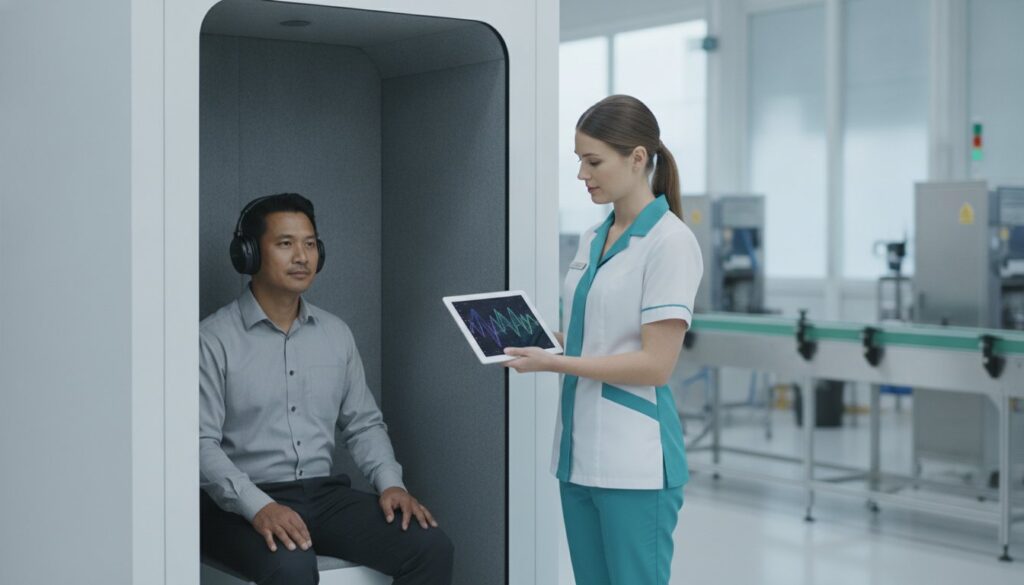
The transition from the factory floor to a clinical testing environment is designed to be as seamless as possible. When our mobile unit arrives, it functions as a fully equipped, self-contained health hub. Inside, you’ll find sound-attenuated booths that meet the strict requirements of AS/NZS 1269.4, housing precision-calibrated audiometers. This professional setup ensures that on-site audiometry testing for factory workers Dandenong businesses receive is of the same clinical standard as a fixed-location medical centre, without the logistical burden of travel.
An individual worker’s journey begins with a brief briefing from our qualified technician. They explain the air-conduction test, where the worker listens to a series of tones through headphones and responds by pressing a button. This process is non-invasive and typically takes less than 15 minutes. Our technicians are trained not just in the technical aspects of the equipment, but in providing a supportive experience that alleviates any anxiety a worker might have about their hearing health results. Immediate feedback is provided to each participant, helping them understand their current hearing capacity and the importance of their protective equipment.
The Testing Process: From Baseline to Follow-up
Accuracy in hearing health surveillance relies on two main factors: consistency and preparation. A baseline audiogram is the initial test that sets the standard for a worker’s hearing capacity, while periodic monitoring, usually conducted every two years, tracks any changes over time. To ensure the most accurate results, workers must observe a 16-hour ‘quiet time’ before their assessment. This means avoiding exposure to hazardous noise, including power tools or loud music, for the duration of the quiet period. By comparing current results to the baseline, we can immediately identify any shifts in hearing thresholds and provide workers with instant, actionable advice on how to better protect their ears.
Integrating Broader Safety with InjuryQR
While hearing health is a long-term focus, managing immediate physical safety is equally important for a productive factory floor. To complement your health surveillance programme, we recommend integrating InjuryQR into your daily operations. This is a free, AI-powered triage resource designed specifically for Australian workplaces. By scanning a simple QR code, workers can voice-describe any injury and receive instant guidance. Whether it’s self-care advice or a telehealth appointment typically available within 3-4 hours, InjuryQR helps Dandenong businesses reduce Lost Time Injuries (LTIs) and ensures that incident reporting is both fast and accurate. It is an essential tool for any modern industrial safety kit that empowers workers to take charge of their immediate wellbeing.
Navigating Victorian OHS Regulations and Compliance Standards
Compliance with the Occupational Health and Safety Regulations 2017 is an ongoing commitment that extends far beyond the initial screening. Under Victorian law, employers are required to maintain health surveillance records for the entire duration of a worker’s employment. These records serve as a clinical history, proving that you have met your duty of care and provided a safe working environment. While earmuffs and plugs are essential, they are only one part of the solution; regular monitoring is the only way to validate that your PPE is being used correctly and is actually providing the protection your team needs.
A critical term for any factory manager to understand is the ‘Standard Threshold Shift’ (STS). An STS occurs when a worker’s hearing threshold changes by an average of 10 dB or more at specific frequencies compared to their baseline test. When such a shift is detected, it’s a signal that your current noise control measures may be failing. In these instances, you must review your workplace noise levels, check the fit and suitability of PPE, and potentially refer the worker for further clinical assessment. Investing in on-site audiometry testing for factory workers Dandenong wide provides the precise data you need to identify these shifts early, allowing for intervention before permanent damage occurs.
Reporting and Documentation for Employers
Managing the paperwork for a large workforce can be overwhelming. We simplify this through modern, digital-first reporting that delivers clear, actionable insights directly to your inbox. Our reports don’t just list individual results; they provide group data that helps you identify ‘noise hotspots’ within your Dandenong facility. If one specific department shows a higher rate of threshold shifts, you can target your engineering controls or safety training to that area specifically. All data is handled with strict adherence to the Australian Privacy Principles, ensuring your business remains compliant with the Privacy Act 1988 while maintaining fast turnaround times for your records.
Actionable Steps After Testing
If a significant hearing loss is detected and confirmed through a follow-up test, specific reporting requirements to WorkSafe Victoria may apply. In complex cases where a worker’s fitness for duty is in question, you may need to refer them to an Independent Medical Examiner to determine the extent of the impairment and any necessary workplace adjustments. Remember that Victorian law requires these tests to be repeated at least every two years. This biennial cycle ensures that your health surveillance remains current and that your noise management strategy evolves alongside your factory’s production needs.
Partnering with Persona Health for Dandenong Factory Health Surveillance
Persona Health specialises in delivering comprehensive, employer-focused medical solutions across the Melbourne industrial corridor. We recognise that for Dandenong businesses, health surveillance is a critical pillar of risk management. By choosing Persona Health, you’re gaining a partner dedicated to protecting your most valuable asset; your workforce. Our approach to on-site audiometry testing for factory workers Dandenong wide is built on the foundation of modern digital reporting and clinical excellence. We provide fast turnaround times that ensure your records are always up to date, allowing you to focus on your core production goals while we handle the complexities of Victorian compliance.
Our capabilities extend beyond hearing assessments. We offer a holistic suite of health surveillance services that can be delivered directly to your site, including:
- Spirometry for workers exposed to hazardous dust, such as silica or chemicals.
- Drug and alcohol screening to maintain a safe, high-performance work environment.
- Functional assessments to ensure workers are physically suited to their specific roles.
This multi-disciplinary approach allows you to bundle multiple compliance requirements into a single visit, significantly reducing disruption to your factory floor. We don’t just provide data; we offer a supportive, clinical presence that helps your employees feel valued and protected.
Local Expertise with National Reach
While our mobile clinics are the heartbeat of our service in Dandenong, we are supported by a robust physical presence across Melbourne. Our clinics in Cairnlea and Craigieburn serve as local support hubs for more complex medical needs or follow-up assessments. For businesses with a distributed workforce, our network of 100 affiliate clinics nationwide ensures that even employees living outside the local area have access to high-quality care. This combination of local Melbourne expertise and national reach means we can scale our services to meet the needs of any manufacturing operation, regardless of its size. Our customer service team is highly responsive and understands the unique pressures faced by busy factory managers.
Book Your On-Site Testing Today
Organising on-site audiometry testing for factory workers Dandenong shouldn’t be a source of stress. We’ve simplified the booking process to ensure you can secure your preferred dates with minimal fuss. Proactive compliance is the best way to avoid the end-of-year rush that often occurs when businesses realise their biennial testing window is closing. By scheduling your health surveillance now, you ensure your site remains fully compliant with WorkSafe Victoria standards well into the future. It’s about making safety simple. We invite you to reach out and discuss how we can tailor our mobile clinic services to the specific needs of your facility.
Securing Your Factory’s Future Hearing Health
Protecting your team’s hearing is a long-term investment in both safety and productivity. By moving away from off-site clinic visits, you eliminate the logistical burden of travel and production downtime while ensuring every worker receives the individualised clinical attention they deserve. Implementing on-site audiometry testing for factory workers Dandenong wide allows you to meet your biennial WorkSafe Victoria obligations with absolute precision and minimal disruption to your daily output.
Our mobile service specifically services Dandenong South, providing high-quality assessments that are fully compliant with AS/NZS 1269.4. With fast turnaround times on modern digital reporting, you’ll have the clinical clarity needed to manage your health surveillance records with complete confidence and ease.
We are here to help you build a safer, more resilient workplace where every employee can flourish and work with peace of mind.
Frequently Asked Questions
How often is audiometry testing required for factory workers in Victoria?
Testing is required every two years. Under the Occupational Health and Safety Regulations 2017, WorkSafe Victoria mandates that employees frequently required to wear hearing protection undergo audiometric testing at least biennially. Additionally, a baseline test must be conducted within three months of an employee commencing work in a noisy environment. This regular cycle helps identify early changes in hearing thresholds and ensures your health surveillance program remains fully compliant with Victorian law.
What is the 16-hour quiet period before a hearing test?
The 16-hour quiet period is a mandatory requirement where workers must avoid exposure to hazardous noise before their assessment. This includes both workplace noise and loud leisure activities like using power tools or attending concerts. The goal is to eliminate “temporary threshold shift,” which can skew results and hide permanent damage. Adhering to this quiet time ensures the on-site audiometry testing for factory workers Dandenong teams undergo provides a truly accurate clinical baseline.
Can on-site audiometry be conducted in a noisy factory environment?
Yes, mobile testing is designed specifically for industrial sites. While the factory floor itself is loud, the assessments take place inside specialised, sound-attenuated booths within our mobile medical units. These booths are engineered to block out ambient factory noise, ensuring the environment meets the strict acoustic requirements of AS/NZS 1269.4. This allows for clinical-grade testing to happen right outside your warehouse doors without sacrificing accuracy or legal compliance.
What happens if a worker is found to have a hearing threshold shift?
If a threshold shift is detected, the first step is usually a follow-up test to confirm the result. If the shift is permanent, you must review your current noise control measures and ensure the worker’s PPE is fitted and used correctly. In some cases, a referral to an Independent Medical Examiner may be necessary to determine the cause and extent of the loss. It is a supportive process aimed at preventing further degradation of the individual’s hearing health.
Is on-site audiometry more expensive than clinic-based testing?
While the service fee for a mobile clinic may differ from a single clinic appointment, the total cost of on-site testing is often significantly lower. You must consider the “hidden costs” of off-site visits, such as travel time, lost production, and shift disruptions. By bringing the clinic to Dandenong, you eliminate these overheads. Most businesses find that the logistical efficiency and reduced downtime make on-site testing the more cost-effective choice for large-scale manufacturing operations.
What information is included in the employer’s summary report?
The employer’s summary report provides a comprehensive overview of your workforce’s hearing health while respecting individual privacy. It includes de-identified data that highlights trends, such as “noise hotspots” in specific departments, and tracks overall compliance with the biennial testing cycle. You will receive clear, digital reporting that identifies which workers have had a threshold shift and offers actionable recommendations for improving your workplace noise management strategy and safety protocols.
Does the worker get their results immediately after the test?
Yes, each worker receives immediate verbal feedback from the technician regarding their hearing capacity. This direct communication is a vital part of the educational process, helping employees understand how their work environment affects their health. While the detailed digital reports are sent to the employer shortly after the visit, providing workers with their results on the day encourages better buy-in for wearing hearing protection and taking ownership of their personal safety on the factory floor.
What qualifications do the audiometric technicians hold?
Our technicians are qualified professionals who have completed competency-based training in line with Australian Standards. They are experts in conducting air-conduction audiometry and are trained to use precision-calibrated equipment within sound-attenuated environments. Beyond their technical skills, our team is chosen for their empathetic approach, ensuring that on-site audiometry testing for factory workers Dandenong is a reassuring and professional experience for every member of your staff, from the booth to the final report.

Article by
Ian Nicholson
Ian is the Business Support Manager at Persona Health, where he plays a key role across IT, sales, marketing and business operations. With a broad skill set and a practical, solutions-focused approach, Ian helps drive the systems, communication and commercial strategy that support Persona Health’s continued growth across Australia.