

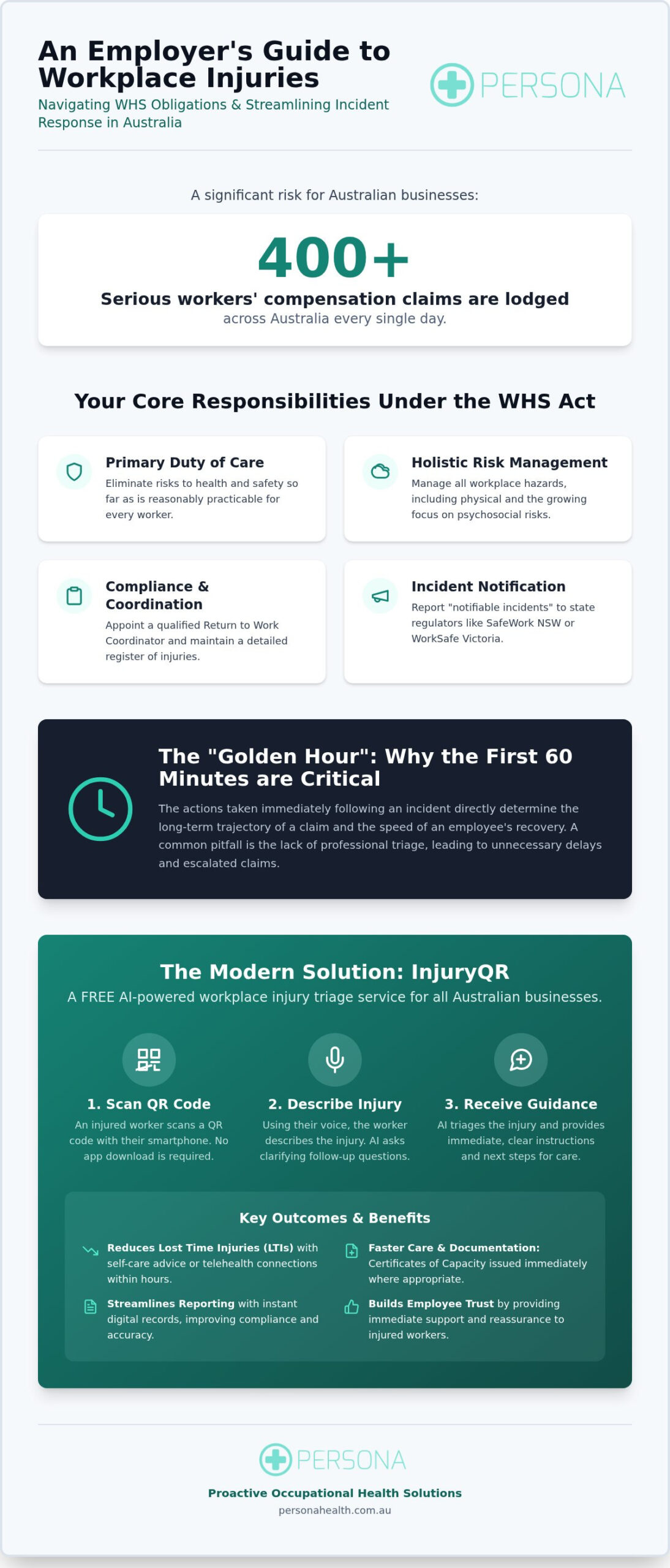
Did you know that over 400 serious workers’ compensation claims are lodged across Australia every single day? For any business owner or HR manager, these figures represent more than just statistics; they represent a significant risk to both your people and your bottom line. This comprehensive employer guide to workplace injuries provides the clarity you need to navigate the evolving 2026 legislative landscape with confidence.
We understand the pressure of keeping up with SafeWork regulations and the genuine concern that follows a workplace incident. It’s often difficult to balance empathy for an injured worker with the complexities of state-specific legislation and rising insurance premiums. This guide will help you master your WHS obligations and demonstrate how proactive medical triage can drastically reduce Lost Time Injuries (LTIs) while fostering a culture of trust. We’ll explore streamlined incident response strategies, including the use of InjuryQR for immediate AI-powered triage, and explain how specialist care at our Gregory Hills and Rosebery clinics ensures your team receives the tailored support they deserve for a safe, sustainable return to work.
Key Takeaways
- Understand your evolving duty of care under the WHS Act and state-based regulations to maintain full compliance and protect your workforce.
- Learn why the first hour of an incident is critical for the claim trajectory and how AI-powered triage provides immediate support for injured staff.
- Use this employer guide to workplace injuries to navigate reporting timelines for SIRA and WorkSafe Victoria, helping to manage premiums effectively.
- Discover the clinical advantages of partnering with Occupational Physicians to create sustainable return-to-work plans that reduce long-term absences.
- Access a streamlined incident response framework that builds employee trust while utilising modern digital reporting and a national clinic network.
Employer Obligations and the Australian WHS Framework
The Australian work health and safety framework is built on the fundamental principle that every worker has the right to return home safely. As an employer, or Person Conducting a Business or Undertaking (PCBU), your primary duty of care is set out in the Work Health and Safety Act. This legislation requires you to eliminate risks to health and safety so far as is reasonably practicable. This employer guide to workplace injuries highlights that your responsibilities extend beyond physical hazards to include the management of psychosocial risks, which have seen significant regulatory tightening in 2026. SafeWork Australia provides the national model, but enforcement and specific requirements are managed by state regulators such as SafeWork NSW, WorkSafe Victoria, and Comcare. Failing to maintain a documented Injury Management Program doesn’t just invite legal scrutiny; it directly correlates with higher workers’ compensation premiums and a breakdown in workplace culture.
Primary Duties Under WHS Legislation
Your first line of defence is the provision of a safe work environment through rigorous risk management. This involves more than just identifying hazards; it requires active consultation with your workforce. Under the current 2026 framework, businesses must appoint a qualified Return to Work Coordinator to oversee the recovery process of injured staff. You’re also legally required to maintain a detailed register of injuries and adhere to strict incident notification protocols. Recent amendments to model WHS laws have expanded these requirements. You must now notify your state regulator of “notifiable incidents” that include violent events, work-related suicide attempts, or any injury resulting in a worker being absent for 15 or more calendar days. Clear documentation is vital for both compliance and ensuring that Workplace Injury Management remains focused on the individual’s recovery.
Codes of Practice and Australian Standards
The principles of occupational safety and health are further defined by approved Codes of Practice. In New South Wales, as of 1 July 2026, these codes have become mandatory. This means you must either follow the specific steps outlined in the code or prove that your alternative safety measures provide an equal or higher level of protection. Australian Standards also provide technical guidance for safety equipment and environmental controls, such as the new Workplace Exposure Limits for airborne contaminants effective from December 2026. Balancing these safety requirements with the Privacy Act 1988 is a delicate process. You must ensure that sensitive medical information is handled according to Australian Privacy Principles. Persona Health supports this by providing secure, modern digital reporting, ensuring your business stays compliant while respecting the privacy and dignity of every employee.
Immediate Incident Response: The Critical First Hour
The first 60 minutes following a workplace incident are often referred to as the “Golden Hour”. This period is critical because the actions you take immediately determine the long-term trajectory of a workers’ compensation claim and the speed of an employee’s recovery. This employer guide to workplace injuries emphasises that a calm, structured response reduces panic and ensures compliance with SafeWork Australia standards. Your priority is to ensure the injured person’s safety, provide immediate first aid, and secure the incident site to prevent further harm. However, once the immediate danger has passed, the most common mistake is a lack of professional triage. This often leads to workers waiting hours in an Emergency Department for non-critical issues or visiting a general GP who may lack specific occupational expertise.
The InjuryQR Triage Process
To bridge this gap, Persona Health provides InjuryQR, a free AI-powered workplace injury triage service available to all Australian businesses. We offer free posters, stickers, and magnets for your first aid stations or high-traffic areas. When an incident occurs, the worker simply scans a QR code with their smartphone, with no app download required. They describe the injury using their voice, and the AI asks clinical follow-up questions to assess the severity. This shift from manual, paper-based reporting to instant digital triage provides immediate peace of mind for both the worker and the supervisor. The AI categorises the injury into one of four distinct pathways:
- Self-Care Advice: Immediate instructions for managing minor strains or abrasions.
- Telehealth Appointment: A consultation with a clinician, usually within 3 to 4 hours.
- Emergency Department: Direction to the nearest hospital for urgent care.
- Call 000: Immediate escalation for life-threatening emergencies.
Telehealth and Immediate Medical Intervention
Accessing telehealth within that 3 to 4 hour window is a game-changer for injury management. For non-life-threatening injuries, this prevents unnecessary and costly trips to the hospital while still providing professional medical intervention. During the telehealth session, a doctor can issue a Certificate of Capacity immediately where appropriate. This allows the worker to understand their limitations and potential modified duties right away, which is vital for reducing Lost Time Injuries (LTIs). If physical intervention or follow-up is required, we can direct workers to our specialist clinics in Gregory Hills or Rosebery, or one of our 100 affiliate clinics nationwide. If you need help setting up a more robust response framework, you can speak with our team to discuss how we support your specific industry requirements.
Best Practice Injury Management and Return to Work
While immediate triage via InjuryQR sets the stage for a successful claim, the long-term recovery of your employee depends on specialist clinical expertise. Many business owners find themselves frustrated by vague medical certificates from general practitioners who may not understand the specific physical demands of a construction site or a busy warehouse. This employer guide to workplace injuries advocates for a specialist-led approach. By involving experts who understand the intersection of medicine and the Australian workplace, you ensure that recovery is both safe and sustainable. Professional intervention ensures that the individual’s needs are met while maintaining the operational requirements of your business.
The Role of the Occupational Physician
The primary difference between a standard GP and an Occupational Physician lies in their clinical focus. A GP treats a patient’s symptoms in isolation; however, an Occupational Physician evaluates a worker’s “fitness for work” within their specific environment. These specialists understand the biomechanical demands of different roles and the legislative frameworks of SafeWork NSW or WorkSafe Victoria. They act as a bridge between the clinical setting and the workplace. For complex cases where recovery has plateaued, an Injury Management Consultant can provide the necessary direction to overcome barriers. This level of Best Practice Injury Management in Melbourne and Sydney ensures that workers aren’t left off work longer than medically necessary, which is the most effective way to control your insurance premiums.
Implementing Modified and Suitable Duties
A sustainable Return to Work (RTW) plan is built on objective data rather than guesswork. We use Functional Assessments to precisely measure a worker’s physical capabilities against their job description. This data allows us to match the employee with suitable duties that respect their clinical restrictions while keeping them productive. Staying connected to the workplace has profound psychological benefits. It prevents the “disability mindset” and maintains vital social connections with colleagues. We recommend following these principles:
- Meaningful Contribution: Avoid tasks that feel like “busy work”. Modified duties should contribute to business goals.
- Graduated Progression: Slowly increase hours or physical demands as healing progresses, monitored by clinical reviews.
- Regular Communication: Maintain an open dialogue between the worker, the RTW coordinator, and the treating physician.
If a worker’s recovery stalls, we provide escalated care at our Gregory Hills or Rosebery clinics to identify and address underlying issues. Providing tailored support shows your team that you value their long-term health. This approach is a cornerstone of a positive safety culture and ensures your workforce remains resilient and supported through every stage of their recovery.
Navigating Workers Compensation and Legislative Reporting
Understanding the administrative side of a claim is just as vital as the clinical recovery. Each state has its own regulatory body, such as SIRA in New South Wales, WorkSafe Victoria, or the federal Comcare system. While these organisations provide the framework, your business’s ability to navigate reporting timelines determines your future financial liability. This employer guide to workplace injuries underscores that delays in reporting often lead to a longer “claims tail,” where costs continue to mount long after the initial incident. Persona Health acts as the essential bridge between the incident and the insurance claim. Whether you are visiting our specialist clinics in Gregory Hills or Rosebery, or utilising our network of 100 affiliate clinics nationwide, our focus remains on providing the objective clinical data required to resolve claims efficiently.
Reducing Lost Time Injuries (LTIs)
Lost Time Injuries are a primary driver of rising insurance premiums because they directly impact your experience rating. When a worker is away from the business, the costs extend beyond weekly payments to include lost productivity and the expense of hiring temporary staff. Early intervention is your most powerful tool. By utilising modern digital reporting through InjuryQR, you can identify injury hotspots before they become chronic issues. This data allows you to implement targeted safety interventions. Keeping a worker in “suitable duties” rather than allowing them to sit at home isn’t just about cost; it’s about maintaining their professional identity and momentum toward a full recovery.
Legislative Compliance and Privacy
Handling a worker’s medical information requires strict adherence to the Privacy Act 1988 and the Australian Privacy Principles. You have a statutory obligation to protect sensitive data and ensure it’s only shared with relevant parties, such as insurers or authorised medical providers. As noted throughout this employer guide to workplace injuries, compliance also involves reporting “notifiable incidents” to your state regulator, such as SafeWork NSW, within the required timeframes. In cases where a recovery process becomes complex or a dispute arises regarding capacity, you may need to arrange Independent Medical Examinations (IMEs). These assessments provide an objective, third-party clinical opinion to help all parties move forward with a clear plan. Our employer-focused approach ensures all documentation is clinically sound and delivered with the fast turnaround times your business needs to stay compliant.
Partnering with Persona Health for Proactive Safety
Partnering with a specialised occupational health provider transforms your safety approach from a reactive burden into a streamlined, preventative strategy. This employer guide to workplace injuries has detailed the legislative and clinical demands of the 2026 framework; however, the true value lies in having a reliable partner who understands the nuances of your industry. Persona Health provides the infrastructure and expertise required to manage every stage of the employee lifecycle. Whether you are navigating a complex claim or implementing a national safety programme, our focus on fast turnaround times and modern digital reporting ensures you have the data needed to make informed decisions. We act as an extension of your HR and safety teams, providing the clinical authority that builds trust with your workforce.
Our Sydney and Melbourne Clinic Network
Our flagship clinics in Gregory Hills and Rosebery are strategically positioned to support Sydney’s major infrastructure and industrial sectors. The Gregory Hills clinic serves the rapidly growing South West Sydney corridor, while our Rosebery facility is ideally located for businesses in the inner south and port areas. Along with our Parramatta and Dee Why locations, we provide comprehensive coverage across the Sydney basin. In Victoria, our clinics in Cairnlea and Craigieburn support the state’s vital transport and logistics hubs. If your operations extend beyond these metropolitan centres, our network of 100 affiliate clinics nationwide ensures your team receives consistent, high-quality care regardless of their location. For businesses with high-volume requirements or remote sites, our mobile workplace services bring expert clinicians directly to your facility, minimising downtime and ensuring total compliance.
Comprehensive Occupational Health Solutions
A proactive safety culture begins long before an incident occurs. By integrating Pre-Employment Medicals with your ongoing injury management strategy, you ensure that every team member is physically and mentally suited for their specific role. We also provide specialised Health Surveillance to monitor exposure to hazardous materials. This includes Crystalline Silica Medicals and Asbestos Medicals, which are essential for meeting the 2026 Workplace Exposure Limits. These targeted assessments, combined with regular Drug and Alcohol Testing, create a robust defence against workplace harm. When an incident does occur, Workplace Injury Reporting with InjuryQR provides the immediate, AI-powered triage necessary to lower LTIs and secure the best possible recovery outcomes for your people.
Future-Proofing Your Workplace Safety Strategy
Managing workplace safety in 2026 requires more than just baseline compliance; it demands a proactive, human-centred approach to recovery. Throughout this employer guide to workplace injuries, we’ve explored how the first 60 minutes of an incident can define the long-term trajectory of a claim. By implementing immediate, AI-powered triage through InjuryQR, you provide your team with instant clinical support while significantly reducing Lost Time Injuries and insurance premiums.
Transitioning from reactive management to specialist-led care at our Gregory Hills, Rosebery, or Parramatta clinics ensures that every worker receives a tailored recovery plan. With fast digital reporting and a national network of 100 affiliate clinics, Persona Health provides the clinical authority and responsive service needed to protect your people and your bottom line. You don’t have to navigate these legislative complexities alone.
We’re here to help you build a safer, more resilient workplace where every employee feels truly valued and supported through every stage of their recovery journey.
Frequently Asked Questions
What are the first three things an employer should do after a workplace injury?
After a workplace injury, your first priority is ensuring the safety of the worker and others by providing immediate first aid. Second, you must secure the incident site to prevent further harm and preserve evidence for any potential investigation. Finally, you should initiate professional triage through a service like InjuryQR. This ensures the worker receives clinical advice within hours, which is a key step in this employer guide to workplace injuries for maintaining compliance.
How does InjuryQR help reduce my workers compensation premiums?
InjuryQR reduces premiums by lowering the number and duration of Lost Time Injuries (LTIs). By providing immediate AI-powered triage and telehealth appointments within 3 to 4 hours, workers receive early clinical intervention. This allows for the immediate issuance of a Certificate of Capacity where appropriate, facilitating an earlier return to suitable duties. Keeping workers engaged with the business prevents the high costs associated with long-term claims and improves your insurance experience rating.
Do I need a Return to Work Coordinator for a small business in Australia?
Requirements for a Return to Work (RTW) Coordinator vary depending on your state legislation and the size of your workforce. In NSW, businesses with a basic tariff premium over a certain threshold or those in high-risk industries must appoint a coordinator. Even if you aren’t legally required to have a dedicated person, you still have a statutory obligation to support an injured worker’s recovery. Small businesses often partner with Persona Health to manage these legislative duties effectively.
What is the difference between a GP and an Occupational Physician for injury management?
A standard GP focuses on treating a patient’s general health symptoms, whereas an Occupational Physician specialises in the relationship between health and work. These specialists understand the specific physical and psychological demands of Australian workplaces, such as construction or transport. They provide more precise work restrictions and fitness for work assessments. This expertise is vital for managing complex recovery journeys and ensuring that return-to-work plans are both safe and sustainable for the employee.
Can an employer attend a medical appointment with an injured worker?
An employer does not have an automatic right to attend a medical appointment with an injured worker. Under the Privacy Act 1988 and Australian Privacy Principles, medical consultations are confidential. You may only attend if the worker provides explicit, informed consent. It’s often more effective to communicate directly with the treating doctor via a written request for information regarding the worker’s capacity for suitable duties rather than being present in the clinical room during the examination.
What happens if an injured worker refuses to participate in a Return to Work plan?
Injured workers have a statutory obligation to participate and cooperate in reasonable return-to-work planning and suitable duties. If a worker refuses without a valid medical reason, they may be in breach of their obligations under state legislation like the Workplace Injury Management and Workers Compensation Act. This can lead to a suspension of weekly payments. In these situations, we recommend an empathetic approach, often involving an Independent Medical Examiner to provide objective clarity on their capacity.
How long do I have to report a workplace injury to my insurer in NSW or Victoria?
In New South Wales, you must notify your insurer of a workplace injury within 48 hours of becoming aware of it. In Victoria, employers generally have 10 calendar days to forward a worker’s claim form to their WorkSafe agent. Failing to meet these timelines can result in financial penalties or an increase in your claims excess. Using this employer guide to workplace injuries as a reference ensures you meet these legislative deadlines while providing a clear audit trail.
Is InjuryQR really free for Australian businesses to use?
Yes, the InjuryQR triage service is completely free for all Australian businesses to use. Persona Health provides free posters, stickers, and magnets containing the QR code for your workplace. There’s no cost for workers to scan the code and receive AI-powered triage advice. If the triage process leads to a telehealth appointment or a visit to our clinics in Gregory Hills or Rosebery, those clinical services are billed as standard workplace medical consultations through the workers’ compensation system.

Article by
Ian Nicholson
Ian is the Business Support Manager at Persona Health, where he plays a key role across IT, sales, marketing and business operations. With a broad skill set and a practical, solutions-focused approach, Ian helps drive the systems, communication and commercial strategy that support Persona Health’s continued growth across Australia.