
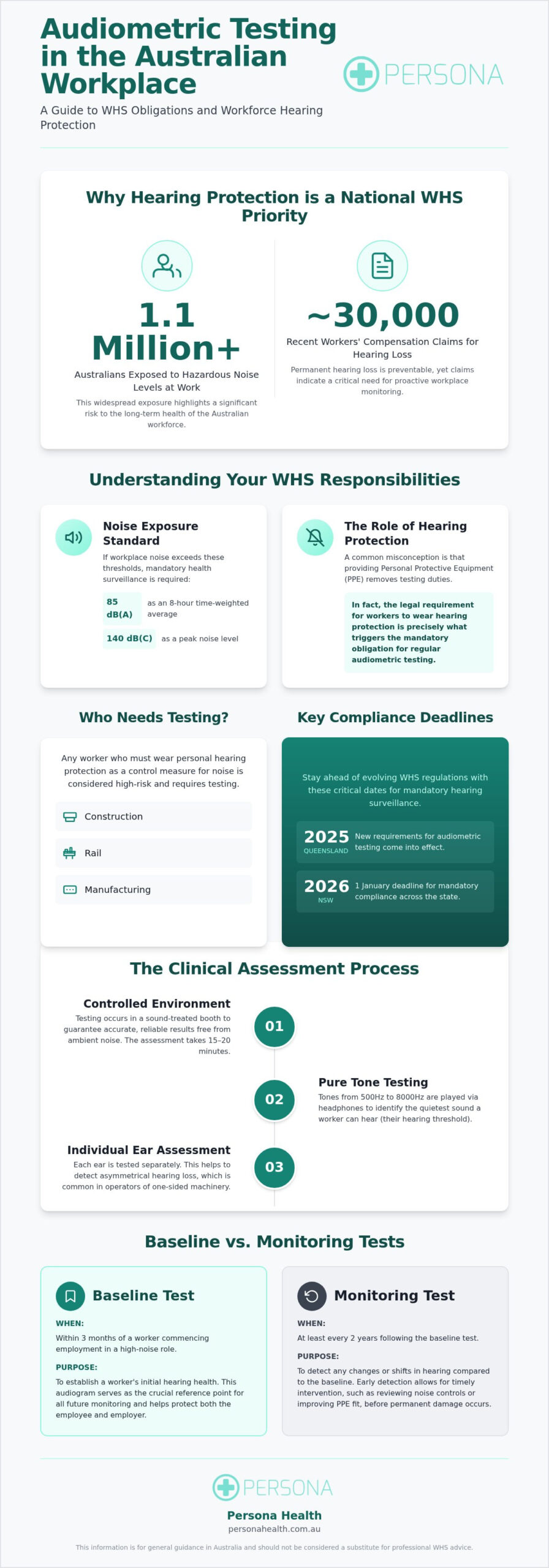
Did you know that more than 1.1 million Australians are currently exposed to hazardous noise levels in their daily work? This staggering figure, coupled with nearly 30,000 recent compensation claims for hearing loss, explains why audiometric testing has moved to the very top of the national WHS agenda. If you are feeling the pressure of the 1 January 2026 compliance deadline in New South Wales or the new 2025 requirements in Queensland, you are certainly not alone. It is challenging to keep pace with evolving SafeWork Australia standards while managing the logistics of a large or remote workforce.
We understand that maintaining strict compliance can feel like a complex administrative burden. This guide provides a clear roadmap to help you navigate Australian hearing regulations and protect your team from permanent noise-induced hearing loss. You will learn the essential differences between baseline and monitoring tests, discover how to coordinate testing across our national network from Parramatta to Craigieburn, and see how our free AI-powered triage service, InjuryQR, can simplify your injury management. By the end of this article, you will have the clinical insights and practical steps needed to ensure your business remains both compliant and supportive of every worker’s unique health journey.
Key Takeaways
- Understand your legal obligations under the latest WHS Regulations, including the critical 2026 and 2027 deadlines for mandatory hearing surveillance across different states.
- Learn how professional audiometric testing serves as a vital clinical tool for the early detection of noise-induced injuries and long-term risk mitigation.
- Discover what to expect during a clinical assessment, from the use of sound-treated environments to the interpretation of complex audiogram results.
- Identify the essential differences between baseline and monitoring tests to ensure your workforce remains protected and your documentation is always audit-ready.
- Explore how to coordinate national testing through mobile on-site services or clinical hubs to maintain a healthy, productive, and compliant workforce.
Understanding Audiometric Testing and Australian WHS Obligations
Audiometric testing is a non-invasive clinical assessment designed to measure the quietest sounds a person can hear across various frequencies. It is an essential part of occupational health because noise-induced hearing loss is often permanent, yet it remains entirely preventable through proactive monitoring. If you are looking for a deeper clinical perspective on What is audiometry?, it is formally defined as a pure tone air conduction threshold test conducted in accordance with Australian Standard AS/NZS 1269.4. By identifying subtle changes in hearing acuity early, employers can adjust safety controls before a worker suffers a life-altering injury.
Under the model WHS Regulation, businesses (PCBUs) must provide these tests for any worker required to wear personal hearing protection as a control measure for noise that exceeds the exposure standard. This isn’t just a recommendation; it’s a mandatory health surveillance duty. To better understand how this clinical process works in practice, watch this helpful video:
The Legal Framework: SafeWork Australia and State Regulations
The national framework for noise management is guided by SafeWork Australia, but enforcement falls to state-based bodies like SafeWork NSW and WorkSafe Victoria. These regulators mandate that if your workplace noise levels reach the threshold, you must implement health surveillance. It’s a common misconception that providing earplugs or muffs relieves an employer of their testing duties. In reality, the requirement for PPE is exactly what triggers the legal need for regular audiometric testing. This ensures that the chosen protection is actually effective and that no silent damage is occurring while the worker is on the job.
Who is Considered a High-Risk Worker?
Identifying which employees require monitoring is the first step toward compliance. The national standard defines hazardous noise as an 8-hour time-weighted average of 85 decibels (dB(A)) or a peak noise level of 140 decibels (dB(C)). Workers in the construction, rail, and manufacturing sectors are frequently exposed to these levels. For businesses with large or mobile teams, coordinating this can be difficult. Utilising on-site health surveillance allows you to bring the testing clinic to the workplace, ensuring every high-risk individual is accounted for without disrupting operations. This proactive approach helps catch hearing shifts before they become workers’ compensation claims.
The Clinical Process: What Happens During a Hearing Assessment?
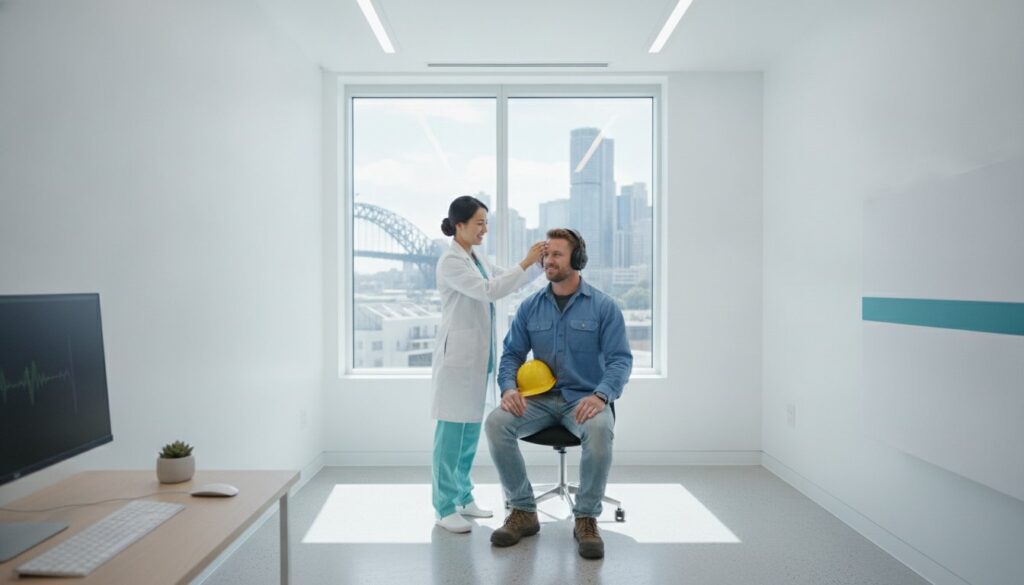
A standard audiometric test is conducted within a controlled, sound-treated environment or a specialised mobile booth. This setting is vital because even minor ambient noise can interfere with the accuracy of the results. The process is designed to be professional, comfortable, and efficient, usually taking between 15 and 20 minutes per person. During the assessment, the clinician identifies the hearing threshold, which is the lowest level of sound the worker can consistently detect across the tested frequency range. This measurement provides a clinical baseline that allows us to monitor any changes in an individual’s hearing health over time.
Pure Tone Air Conduction Testing Explained
During audiometric testing, we utilise pure tone air conduction to map the full range of human hearing. This involves presenting a series of tones through headphones at frequencies ranging from 500Hz up to 8000Hz. We test each ear individually to identify asymmetrical hearing loss, which occurs when one ear shows more significant damage than the other. This is common in workers who operate machinery positioned on one side of their body. Air conduction remains the industry standard for workplace health monitoring because it provides a comprehensive view of how the entire auditory system is functioning in response to external sound.
Preparation: The 16-Hour Quiet Period
For the results to be clinically valid, workers must avoid exposure to loud noises for at least 16 hours before their assessment. This quiet period is essential to prevent a temporary threshold shift, a condition where the ear’s sensitivity is temporarily reduced after recent noise exposure. If a worker comes straight from a noisy construction site or factory floor into a test, the results might suggest permanent damage that isn’t actually present. It’s often helpful for managers to schedule these assessments at the start of a shift or immediately following a weekend to ensure the 16-hour requirement is met without stress.
We understand that coordinating these schedules can be logistically demanding for busy operations. If you are managing a large or remote workforce, our team specialising in on-site health surveillance can work with you to design a testing roster that ensures clinical accuracy while minimising disruption to your daily productivity. By following these precise clinical protocols, we ensure that every worker receives a fair and accurate assessment of their unique hearing profile.
Compliance Timelines: The 2025 to 2027 Requirements
For many Australian businesses, 2026 represents a critical transition phase in workplace health surveillance. While the requirement for audiometric testing has been active in New South Wales since early 2024, the deadline for completing baseline tests for existing staff in that state is 1 January 2026. Meanwhile, employers in Queensland are preparing for their own enforceable requirements starting 29 July 2025. This creates a complex “middle-ground” where a single workforce might be subject to different compliance deadlines based on their commencement date and location. We understand that tracking these dates for hundreds of employees can be overwhelming, but staying ahead of these milestones is the only way to ensure your business remains audit-ready.
The regulations generally follow a clear tiered approach. Any new worker starting after 29 July 2025 must receive their baseline test within three months of commencement. For your long-term staff who were employed before this date, the regulations provide a grace period until 29 July 2027 to complete their first mandated test. Once this initial baseline is established, you must provide follow-up monitoring tests at least every two years. Persona Health helps businesses simplify this administrative burden through our comprehensive pre-employment medicals and ongoing surveillance programmes, ensuring no worker misses their critical window.
Baseline vs. Monitoring Tests
The baseline test is the gold standard reference point for a worker’s hearing. It captures their auditory health at the very start of their employment or at the beginning of the new regulatory period. This is your business’s strongest defence against future workers’ compensation claims, as it provides clinical proof of a worker’s hearing status before any potential workplace exposure. Monitoring tests are then compared against this baseline to identify a “standard threshold shift” (STS). An STS is a measurable change in hearing acuity that, if caught early, allows you to review noise controls and prevent permanent injury. Without an accurate baseline, it is impossible to determine if hearing loss was pre-existing or caused by your specific workplace environment.
Managing Compliance for Large or Remote Workforces
Coordinating assessments for a mobile or geographically dispersed team requires a methodical approach. To reduce worker downtime, many employers find that mobile on-site services are the most efficient solution, as the clinic comes directly to your facility or site. For staff located in regional areas, our extensive network of 100 affiliate clinics ensures that every employee receives the same high standard of care, regardless of their location. Centralising these records is essential for meeting SafeWork NSW or WorkSafe Victoria audit requirements. Whether your team visits our clinical hubs in Gregory Hills, Dee Why, or Craigieburn, we ensure all results are securely managed and easily accessible for your compliance reporting.
Interpreting Results and Implementing Effective Noise Control
Once audiometric testing is complete, the results are typically presented as an audiogram. This visual graph plots the hearing threshold for each ear, illustrating the quietest sounds a worker can hear across various frequencies. We look specifically for a Standard Threshold Shift (STS), which is a measurable change in hearing sensitivity relative to the worker’s baseline. Detecting an STS is often the first sign of an early-stage injury. If a shift is identified, the PCBU has a legal duty to review existing noise controls and provide the worker with appropriate medical follow-up to prevent further deterioration. Integrating these clinical findings into a broader injury management plan is essential for maintaining long-term workforce health and productivity.
The Hierarchy of Control for Noise
Protecting your team requires moving beyond a simple reliance on earplugs or muffs. While PPE is a necessary part of the safety mix, it sits at the bottom of the hierarchy of control. You should first consider elimination or substitution, such as replacing old, noisy machinery with quieter, modern alternatives. Engineering controls, like installing sound-dampening enclosures or vibration mounts, can also significantly reduce ambient decibels. Administrative controls, such as rotating staff to limit the time individuals spend in high-noise zones, further lower exposure risks. Regular testing is the only objective way to validate whether your current PPE and control measures are actually effective in your specific environment.
Immediate Triage with InjuryQR
While biennial testing identifies gradual loss, sudden hearing changes or acoustic shocks require an immediate, structured response. We provide InjuryQR as a free, AI-powered triage service to help your workers report incidents the moment they occur. There’s no app to install; a worker simply scans a QR code and describes the event using their voice. The AI then asks follow-up questions to determine the best care pathway, ranging from self-care and telehealth to emergency intervention. This immediate triage can provide instant Certificates of Capacity and significantly reduce Lost Time Injuries (LTIs) by ensuring workers receive the right clinical support without delay.
Effective noise management is a continuous cycle of assessment, action, and adjustment. If you need help interpreting your latest results or want to modernise your safety protocols, our occupational health experts can provide the guidance required to keep your business compliant. Speak with our team today about your injury management and health surveillance needs.
Professional Audiometric Services with Persona Health
Persona Health provides a streamlined, employer-focused approach to hearing surveillance. We recognise that every business has unique operational demands, so we don’t offer one-size-fits-all solutions. Whether you require audiometric testing as part of a large-scale on-site project or need individual assessments at one of our clinics, we tailor our process to your specific needs. Our clinicians are highly experienced in specialised assessments, including Cat 3 rail medicals, ensuring that your workforce meets the rigorous health standards required for safety-critical roles. By choosing a partner that understands the specific nuances of Australian industry, you can focus on your core operations while we manage the clinical details.
Why Choose Persona Health for Your Surveillance Programme?
Efficiency and accuracy are at the heart of our service. We pride ourselves on fast turnaround times for results, which allows your WHS team to make informed safety decisions without unnecessary delay. Every assessment is backed by professional clinical oversight from experienced occupational health specialists who understand the complexities of noise-induced hearing loss. We don’t just provide data; we provide peace of mind. Our commitment is to help Australian businesses stay fully compliant with the latest WHS legislation, transforming a regulatory requirement into a proactive health strategy that values the individual needs of every worker.
Booking Your Assessments in Sydney and Melbourne
Getting started is simple. Whether you are launching a site-wide surveillance programme or need individual pre-employment checks, we have the capacity to scale our services to match your timeline. We operate modern, accessible clinics across Sydney in Parramatta, Rosebery, Gregory Hills, and Dee Why. In Melbourne, our expert teams are ready to assist you in Cairnlea and Craigieburn. For businesses with a national footprint, our network of more than 100 affiliated clinics ensures consistency and quality for your regional staff Australia-wide.
We provide customised reporting that delivers actionable data directly to your WHS committee. This enables you to track trends and identify potential risks before they escalate into injuries. By centralising your health surveillance with Persona Health, you benefit from a unified approach to compliance and worker well-being. Our team is here to support you through every step of the process, ensuring your workforce remains healthy, productive, and safe. We believe that professional care should be both accessible and reliable, positioning us as your trusted partner in occupational health.
Securing Your Workforce’s Future and Compliance
Protecting your workers from noise-induced hearing loss is both a clinical necessity and a significant legal responsibility. By prioritising audiometric testing, you are doing more than just meeting a SafeWork NSW or WorkSafe Victoria requirement; you are actively preserving the long-term well-being of your most valuable asset. Whether you need a baseline for a new hire or a biennial monitoring programme for a large industrial team, having a reliable partner makes all the difference.
Persona Health offers the clinical authority and national reach you need. With dedicated clinics across Sydney and Melbourne, plus our innovative InjuryQR triage service, we ensure your compliance journey is seamless and employer-focused. We specialise in complex assessments like rail and industrial medicals, providing the fast turnaround times your business demands. Our team understands the nuances of Australian WHS legislation and is committed to helping you navigate these changes with confidence.
Contact Persona Health today to book your audiometric testing and ensure WHS compliance. We are here to support you in building a healthier, more resilient, and fully compliant workforce.
Frequently Asked Questions
Is audiometric testing mandatory for all Australian workers?
No, it is mandatory only for workers required to wear personal hearing protection to manage noise that exceeds the national exposure standard. This standard is defined as an 8-hour time-weighted average of 85 decibels. Employers in Sydney and Melbourne must identify these high-risk roles through thorough noise assessments to ensure they meet their health surveillance duties as defined by SafeWork NSW, WorkSafe Victoria, or other relevant state regulators.
How often do my employees need to have their hearing tested?
Following an initial baseline assessment, monitoring audiometric testing must be provided at least every two years. This biennial schedule is the recognised national standard for tracking long-term auditory health in the workplace. If a worker is exposed to significantly high noise levels or if a previous test indicated a shift in hearing, a more frequent testing schedule might be recommended by our occupational physicians to ensure ongoing safety.
What happens if a worker fails a hearing test?
There isn’t a simple pass or fail in clinical hearing surveillance; instead, we look for a significant change from the worker’s baseline. If a shift is detected, the PCBU has a legal duty to review workplace noise controls and provide the employee with medical follow-up advice. For sudden changes or acoustic incidents, workers can use InjuryQR for immediate AI-powered triage, ensuring the right care pathway is established quickly to prevent permanent damage.
Can I do audiometric testing on-site at my workplace?
Yes, we provide mobile on-site health surveillance services that bring the testing clinic directly to your facility. This is often the most efficient way to manage large workforces in industrial areas of Sydney and Melbourne, as it minimises worker downtime. Our mobile units are equipped with sound-treated booths that meet Australian Standard AS/NZS 1269.4, ensuring the same clinical accuracy as audiometric testing conducted in our permanent clinics in Parramatta or Craigieburn.
How much does an audiometric test cost for an employer?
The cost of all mandatory health surveillance must be fully covered by the employer and provided at no cost to the worker. While specific clinical fees vary based on the number of employees and whether you choose on-site or in-clinic assessments, investing in regular testing is far more cost-effective than managing long-term workers’ compensation claims. We provide customised quotes based on your specific operational needs, workforce size, and geographic location across Australia.
What is a “standard threshold shift” and why does it matter?
A standard threshold shift is a measurable change in a worker’s hearing threshold relative to their baseline test. It matters because it serves as an early warning sign of noise-induced hearing loss. Detecting this shift allows you to intervene before the damage becomes permanent. It triggers a mandatory review of your hierarchy of controls, ensuring that your current safety measures and hearing protection are actually providing the necessary level of defence for that individual.
Do I need to test workers who only wear hearing protection occasionally?
Yes, if the worker is frequently required to wear hearing protection to manage noise that exceeds the exposure standard, they must be included in your surveillance programme. The regulation focuses on the risk of exposure rather than the duration of the shift. Even occasional exposure to hazardous noise can lead to cumulative damage, making regular monitoring essential for protecting both the worker’s health and your business’s legal compliance under national WHS laws.
Can a pre-employment medical count as a baseline audiometric test?
Yes, a pre-employment medical can serve as a baseline, provided the hearing test is conducted within three months of the worker commencing their role. It must also be performed in accordance with Australian Standard AS/NZS 1269.4. Establishing this baseline early is vital, as it provides the clinical reference point needed to monitor the worker’s hearing health throughout their entire tenure with your organisation, whether they are based in Rosebery, Cairnlea, or a regional site.

Article by
Ian Nicholson
Ian is the Business Support Manager at Persona Health, where he plays a key role across IT, sales, marketing and business operations. With a broad skill set and a practical, solutions-focused approach, Ian helps drive the systems, communication and commercial strategy that support Persona Health’s continued growth across Australia.