

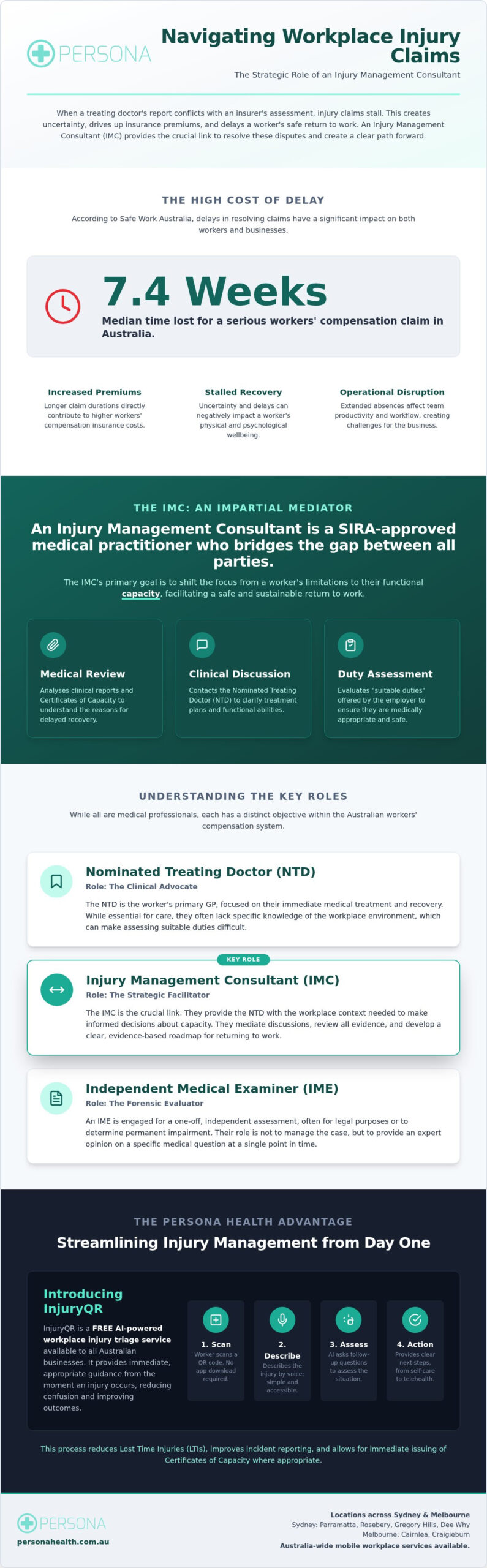
Imagine you’re caught in a stalemate where a treating GP’s certificate says “total incapacity,” yet your insurer’s report suggests the employee is fit for suitable duties. This friction doesn’t just stall recovery; it drives up your workers’ compensation premiums and leaves your team in a state of uncertainty. With the median time lost for a serious claim in Australia now reaching 7.4 weeks, according to Safe Work Australia, every day of delay impacts your bottom line and your worker’s wellbeing.
We understand how overwhelming it feels when medical advice conflicts and regulatory compliance seems like an impossible puzzle. This guide explains how an injury management consultant (IMC) acts as a strategic mediator to resolve these complex disputes. You’ll learn how an IMC facilitates faster return to work outcomes by providing clear, evidence-based assessments of a worker’s functional capacity. We will also look at how Persona Health integrates clinical expertise with innovative tools like InjuryQR to reduce employer risk and simplify the recovery journey from the very first moment an injury occurs.
Key Takeaways
- Understand how a SIRA approved injury management consultant acts as an impartial mediator to resolve medical disputes and clear the path for a successful return to work.
- Discover the critical differences between an IMC, an Independent Medical Examiner (IME), and a treating GP to ensure you engage the right expert at the right stage of a claim.
- Learn to identify the “red flags” in workers’ compensation cases that indicate a need for strategic intervention before costs and lost time escalate.
- Explore how targeted injury management strategies can significantly reduce your Lost Time Injuries (LTIs) and lower your annual insurance premiums.
- See how integrating AI-powered triage through InjuryQR with expert clinical oversight from Persona Health clinics in Rosebery and Gregory Hills streamlines the recovery process.
What is an Injury Management Consultant (IMC)?
An injury management consultant is a registered medical practitioner with specialised training and accreditation to navigate the complexities of the Australian workers’ compensation system. Unlike a general practitioner who focuses primarily on individual patient care, the IMC looks at the broader ecosystem of workplace reintegration. They act as an impartial mediator, bridging the gap between the worker, the employer, the insurer, and the treating doctor to ensure everyone is moving toward the same goal: a safe and sustainable return to work.
The primary objective of an injury management consultant is to shift the focus from a person’s limitations to their “capacity.” This perspective aligns with the Principles of Physical Therapy and Rehabilitation, which prioritise progressive management and the restoration of function over simply treating symptoms. By assessing what a worker can safely do, rather than just what they cannot, the IMC helps create a roadmap for recovery that keeps the individual connected to their workplace and community.
To better understand how this role functions within the Australian healthcare system, watch this helpful video:
The Core Responsibilities of an IMC
When a claim stalls, the injury management consultant steps in to identify clinical or communication barriers. Their responsibilities are practical and outcome-focused:
- Medical Review: They analyse clinical reports and certificates of capacity to identify why a recovery might be slower than expected.
- Clinical Discussions: The IMC contacts the Nominated Treating Doctor (NTD) to discuss treatment plans and clarify the worker’s physical or psychological abilities.
- Duty Assessment: They review the “suitable duties” offered by the employer to ensure they are medically appropriate and won’t risk re-injury.
Regulatory Framework in Australia
Operating within a strict legal structure is essential for maintaining trust and impartiality. In New South Wales, an IMC must be approved by the State Insurance Regulatory Authority (SIRA), while other states have similar accreditation requirements through bodies like WorkSafe Victoria. This ensures that every consultant has the necessary expertise in both medicine and legislation.
Adherence to the Privacy Act 1988 is a non-negotiable part of the process, ensuring health information is handled with the highest level of confidentiality. Above all, the work of an IMC is grounded in the Health Benefits of Good Work (HBGW) philosophy. This evidence-based approach recognizes that long-term absence from work can lead to poorer health outcomes, making timely intervention a matter of clinical necessity as much as economic benefit.
IMC vs. IME vs. Treating GP: Understanding the Differences
Understanding who does what is the first step in resolving a stalled workers’ compensation claim. While all three are medical professionals, their objectives within the Australian framework are distinct. An injury management consultant acts as a facilitator, whereas a treating GP is a clinical advocate and an IME is a forensic evaluator. Misidentifying which expert you need can lead to unnecessary delays and friction between the employer and the worker.
The Nominated Treating Doctor (NTD) Role
Your employee’s GP, known as the Nominated Treating Doctor (NTD), is the primary clinical caregiver. Their focus is on the patient’s immediate recovery and medical advocacy. However, GPs often face a significant hurdle: they rarely have the time or opportunity to visit your worksite. They may not understand the physical requirements of a “light duties” role or the specific safety protocols in your industry. This is where an injury management consultant adds value. They don’t take over the treatment; instead, they provide the NTD with the workplace context needed to upgrade a certificate of capacity with confidence.
The Independent Medical Examiner (IME) Role
An Independent Medical Examiner (IME) is typically engaged for a one-off forensic assessment. Their role is to provide an objective opinion on specific legal or insurance questions, such as the degree of permanent impairment or whether a condition is truly work-related. Because an IME report can lead to the cessation of benefits or a large lump-sum payout, the process often feels adversarial to the worker. In contrast, an IMC works collaboratively. They engage in discussions rather than just issuing a verdict, aiming to find a path forward that benefits both the employee’s health and the employer’s productivity.
Choosing the right professional depends on the current state of the claim. Use your employee’s GP for day-to-day clinical care. Book an IME when you need a definitive legal opinion on liability or impairment. Engage an IMC when communication has broken down, the return to work has stalled, or there is a disagreement about what the worker is safely capable of doing. If you are struggling with a complex case, you can enquire about our injury management services to help get the recovery process back on track.
- GP (NTD): Ongoing clinical care and primary advocacy.
- IME: Forensic evaluation for liability and impairment.
- IMC: Strategic mediation and return to work facilitation.
When to Engage an Injury Management Consultant
Deciding exactly when to involve an injury management consultant is a critical choice that can save thousands in insurance premiums and weeks of lost productivity. Many employers fall into the “wait and see” trap, hoping that the next medical certificate will finally show an upgrade in capacity. However, data from late 2025 indicates that return to work rates for psychological injuries are significantly lower at 76.5% compared to 90.2% for physical injuries. This gap highlights why waiting for a claim to become chronic is a high risk strategy. Proactive engagement ensures that clinical barriers are addressed before they become permanent obstacles to recovery.
The most effective time to intervene is when you notice a disconnect between the clinical reports and the reality of the workplace. If a worker’s recovery timeline has plateaued, or if there is a persistent disagreement regarding what duties are safe to perform, the situation requires a fresh, impartial perspective. An IMC doesn’t just look at the injury; they look at the friction in the system that is preventing progress. By stepping in early, they can facilitate a dialogue that moves the focus back to the worker’s strengths and the available support within your organisation.
Common Referral Triggers
You don’t need to be a medical expert to know when a case requires specialist help. Look for these specific “red flags” that suggest a claim is losing momentum:
- Stagnant Capacity: The worker has been issued “totally unfit” certificates for more than four consecutive weeks without a clear clinical explanation for the lack of progress.
- Suitability Disputes: There is a direct conflict between the employer’s offer of light duties and the GP’s refusal to approve them, despite the duties meeting all stated restrictions.
- Treatment Non-Compliance: The worker is not attending recommended rehabilitation programs or there are concerns that the current treatment plan isn’t aligned with return to work goals.
- Communication Breakdown: The treating doctor is unresponsive to workplace enquiries or refuses to discuss the functional requirements of the role.
The Referral Process for Employers
Initiating a review is a straightforward process, but it requires coordination with your workers’ compensation insurer. Under SIRA guidelines in NSW or WorkSafe Victoria protocols, an employer or insurer can request an IMC review to resolve specific disputes about capacity or suitable duties. To ensure a successful outcome, you should prepare a detailed package of information, including the current certificate of capacity, a clear list of available duties, and any previous correspondence with the treating doctor.
If you’re managing a case in New South Wales and the path forward seems blocked, engaging an Injury Management Consultant Sydney can provide the strategic circuit-breaker needed to get the recovery back on track. Our consultants focus on building a consensus between all parties, ensuring that the return to work plan is both medically sound and practically achievable for your business.
The Strategic Benefits: Reducing LTIs and Premiums
Engaging an injury management consultant provides a clear return on investment by addressing the two most expensive variables in any claim: time and uncertainty. When a worker remains off site without a clear plan, the costs to your business extend far beyond simple wages. You face the administrative burden of managing the claim, the cost of hiring temporary staff, and the inevitable rise in your insurance premiums. By resolving medical stalemates early, an IMC acts as a strategic lever to pull the claim back toward a productive resolution.
The financial impact of delayed recovery is stark. In Victoria, the average WorkCover insurance premium rate for 2026–27 is 1.8% of rateable remuneration. While this percentage is a state average, your specific premium is influenced by your “experience rating,” which looks at the cost and duration of your claims over time. Every week a worker remains on a “totally unfit” certificate adds to the total claim cost, potentially locking your business into higher premiums for years to come. An IMC helps mitigate this risk by ensuring certificates of capacity accurately reflect what a worker can safely do, rather than defaulting to total incapacity.
Impact on Workers Compensation Premiums
The relationship between claim duration and premium calculations is direct. Insurers look at “Lost Time” as a primary indicator of claim severity. When an IMC intervenes to clarify functional capacity, they often find opportunities for a worker to return to modified duties safely. This transition from a Lost Time Injury (LTI) to a “suitable duties” status can significantly lower the final cost of the claim. Implementing Best Practice Injury Management ensures that your organisation isn’t just reacting to injuries, but actively managing the financial trajectory of every case.
Improving Workplace Culture and Morale
Beyond the balance sheet, an IMC helps protect your most valuable asset: your people. We know that the longer a person is away from work, the less likely they are to ever return. This absence often leads to secondary psychological injuries, which are becoming a major challenge for Australian employers. In 2023-24, mental health conditions accounted for 12% of all serious claims, with a median time off work of 35.7 weeks. This is nearly five times the average for physical injuries.
By prioritising “stay at work” as a clinical goal, you send a powerful message to your team that their health and recovery are valued. This approach reduces the burden on other staff members who often have to “pick up the slack” for an absent colleague, thereby improving overall morale. It also ensures you remain compliant with relevant WHS legislation and SafeWork NSW or WorkSafe Victoria guidelines, which mandate that employers must provide suitable employment to injured workers where reasonably practicable.
Persona Health: Modern Injury Management with InjuryQR
Persona Health bridges the gap between clinical excellence and modern workplace needs. While an injury management consultant provides the strategic oversight needed for complex cases, we believe that effective management begins the moment an incident occurs. Our approach combines the deep expertise of SIRA-approved practitioners with responsive, digital-first reporting to ensure that no injury is left to chance. With flagship clinics in Rosebery and Gregory Hills, alongside our facilities in Parramatta, Dee Why, Cairnlea, and Craigieburn, we provide a stable foundation for recovery across Sydney and Melbourne.
Introducing InjuryQR: AI-Powered Triage
The most effective way to prevent a minor injury from escalating into a complex claim is immediate, accurate triage. This is why we offer InjuryQR, a free AI-powered service available to all Australian businesses. We provide free posters, stickers, and magnets for your workplace to make access simple. When a worker is injured, they scan the QR code with their smartphone. There’s no app to download; they just describe the injury using their voice, and the AI asks tailored follow-up questions to assess the situation.
The system provides instant direction, which might include self-care advice, a telehealth appointment (typically within 3-4 hours), or instructions to head to the Emergency Department or call 000. Where appropriate, Certificates of Capacity can be issued immediately. This rapid response significantly reduces Lost Time Injuries (LTIs) and ensures that your injury management consultant has accurate, real-time data if the case requires further intervention. It’s a proactive way to support your team while improving the accuracy of incident reporting.
Why Choose Persona Health for Your IMC Needs?
We specialise in high-risk sectors where safety and compliance are paramount, such as rail, infrastructure, and transport. Our team understands that HR and safety managers need more than just a medical report; they need actionable advice that respects the operational realities of the business. Beyond standard injury management, we offer a full suite of services, including Fitness for Duty Medicals, health surveillance, and drug and alcohol testing.
If your operations extend beyond our main hubs, our network of 100 affiliate clinics nationwide ensures your workers receive consistent care anywhere in Australia. We also provide mobile workplace services for on-site convenience. By focusing on fast turnaround times and modern digital reporting, we help you build a more resilient workforce while keeping your workers’ compensation costs under control. Our goal is to activate the inner resources of every individual, ensuring their recovery is as unique as their role in your company.
Strengthening Your Workplace Recovery Strategy
Managing workplace injuries doesn’t have to be a constant source of friction or rising insurance costs. By engaging a SIRA-approved injury management consultant, you gain an impartial expert who can cut through medical uncertainty and provide a clear, functional path forward for your team. This strategic intervention ensures that recovery remains the priority, resolving disputes before they impact your workplace culture or your bottom line. It’s about moving away from a wait-and-see approach and toward a model that prioritises active, evidence-based reintegration.
Our clinics across Rosebery, Gregory Hills, and Melbourne are dedicated to an employer-focused approach that balances clinical care with operational reality. By integrating professional expertise with modern tools like our free AI-powered InjuryQR triage service, Persona Health helps you streamline reporting and reduce Lost Time Injuries from the very first scan. We believe that every individual has a unique capacity for recovery, and our goal is to help you help them reach it through clear, actionable advice and responsive customer service.
You have the opportunity to transform your safety culture and support your employees through every stage of their recovery journey with confidence.
Frequently Asked Questions
What is the difference between an IMC and an Australia-based IME?
An injury management consultant acts as a facilitator and mediator to resolve return to work disputes through collaboration with the treating GP. In contrast, an Independent Medical Examiner (IME) provides a forensic, one-off report to determine specific legal or insurance issues like liability or permanent impairment. While an IME assessment can feel adversarial, an IMC review is designed to be a supportive process that bridges communication gaps between all parties.
Who pays for an Injury Management Consultant assessment?
The cost of an IMC assessment is typically covered by your workers’ compensation insurer as part of the claim management process. In some instances, an employer may choose to fund the service directly to expedite the resolution of a complex case and reduce the long-term impact on their premiums. In New South Wales, these fees are regulated by the State Insurance Regulatory Authority (SIRA) to ensure consistency and transparency.
Can an employer directly request an IMC review for an injured worker?
Yes, an employer can request an IMC review through their workers’ compensation insurer if they believe the return to work progress has stalled. This is a common step when there is a disagreement regarding suitable duties or when a worker’s capacity remains unchanged for an extended period. Persona Health practitioners work closely with HR and safety managers in Sydney and Melbourne to ensure these reviews provide clear, actionable outcomes.
Do I need an IMC if the worker is already seeing a physiotherapist?
While a physiotherapist provides essential clinical treatment to help a worker recover, they don’t have the same regulatory authority as an injury management consultant to resolve complex capacity disputes. The IMC provides a strategic medical overview and conducts clinical discussions with the treating GP to upgrade certificates of capacity. Engaging an IMC ensures that the rehabilitation provided by the physiotherapist is aligned with the actual functional requirements of the workplace.
How long does it take to get a report back from an IMC at Persona Health?
Persona Health is committed to fast turnaround times to ensure that the momentum of a return to work plan is never lost. You can typically expect to receive a comprehensive report within three to five business days following the clinical review or discussion. This responsive approach allows HR teams at our Gregory Hills and Rosebery hubs to make informed decisions quickly, reducing the administrative burden and the risk of claim escalation.
Is an Injury Management Consultant different from a Rehab Provider?
As a senior medical practitioner, the IMC provides the clinical authority needed to determine work capacity and negotiate with other doctors. An occupational rehabilitation provider is usually an allied health professional, such as an exercise physiologist, who implements the return to work plan on the ground. The IMC sets the clinical direction, while the rehab provider manages the day-to-day logistics of the worker’s reintegration into the workplace.
Does an IMC conduct a physical examination of the worker?
A physical examination is not always required for an IMC review, but it can be conducted if the consultant needs to clarify a worker’s functional abilities. Often, the process involves a file review and a peer-to-peer clinical discussion with the worker’s treating GP to identify barriers to recovery. If a face-to-face assessment is necessary, it focuses on what the worker can safely do in the context of their specific job requirements.
How does the InjuryQR service assist with the injury management process?
InjuryQR provides immediate AI-powered triage at the moment an incident occurs, which often prevents a claim from ever needing an IMC. By scanning a QR code and describing the injury, workers receive instant direction to self-care, telehealth, or emergency services. This rapid response ensures that accurate Certificates of Capacity are issued early, reducing Lost Time Injuries (LTIs) and providing a clear data trail for any future injury management needs.

Article by
Ian Nicholson
Ian is the Business Support Manager at Persona Health, where he plays a key role across IT, sales, marketing and business operations. With a broad skill set and a practical, solutions-focused approach, Ian helps drive the systems, communication and commercial strategy that support Persona Health’s continued growth across Australia.