

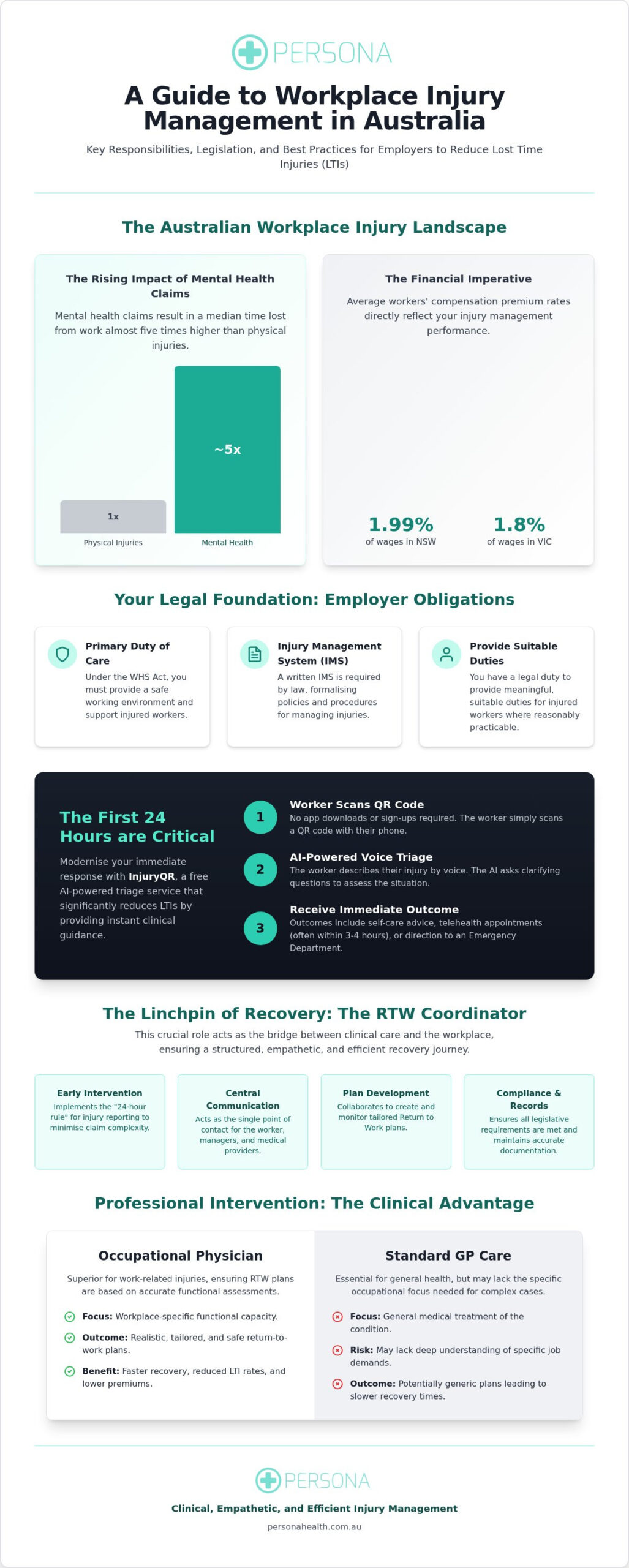
Did you know that mental health claims in Australia now result in a median time lost from work that is almost five times higher than physical injuries? As an employer, you’ve likely felt the mounting pressure of rising workers compensation premiums and the frustration of navigating the subtle differences between SafeWork NSW and WorkSafe Victoria. It’s a heavy burden to balance legislative compliance with the genuine desire to see your team recover. Central to this challenge is a clear understanding of return to work coordinator responsibilities, a role that has become increasingly complex under the 2026 regulations.
At Persona Health, we believe that injury management should be clinical, empathetic, and, above all, efficient. This guide promises to simplify the Australian legislative landscape and provide you with a repeatable system for reducing Lost Time Injury (LTI) rates. We will preview how modern digital triage, specifically the AI powered InjuryQR service, works alongside professional intervention to speed up recovery times and lower your operational costs. By the end of this article, you’ll have a clear roadmap to move from a place of uncertainty to a position of professional authority in workplace health.
Key Takeaways
- Navigate the 2026 Australian legislative landscape with confidence by understanding the latest mandatory codes of practice and state-specific requirements from SafeWork NSW and WorkSafe Victoria.
- Master the essential return to work coordinator responsibilities to ensure your organisation provides structured, empathetic support that facilitates a faster recovery for valued staff.
- Discover how integrating the free InjuryQR digital triage tool reduces Lost Time Injuries (LTIs) by offering workers immediate clinical guidance and telehealth appointments within hours.
- Learn why professional intervention from Occupational Physicians is superior to standard GP care for ensuring return to work plans are based on accurate functional assessments.
- Implement a clear, repeatable injury management system that balances clinical expertise with an employer-focused approach to lower premiums and improve workplace safety.
Understanding Workplace Injury Management and Australian Legislation
Workplace injury management is a coordinated process that integrates medical treatment, rehabilitation, and workplace support to help an employee return to their pre-injury life as safely as possible. It isn’t just about managing a claim; it’s about managing a person’s recovery. This field is deeply rooted in Occupational safety and health principles, ensuring that the physical and psychological needs of the worker are met while maintaining the operational integrity of the business. For many organisations, the success of this process hinges on clearly defined return to work coordinator responsibilities, which act as the bridge between clinical care and the workplace.
To better understand this concept, watch this helpful video regarding the coordinator’s role:
Under the Work Health and Safety (WHS) Act, employers hold a primary duty of care to provide a safe working environment. When an injury occurs, this duty extends to supporting the worker through the recovery journey. Failing to meet these obligations carries heavy consequences. Beyond the human cost, non-compliance leads to significant financial penalties and escalated insurance premiums. In 2026, the average premium rate for the NSW Nominal Insurer is 1.99% of wages, while Victoria sits at 1.8%. Any mismanagement that increases your Lost Time Injury (LTI) rates will directly impact these figures, making professional workplace injury management a financial necessity as much as a moral one.
The Legal Framework: SafeWork Australia and State Regulators
Australia operates under a harmonised WHS framework in most jurisdictions, overseen by SafeWork Australia. However, day-to-day regulation is managed by state-based bodies like SafeWork NSW and WorkSafe Victoria. National employers or federal agencies may fall under the jurisdiction of Comcare. It’s vital to recognise regional nuances; for example, as of July 2026, NSW has made compliance with approved Codes of Practice mandatory under section 26A of the WHS Act. This means Sydney-based businesses must prove their safety standards are at least equivalent to these codes, whereas Melbourne-based employers must focus on specific WorkCover premium deadlines to secure early payment discounts.
Employer Obligations Under the 1998 Act
The Workplace Injury Management and Workers Compensation Act 1998 requires employers to maintain a written Injury Management System (IMS). This system ensures that return to work coordinator responsibilities are formalised and that there is a clear pathway for every incident. Employers also have a legal duty to provide suitable duties for injured workers where it’s reasonably practicable to do so. According to SafeWork Australia, an Injury Management System is a set of policies and procedures for the management of workplace injuries and the return to work of injured workers. By having a robust IMS in place, you protect your business from litigation while ensuring your employees feel valued and supported during their most vulnerable moments.
Return to Work Coordinator Responsibilities and Best Practices
An effective Injury Management System (IMS) is built on more than just compliance; it’s built on trust. At its core, the system requires clear policies, structured procedures, and, most importantly, designated roles that employees recognise and respect. The Return to Work (RTW) Coordinator is the linchpin of this structure. By implementing a “24-hour rule” for reporting, businesses can drastically reduce the complexity of claims. Early intervention is the single most effective way to lower Lost Time Injury (LTI) rates. When a worker knows exactly what to expect in those first critical hours, their anxiety levels drop. Their focus shifts from the fear of job loss to the goal of recovery, creating a supportive environment that benefits both the individual and the organisation.
Defining Return to Work Coordinator Responsibilities
The primary aim of this role is to act as the central point of contact between the injured worker, their treating physician, and the insurer. It’s a delicate balancing act that requires clinical empathy and professional authority. One of the most vital injury management tasks is developing a specialised return to work plan that reflects the worker’s unique functional capacity. These plans must be dynamic, adjusting as the individual recovers and regains their strength.
Key return to work coordinator responsibilities include:
- Identifying suitable duties: Finding meaningful work that accommodates medical restrictions while remaining productive for the business.
- Liaising with medical professionals: Ensuring Certificates of Capacity are current and accurately reflect the worker’s progress.
- Workplace monitoring: Regularly checking in to ensure that suitable duties are being followed and not exceeded by supervisors.
- Appointment coordination: Managing specialist medical appointments to prevent delays in the treatment cycle.
If you’re looking to refine these processes within your own organisation, you can begin by speaking with our professional team about tailored employer support.
Documentation and Privacy Principles
Handling sensitive medical data requires strict adherence to the Privacy Act 1988 and the Australian Privacy Principles (APPs). A common mistake is storing injury records within a general HR file. To maintain trust and legal compliance, medical files must be kept separate and confidential. This ensures that only authorised personnel involved in the injury management process have access to sensitive health information. Using standardised forms for incident reporting and medical releases not only streamlines the process but also provides a clear audit trail for regulators like SafeWork NSW or WorkSafe Victoria. A well-documented system provides a safety net for the business, ensuring that every step taken is transparent, fair, and focused on the employee’s long-term well-being.
Immediate Response: Digital Triage and AI Integration
The transition from traditional paper-based reporting to immediate digital triage is a defining shift in modern occupational health. In the past, the “wait and see” approach often allowed minor musculoskeletal strains to escalate into complex claims, simply because professional clinical advice was not accessible in those first critical hours. By digitising the initial report, organisations can capture objective data instantly, removing the administrative bottlenecks that typically delay treatment. This proactive approach ensures that return to work coordinator responsibilities are supported by real-time insights, allowing for a more precise and empathetic management of the worker’s recovery journey from the very beginning.
Introducing InjuryQR: AI-Powered Workplace Triage
InjuryQR is a free AI-powered workplace injury triage service available to all Australian businesses, designed to make reporting frictionless and clinical. To ensure the service is accessible to every worker, InjuryQR provides free posters, stickers, keyrings, and fridge magnets for the workplace. The process is straightforward and requires no app download; a worker simply scans a QR code and describes their injury by voice in their own words. The AI then asks targeted follow-up questions to determine the severity and nature of the incident. This voice-to-data technology ensures that the nuances of the injury are captured accurately, providing a consistent starting point for the entire injury management process.
From Triage to Treatment: Telehealth and Recovery Outcomes
Once the AI assessment is complete, the system provides immediate direction based on the clinical severity of the report. Outcomes include tailored self-care advice for minor incidents, telehealth appointments typically available within 3 to 4 hours, or urgent direction to an Emergency Department or 000 for critical events. For workers who require medical intervention, Certificates of Capacity can be issued immediately where appropriate during the telehealth consultation. This speed is a vital component in reducing Lost Time Injuries (LTIs), as it allows the return to work coordinator responsibilities to shift immediately toward identifying suitable duties. By providing professional oversight within hours rather than days, InjuryQR improves reporting culture and ensures that every valued employee feels supported by a modern, responsive system.
Professional Roles in the Recovery and RTW Journey
While the administrative side of return to work coordinator responsibilities focuses on policy and communication, the clinical success of a claim often depends on the specific expertise of the medical professionals involved. A standard General Practitioner (GP) is a vital part of the Australian healthcare system, but they may not always understand the unique physical demands of industrial, rail, or transport roles. This disconnect can lead to overly restrictive Certificates of Capacity that inadvertently stall the recovery process. Professional injury management requires a more nuanced approach, where clinical care is aligned with the actual functional requirements of the workplace.
Occupational Physicians vs General Practitioners
Occupational Physicians specialise in the relationship between health and the work environment. Unlike a standard GP, an Occupational Physician applies an employer-focused perspective that prioritises durable recovery and safe, sustainable productivity. They are experts in conducting fitness for work assessments, ensuring that an employee is not just “better,” but physically capable of performing their specific duties without risk of re-injury. Specialised medical knowledge is vital for durable return to work because it bridges the gap between clinical recovery and the actual physical requirements of the job. This ensures that any work restrictions are evidence-based and tailored to the individual’s unique role within the organisation.
The Injury Management Consultant (IMC) Role
In cases where a claim has stalled or workplace conflict has arisen, engaging an IMC in Sydney or Melbourne can provide essential independent mediation. An Injury Management Consultant is a registered medical practitioner who acts as a facilitator between the treating doctor, the worker, and the employer. Their role is particularly valuable when addressing complex biopsychosocial factors, such as a worker’s fear of re-injury or perceived lack of support, which can be greater barriers to recovery than the physical injury itself. By providing an objective clinical opinion, the IMC helps resolve disagreements regarding suitable duties or treatment pathways, ensuring the focus remains on a positive outcome for all parties.
To determine exactly what an employee can safely do, we often utilise a Functional Capacity Evaluation (FCE). This is a comprehensive battery of physical tests used to measure a worker’s ability to perform tasks like lifting, carrying, or reaching. Having this concrete data streamlines return to work coordinator responsibilities by providing an objective baseline for identifying suitable duties. Instead of relying on vague medical advice, you gain a clear report on safe work limits, which builds confidence for both the worker and their supervisor during the transition back to full duties.
Speak with an Occupational Physician today
Persona Health: Your Partner in Australian Injury Management
Persona Health acts as the essential bridge between the injured worker and the employer, ensuring that medical treatment is always aligned with operational realities. We understand that return to work coordinator responsibilities extend far beyond administrative tasks; they require a partner who provides clinical certainty and fast turnaround times. Our employer-focused approach prioritises a durable return to work by providing clear, evidence-based medical advice that reduces the total cost of claims. By fostering a professional and clinical environment that remains deeply empathetic, we ensure that every worker feels valued while the business maintains its productivity and safety standards.
Local Expertise in Sydney and Melbourne
We provide dedicated clinical support across Sydney’s key regions, including Gregory Hills, Rosebery, Parramatta, and Dee Why. For our Victorian clients, we offer comprehensive services at our Cairnlea and Craigieburn locations in Melbourne. This local presence is backed by a nationwide network of over 100 affiliate clinics and mobile workplace services available Australia-wide. This extensive reach allows us to manage the entire employee lifecycle, from initial Pre-Employment Medicals to ongoing on-site health surveillance for hazardous materials. Having a consistent medical partner across multiple sites ensures that your injury management data remains centralised and your safety protocols are applied uniformly.
A Tech-Forward Approach to Employee Health
Modern occupational medicine requires real-time transparency to be effective. Our digital reporting systems provide HR and WHS managers with immediate updates, ensuring that return to work coordinator responsibilities are supported by the latest clinical data. By integrating our specialised injury management services with modern digital triage tools, we create a seamless end-to-end experience that minimises administrative delays. This tech-forward approach ensures that your organisation stays ahead of potential risks while providing a supportive, professional environment for every employee’s recovery. We don’t believe in template-driven care; our modern reporting and expert clinical management are tailored to the unique physical and psychological needs of your specific workforce.
Choosing Persona Health means choosing a partner committed to clinical excellence and responsive customer service. We provide the stability and advanced professional outlook needed to navigate the recovery process, ensuring that every worker’s journey back to health is managed with the highest level of professional authority. We are here to help you activate your internal resources and build a more resilient, safer workplace for the future.
Securing a Sustainable Future for Your Workforce
Navigating the complexities of the 2026 Australian workers compensation landscape requires a shift from reactive reporting to proactive, clinical management. By formalising return to work coordinator responsibilities and integrating free AI powered triage through InjuryQR, you don’t just reduce premiums; you build a culture of safety and clinical excellence. This approach ensures that every worker receives immediate clinical oversight, preventing minor strains from becoming long term claims that drain resources and team morale.
Whether you are accessing our specialised clinics in Gregory Hills and Rosebery or utilising our nationwide network of expert Occupational Physicians and Injury Management Consultants (IMCs), the goal remains the same: a safe, durable return to work for every employee. You now have the tools to transform a challenging incident into a managed process that prioritises human recovery alongside business stability. We’re here to guide you through every step of that transition, ensuring your team stays strong and your operations remain compliant.
Taking the first step towards a better injury management system is an investment in your people and your future. We look forward to helping you create a safer, more resilient workplace.
URL Slug: workplace-injury-management-australia-2026-guide
Frequently Asked Questions
What are the first steps an employer should take when a worker is injured?
The immediate priority is ensuring the worker’s safety through first aid and professional medical assessment. You should encourage the worker to use the free InjuryQR triage tool to get clinical advice within minutes. InjuryQR provides free posters, stickers, keyrings, and fridge magnets to make triage accessible across your site. Once initial care is provided, you must record the incident in your register of injuries and notify your insurer to ensure compliance with relevant WHS legislation.
Is an employer required to have a Return to Work Coordinator in Australia?
Legal requirements vary by state and are determined by employer size or premium thresholds. In NSW, Category 1 employers with a basic tariff premium over $50,000 must appoint a trained coordinator. In Victoria, the requirement applies to employers with over $2,518,510 in rateable remuneration. Even if not legally mandated, designating a staff member to manage return to work coordinator responsibilities is a best practice for any Australian business seeking to lower LTI rates and improve recovery outcomes.
What are the primary return to work coordinator responsibilities in NSW and Victoria?
The primary return to work coordinator responsibilities in NSW and Victoria involve acting as the central liaison between the injured worker, their treating physician, and the insurer. Coordinators are tasked with developing individualised return to work plans and identifying suitable duties that align with medical restrictions. They also ensure that all documentation, including Certificates of Capacity, remains current. This consistent monitoring helps prevent administrative delays and ensures the recovery process remains focused on a safe, durable return to productivity.
What is the difference between an Injury Management System and a Return to Work Program?
An Injury Management System (IMS) is the overarching framework of policies and procedures used by an entire organisation to manage workplace injuries. In contrast, a Return to Work Program is a specific document that outlines how an employer will help injured workers return to the workplace. While the IMS provides the strategic structure for the business, the RTW Program focuses on the operational steps and individual support required during a worker’s specific rehabilitation journey.
Can an employer choose the doctor for an injured worker’s treatment?
Under Australian law, an injured worker has the right to choose their own treating doctor. You cannot force an employee to see a specific GP for ongoing treatment. However, you can suggest specialists who understand occupational medicine, such as our team at Gregory Hills or Rosebery. For independent assessments, an employer may engage an Independent Medical Examiner (IME) to provide an objective clinical perspective on the worker’s capacity, often referencing their initial Pre-Employment Medicals results.
How does InjuryQR help reduce Lost Time Injuries (LTIs)?
InjuryQR reduces Lost Time Injuries (LTIs) by replacing the traditional wait and see approach with immediate clinical triage. Workers scan a QR code and describe the injury by voice, with AI providing immediate self-care advice or telehealth within hours. This speed allows for the immediate issuance of Certificates of Capacity and the early identification of suitable duties. This clinical oversight ensures the worker remains connected to the workplace rather than entering a period of prolonged absence.
What happens if an employer cannot provide suitable duties for an injured worker?
If you cannot provide suitable duties after a thorough assessment, you must demonstrate that it is not reasonably practicable to do so. In these instances, the worker may remain off work while receiving weekly compensation benefits from the insurer. We recommend seeking a Functional Capacity Evaluation (FCE) to identify every possible modification or alternative task. Maintaining a workplace connection is vital for the individual’s long-term psychological and physical recovery outcomes and overall well-being.
What legislation governs workplace injury management in New South Wales?
Workplace injury management in New South Wales is primarily governed by the Workplace Injury Management and Workers Compensation Act 1998 and the Work Health and Safety Act 2011. As of July 2026, compliance with approved Codes of Practice has become mandatory under section 26A of the WHS Act. These laws require employers to maintain a safe environment and provide structured support for any worker who suffers a physical or psychological injury during their employment.

Article by
Ian Nicholson
Ian is the Business Support Manager at Persona Health, where he plays a key role across IT, sales, marketing and business operations. With a broad skill set and a practical, solutions-focused approach, Ian helps drive the systems, communication and commercial strategy that support Persona Health’s continued growth across Australia.