
Could a single oversight in your 2026 safety schedule lead to a A$50,000 fine under the latest SafeWork Australia regulations? For many business owners across Sydney and Melbourne, the shifting landscape of workplace health and safety feels like a moving target. You already understand that protecting your team’s hearing is both a moral and a legal priority, yet the logistical challenge of organizing audiometric testing without halting your production line often causes significant anxiety. It’s stressful to balance these strict compliance deadlines with the daily need for operational efficiency.
At Persona Health, we believe your business deserves a partner who simplifies this process through a personalized, clinical approach. This guide promises to clarify the 2025 and 2026 legislative changes so you can achieve full regulatory compliance and protect yourself against future hearing loss claims. We’ll walk you through the essential testing procedures and highlight how our new Melbourne clinics in Cairnlea and Craigieburn offer streamlined, empathetic care that minimizes employee downtime. You’ll gain a clear roadmap to secure your workforce’s health and your company’s future with total confidence.
Key Takeaways
- Understand your legal obligations under Section 58 of the WHS Regulation and the mandatory two-year re-testing requirement for workers in high-noise environments.
- Learn how a standard 15 to 20 minute audiometric testing appointment uses pure tone air conduction to establish accurate hearing thresholds for your team.
- Discover the clinical benefits of integrating hearing assessments into a holistic pre-employment medical to protect staff from industrial risks like silica and asbestos.
- Access expert hearing health services across our Sydney and Melbourne network, including our brand-new clinic locations in Cairnlea and Craigieburn.
What is Audiometric Testing and Why is it Essential in Australia?
Audiometric testing is a precise, non-invasive procedure designed to establish your hearing threshold. It identifies the quietest sounds you can detect across various frequencies, providing a baseline for your auditory health. In Australian industrial settings, clinicians primarily use pure tone air conduction threshold tests to monitor employee wellbeing. This isn’t just about ticking a compliance box; it’s about preserving your quality of life outside the workshop or construction site. At Persona Health, we view this as a vital part of our on-site health surveillance programs, ensuring that your hearing remains protected throughout your career.
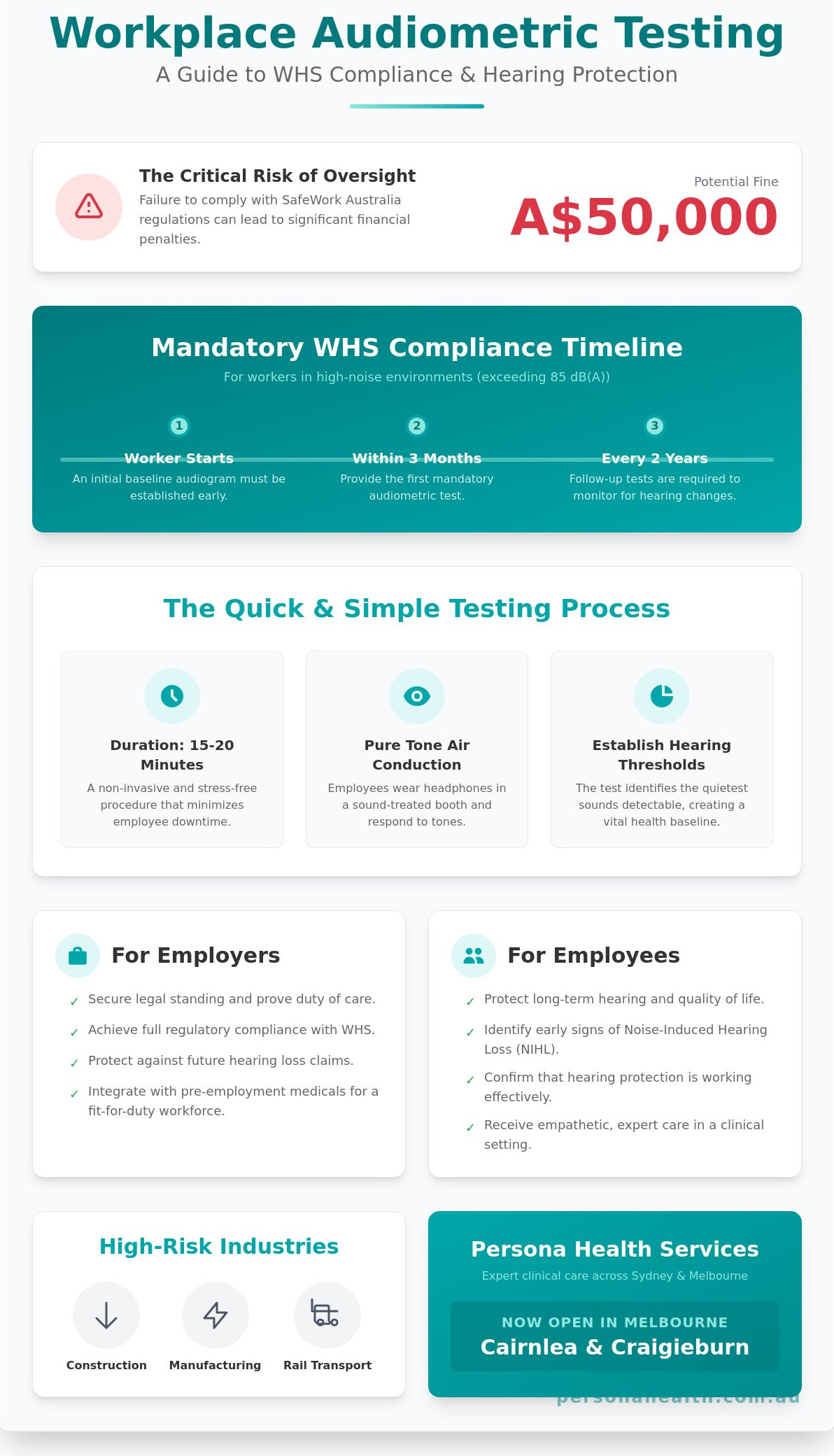
SafeWork Australia sets clear standards under the Model Work Health and Safety (WHS) Regulations 2011. Employers must provide audiometric testing within three months of a worker starting a role that requires hearing protection. Following this initial baseline, follow-up tests must occur at least every two years. Relying solely on passive hearing protection like earplugs or muffs is a common mistake. While these tools reduce noise, active monitoring through clinical testing is the only way to confirm they’re working effectively for your unique ear anatomy. Without regular checks, gradual hearing loss can go unnoticed until it’s too late to reverse.
The Science of Hearing Thresholds
We measure hearing thresholds by presenting tones at different pitches, from low bass to high treble, measured in Hertz (Hz). Testing each ear individually is critical because noise exposure often affects one side more than the other, especially in trades where machinery is positioned to one side. By catching early signs of noise-induced hearing loss (NIHL), we can intervene before the damage becomes permanent. Our clinicians look for a specific “notch” in the audiogram results, which is a classic indicator of industrial noise damage. This personalized data allows us to empower you with the right knowledge to protect your future health.
Audiometry in the Modern Australian Workplace
Industries like construction, manufacturing, and rail transport are high-risk zones where noise levels frequently exceed the 85 dB(A) limit. For those in the rail sector, specialized assessments such as CAT 3 rail medicals are often mandatory to ensure safety on the tracks. Persona Health has recently expanded its clinical excellence to the Melbourne region, opening new state-of-the-art facilities in Cairnlea and Craigieburn. These locations provide a supportive environment where your health is the priority.
- Testing protects employee health by identifying early-stage hearing fatigue.
- It secures the employer’s legal standing by providing documented proof of duty of care.
- Our pre-employment medicals ensure workers are fit for their specific environments from day one.
Our approach ensures Victorian businesses meet their legal obligations while employees receive empathetic, expert care. Whether you’re visiting our new Cairnlea clinic or our facility in Craigieburn, you’ll find a team dedicated to your long-term recovery and health maintenance.
The Audiometric Testing Process: What to Expect During an Appointment
Entering a clinical environment can sometimes feel overwhelming, but the audiometric testing process at Persona Health is designed to be entirely stress-free. Our team at the new Cairnlea and Craigieburn clinics ensures that every individual feels supported from the moment they arrive. The procedure is non-invasive and typically takes between 15 to 20 minutes to complete. You’ll spend this time in a specialised, sound-treated booth or a quiet room that meets the strict ambient noise standards set by SafeWork Australia. This controlled environment is vital for accuracy because even a faint background hum can skew the results.
During the test, you’ll wear a pair of comfortable headphones. The technician will play a series of tones at different pitches and volumes. Your only task is to press a button or raise your hand every time you hear a sound, even if it feels very faint. We understand that some employees worry about “failing” the test; however, this is simply a baseline measurement to help protect your future wellbeing. It’s a proactive step toward health, not a test of your performance as a worker. Our clinicians are trained to guide you through each step with a calm, patient approach.
Preparing for Your Hearing Test
To ensure we capture the most accurate data, you need to avoid loud noises for at least 16 hours before your appointment. This quiet period prevents a temporary threshold shift, which is a short-term dulling of hearing that occurs after exposure to heavy machinery or loud music. When you arrive at our Melbourne facilities, the technician will ask about your work history and any recent ear-related issues. Following simple instructions, such as keeping still and focusing on the tones, allows us to provide the most precise health profile possible. Your comfort is our priority throughout this brief session.
Understanding Your Audiogram Results
Your results are plotted on an audiogram; this is a graph showing the softest sounds you can hear at various frequencies. We measure frequency in Hertz (Hz) and volume in decibels (dB). A normal hearing range usually falls between 0 and 20 dB across all frequencies. If the results show a dip in the higher frequencies, it can be an early warning sign of noise-induced hearing loss. Persona Health provides comprehensive, easy-to-read reports for both staff and employers, ensuring everyone understands the next steps for protection. For businesses looking to manage these requirements efficiently, our on-site health surveillance services bring this clinical expertise directly to your workplace.
Legal Obligations for PCBUs: WHS Regulations and Compliance
Section 58 of the Work Health and Safety (WHS) Regulation is the cornerstone of hearing protection in Australian workplaces. It mandates that a Person Conducting a Business or Undertaking (PCBU) must provide audiometric testing for any worker who is frequently required to use personal protective equipment to protect against noise levels that exceed the exposure standard. This legal requirement ensures that hearing protection isn’t just provided, but is actually effective in preventing permanent damage. We understand that managing these schedules can be complex, but our clinical teams at the new Persona Health clinics in Cairnlea and Craigieburn are ready to help you navigate these statutory requirements with ease.
The timing of these tests is strictly regulated to ensure a clear medical history is established. You must arrange a baseline test for new employees within three months of them starting work. This 12 week window is vital for documenting their hearing health before significant exposure occurs. Following this baseline, mandatory re-testing must happen every two years. In environments with extreme noise or where protective gear is less effective, more frequent monitoring may be required by a medical professional to ensure the worker’s safety. Our fitness for duty medicals can be integrated with these tests to streamline your compliance process.
Privacy is a paramount concern during this process. All medical records, including individual test results, must be kept as confidential documents. These records should be stored securely for the duration of the worker’s employment and must be provided to the worker upon request or when they leave the company. At Persona Health, we use secure, clinical grade systems to manage this data, giving you peace of mind that your business meets all Australian privacy standards.
SafeWork Australia Standards and Noise Assessments
SafeWork Australia defines the exposure standard as a steady noise level of 85 decibels (dB(A)) averaged over an eight hour shift. If your workplace features impact noises, the peak level must not exceed 140 decibels (dB(C)). If you’re unsure whether your site hits these levels, you must conduct a formal workplace noise survey. This objective data determines whether you are legally bound to implement on-site health surveillance programs. Our experts at the Cairnlea and Craigieburn sites can review these surveys to help tailor a testing schedule that reflects the unique risks of your facility.
Consequences of Non-Compliance
Failing to monitor hearing health can lead to severe financial and legal repercussions. SafeWork regulators can issue significant fines for breaches of Section 58, often reaching thousands of dollars per instance. Beyond immediate penalties, the long term impact on workers compensation premiums is substantial. A single claim for occupational hearing loss can increase your annual premiums by 15% to 25% for several years. Proactive audiometric testing serves as a powerful risk management tool; it allows for early intervention and demonstrates your commitment to a safe work environment. If an issue is detected, our injury management protocols ensure your workers receive the right care immediately, reducing the likelihood of permanent disability claims.
Accessing Audiometric Testing in Melbourne and Sydney
Finding a reliable partner for audiometric testing shouldn’t be a hurdle for your business. Persona Health provides comprehensive coverage across major industrial hubs, ensuring your team remains compliant with SafeWork Australia standards. While a local GP might offer basic hearing checks, they often lack the calibrated booths and specialised knowledge required for occupational health surveillance. Choosing a dedicated provider ensures your data is accurate, legally defensible, and stored correctly for long-term health monitoring.
We offer flexible delivery models to suit your operational needs. For individual assessments or new hires, our clinics provide a controlled, clinical environment. However, for teams larger than 15 people, our on-site health surveillance is often the more efficient choice. This mobile service brings the clinic to your doorstep, reducing employee downtime by up to 60% compared to off-site appointments. It’s a practical solution that keeps your productivity high while meeting your duty of care.
Melbourne Focus: Cairnlea and Craigieburn Hubs
Our commitment to Victoria has grown significantly in 2024 with the opening of our new clinics in Cairnlea and Craigieburn. These locations provide vital access for the industrial sectors in Melbourne’s North and West. With manufacturing and logistics in these corridors growing by roughly 4.2% annually, local businesses need rapid, high-quality screening. These state-of-the-art facilities are designed for speed and precision, ensuring your workers aren’t waiting in crowded waiting rooms. We’ve tailored these sites to support the unique needs of the Victorian workforce, focusing on the specific noise exposure profiles found in heavy industry.
Sydney Services: Parramatta and Beyond
In New South Wales, our Parramatta clinic serves as a central hub for the Greater Western Sydney workforce. We understand the complexities of the local transport and infrastructure boom. Our team is highly experienced in delivering Cat 3 rail medicals, which are essential for maintaining safety on our tracks. We’ve streamlined our booking processes to handle large-scale employee groups, making it easier for project managers to coordinate compliance for hundreds of contractors at once. Whether you’re based in the CBD or the outer suburbs, our Sydney network provides the clinical authority you need to protect your staff.
Protecting your team’s hearing is an investment in your company’s future. You can book your audiometric testing at one of our specialised clinics today to ensure your business stays ahead of regulatory requirements.
Integrating Hearing Health into Your Broader Medical Surveillance
Effective workplace safety isn’t just about ticking boxes; it’s about protecting the long-term quality of life for your staff. SafeWork Australia reports that occupational noise-induced hearing loss remains a significant yet preventable issue across the country. Integrating audiometric testing into a holistic pre-employment medical ensures you establish a baseline for every new hire. This proactive step helps identify pre-existing conditions before they become a liability or a safety risk on site.
Annual health check-ups serve as a vital pulse check for your workforce. When workers feel their health is valued, productivity often sees a measurable increase. In fact, Australian businesses that invest in comprehensive health programs frequently report lower absenteeism and higher employee retention rates. These assessments aren’t just clinical requirements; they are a commitment to the person behind the role. Persona Health acts as your long-term occupational health partner, providing the continuity of care needed to track changes in health over years, not just months.
Comprehensive Health Surveillance Packages
High-risk roles in construction and manufacturing often involve multiple hazards. We streamline your compliance by linking hearing health to crystalline silica medicals for stonemasons and asbestos medicals for demolition teams. Monitoring the cumulative effects of noise alongside hazardous dust exposure provides a complete picture of worker safety. Our fitness for duty assessments ensure your team remains capable of performing their duties safely, reducing the risk of workplace incidents by up to 25% through early detection of health decline.
The Persona Health Difference
We understand that medical assessments can feel daunting for employees. That’s why we prioritise empathetic, clinical care that puts the individual at ease. We’ve expanded our reach to better serve the Melbourne region, with new state-of-the-art clinics now open in Cairnlea and Craigieburn. These locations bring our premium, patient-centred approach to the local workforce, making it easier than ever for busy employers to manage complex WHS requirements. Our team simplifies the process, handling the logistics so you can focus on your core operations. Take the first step in protecting your team’s future by booking your first round of audiometric testing at our Cairnlea or Craigieburn sites today.
Prioritise Your Compliance and Employee Wellbeing
Protecting your team’s hearing is a critical legal obligation under SafeWork Australia regulations. It isn’t just about ticking a compliance box; it’s about the long-term health of every individual in your workplace. By 2026, the standards for workplace safety will demand even greater precision from employers. Our clinicians specialise in comprehensive medical surveillance, including Cat 3 Rail and hazardous substance medicals, ensuring your business meets every WHS requirement. We’ve expanded our reach to better serve the Melbourne region with two new state-of-the-art clinics now open in Cairnlea and Craigieburn. These facilities provide the accurate audiometric testing data you need to manage noise risks effectively. Choosing a partner who understands the unique industrial landscape of Sydney and Melbourne makes the entire process seamless for your staff. We’re here to provide the clinical expertise you need while keeping your employees’ comfort at the forefront of every assessment. Your team deserves a safer, quieter, and more productive environment.
Book your audiometric testing at our Melbourne or Sydney clinics today
Frequently Asked Questions
Is audiometric testing mandatory for all employees in Australia?
Yes, audiometric testing is mandatory under the Work Health and Safety Regulations 2011 for any worker required to wear hearing protectors as a control measure. SafeWork Australia requires these assessments to ensure that noise exposure doesn’t exceed the standard of 85 decibels over an eight-hour shift. You can ensure your business stays compliant by booking a session at our Cairnlea clinic, where we provide professional oversight tailored to your industry’s needs.
How often do my workers need to have a hearing test?
Workers must have a baseline test within three months of starting work and then follow-up tests at least every two years. This biennial schedule is vital for detecting early signs of noise-induced hearing loss before it becomes a permanent disability. Our team at the Craigieburn clinic helps you track these timelines so you never miss a compliance window. It’s a simple way to show your team that you value their long-term health and wellbeing.
What happens if an employee fails their audiometric test?
If a test reveals a significant threshold shift of 15 decibels or more, the worker must be referred for a specialist diagnostic assessment. This step determines if the loss is temporary or requires a more permanent management plan. At Persona Health, we handle these situations with deep empathy and clinical precision. We offer comprehensive support at our Melbourne locations to guide both you and your employee through the next steps of their recovery.
Does a pre-employment hearing test count towards the two-year requirement?
Yes, a pre-employment test serves as the essential baseline for all future monitoring required by Australian health and safety laws. It establishes the “normal” hearing level for a worker before they are exposed to your specific site noise. Starting this process at our Cairnlea facility ensures you have a clear, professional record from day one. It’s an investment in a personalised health journey for every new member of your staff.
Can audiometric testing be performed on-site at our workplace?
Yes, we provide mobile services that bring our clinical expertise directly to your workplace to minimise operational downtime. This approach is often more convenient for large teams in industrial sectors. For those who prefer a quiet, clinical environment, our new Craigieburn clinic offers a serene space designed to make patients feel calm and supported during their audiometric testing. We adapt our delivery to fit the unique rhythm of your business.
How long do I need to keep the records of hearing tests?
You must keep audiometric testing records for the entire duration of the worker’s employment to comply with Australian occupational health laws. These records are private medical documents and must be stored securely to protect employee confidentiality. Persona Health provides detailed reports that make this record-keeping process straightforward for your HR department. You can learn more about our data standards by visiting our resource page, which focuses on empowering Melbourne employers with accurate health data.
What is the difference between a screening test and a diagnostic test?
A screening test is a quick assessment used to identify potential hearing issues, while a diagnostic test is a detailed evaluation performed by an audiologist to find the root cause of a problem. Think of screening as a preventative check-up and diagnostic as a deep dive into an individual’s unique ear health. Our specialists at Persona Health Cairnlea use state-of-the-art equipment for both, ensuring that no detail of your employee’s health is overlooked.
Do workers need to avoid noise before their audiometric appointment?
Yes, workers should avoid noise levels above 80 decibels for at least 16 hours before their scheduled test. This quiet period is necessary to ensure that temporary ear fatigue doesn’t lead to an inaccurate “fail” on the assessment. We recommend that workers wear high-quality earplugs if they are commuting or working in the hours leading up to their visit at our Craigieburn clinic. It’s a small but vital step to ensure the results are as precise as possible.