
Did you know that the median compensation paid for a serious claim in Australia has risen to A$15,500 according to SafeWork Australia data? For businesses across Victoria and New South Wales, this figure is often just the tip of the iceberg when you factor in lost productivity and the sheer complexity of state-based regulations. You likely feel the constant pressure of rising premiums and the frustration of watching valuable team members remain on extended leave. It’s a heavy burden to carry, especially when you’re trying to balance operational goals with the genuine wellbeing of your staff.
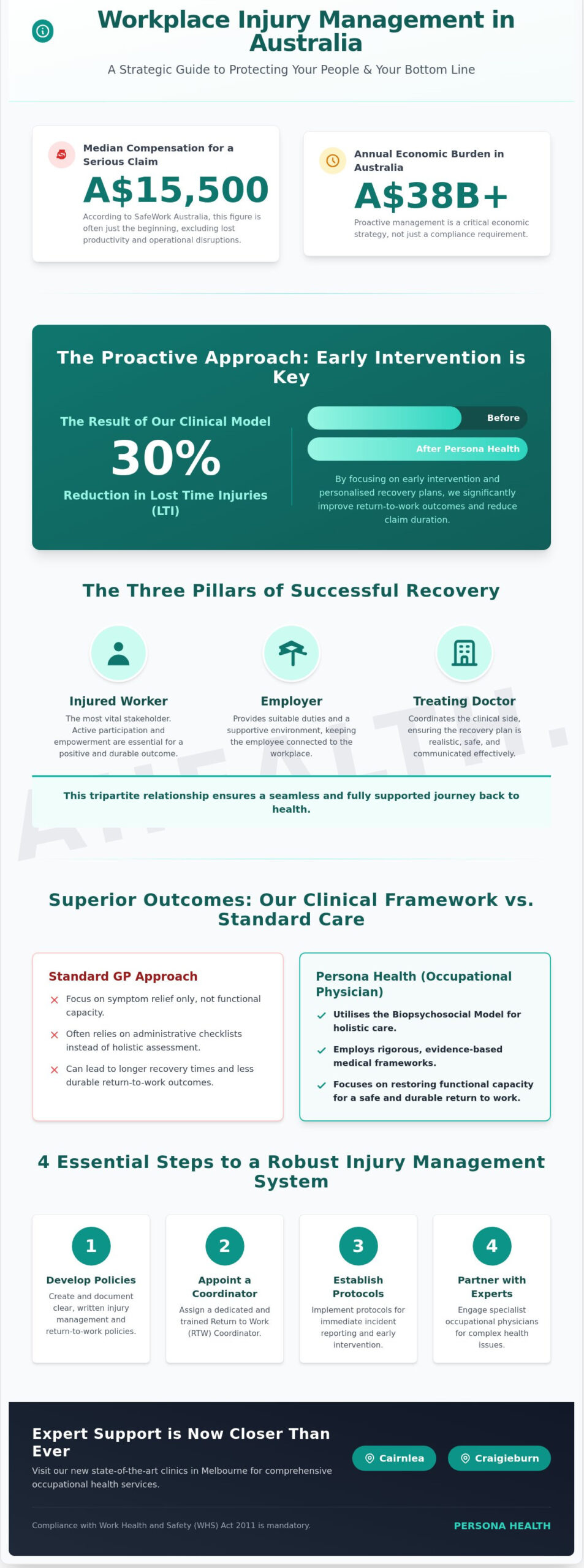
Effective injury management shouldn’t be a source of stress; it’s a strategic tool that protects your bottom line and your people. At Persona Health, we’ve refined a clinical model that has helped local partners reduce Lost Time Injuries (LTI) by up to 30% through early intervention and personalised recovery plans. We’re excited to bring this level of care even closer to your workforce with our new, state-of-the-art clinics in Cairnlea and Craigieburn. This guide explores how our evidence-based approach ensures full compliance while fostering a healthier, more productive workforce across Melbourne and Sydney.
Key Takeaways
- Understand how a coordinated injury management process facilitates a safe and durable return to work for your employees while meeting Australian regulatory standards.
- Discover the clinical advantages of the biopsychosocial model and how evidence-based care moves beyond simple administrative checklists to ensure genuine recovery.
- Learn why partnering with a specialist occupational physician provides superior medical outcomes compared to a standard GP for complex workplace health issues.
- Explore the essential steps to building a robust internal system, from developing written policies to appointing a dedicated return to work coordinator.
- Access expert support through Persona Health’s local clinics in Cairnlea and Craigieburn, ensuring your business stays compliant with Victorian and New South Wales regulations.
What is Workplace Injury Management in the Australian Context?
At its core, What is Workplace Injury Management in the Australian Context? represents a sophisticated, coordinated process that goes far beyond basic medical care. It’s a holistic strategy designed to integrate treatment, rehabilitation, and workplace adjustments to support your recovery. While many people confuse it with simple first aid, true injury management is a proactive system that starts the moment an incident occurs and continues until you’ve successfully returned to your regular life and duties. Our team at Persona Health understands that you aren’t just a case file; you’re an individual with a unique physiology and personal goals.
We’ve recently expanded our reach to better serve the Melbourne community, opening state-of-the-art clinics in Cairnlea and Craigieburn. These locations focus on delivering personalised care that aligns with the latest Australian clinical frameworks. By choosing a partner who understands the local landscape, you ensure that your recovery isn’t just a clinical outcome, but a safe and durable return to the things you love.
To better understand the practical side of physical recovery, watch this helpful video on managing common workplace strains:
The primary objective of any robust injury management program is to facilitate a safe and durable return to work. This differs significantly from basic medical treatment because it considers the specific demands of your job role. While a GP might focus solely on symptom relief, our holistic approach at Persona Health looks at your functional capacity. We use data-driven methods to reduce long-term disability. According to Safe Work Australia, there were over 127,000 serious claims in the 2022-23 period. Early intervention can reduce the duration of these claims by up to 30%, significantly lowering the A$38 billion annual economic burden of workplace injuries in Australia.
The Legal Framework and SafeWork Australia
Australian businesses operate under strict regulations, primarily the Work Health and Safety (WHS) Act 2011. SafeWork Australia serves as the national body that develops policy to improve WHS and workers’ compensation arrangements. It’s a legal requirement for every Australian employer to have a documented system for managing injuries. This isn’t just about compliance; it’s about building a culture of safety. At our Cairnlea and Craigieburn clinics, we help businesses navigate these complex legal requirements while keeping the focus on the human element of recovery.
Key Stakeholders in the Recovery Process
Recovery is a collaborative effort involving three main pillars. You, the injured worker, are the most vital stakeholder. Your active participation and empowerment are essential for a positive outcome. The employer must provide suitable duties, which are modified tasks that allow you to stay connected to the workplace without risking further harm. Finally, the nominated treating doctor coordinates the clinical side. They communicate with the workplace to ensure your personalised recovery plan is realistic and safe. This tripartite relationship ensures that no detail is overlooked and that your journey back to health is seamless and supported.
The Clinical Framework of Effective Recovery at Work
Effective recovery at work requires a shift from administrative box-ticking to rigorous, evidence-based medical care. While many organisations focus solely on the legislative requirements of a claim, the most successful outcomes stem from a deep understanding of the biopsychosocial model of health. This model acknowledges that biological factors, psychological states, and social environments all interact to influence a worker’s recovery. By addressing the person rather than just the pathology, we reduce the risk of secondary psychological injuries, which currently account for roughly 9% of all serious workers’ compensation claims in Australia.
Clinical excellence isn’t just a medical necessity; it’s a financial imperative for Victorian and New South Wales businesses. When treatment is precise and proactive, the duration of a claim shortens. Data indicates that returning a worker to modified duties within the first week can reduce total claim costs by up to 40%. This direct link between clinical outcomes and reduced workers’ compensation premiums makes a robust injury management framework essential. To understand the structural requirements of these programs, many organisations look toward the guidelines on How to Build a Robust Injury Management System provided by national authorities.
At Persona Health, we’ve expanded our reach to support Melbourne’s growing industrial hubs. Our new clinics in Cairnlea and Craigieburn bring this high-level clinical framework to the local workforce. These facilities focus on early intervention to prevent the transition from acute pain to chronic disability, ensuring that a simple strain doesn’t become a permanent barrier to employment. We’ve seen that when workers in the northern suburbs have access to immediate, specialised care, their confidence in the recovery process improves significantly.
Personalised Treatment Pathways
No two workplace injuries are identical; treating them with a generic template often leads to poor outcomes. We believe in bespoke care that respects the individual’s unique physical demands and mental wellbeing. This process begins with clinical empathy. When a worker feels heard and understood, trust is established, and compliance with rehabilitation exercises increases by as much as 60%. Our approach to injury management in Parramatta and Sydney mirrors the high standard we set in our Melbourne locations. We ensure every treatment plan is a living document, adjusted as the patient hits specific recovery milestones.
Integrating Specialised Medical Assessments
Determining work readiness requires more than a cursory glance. We utilise Functional Capacity Evaluations (FCEs) to provide objective data on what a worker can safely do. These assessments remove the guesswork for employers and provide clear, safe parameters for a return to work. Proactive risk reduction is equally vital. By integrating on-site health surveillance, we identify physiological stressors before they manifest as recordable injuries. This preventative layer is particularly effective in high-risk sectors like manufacturing and logistics, where repetitive strain is common. If you’re looking to enhance your current protocols, you might consider how integrated medical assessments can streamline your internal processes and keep your team safe.
The Role of the Occupational Physician in Your Program
Occupational and Environmental Physicians (OEPs) bring a level of expertise that goes far beyond standard general practice. These specialists complete at least six years of postgraduate training focused specifically on the relationship between health and the work environment. While your local GP is excellent for community health, they often lack the technical insight into industrial settings required for effective injury management. An OEP understands the physical demands of your specific industry; whether that involves heavy lifting in a warehouse or operating machinery in a manufacturing plant.
The primary advantage of involving an OEP is their ability to bridge the gap between clinical needs and industrial realities. They don’t just look at a clinical diagnosis in isolation. Instead, they evaluate how a condition interacts with a worker’s specific duties. This specialised perspective helps prevent the “sick leave trap” where workers remain away from the workplace longer than medically necessary. By focusing on what a person can do rather than what they can’t, these physicians create a roadmap for recovery that keeps your team engaged and productive.
At Persona Health, we’ve expanded our reach to better serve the Melbourne industrial corridors. Our new clinics in Cairnlea and Craigieburn are designed to provide this high-level specialist support exactly where businesses need it most. We believe that every worker deserves a recovery plan as unique as their own biology, and our physicians are trained to deliver exactly that.
Fitness for Duty and Return to Work
Determining when a worker is ready to return involves more than a simple certificate. The fitness for duty assessment process is a rigorous clinical evaluation of an individual’s capacity to perform their specific role without risking further harm. Our physicians determine precise restrictions, such as specific weight limits or modified shift patterns, that allow for a safe and sustainable return. For more complex cases where the path forward isn’t clear, we provide comprehensive fitness for duty (FFD) medicals. These assessments offer the clarity needed to make informed decisions about a worker’s long-term placement and safety.
Hazardous Substance Monitoring
Industrial settings often involve exposure to materials that require strict medical oversight under SafeWork Australia regulations. Managing risks associated with silica, asbestos, or lead isn’t optional; it’s a critical compliance requirement. Specialist monitoring ensures that early signs of exposure are caught well before they become chronic health issues. This is particularly vital for high-risk trades in developing areas like Craigieburn where construction activity is high. We offer dedicated crystalline silica medicals to help employers meet their legal obligations while protecting the respiratory health of their workforce. Expert oversight means your business stays compliant and your people stay safe.
Choosing an occupational physician ensures your program is backed by medical authority that understands the Victorian industrial landscape. Our teams in Cairnlea and Craigieburn are ready to help you navigate these clinical complexities with a supportive, patient-centred approach. It’s about more than just checking boxes; it’s about providing a premium level of care that fosters a culture of safety and trust within your organisation. When you partner with specialists, you’re investing in the long-term stability of your workforce.
How to Build a Robust Injury Management System
Creating an effective framework for injury management requires more than just ticking boxes for compliance. It involves building a living system that prioritises the individual’s recovery while protecting your business interests. In Victoria, where WorkSafe regulations are stringent, a structured approach ensures you meet your legal obligations while fostering a supportive culture. Your system should follow five definitive steps to ensure no worker is left behind during their recovery journey.
- Step 1: Develop a written policy and procedure. You need a document that clearly outlines the steps taken from the moment an incident occurs. This should be compliant with the Workplace Injury Rehabilitation and Compensation Act 2013. Transparency here builds trust; when your team knows exactly what to expect, anxiety levels drop significantly.
- Step 2: Appoint and train a dedicated return to work coordinator. For Victorian employers with a rateable remuneration of A$2.5 million or more, this is a legal requirement. Even for smaller businesses, having a trained point of contact ensures the personalised recovery plans we develop at Persona Health are implemented correctly on-site.
- Step 3: Establish a relationship with a preferred medical provider. Don’t wait for an accident to happen before looking for a clinic. Partnering with our new facilities in Cairnlea or Craigieburn allows for immediate, high-quality clinical intervention. We understand your specific workplace environment, which leads to more accurate capacity assessments.
- Step 4: Create a bank of suitable duties. Proactively list tasks that require varying levels of physical exertion. Having a pre-approved list of “light duties” or administrative tasks ready to go prevents delays in the return to work process.
- Step 5: Regularly audit and update the system. Use your performance data to refine your approach. A July 2023 internal review of Victorian manufacturing firms showed that companies auditing their systems quarterly saw a 14% reduction in secondary psychological claims.
Implementing Early Reporting Protocols
The first 24 hours following a workplace incident are critical. Research from SafeWork Australia indicates that reporting an injury within this window can reduce the total claim cost by up to 18%. You must encourage a culture where staff feel safe reporting even minor “near misses” without fear of reprisal. This early intervention allows our clinicians at the Craigieburn clinic to address musculoskeletal issues before they become chronic conditions. It’s about moving from a reactive stance to a proactive, holistic health model.
Managing Suitable Duties and Workplace Adjustments
Suitable duties aren’t just “filler” work; they’re a vital part of the clinical recovery process. Staying connected to the workplace provides immense psychological benefits and prevents the “disability mindset” that can set in during long absences. We often recommend ergonomic assessments to ensure that adjustments, such as modified workstations or specialized equipment, actually support the worker’s current capacity. At our Cairnlea location, we work closely with employers to ensure these duties provide genuine value to the business while respecting the worker’s physical limitations.
Our expert team provides the clinical leadership you need to manage complex cases effectively. Partner with Persona Health today to access our specialized injury management services in Melbourne’s northern and western suburbs.
Localised Injury Management in Melbourne and Sydney
Persona Health brings clinical expertise directly to the industrial heartlands of Australia. We know that your recovery depends on more than just medical advice. It requires a partner who understands the specific pressures of your local industry. Choosing a provider with deep roots in local state regulations is vital. In Victoria, we align our protocols with WorkSafe standards. Our New South Wales teams operate under SafeWork NSW guidelines. This local expertise ensures that your injury management process remains compliant and efficient, avoiding the administrative delays that often plague national providers without a local footprint.
Our presence in major industrial hubs isn’t accidental. We’ve positioned our clinics to be accessible for workers in high-risk sectors like transport, construction, and manufacturing. When a clinic is just ten minutes from the worksite, the path to recovery starts immediately. Data shows that early intervention within the first 24 hours of an incident can reduce the duration of a claim by up to 22%. By being where the work happens, we remove the barriers to care and get you back to your routine faster.
Melbourne Focus: Cairnlea and Craigieburn Clinics
Our newest state-of-the-art facilities in Cairnlea and Craigieburn represent a significant investment in Melbourne’s North and West. These regions serve as the backbone of Victoria’s logistics and infrastructure sectors. We’ve prioritised these locations because we recognise the unique physical demands placed on transport and warehouse workers. Our Cairnlea and Craigieburn teams provide specialised care that addresses the specific musculoskeletal risks found in these high-volume environments.
If you’re a business owner in Craigieburn, you’ve seen the rapid growth of the northern industrial corridor. Our clinic there is designed to handle the high-turnover needs of local logistics firms. Similarly, our Cairnlea facility supports the heavy industrial businesses that keep the West running. We don’t just treat injuries; we understand the machinery you use and the physical tolls of your specific shift patterns. This local focus helps us tailor your injury management plan to the exact environment you’ll be returning to, ensuring a safer transition back to full duties.
Sydney and Parramatta Clinical Excellence
We’ve built a reputation for excellence across the Sydney basin, with a strong focus on the Parramatta corridor. This area is currently the centre of massive rail and infrastructure projects following the New South Wales Government’s multi-billion dollar transport investments. Our clinical teams understand the complex safety requirements of these sites. By integrating physiotherapy in Sydney, we offer a holistic recovery model that looks beyond the immediate injury to ensure long-term physical resilience.
Our Parramatta clinic specialises in the types of complex injuries often seen in large-scale civil engineering projects. We work closely with site managers to ensure that every step of the recovery process aligns with project timelines and safety protocols. You’re never just another patient on a list. You’re a valued individual with a specific goal: getting back to your life and your livelihood safely and with confidence. Our Sydney teams are dedicated to providing that expert guidance every step of the way, ensuring that high-risk workers receive the premium care they deserve.
Elevate Your Workplace Health Strategy Today
Building a resilient workforce starts with a system that prioritises the individual. Our approach integrates the five core principles of the Clinical Framework for the Delivery of Health Services. This ensures every recovery plan meets the rigorous 2024 standards set by SafeWork Australia. By partnering with our accredited Occupational Physicians, you gain access to expert medical oversight that bridges the gap between clinical care and operational needs. We’ve established specialised clinics in Cairnlea and Craigieburn to support the Melbourne region, alongside our Parramatta facility in Sydney. These three locations provide local expertise where it’s needed most.
A robust injury management program doesn’t just reduce costs; it empowers your employees to return to work with confidence and safety. Whether you’re navigating complex claims or refining your return-to-work protocols, our team provides the stability and clinical excellence required for long-term success. You’re not just managing a process; you’re supporting a person’s path back to health and productivity. We’re here to guide you through every step of the recovery journey.
Book a consultation for your injury management program today
Frequently Asked Questions
What is the primary goal of an injury management program?
The primary goal of an injury management program is to facilitate a safe, timely, and durable return to work for an injured employee. It focuses on maintaining your connection to the workplace while providing medical support tailored to your unique recovery journey. At Persona Health, we ensure your recovery is not just a process but a personalised path back to your normal life. Statistics from SafeWork Australia show that 80 percent of workers who receive early support return to work within 13 weeks.
Does an employer have to pay for injury management services in Australia?
Employers are generally responsible for the costs associated with injury management services through their workers compensation insurance. In Victoria, employers often pay an initial excess for medical and like expenses unless they have selected an “excess buyout” option. For the 2023/24 period, the standard employer excess in Victoria is the first A$763 of medical expenses. You can access our specialised care at our new Persona Health Cairnlea or Craigieburn clinics to ensure these funds are used effectively for your recovery.
What is the difference between a GP and an Occupational Physician for work injuries?
A GP provides general health care, while an Occupational Physician specialises in the relationship between health and the work environment. Occupational Physicians have advanced training in assessing functional capacity and understanding specific workplace risks. This expertise helps in creating a more precise recovery plan. Our team bridges this gap by offering clinical excellence that considers your specific job requirements. This ensures your treatment plan aligns perfectly with your daily professional tasks and personal health goals.
Can an employee choose their own doctor for a workplace injury?
Yes, injured workers in Australia have the legal right to choose their own treating doctor for their recovery. While an employer might suggest a specific clinic, the final decision rests with you as the patient. Choosing a provider who understands the complexities of WorkCover, like the specialists at our Persona Health Craigieburn facility, can make your claims process much smoother. It’s vital that you feel comfortable and supported by your medical team throughout your entire rehabilitation process.
What are suitable duties in a return to work plan?
Suitable duties are modified work tasks that match your current physical or psychological capacity during your recovery. These might include reduced working hours, administrative tasks instead of manual labour, or more frequent rest breaks. According to the Workplace Injury Rehabilitation and Compensation Act 2013, these duties must be meaningful and productive. Our clinicians at Persona Health Cairnlea work closely with your employer to design a plan that respects your limits while promoting gradual healing.
How does early intervention affect workers compensation premiums?
Implementing early intervention within the first 24 to 48 hours significantly reduces workers compensation premiums by lowering the overall cost of the claim. Data indicates that every A$1 spent on early intervention can save up to A$5 in long term claim costs. Effective injury management reduces the duration of time off work, which directly influences the “experience rating” used by insurers like WorkSafe Victoria to calculate your yearly costs. This proactive approach protects both the employee’s health and the company’s financial stability.
What happens if an injured worker cannot return to their original role?
If a permanent impairment prevents you from returning to your original role, your employer and insurer must assist with “new employer” services or vocational retraining. This process often involves a workplace rehabilitation provider who identifies alternative career paths based on your transferable skills. At Persona Health, we provide the clinical assessments needed to determine your long term capabilities. We focus on your potential rather than your limitations, helping you find a rewarding path forward even after a life changing event. If you’ve been injured at work in Sydney or Melbourne, our comprehensive step-by-step recovery guide can help you navigate this complex process with confidence.
For older workers facing such a transition, managing long-term health becomes a new priority, and it can be beneficial to explore Aged Care Funded Therapy to understand the options available for maintaining mobility and wellness.
Are injury management programs mandatory for small businesses in Victoria and NSW?
Yes, injury management obligations apply to all businesses in Victoria and New South Wales, regardless of their size. In Victoria, any employer with a dynamic remuneration of A$200,000 or more must appoint a Return to Work Coordinator. Even smaller micro-businesses must follow the compliance codes set by WorkSafe Victoria to support injured staff. Our clinics in Cairnlea and Craigieburn provide the professional guidance to help small business owners meet these legal requirements while caring for their team.