

Could your current health monitoring program withstand a surprise audit from SafeWork NSW tomorrow? With regulators issuing 145 silica-related notices in a recent nine-month period, the pressure to maintain perfect records has never been higher. It’s a common frustration for many Australian employers who find themselves navigating a sea of state-based variations and complex rolling schedules for their teams. You want to ensure your workers are protected from the irreversible risks of crystalline silica, yet the core question remains: how often are silica medicals required to stay fully compliant with evolving WHS laws?
At Persona Health, we recognise that managing these clinical requirements can feel like a moving target. This 2026 guide is designed to provide the professional clarity you need. You will discover the mandatory intervals for health surveillance, including baseline assessments, annual spirometry, and the specific frequency for chest X-rays. We also explore how modern digital tools like InjuryQR can simplify your reporting, turning a complex legal obligation into a streamlined and protective process for your unique workforce.
Key Takeaways
- Understand the mandatory baseline requirements and exactly how often are silica medicals required to maintain full compliance with SafeWork Australia standards.
- Learn about the specific clinical triggers that may necessitate a shift from standard annual reviews to more frequent six-monthly monitoring.
- Identify how state-specific regulations and the 2024 engineered stone ban continue to shape your health monitoring responsibilities.
- Discover why Low Dose HRCT scans are now the preferred radiological tool for identifying early-stage lung changes in at-risk workers.
- See how a professional health partner can simplify the management of rolling medical schedules across your Sydney and Melbourne locations.
Understanding the Frequency of Crystalline Silica Health Monitoring
Health monitoring for respirable crystalline silica is a strict legal mandate for any Person Conducting a Business or Undertaking (PCBU) across Australia. When your workers are exposed to dust that can lead to Silicosis, the law requires a proactive approach to health surveillance. This isn’t just a simple safety check; it’s a clinical safeguard designed to detect early changes in lung function before they become life-altering. By identifying potential issues early, you can adjust workplace controls and ensure your team stays safe and productive.
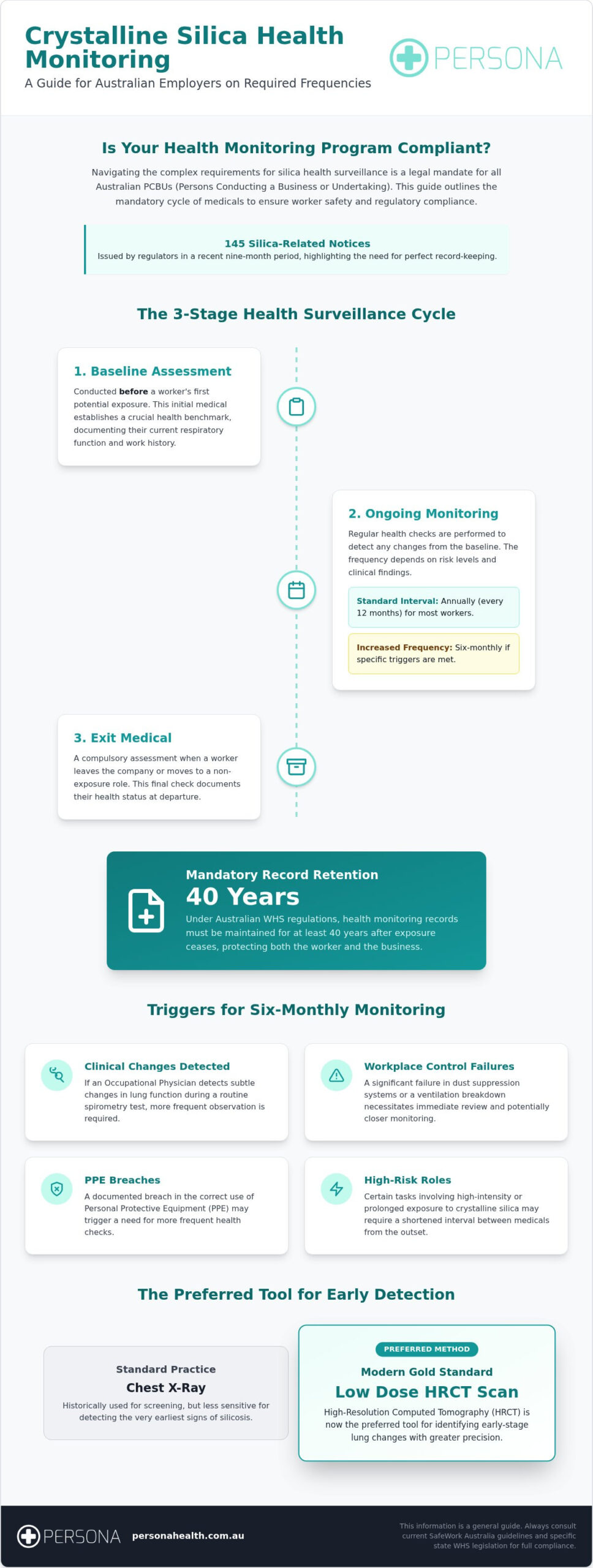
To maintain compliance and protect your staff, you must understand the clinical cycle of these assessments. A common question for safety managers is how often are silica medicals required to meet the standards set by SafeWork Australia and state regulators. While specific triggers can vary based on exposure levels, the process always begins with a baseline, followed by annual reviews, and concludes with a formal exit assessment. This structured approach ensures no worker’s health is left to chance.
To better understand the hazards involved and why this frequency is so strictly regulated, watch this helpful video:
The Baseline Assessment: Setting the Standard
Before a worker even touches a grinder or enters a high-risk zone, they must undergo a baseline medical. This establishes a “clean” benchmark of their respiratory health. Our team at Persona Health conducts these Crystalline Silica Medicals to document current lung function and detailed work history. Without this initial data, it’s impossible to accurately measure the impact of workplace exposure over time. A Registered Medical Practitioner (RMP) will review these results to confirm the individual is fit for the specific demands of the role, providing you with the confidence that your workforce is starting from a position of health.
The Exit Medical: Closing the Compliance Loop
The duty of care doesn’t end when a worker hands in their notice or moves to a different department. An exit medical is a compulsory requirement when an employee leaves the company or transitions to a role where silica exposure is no longer a risk. This final check documents their health status at the point of departure, which is vital for long-term health management. Under current Australian guidelines, these medical records must be maintained for 40 years after exposure ceases. This protects the individual’s future health pathway and provides your business with a clear record of compliance, shielding you from potential liability claims decades down the line.
Standard Intervals and Triggers for More Frequent Testing
While a baseline assessment sets the foundation for respiratory health, the ongoing schedule is where many PCBUs find themselves in a compliance muddle. For the majority of workers in construction, mining, and fabrication, an annual review is the accepted standard. However, the answer to how often are silica medicals required depends heavily on the specific risks present in your workplace. A twelve-month interval is a minimum requirement, but it isn’t a “set and forget” solution for every employee.
There are several clinical and environmental factors that can shorten this timeframe. If an Occupational Physician detects subtle changes in lung function during a routine spirometry test, they may recommend increasing the frequency to six-monthly reviews. This allows for much closer observation and the ability to intervene before minor changes become permanent damage. Similarly, if your workplace experiences a significant failure in dust suppression systems or a documented breach in Personal Protective Equipment (PPE), you shouldn’t wait for the annual anniversary. An immediate medical review is necessary to ensure no harmful exposure has occurred.
High-Risk Roles and Shortened Intervals
Certain tasks carry a much higher intensity of respirable dust, necessitating a more rigorous surveillance cycle. Workers involved in heavy-duty concrete cutting or those managing the removal of legacy materials often face higher exposure risks than those in general site roles. Environmental air monitoring data plays a crucial role here. If monitoring shows silica levels at or above 0.025 mg/m³, which is half the current Workplace Exposure Standard, regulators often expect more frequent health checks. This shift towards earlier detection is already reflected in Western Australia’s HRCT screening requirements, where advanced imaging is mandated to identify issues that traditional X-rays might miss. We help businesses manage these complex requirements through our on-site health surveillance programs, tailoring the medical schedule to match your unique site risk profile.
Immediate Reporting Between Scheduled Medicals
Safety culture is strongest when workers feel empowered to report symptoms the moment they appear. A persistent cough, unusual shortness of breath, or chest pain should never be ignored just because a medical isn’t due for another six months. To streamline this process, we recommend using InjuryQR. This free, AI-powered triage tool allows workers to scan a QR code on a site poster or magnet and describe their symptoms by voice. There is no app to download, making it accessible for everyone on site. The AI provides immediate guidance, which might include self-care advice or a recommendation for a formal medical assessment. By implementing this “scan-to-report” technology, you can significantly improve incident reporting and reduce Lost Time Injuries (LTIs) by catching respiratory concerns early. Our team can help you organise a customised medical schedule that prioritises worker wellbeing while maintaining strict compliance.
Australian Regulatory Requirements and State Variations
While the model Work Health and Safety (WHS) laws provided by SafeWork Australia create a national framework, the actual enforcement and specific nuances of compliance are managed at a state level. This can create significant confusion for businesses operating across borders, particularly regarding how often are silica medicals required in different jurisdictions. For example, SafeWork NSW and WorkSafe Victoria have established their own rigorous reporting portals and notification triggers that PCBUs must navigate to remain compliant. The landmark national ban on engineered stone, which took effect on 1 July 2024, has not removed these obligations. Instead, it has intensified the focus on health monitoring for any worker with a history of exposure to these materials.
If a health monitoring report indicates that a worker has been exposed to silica and has contracted a disease, or if the report contains any recommendations for remedial measures, the PCBU has a legal duty to provide a copy of that report to the relevant state regulator. In NSW, this is further supported by the mandatory Silica Worker Register, which has seen nearly 15,000 workers enrolled. Failure to meet these reporting obligations can lead to heavy fines and increased scrutiny. SafeWork NSW issued 145 silica-related notices between July 2025 and March 2026 alone, proving that regulators are taking a zero-tolerance approach to non-compliance.
SafeWork NSW and Victoria: Key Differences
The practicalities of managing a surveillance program often change once you cross the Murray River. In Sydney, businesses must be aware of specific notification triggers for “adverse results” that might differ slightly from the requirements in Melbourne. Regardless of the state, you are generally required to provide a copy of the health monitoring report to the worker as soon as practicable, which is typically interpreted as within 14 days of receiving it from the medical practitioner. At Persona Health, we specialise in managing these cross-border complexities for national infrastructure projects. Whether your team is based in our Parramatta, Rosebery, Gregory Hills, or Dee Why clinics in Sydney, or our Cairnlea and Craigieburn sites in Melbourne, we ensure your on-site health surveillance meets every local legislative requirement.
The Role of the PCBU in Record Keeping
Managing medical data requires a deep understanding of the Privacy Act 1988, as health information is classified as sensitive data. Employers must ensure that these records are stored securely and only accessed by authorised personnel. One of the most critical regulatory requirements in Australia is the retention period. Because diseases like silicosis can have long latency periods, you must maintain all silica-related health monitoring records for 40 years after the worker’s exposure has ceased. This is a significant administrative burden for many businesses. Our modern digital reporting systems at Persona Health are designed to alleviate this pressure, providing an audit-ready compliance trail that ensures your Crystalline Silica Medicals records remain accessible and secure for the full duration required by law.
The Shift to High-Resolution Computed Tomography (HRCT)
The diagnostic landscape for occupational lung disease has changed dramatically over the last few years. While traditional chest X-rays were once the primary tool for surveillance, they are now widely recognised as insufficient for detecting the early, subtle stages of silicosis. This clinical shift is a key factor in determining how often are silica medicals required and what specific diagnostic tests must be included to satisfy modern compliance standards. Regulators across the country, including WorkSafe Victoria and SafeWork NSW, now strongly prefer High-Resolution Computed Tomography (HRCT) because it provides a level of detail that traditional films simply cannot match.
To ensure these advanced scans are useful for long-term health tracking, the results must be standardised. This is achieved using the ILO International Classification of Radiographs, a global system that allows doctors to categorise the severity of lung changes consistently. Accuracy is paramount here, which is why these scans must be interpreted by B-reader accredited radiologists. These specialists have undergone rigorous training to identify the specific patterns of occupational dust diseases, ensuring that even the most minute changes are documented correctly from the very first baseline assessment.
HRCT vs. Traditional Chest X-Rays
The primary advantage of HRCT is its superior sensitivity in identifying ground-glass opacities and small nodules that often remain invisible on a traditional X-ray until the disease is well advanced. When we perform these assessments, we specifically utilise Low Dose HRCT protocols. This approach follows the ALARA principle, keeping radiation exposure as low as reasonably achievable while still capturing the high-definition images needed for a precise diagnosis. Because HRCT can detect issues years earlier than an X-ray, it has become the gold standard for protecting workers in high-risk industries. This early detection is the only way to intervene effectively before respiratory function is permanently compromised.
What to Expect During the Assessment Process
When your workers attend a medical, the process is designed to be thorough yet efficient. The radiological imaging is integrated with a battery of other tests, most notably spirometry. This lung function test measures how much air a worker can breathe out and how quickly they can do it, providing a real-time snapshot of their respiratory health. Workers also complete standardised questionnaires that detail their full work history, previous dust exposure, and smoking status. This holistic data set allows Persona Health’s specialised medical team to provide you with a clear, actionable health monitoring report. By focusing on precision and fast turnaround times, we help you understand exactly how often are silica medicals required for your specific team members. If you need to transition your workforce to these modern imaging standards, you can book your Crystalline Silica Medicals through our national clinic network today.
Managing Your Silica Surveillance Program with Persona Health
Managing a compliant silica surveillance program is a significant administrative undertaking for any Australian business. Understanding how often are silica medicals required is just the first step; the real challenge lies in the consistent execution of those schedules. At Persona Health, we take the guesswork out of the process by providing comprehensive Crystalline Silica Medicals across our dedicated clinics in Parramatta, Rosebery, Gregory Hills, and Dee Why in Sydney, as well as Cairnlea and Craigieburn in Melbourne. For larger workforces or remote project sites, our Australia-wide mobile services bring clinical expertise directly to your gate, ensuring minimal disruption to your daily operations.
Our approach is built on the foundation of clinical excellence and employer-focused reporting. We don’t just provide a set of results; we provide a clear pathway to compliance. By leveraging our network of over 100 affiliate clinics, we can support your workers wherever they are located, maintaining a single, centralised digital record for every individual. This ensures that whether a worker is starting a new role or requires an annual review, their respiratory health history is always at our fingertips, allowing for more accurate longitudinal tracking of their lung function.
Streamlining Compliance and Reporting
Our digital systems are designed specifically to handle the complexities of rolling medical schedules. We track every worker’s history, ensuring you never miss a periodic medical deadline or a mandatory review. The reports we provide are clear and actionable, allowing PCBUs to make informed decisions about workplace dust controls and the effectiveness of current PPE. By integrating Health Surveillance with broader Workplace Injury Management strategies, we help you build a holistic safety culture that identifies risks long before they result in a regulator notice or a health decline. We understand that every worker is unique, and our reporting reflects this by highlighting individual needs within the context of your broader organisational goals.
InjuryQR: The Future of Incident Management
To further support your team between scheduled assessments, we recommend implementing InjuryQR. This free, AI-powered triage service bridges the gap for immediate symptom reporting. By placing InjuryQR posters and magnets in high-risk areas, you give your workers a direct line to immediate support without the need for a complex app. When a worker scans the QR code, they can describe any respiratory concerns or injuries by voice. The AI then provides guided next steps, such as self-care, telehealth, or emergency direction. This transparent, tech-led protocol significantly reduces Lost Time Injuries (LTIs) and gives your workforce the confidence that their health is being prioritised every single day. Businesses can order free physical InjuryQR assets to ensure this safety net is visible and accessible across all sites.
Maintaining compliance with Australian WHS laws and understanding how often are silica medicals required for your specific industry shouldn’t be a source of stress. Whether you need a single baseline assessment or a full-scale mobile surveillance program, Persona Health is your modern professional partner. Contact our team today to request a quote or to speak with our experts regarding your occupational health requirements.
Securing Your Workforce for the Long Term
Protecting your team from the risks of silica exposure requires a commitment to clinical precision and regulatory vigilance. We have explored the essential shift towards Low Dose HRCT imaging and the critical importance of maintaining records for the mandatory 40-year period. Navigating the question of how often are silica medicals required doesn’t have to be a source of administrative burden for your business. By establishing a clear cycle of baseline, annual, and exit assessments, you ensure that every individual’s respiratory health is documented with the highest level of care.
Persona Health is here to support you with our experienced Occupational Medicine team and a modern digital reporting system that provides fast turnaround times. With physical clinics across Sydney and Melbourne, and an extensive 100-clinic affiliate network, we provide the stability and reach you need for national compliance. You can contact Persona Health today to organise your silica health monitoring program and gain peace of mind knowing your workers are in expert hands. Let’s work together to build a safer, healthier future for your entire organisation.
Frequently Asked Questions
Is silica health monitoring mandatory for all construction workers in Australia?
Silica health monitoring is only mandatory for workers who are exposed to respirable crystalline silica and where there is a significant risk to their health. This typically applies to roles involving the mechanical processing of materials like concrete, brick, or stone. Employers must use air monitoring data to determine if exposure levels reach the regulatory trigger point, which is often set at half the workplace exposure standard.
Can a worker refuse to undergo a silica medical assessment?
A worker can refuse a medical, but it creates a significant compliance issue for the employer. Under Australian WHS laws, workers have a duty to comply with reasonable health and safety instructions. If a medical is a mandatory requirement for a high-risk role, the PCBU may be legally unable to allow that worker to continue in their current position to ensure their safety and the business’s compliance.
What happens if a worker is diagnosed with silicosis during a periodic medical?
The employer must take immediate action by notifying the relevant state regulator, such as SafeWork NSW or WorkSafe Victoria, and providing them with a copy of the medical report. The worker must be removed from any further exposure to silica dust immediately. The PCBU is also required to review and improve their existing workplace risk controls to prevent any further instances of disease among the rest of the workforce.
How much does a silica medical cost the employer?
The PCBU is legally required to pay for all costs associated with health monitoring for their workers. This includes the fees for the medical practitioner, all diagnostic tests such as spirometry and HRCT scans, and any travel expenses. The employer must also pay the worker their normal wages for the time spent attending the medical appointments, ensuring the worker is not financially disadvantaged by the process.
Does the employer or the worker choose the medical practitioner for health monitoring?
The employer is responsible for selecting and engaging the Registered Medical Practitioner (RMP) to conduct the health monitoring. However, the PCBU has a legal obligation to consult with their workers before making this selection. Choosing a specialised provider like Persona Health ensures the assessment is conducted by experts who understand the specific clinical and reporting requirements of Australian occupational health legislation.
How long do I need to keep silica health monitoring records in Australia?
You must maintain silica health monitoring records for 40 years from the date the record was made. This exceptionally long period is a mandatory requirement because silica-related diseases can have a latency period of several decades. Keeping these records secure and accessible for 40 years ensures that workers have a documented health history if they require medical support or need to make a claim later in life.
Is an HRCT scan required for every annual silica medical?
An HRCT scan is not typically required every single year. While the question of how often are silica medicals required involves an annual clinical review and lung function testing, radiological imaging is usually performed at baseline and then at intervals of five to ten years. The Occupational Physician may recommend more frequent scans if the worker shows symptoms or if their spirometry results indicate a decline in lung function.
What is the difference between a baseline and a periodic silica medical?
A baseline medical is conducted before a worker starts in a high-risk role to establish their initial health status, whereas a periodic medical monitors changes over time. The baseline provides the benchmark data needed to detect any future decline in respiratory function. Understanding how often are silica medicals required involves managing this transition from the initial baseline to the ongoing annual reviews that form the core of your health surveillance program.

Article by
Ian Nicholson
Ian is the Business Support Manager at Persona Health, where he plays a key role across IT, sales, marketing and business operations. With a broad skill set and a practical, solutions-focused approach, Ian helps drive the systems, communication and commercial strategy that support Persona Health’s continued growth across Australia.