
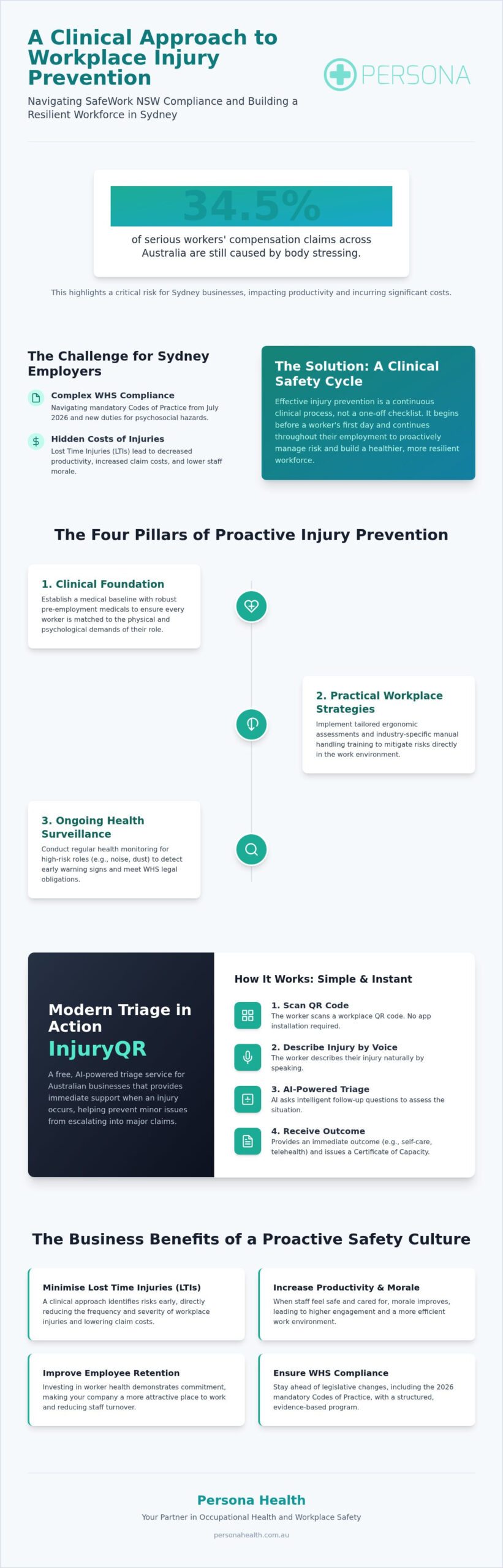
Did you know that body stressing still accounts for 34.5% of serious workers’ compensation claims across Australia? In the fast-paced Sydney market, managing these physical risks while navigating the mandatory Codes of Practice introduced in July 2026 often feels like a constant uphill battle. You’re likely feeling the pressure of complex SafeWork NSW compliance and the hidden costs of lost productivity. Implementing robust workplace injury prevention programs sydney wide isn’t just about ticking a box anymore; it’s about protecting your most valuable asset: your people.
We understand that recent regulatory shifts, including new duties around digital work systems and psychosocial hazards, can feel overwhelming. At Persona Health, we believe that effective safety is a clinical cycle that begins before a worker even starts their first shift. This guide shows you how to move beyond basic safety checklists toward medical-led injury prevention strategies that actually lower your Lost Time Injury (LTI) rates. You’ll discover how to navigate the 2026 legislative landscape, leverage AI-powered triage like InjuryQR, and build a resilient workforce that thrives under the latest Australian WHS standards.
Key Takeaways
- Learn how to align your safety protocols with 2026 SafeWork NSW standards to manage both physical and psychosocial risks effectively.
- Discover why the most successful workplace injury prevention programs sydney wide begin with robust pre-employment medicals and ongoing clinical health surveillance.
- Identify practical strategies for reducing claims through tailored ergonomic assessments and manual handling training specific to your industry.
- Understand how rapid response tools like InjuryQR provide immediate AI-powered triage to prevent minor incidents from escalating into long-term claims.
- Gain insights into selecting an occupational health partner that offers deep expertise in NSW legislation and a comprehensive clinic network for your team.
What defines an effective workplace injury prevention program?
An effective program isn’t a dusty folder on a shelf; it’s a living, breathing clinical framework. It requires a structured approach that tackles both the physical strain of manual labour and the increasingly regulated psychosocial risks. By integrating the foundational principles of occupational safety and health, businesses can move beyond mere compliance to a model of genuine care. This involves aligning every process with SafeWork Australia and SafeWork NSW standards, ensuring that medical evidence guides every safety decision you make.
To better understand how responsibility is shared in the workplace, watch this helpful video:
Effective workplace injury prevention programs sydney wide now rely on the seamless integration of clinical assessments with practical workplace training. It’s about knowing exactly what a worker’s body can handle before they even step onto the site. This process often begins with thorough pre-employment medicals to ensure a perfect match between the individual and their specific role. Evidence-based medicine plays a vital role here; it helps identify early warning signs of musculoskeletal wear and tear, significantly reducing the risk of long-term disability. By using data-driven insights, you can tailor your safety protocols to the unique needs of your workforce.
A structured program doesn’t just look at what happened yesterday; it anticipates what might happen tomorrow. This foresight is especially important given the 2026 changes to digital work systems legislation. Employers are now expected to manage the risks associated with AI and algorithmic work allocation as part of their WHS duties. When clinical expertise is combined with on-site observations, you create a safety net that catches small issues before they become major incidents. This holistic view ensures that your safety strategy is both compliant and compassionate, acknowledging the unique biological makeup of every employee.
The core components of WHS compliance in Sydney
Compliance starts with the Work Health and Safety Act 2011, but the bar has been raised. From 1 July 2026, approved Codes of Practice in NSW are mandatory. For Sydney employers, this requires prioritising risk identification across all operations. Regular health surveillance is now a critical tool for monitoring exposure to hazards like noise or airborne contaminants in high-risk roles, ensuring you meet your legal obligations while protecting staff.
Benefits of a proactive safety culture
A proactive approach protects your workers and your bottom line. While NSW workers’ compensation premiums are frozen for the 2026/27 period, claim costs remain a significant burden. By minimising Lost Time Injuries (LTIs), businesses in Sydney’s infrastructure and transport sectors improve employee retention. When staff see their health is supported by expert injury management, morale and productivity naturally increase, creating a more stable and efficient work environment.
The clinical foundation: Pre-employment and health surveillance
Building a resilient workforce begins long before an employee steps onto a worksite or warehouse floor. It’s about establishing a clinical baseline that ensures every individual is physically and psychologically matched to their specific duties. Effective workplace injury prevention programs sydney employers trust rely on this data-driven foundation to identify potential vulnerabilities early. By consulting icare Injury Prevention Resources, businesses can better understand their obligations to provide a safe environment, but the clinical execution requires a more specialised touch. This proactive screening identifies pre-existing conditions that work tasks might otherwise aggravate, allowing for informed decision-making from the very start.
Pre-employment medicals as a preventative tool
The most direct way to prevent injuries is to ensure a candidate’s physical capabilities align with the demands of the role. Using pre-employment medicals as a preventative tool allows you to screen for high-risk indicators such as reduced joint mobility or underlying cardiovascular issues. Functional capacity evaluations provide a clear picture of how a worker will perform under real-world stress. Whether you’re hiring for roles in Parramatta, Rosebery, or Gregory Hills, standardising these medical checks ensures your safety standards remain high across all Sydney locations. It’s a simple step that significantly lowers the likelihood of early-tenure musculoskeletal injuries.
Specialised surveillance for hazardous environments
For industries dealing with specific environmental risks, generic safety checks aren’t enough. In the NSW construction sector, managing exposure to airborne contaminants is a critical duty. Implementing crystalline silica medicals is now essential for identifying early respiratory changes before they become life-altering diseases. This clinical oversight extends to other hazards as well, including:
- Audiometric testing: As of 1 January 2026, this is a mandatory requirement for NSW workers exposed to hazardous noise.
- Respiratory surveillance: Essential for those working with asbestos or other hazardous dusts.
- Vision and hearing: Critical for specialised roles like those requiring Cat 3 rail medicals.
These surveillance programmes create a long-term health record, making it easier to spot trends and intervene before a minor exposure leads to a serious claim. If you’re looking to refine your screening process, our team can help you assess fitness for duty with clinical precision, ensuring your workforce remains healthy and productive.
Practical workplace strategies for injury reduction
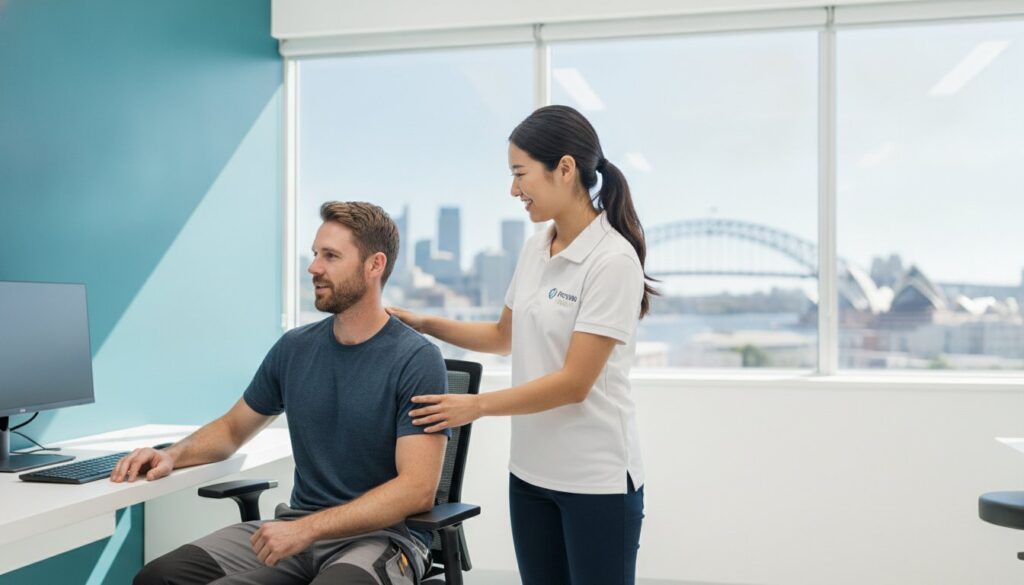
While clinical screening identifies a worker’s baseline, the daily environment is where injuries are either prevented or provoked. A proactive approach means looking at the physical interaction between the worker and their task. This is a core part of effective workplace injury prevention programs sydney businesses use to stay ahead of the curve. Instead of waiting for a strain to occur, we focus on identifying the “early warning signs” through on-site monitoring and task analysis. The goal is simple: the job must fit the person. By implementing a suitable duties register before an incident happens, you create a clear roadmap for recovery and ensure that any transition back to full capacity is handled with clinical oversight.
On-site health monitoring allows our team to observe workers in their natural environment. This often reveals subtle risks that a standard office check might miss. For example, a worker might be favouring one side due to a poorly positioned tool or an awkward reach. Early intervention at this stage, perhaps through targeted physiotherapy in sydney, can prevent a minor ache from becoming a long-term claim. It’s about building a culture where safety is seen as a shared, daily responsibility rather than a yearly seminar.
Ergonomics and task analysis in the Sydney workplace
Ergonomic assessments aren’t just for office workers in the CBD. In transport and logistics hubs near our Rosebery or Parramatta clinics, analysing heavy lifting tasks is vital. We conduct workstation reviews that look at the repetitive nature of the labour and the physical load on a worker’s joints. By adjusting bench heights or introducing mechanical aids, you can significantly reduce the cumulative strain on your team. These practical changes are often low-cost but provide high-impact results in reducing body stressing, which remains the leading cause of serious claims in Australia.
Psychological safety and resilience training
Mental health conditions are the fastest-growing category of work-related injuries, increasing by 14.7% recently. In high-pressure Sydney corporate environments, addressing psychosocial hazards is now a regulated and enforceable obligation. We help managers recognise the early signs of workplace stress and burnout before they escalate. Building resilience within your team involves more than just “wellbeing” apps; it requires a structured approach to managing work volume and support systems. When your staff feel psychologically safe, their productivity increases and your injury management outcomes improve significantly. This holistic view of health ensures that every individual has the internal and external resources they need to thrive.
Preventing escalation: Modern triage and injury management
Even the most comprehensive workplace injury prevention programs sydney has to offer cannot eliminate every potential risk. When an incident does occur, the speed and quality of the initial response determine whether it remains a minor event or escalates into a complex, long-term claim. Rapid response isn’t just about basic first aid; it’s about immediate clinical triage that guides the worker toward the most appropriate care pathway. By involving an Occupational Physician early in the process, businesses ensure that medical decisions are evidence-based and focused on safe, sustainable recovery. This clinical leadership reduces uncertainty for both the employer and the employee, fostering a culture of trust and transparency during a stressful time.
Modern digital systems allow for real-time incident tracking, which is essential for maintaining WHS compliance in a fast-moving environment. When every worker has immediate access to medical guidance, the likelihood of secondary complications or “doctor shopping” decreases significantly. This structured approach to the early minutes of an injury creates a safety net that protects the individual’s health while preserving the operational continuity of the business. It’s a shift from reactive paper-shuffling to proactive, clinically-led management that prioritises the person behind the claim.
Introducing InjuryQR for immediate incident response
In the critical minutes following an injury, clarity is essential for a positive outcome. We provide our partners with InjuryQR, a free AI-powered triage service that simplifies the reporting process. Workers simply scan a QR code using their smartphone, with no app required. They describe the injury by voice, and the AI provides immediate next steps, which may include self-care instructions, a telehealth consultation, or a direction to the nearest emergency department. This system improves the accuracy of incident data and can issue immediate Certificates of Capacity where appropriate. By providing instant medical guidance, InjuryQR significantly reduces Lost Time Injuries (LTIs). Businesses can also order free physical assets like posters and magnets to ensure the service is always accessible on the workshop floor or in the office.
Best practice injury management and recovery
Our approach to injury management is built on fast turnaround times and clear, empathetic communication. We understand that Sydney businesses need medical reports quickly to make informed operational and insurance decisions. Whether your team visits our clinics in Parramatta, Rosebery, Gregory Hills, or Dee Why, they receive care from an experienced medical team that understands the nuances of the NSW workers’ compensation scheme. We coordinate closely with insurers and employers to facilitate a safe return to work, ensuring that any “suitable duties” are clinically appropriate for the individual’s specific stage of recovery. If you’re looking to modernise your response strategy, you can partner with our injury management team to ensure your workers are always in expert hands.
Partnering with a Sydney occupational health specialist
Selecting an occupational health partner is one of the most critical decisions for any Sydney employer. You need more than just a service provider; you need a modern professional partner who understands the intricacies of the Work Health and Safety Act 2011 and the specific 2026 mandates from SafeWork NSW. Effective workplace injury prevention programs sydney rely on clinical expertise that is both accessible and highly reliable. Our team at Persona Health brings years of experience in handling complex fitness for duty cases, ensuring that your workforce is supported by evidence-based medical decisions. We prioritise digital-first reporting systems that provide the fast turnaround times essential for maintaining operational momentum in a competitive city.
A true partnership involves more than just reactive care. It requires a deep understanding of your industry, whether you’re managing transport logistics in Western Sydney or high-pressure corporate teams in the CBD. By leveraging an experienced medical team, you can navigate the nuances of the 2026 legislative changes, such as the new duties surrounding digital work systems and AI. This ensures your compliance is always current and your risk management strategies are future-proofed against evolving regulatory standards.
Local expertise across Sydney and Melbourne
We operate physical clinics in Parramatta, Rosebery, Gregory Hills, and Dee Why, providing local support for Sydney’s major industrial and corporate hubs. Our presence extends to Melbourne with clinics in Cairnlea and Craigieburn, ensuring consistency for businesses with interstate operations. Beyond our own doors, we manage an extensive affiliate network of over 100 clinics Australia-wide. This broad reach allows us to deliver on-site health surveillance directly to your facility. Mobile services are often the most efficient way to manage large-scale assessments, such as audiometric testing or respiratory checks, without disrupting your daily production schedule.
Customising your prevention program for 2026
No two workplaces are identical, and your safety strategy shouldn’t be either. We recommend starting with a comprehensive workplace health audit to identify specific risk areas unique to your site. From there, we develop a bespoke calendar of medical assessments, ranging from Cat 3 rail medicals to specialized screening for crystalline silica. This structured approach ensures you meet all legislative requirements while fostering a genuine culture of care. Our employer-focused systems allow you to track every assessment in real-time, providing the transparency needed for modern WHS management.
Securing a healthier future for your Sydney workforce
Effective workplace injury prevention programs sydney employers implement today are the key to navigating the complex regulatory landscape of 2026. By combining clinical pre-employment screening with proactive health surveillance, you create a foundation of safety that respects the unique biological needs of every worker. We have seen how rapid, AI-powered triage through tools like InjuryQR can transform incident response, preventing minor strains from becoming long-term claims while significantly lowering your Lost Time Injury rates. Compliance with SafeWork NSW is no longer just a legal hurdle; it’s an opportunity to build a more resilient and productive team.
With clinics located in Parramatta, Rosebery, Gregory Hills, and Dee Why, Persona Health is perfectly positioned to support your operations across the city. Our team of experienced Occupational Physicians and medical specialists provides the clinical authority you need to manage complex fitness for duty cases with confidence. We also offer your workforce free access to InjuryQR to ensure immediate care is always just a scan away. Contact Persona Health today to discuss a tailored injury prevention program for your Sydney workplace. We look forward to helping you protect your most valuable assets and ensuring your business thrives in a safer, more compliant environment.
Frequently Asked Questions
What are the most common workplace injuries in Sydney businesses?
Musculoskeletal injuries caused by body stressing remain the most prevalent, accounting for 34.5% of serious claims across Australia. Falls, trips, and slips follow at 21.8%, while being hit by moving objects makes up 16% of incidents. In Sydney’s logistics and construction sectors, these physical strains are often cumulative. Mental health conditions are also rising rapidly, now representing 12% of serious claims and requiring significantly more time away from work.
How do injury prevention programs reduce workers compensation premiums in NSW?
Comprehensive workplace injury prevention programs sydney wide lower premiums by reducing the frequency and severity of claims. Your premium is directly influenced by your claims history; fewer incidents mean a lower experience rating. By preventing minor strains from escalating into long-term disabilities, you maintain a cleaner safety record. This proactive approach demonstrates to insurers that your workplace is a lower risk, leading to significant long-term cost savings for the business.
Is a pre-employment medical considered part of injury prevention?
Yes, pre-employment medicals are the primary preventative tool for ensuring a candidate’s physical capabilities match their job requirements. By identifying pre-existing conditions or physical limitations before a contract is signed, you prevent injuries caused by unsuitable task allocation. This clinical screening establishes a health baseline, allowing for better monitoring and reducing the likelihood of early-tenure musculoskeletal claims in physically demanding roles like transport or manufacturing.
What is the role of SafeWork NSW in workplace injury prevention?
SafeWork NSW acts as the state’s workplace health and safety regulator, enforcing the Work Health and Safety Act 2011. They provide mandatory Codes of Practice and conduct inspections to ensure businesses are managing hazards effectively. Their role is to provide guidance on risk mitigation while holding employers accountable for breaches. Compliance with their standards is essential for any Sydney business looking to avoid civil penalties and legal action from unions.
How can small businesses in Sydney implement safety programs on a budget?
Small businesses can start by focusing on high-impact strategies like regular risk assessments and tailored manual handling training. Utilising free tools such as the InjuryQR AI-powered triage service provides immediate medical guidance without expensive software subscriptions. Focusing on clear communication and establishing a suitable duties register allows for early return to work. This keeps productivity high and insurance costs manageable even with limited financial resources or smaller teams.
What is the difference between a GP and an Occupational Physician in injury prevention?
While a GP focuses on general community health, an Occupational Physician specialises in the relationship between health and the work environment. They have a deep understanding of WHS legislation and the specific physical demands of industrial roles. This expertise allows them to provide more accurate fitness for duty assessments and tailored recovery plans. Their clinical focus is specifically designed to prevent workplace disability and facilitate a safe, sustainable return to work.
How does InjuryQR help in preventing long-term workplace disability?
InjuryQR prevents long-term disability by providing instant AI-guided triage at the moment an injury occurs. By directing workers to the correct level of care immediately, it avoids the “wait and see” approach that often leads to minor strains worsening. The system ensures that appropriate self-care or clinical intervention begins within minutes. This rapid response is proven to reduce Lost Time Injuries and improve the overall prognosis for a full recovery.
Are on-site health surveillance services mandatory for Sydney employers?
Health surveillance is mandatory under NSW WHS Regulations if your workers are exposed to specific hazardous substances or environments. This includes exposure to crystalline silica, asbestos, lead, or hazardous noise levels. As of 1 January 2026, audiometric testing is also a compulsory requirement for workers in noisy environments. Failing to provide these medical checks can result in significant penalties and increased liability for preventable occupational diseases.

Article by
Ian Nicholson
Ian is the Business Support Manager at Persona Health, where he plays a key role across IT, sales, marketing and business operations. With a broad skill set and a practical, solutions-focused approach, Ian helps drive the systems, communication and commercial strategy that support Persona Health’s continued growth across Australia.