

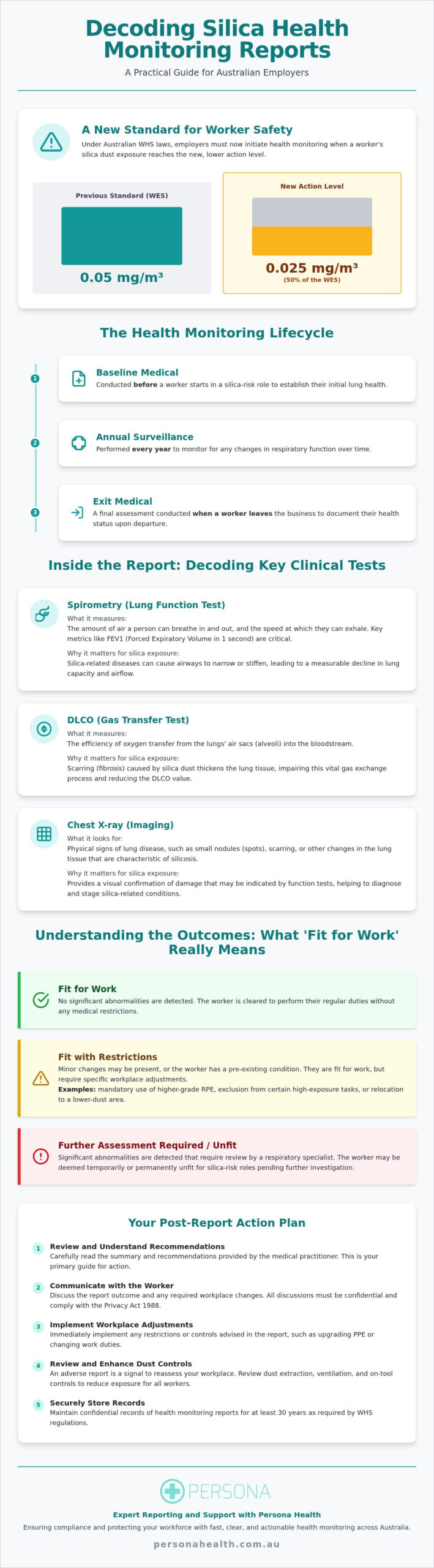
Did you know that Australian employers are now required to trigger health monitoring if a worker’s exposure reaches just 0.025 mg/m³, which is only half of the current Workplace Exposure Standard? It’s completely understandable to feel a sense of unease when a medical file filled with complex clinical data arrives on your desk. For a worker, seeing acronyms like FEV1 or DLCO can spark immediate anxiety about their future health, while for an employer, it often raises urgent questions about safety compliance and mandatory reporting to regulators like SafeWork NSW or WorkSafe Victoria.
We believe that clarity is the first step toward safety and peace of mind. This guide is designed to take the guesswork out of interpreting silica health monitoring reports by breaking down complex medical results into plain English. You’ll learn exactly how to decode these findings and understand your specific legal obligations under Australian WHS laws. We will explore how professional oversight from Persona Health ensures every individual is treated as more than just a number, while also explaining how proactive tools like InjuryQR can help you manage workplace incidents with confidence. By the end of this article, you’ll have a clear, evidence-based roadmap for managing silica risks while ensuring your team feels supported and secure.
Key Takeaways
- Understand the essential purpose of health surveillance and how these reports act as a vital risk management tool under Australian WHS legislation.
- Gain confidence in interpreting silica health monitoring reports by decoding clinical tests like spirometry and DLCO to identify early changes in lung function.
- Learn how to manage ‘Fit with Restrictions’ outcomes effectively, including practical workplace adjustments such as enhanced PPE or temporary relocation from high-dust areas.
- Identify the necessary post-report actions for employers, including reviewing dust extraction controls and scheduling fresh air monitoring assessments to validate safety measures.
- Discover how Persona Health’s national clinic network and digital reporting systems provide fast, expert support to ensure compliance and protect your workers’ long-term health.
Understanding the Purpose and Structure of Silica Health Monitoring Reports
A silica health monitoring report is a formal clinical document that provides a comprehensive snapshot of a worker’s respiratory health. It acts as a primary defence mechanism, allowing both employers and workers to identify potential issues before they become life-altering conditions. To understand the gravity of these assessments, it’s helpful to first learn what is silicosis and how it affects the lungs over time. SafeWork Australia mandates these reports because crystalline silica dust is so fine it can penetrate deep into lung tissue, often causing damage that remains invisible for years.
Think of these documents as the ‘canary in the coal mine’ for your workplace safety systems. If a report shows even a minor decline in lung function, it’s a clear signal that your current dust extraction or ventilation controls might be failing. Correctly interpreting silica health monitoring reports allows you to intervene early, protecting your team from long-term harm. Each report typically follows a structured format, beginning with a detailed work and medical history, followed by clinical test results, and concluding with a registered medical practitioner’s recommendations regarding fitness for duty.
To better understand why this monitoring is so critical for your workforce, watch this helpful video from SafeWork NSW:
Legal Obligations Under Australian WHS Laws
Under WHS laws in NSW and Victoria, employers have a non-negotiable duty to provide health monitoring if there’s a significant risk to health from silica exposure. The regulatory landscape changed significantly on 1 July 2024 with the national ban on engineered stone, which was implemented to curb the rising rates of silica-related diseases across the country. Despite this ban, many industries like construction, tunnelling, and mining still involve high-risk tasks. When handling these reports, you must strictly comply with the Privacy Act 1988. Medical data is highly sensitive; it should only be shared with those who absolutely need it for safety management, ensuring the worker’s dignity is maintained throughout the process.
When Should Monitoring Occur?
Monitoring isn’t a one-off event; it’s a continuous process of care. It starts with a baseline medical before a worker ever picks up a tool, establishing their ‘normal’ lung function. Following this, annual surveillance is essential to track any subtle changes that may occur over time. Finally, an exit medical is a critical step when a worker leaves the business. This documents their health status at the end of their tenure, providing a clear record that protects both the individual and the organisation. At Persona Health, our experienced medical team provides comprehensive Crystalline Silica Medicals across our national clinic network, ensuring your business stays compliant while prioritising the wellbeing of every worker.
Decoding the Clinical Results: Spirometry, DLCO, and Chest X-rays
When you are looking at a medical file, interpreting silica health monitoring reports can feel like learning a new language. These reports contain a variety of clinical metrics that, when viewed together, provide a detailed map of your respiratory health. It is vital to remember that a single ‘low’ result does not automatically mean a silicosis diagnosis. Factors like a recent cold, the time of day, or even how much effort was put into the test can influence the numbers. Clinical correlation by an expert is always required to see the full picture.
Reading Spirometry Results
Spirometry is the most common tool used to measure lung function. Your report will show ‘Predicted’ values, which are based on your age, height, and gender, compared against your ‘Actual’ results. Doctors look for specific patterns in these numbers. An obstructive pattern might suggest issues like asthma or COPD, while a restrictive pattern, often seen in dust diseases, indicates that the lungs have become stiff and cannot expand fully. FEV1 is the volume of air exhaled in the first second of a forced breath. If your FEV1 or Forced Vital Capacity (FVC) drops significantly below your baseline from previous years, it warrants a closer look at your workplace exposure controls.
Advanced Imaging and DLCO
Sometimes, basic lung function tests don’t tell the whole story. This is where DLCO (Diffusing Capacity of the Lungs for Carbon Monoxide) becomes essential. While spirometry measures how much air you can move, DLCO measures how well your lungs transfer oxygen into your bloodstream. It is often more sensitive than spirometry and can detect early changes before they show up elsewhere. If imaging is required, radiologists use the ILO International Classification of Radiographs to ‘score’ chest X-rays. This standardised system helps identify the presence of small opacities that could indicate dust-related damage. If an X-ray is inconclusive, a High-Resolution Computed Tomography (HRCT) scan may be recommended for a much more detailed view of the lung tissue.
Because these metrics are so technical, Persona Health ensures that every assessment is reviewed by specialised occupational physicians who understand the nuances of industrial exposure. This holistic approach to interpreting silica health monitoring reports prevents unnecessary alarm while ensuring no risk is overlooked. Our team focuses on the individual, ensuring that every worker understands their results and every employer knows exactly how to maintain a safe working environment.
Categorisation of Results: What ‘Fit for Work’ Really Means
Once the clinical testing is complete, the focus shifts to the final medical opinion. When interpreting silica health monitoring reports, the most critical section for an employer is the doctor’s determination of fitness for duty. This isn’t just a simple pass or fail. An Occupational Physician will categorise the worker into one of three primary groups: ‘Fit’, ‘Fit with Restrictions’, or ‘Unfit’. Understanding these nuances is essential for maintaining both workplace safety and regulatory compliance under Australian WHS laws.
A ‘Fit with Restrictions’ result is often where confusion arises. It doesn’t necessarily mean a worker must leave the site immediately. Instead, it might involve temporary measures like mandatory P2 respirator use, even in low-dust areas, or a temporary relocation away from high-exposure tasks like stone cutting or grinding. These restrictions are designed to protect the individual while further investigations occur. It’s important to distinguish between a temporary dip in lung function, perhaps caused by a chest cold or recent illness, and the permanent changes associated with long-term silica exposure.
The Role of the Supervising Medical Practitioner
Legal compliance in Australia requires that a registered medical practitioner with experience in occupational health oversees these assessments. An Occupational Physician’s signature provides the necessary authority to ensure your business meets its duties under WHS legislation. At Persona Health, our medical team provides consistent, high-quality reviews across our clinics in Parramatta, Rosebery, and Craigieburn. If a doctor identifies a result that deviates from the norm, they may request a clinical review or further testing to ensure the assessment is tailored to the individual’s unique health profile and work history.
Managing ‘Unfit’ or ‘At Risk’ Findings
If a report indicates a ‘Significant Health Effect’, the employer has an immediate legal obligation to notify the state regulator, such as SafeWork NSW or WorkSafe Victoria. This is a sensitive time for any worker. They have a right to a second opinion and should be supported through referrals to respiratory specialists if needed. Maintaining empathy throughout this process is vital. Use this as an opportunity to review your safety controls rather than as a disciplinary matter. For broader health concerns beyond silica, a Fitness for Duty (FFD) Medical can provide a clearer path forward for both the business and the employee, ensuring everyone remains in expert hands.
Post-Report Actions: Reviewing Controls and Managing Workplace Risks
Receiving the final results is only the beginning of your safety journey. If you’ve finished interpreting silica health monitoring reports and found adverse results or even subtle declines in lung function, Australian WHS laws require you to review your control measures immediately. This isn’t just a tick-box exercise for compliance. It’s a critical opportunity to identify exactly where your safety systems might be failing and to protect your team from permanent harm.
- Step 1: Engineering Controls. Start with your dust extraction and local exhaust ventilation systems. Are the filters being changed according to the manufacturer’s schedule? Are the shrouds on cutting tools positioned correctly?
- Step 2: Air Monitoring. If health monitoring shows a change, it is time for a fresh air monitoring assessment. This quantifies the current respirable crystalline silica levels in the air, helping you see if they exceed the 0.05 mg/m³ standard.
- Step 3: PPE Audit. Ensure every worker has undergone a professional respirator fit test within the last 12 months. A mask that doesn’t seal properly offers almost no protection.
- Step 4: Real-time Reporting. Implement a digital system for immediate feedback. When a worker notices a dust leak, they need a way to report it before it affects their health.
- Step 5: Consultation. Sit down with your team. Those on the tools often know exactly which tasks create the most dust and can offer practical insights for safer workflows.
Auditing Your Dust Mitigation Strategy
When you compare your latest health monitoring results with previous air monitoring data, you might find specific ‘hot spots’ in your workshop. Perhaps exposure peaks during a particular shift or when a specific machine is in use. To help identify these trends, our team provides On-Site Health Surveillance and workplace audits. This proactive approach ensures your controls are actually effective in the real world, rather than just on paper, giving you the data needed to make informed safety investments.
Integrating InjuryQR for Better Safety Outcomes
The most effective way to manage risks is to catch them before they become chronic conditions. With InjuryQR, your workers can simply scan a QR code on a poster or magnet with their smartphone. There’s no app to download. They describe their concern or injury by voice, and the AI-powered system provides immediate guidance, such as self-care or a telehealth referral. This immediate triage significantly reduces Lost Time Injuries (LTIs) and ensures incident reporting is seamless. Businesses can even order free physical InjuryQR assets to display in their lunchrooms or workshops in Sydney or Melbourne.
Taking these steps demonstrates a genuine commitment to the long-term health of your workforce. If you’re unsure how to proceed after your latest results, you can contact Persona Health for an expert review of your monitoring programme.
Expert Reporting and Support with Persona Health
At Persona Health, we recognise that the weight of responsibility on Australian employers is significant. We don’t just provide a document; we provide a partnership that prioritises the individual health of every worker while ensuring your organisation meets its rigorous safety duties. Our experienced medical team specialises in the infrastructure and construction sectors, where the risks of silica exposure are often at their highest. We understand that behind every data point is a person, and our approach reflects a deep commitment to clinical excellence and empathetic care.
Our modern digital reporting systems are built with the employer in mind. We focus on fast turnaround times because we know that delays in receiving results can lead to uncertainty for workers and operational bottlenecks for the business. By streamlining the process of interpreting silica health monitoring reports, we allow you to focus on what you do best: running a safe and productive project. Our reports are clear, actionable, and designed to integrate seamlessly into your existing safety management systems.
Our Clinic Network and Mobile Services
We have established a robust physical presence across Australia’s major hubs to ensure your team has easy access to expert care. You can find our dedicated clinics in Parramatta, Rosebery, Gregory Hills, and Dee Why within the Sydney region, as well as Cairnlea and Craigieburn in Melbourne. For businesses with a national footprint, our 100-clinic affiliate network ensures your workers can access high-quality assessments regardless of where their project is located.
For large-scale projects or remote sites, our on-site mobile testing services bring health surveillance directly to your doorstep. This minimises downtime and ensures that every member of your team receives the same high standard of care without the need for extensive travel. Whether it’s a major tunnelling project in NSW or a civil construction site in Victoria, we have the capacity to support your health monitoring requirements on the ground, providing consistency across all your operations.
Booking Your Crystalline Silica Medicals
Booking your assessments is a straightforward process designed to fit around your project timelines. Whether you require individual pre-employment checks or a bulk assessment for an entire shift, our team is ready to coordinate the logistics for you. We ensure that every Crystalline Silica Medical is conducted with clinical precision and a focus on the individual’s long-term wellbeing. Our streamlined booking system means less time on administration and more time focusing on site safety.
If you’re ready to secure the health of your workforce and ensure your business remains fully compliant with the latest WHS regulations, our team is here to help. Contact Persona Health today to discuss your specific needs or to request a comprehensive quote for your silica health monitoring programme. We are committed to being your expert partner in maintaining a healthy, safe, and resilient workplace for every member of your team.
Protecting Your Workforce with Expert Respiratory Oversight
Correctly interpreting silica health monitoring reports is the most effective way to validate your site’s safety controls and protect your workers from chronic disease. By understanding clinical metrics like spirometry and DLCO, you can move beyond confusion and take proactive steps to manage respiratory risks before they escalate. Whether you’re reviewing a ‘Fit with Restrictions’ result or auditing your current dust extraction systems, clear data provides the foundation for a safer workplace. It’s about turning complex medical files into a clear roadmap for long-term health.
Persona Health is dedicated to supporting your business through this complex process. Our experienced Occupational Physicians provide the clinical authority you need, backed by fast digital reporting systems that keep your projects moving. With a nationwide 100-clinic affiliate network, we ensure your team has access to the highest standard of care, regardless of their location. Our focus remains on individualised care that helps you stay compliant while truly looking after your people.
Secure your team’s health with professional silica monitoring from Persona Health. We’re here to help you build a resilient, compliant, and healthy workplace where every individual feels truly supported and secure in their future.
Frequently Asked Questions
What is the difference between a baseline and an annual silica medical?
A baseline medical is conducted before a worker starts silica-related tasks to establish their initial lung function and health status. In contrast, an annual medical is a periodic review designed to identify any subtle changes or declines in respiratory health compared to that original baseline. This ongoing tracking is essential for the early detection of conditions like silicosis, ensuring that workplace controls are effectively protecting the individual’s health over the long term.
How long does it take to receive the results of a silica health monitoring report?
Turnaround times can vary depending on the complexity of the tests, but Persona Health prioritises fast digital reporting to minimise uncertainty. Typically, summary results are available within a few business days once the Occupational Physician has completed their review. If further investigations like an ILO chest X-ray are required, it may take slightly longer. Our modern systems ensure that both the employer and worker receive clear, actionable information as quickly as possible.
Do I have to show my employer the full medical report or just the summary?
Under the Privacy Act 1988, employers should only receive the ‘Health Monitoring Report’ summary, which outlines the worker’s fitness for duty and any required workplace restrictions. The full clinical data, including specific test scores and medical history, remains confidential between the worker and the examining doctor. This ensures that sensitive health information is protected while still providing the business with the necessary guidance to manage workplace safety and compliance effectively.
What happens if my spirometry results show a decline from last year?
If your results show a decline, the first step is a clinical review by an Occupational Physician to determine if the change is due to silica exposure or other factors like a recent illness. This process is a core part of interpreting silica health monitoring reports accurately. You may be referred for more sensitive testing, such as DLCO or HRCT scans, and the employer must review current dust controls to ensure they are functioning correctly.
Is an ILO chest X-ray different from a standard chest X-ray?
Yes, an ILO chest X-ray is specifically performed and ‘scored’ according to the International Labour Organization (ILO) standards for identifying pneumoconiosis and other dust-related diseases. Unlike a standard clinical X-ray used to find infections or fractures, the ILO method uses a standardised classification system to detect very small opacities in the lung tissue. This high level of detail is essential for the early diagnosis of silica-related lung damage in high-risk industries.
How often should silica health monitoring be conducted for construction workers?
For most construction workers exposed to respirable crystalline silica, health monitoring should be conducted every 12 months. However, the exact frequency is determined by a risk assessment and the recommendations of the supervising medical practitioner. If a worker’s exposure levels are particularly high, or if previous reports have shown minor changes, more frequent monitoring may be required to ensure their health is not being compromised by their work environment.
Can a worker refuse to participate in health monitoring?
While a worker has the right to refuse a medical procedure, participating in mandated health monitoring is often a condition of employment for high-risk roles under WHS legislation. If a worker refuses, the employer may be unable to allow them to continue performing tasks that involve silica exposure, as the business cannot fulfil its legal duty of care to ensure the worker’s safety. We recommend open consultation to address any anxieties regarding the process.
What are the reporting requirements if a worker is diagnosed with silicosis in NSW?
If a worker is diagnosed with silicosis or any significant silica-related health effect, the employer must notify SafeWork NSW immediately. This is a mandatory requirement under the WHS Regulations. The medical practitioner also has a duty to report the finding to the regulator. For immediate incident management and triage of respiratory concerns on-site, businesses can use InjuryQR to ensure that all health-related events are documented and managed with professional AI-guided support.

Article by
Ian Nicholson
Ian is the Business Support Manager at Persona Health, where he plays a key role across IT, sales, marketing and business operations. With a broad skill set and a practical, solutions-focused approach, Ian helps drive the systems, communication and commercial strategy that support Persona Health’s continued growth across Australia.