

Could a single blood test result be the difference between a thriving worksite and a mandatory WorkSafe investigation? Managing lead exposure blood tests melbourne wide is a high-stakes responsibility that demands more than just a clinical approach; it requires a deep understanding of the Victorian OHS Regulations 2017. We know the pressure you face when trying to balance project deadlines with the complex notification levels that trigger at just 5 µg/dL. It is a delicate path to walk, and the anxiety surrounding potential Lost Time Injuries (LTIs) is a challenge every safety manager shares.
This guide simplifies the 2026 standards for lead health monitoring, offering you a clear path to total legal compliance and peace of mind. We will explore the specific testing frequencies for different worker profiles, explain the immediate removal thresholds, and show how Persona Health’s specialised clinics in Cairnlea and Craigieburn support your team. You will also discover how tools like InjuryQR can transform your incident reporting, ensuring that when health risks arise, your response is instant, expert, and fully documented. By the end of this guide, you will have a reliable framework for managing lead-risk work with confidence.
Key Takeaways
- Understand your legal obligations under the Victorian OHS Regulations 2017 to ensure your workplace remains compliant and your employees stay safe.
- Identify the specific blood lead level thresholds that mandate immediate removal from lead-risk work, including the 5 µg/dL notification level for pathology services.
- Learn how to access professional lead exposure blood tests melbourne wide through Persona Health’s clinics in Cairnlea and Craigieburn or our nationwide affiliate network.
- Recognise the mandatory testing frequencies for different worker profiles to maintain accurate health surveillance and prevent potential long-term health complications.
- Discover how integrating InjuryQR can streamline incident reporting and provide immediate AI-guided triage to reduce Lost Time Injuries (LTIs) following an exposure event.
Understanding Lead Exposure in Melbourne Workplaces
Lead is a dense, toxic heavy metal that continues to pose a significant risk within Melbourne’s industrial landscape. Despite stricter modern controls, it remains a common component in older paints, lead-acid batteries, and specialised manufacturing materials. In a busy workshop or on a demolition site, exposure isn’t always obvious. It usually happens when workers inhale fine lead dust or fumes, or accidentally ingest particles through hand-to-mouth contact during meal breaks. High-risk industries such as radiator repairs and stained glass work are particularly vulnerable to these invisible hazards.
While industrial lead paint is a serious hazard, modern creative tools have evolved to be much safer; for example, you can visit PoscART to see how non-toxic paint markers can even be used for detailed nail art.
Relying on a simple visual check of your team’s health isn’t enough. Lead is a “silent” hazard because it accumulates in the blood and bones over time without showing immediate outward signs. This biological accumulation makes regular lead exposure blood tests melbourne a vital part of your safety toolkit. Our teams at the Persona Health clinics in Cairnlea and Craigieburn see first-hand how proactive testing protects local workers by identifying risks long before symptoms appear. It’s the only reliable way to monitor the actual amount of lead entering a worker’s system before it causes irreversible damage.
To better understand why biological monitoring is so critical for your team, watch this helpful video:
Common Sources of Occupational Exposure in Victoria
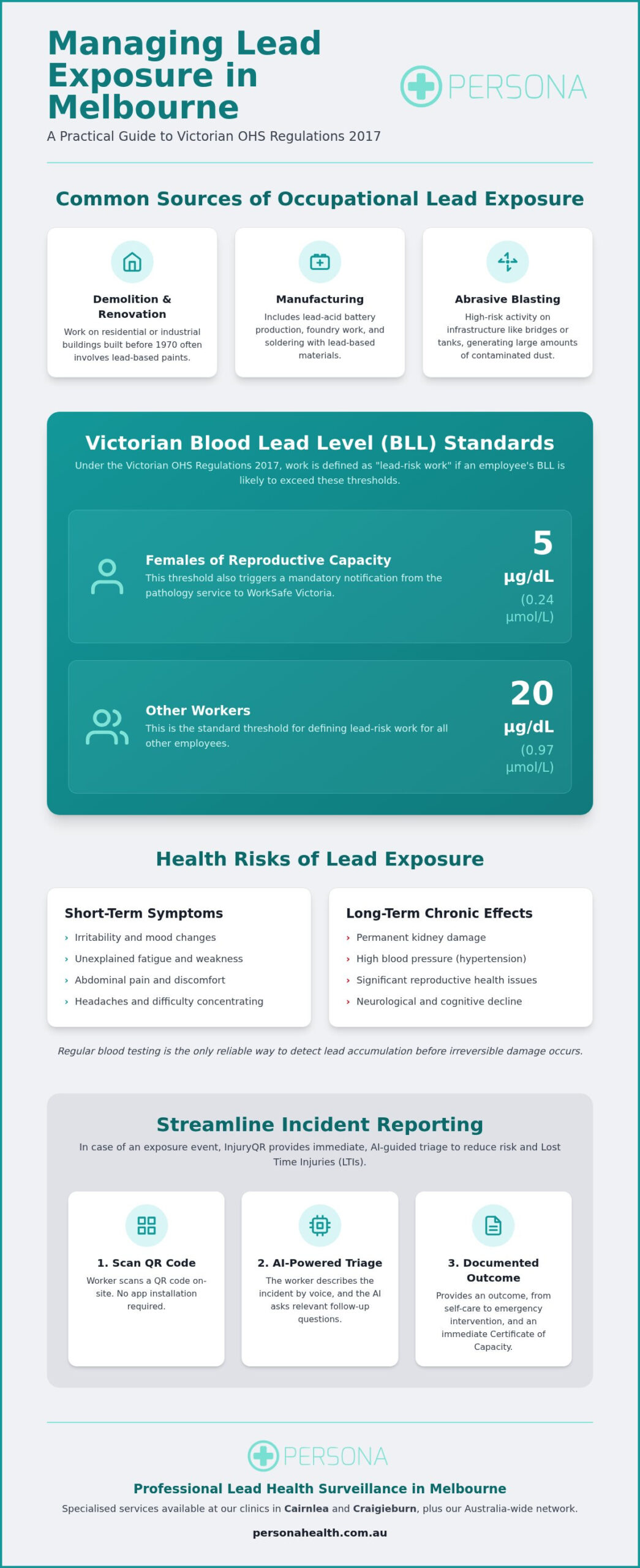
Melbourne’s mix of heritage architecture and heavy manufacturing creates several high-risk environments. Demolition crews working on pre-1970s residential or industrial buildings frequently encounter lead-based paints. Similarly, workers in manufacturing hubs like Dandenong or Campbellfield may face exposure through foundry work or lead-based soldering. Abrasive blasting on large-scale infrastructure, such as bridges or storage tanks, also generates high volumes of contaminated dust. For these sectors, implementing On-Site Health Surveillance is the most effective way to ensure workers stay below the legal limits while maintaining productivity.
The Health Risks for Workers
The health impacts of lead are often subtle at first. Short-term symptoms like irritability, unexplained fatigue, and abdominal pain are easily dismissed as general work stress or minor illness. However, if exposure continues, the internal damage becomes severe. Chronic exposure can lead to permanent kidney damage, hypertension, and significant reproductive issues. Understanding Lead Poisoning is essential for any employer in a lead-process industry, as early detection through regular blood lead level (BLL) testing can prevent these life-altering outcomes. Identifying a spike in BLL early allows you to adjust workplace controls or rotate staff before a serious health incident occurs, protecting both your employees and your business reputation.
Victorian Regulations and Blood Lead Level (BLL) Standards
Compliance with the Victorian Occupational Health and Safety Regulations 2017 is a non-negotiable duty for Melbourne employers. WorkSafe Victoria actively monitors sites where lead processes occur, ensuring that businesses don’t just hope for the best but actively protect their workforce. Understanding your obligations starts with identifying if your team is engaged in lead-risk work. This is defined as work where an employee’s blood lead level is likely to exceed specific thresholds, such as 0.24 µmol/L (5 µg/dL) for females of reproductive capacity or 0.97 µmol/L (20 µg/dL) for other workers.
Managing lead exposure blood tests melbourne requires navigating these strict legal definitions with precision. While general workplace exposure might involve incidental contact, lead-risk work triggers a mandatory requirement for health surveillance. If your processes involve lead-based paints, soldering, or battery recycling, you have a legal obligation to provide medical examinations and biological monitoring. This proactive approach ensures that any elevation in blood lead levels is caught before it becomes a systemic health issue for your staff.
Notification and Removal Thresholds in 2026
Under the Victorian regulations for lead exposure, pathology services must notify the Department of Health within five days if a worker’s blood lead level exceeds 5 µg/dL. As an employer, you must act decisively if levels climb higher. A male worker or a female not of reproductive capacity must be immediately removed from lead-risk work if their blood lead level reaches 1.45 µmol/L (30 µg/dL). For females of reproductive capacity, the removal threshold is much lower at 0.48 µmol/L (10 µg/dL). These strict limits are designed to prevent the long-term health complications discussed earlier in this guide. A registered medical practitioner must oversee these results to ensure the safety of the individual and the compliance of the workplace.
Employer Responsibilities under Victorian Law
Your duties as an employer are comprehensive and begin well before the first needle is used. You are responsible for conducting initial air monitoring to determine the level of risk within your specific environment. If the risk is confirmed, you must organise and pay for regular blood tests for all at-risk employees. This isn’t a one-off task; it’s an ongoing commitment to worker safety. Beyond the testing itself, Victorian law requires you to maintain confidential health records for at least 30 years. This long-term record-keeping reflects how lead can affect the body decades after the initial exposure occurred.
Navigating these regulations can feel overwhelming, but you don’t have to manage the burden of compliance alone. Ensuring your team meets these standards is significantly easier when you partner with experts who understand the nuances of On-Site Health Surveillance and Victorian occupational health requirements.
The Lead Blood Testing Process: What to Expect
Undergoing biological monitoring is a routine and vital part of working in high-risk Victorian industries. The process for lead exposure blood tests melbourne workers undergo is a standard venepuncture, where a small sample of blood is drawn from a vein in the arm by a qualified occupational health professional. While the procedure itself is quick, the protocols surrounding it are precise to ensure the highest level of accuracy for your health surveillance records. At Persona Health, our experienced medical team focuses on making this process as smooth and stress-free as possible for both the individual and the employer.
Unlike some medical assessments, you don’t need to fast before this test. However, hygiene is the most critical factor in preventing a false positive result. Because lead dust is incredibly fine, even a microscopic amount on your skin can contaminate the needle site and skew the results, potentially leading to unnecessary workplace restrictions. We ensure our clinical processes at Persona Health’s Cairnlea and Craigieburn clinics account for these variables. We also prioritise fast turnaround times, as we know that waiting for results can cause anxiety for workers and operational delays for businesses trying to maintain WorkSafe compliance.
Preparing for Your Appointment
A little preparation goes a long way in ensuring your test result reflects your internal health rather than your external environment. Before getting tested for lead exposure, follow these simple steps to ensure a clean sample:
- Thorough Hygiene: Wash your hands and forearms vigorously with soap and water immediately before the blood draw. This removes any residual industrial dust that might be clinging to the skin surface.
- Documentation: Bring a list of any current medications or supplements you are taking. Some treatments can influence how the body processes heavy metals.
- Previous History: If you have results from previous testing at other facilities, bring them along. This helps our doctors establish a clearer picture of your long-term health trends.
- Employer Details: Have your company’s safety contact details ready so we can facilitate seamless, confidential reporting back to your workplace.
Interpreting the Results
Results are measured in micrograms per decilitre (μg/dL). It is important to recognise that almost everyone has a low ‘background’ level of lead due to general environmental factors. Occupational health monitoring, however, focuses on levels that indicate workplace absorption. As part of a comprehensive On-Site Health Surveillance program, any result above 5 μg/dL is used as a trigger for further investigation in Victoria.
A single test is often just the beginning of the process. It serves as a baseline, allowing our medical team to monitor whether your blood lead levels are rising, stable, or falling over time. This trend analysis is what truly keeps you safe. If a result shows an upward trend, it acts as an early warning signal to review your PPE, ventilation, or personal hygiene habits long before you reach the mandatory removal thresholds established by Victorian law.
Managing Workplace Injuries and Exposure Incidents
Acute exposure incidents require a different pace than routine monitoring. If a worker is exposed to a high-concentration lead plume or accidentally ingests contaminated material, the clock starts ticking. Rapid incident reporting is not just a paperwork exercise; it is a critical clinical intervention that directly reduces the risk of systemic harm and the likelihood of Lost Time Injuries (LTIs). While the routine lead exposure blood tests melbourne workers attend are usually scheduled weeks in advance, an accidental exposure demands an unscheduled, urgent assessment to determine the immediate risk to the individual.
Effective management means integrating these sudden events into your broader Workplace Injury Management programme. By having a clear protocol in place, you remove the guesswork for supervisors and provide a sense of security for the affected employee. Modern digital triage tools now allow Melbourne businesses to bridge the gap between a site-based incident and professional medical guidance, ensuring that the first steps taken are the right ones for long-term recovery.
Introducing InjuryQR for Melbourne Workplaces
To support Victorian businesses in those critical first moments after an incident, we provide InjuryQR. This is a free, AI-powered triage service designed to give immediate health guidance directly on-site. There is no app to download; workers simply scan a QR code using their smartphone and describe the incident using voice-to-text. The AI then provides instant next steps based on the description of the exposure or injury. It is a practical way to ensure that even in high-pressure situations, your team has access to expert-led advice. Melbourne site managers can also order free physical assets, including posters and magnets, to ensure the QR code is always visible in high-risk areas like workshops or decontamination units.
From Triage to Recovery
The journey from an initial exposure report to a safe return to work must be seamless. InjuryQR facilitates this by providing AI-guided self-care instructions or direct links to telehealth and emergency services when required. If the incident results in a need for restricted duties, the system can assist in the issuance of Certificates of Capacity where appropriate. This transparency not only helps in managing the clinical side of an injury but also fosters a stronger safety culture. When workers see that reporting an incident leads to immediate support rather than complex bureaucracy, they are more likely to engage with the safety process, helping you maintain a compliant and healthy workplace.
If you need to review your current incident protocols or require expert advice on managing a recent exposure event, our team is ready to help. You can easily enquire about our injury management services to ensure your business is fully prepared for any workplace health challenge.
Professional Lead Health Surveillance in Melbourne with Persona Health
Choosing a partner for your occupational health requirements is about more than just finding a clinic; it is about finding a team that understands the specific pressures of the Victorian industrial landscape. We know that as a business owner or safety manager, you need more than just raw data. You need clear, actionable feedback that helps you maintain a safe worksite while keeping your projects on track. Persona Health provides this through a combination of clinical excellence and a deep understanding of the Victorian Occupational Health and Safety Regulations 2017. Our experienced doctors specialise in the nuances of lead exposure blood tests melbourne wide, ensuring that every assessment is conducted with both worker well-being and employer compliance in mind.
Our approach is built on speed and accuracy. We utilise modern digital reporting systems that provide fast feedback to employers, allowing you to make informed decisions about worker placement or site controls without delay. We recognise that every Melbourne workplace is unique, which is why we offer flexible delivery options. Whether you need a small team assessed at one of our specialised clinics or a comprehensive on-site programme for a large-scale project, we tailor our services to fit your operational needs. This personalised approach ensures that your health surveillance isn’t just a box-ticking exercise, but a genuine asset to your safety culture.
Our Melbourne Clinic Locations
Accessibility is key to maintaining a consistent testing schedule. We operate specialised clinics in Cairnlea and Craigieburn, providing convenient local access for businesses across Melbourne’s northern and western industrial hubs. For companies with a wider geographic footprint, we provide access to an extensive 100-clinic affiliate network across Australia, ensuring your workers receive the same high standard of care regardless of their location. If your project involves a large workforce where downtime must be kept to a minimum, our mobile on-site services can bring our medical team directly to your facility or construction site, streamlining the entire biological monitoring process.
Comprehensive Occupational Health Services
Lead surveillance is often just one part of a broader health and safety strategy. We offer a holistic suite of services that allows you to manage all your occupational health needs through a single, reliable partner. This includes integration with pre-employment medicals for new starters, ensuring they are fit for lead-risk work before they even step onto the site. If an incident does occur, our expert injury management and return-to-work support provide a clear path to recovery, minimising the impact on both the worker and your business productivity. Additionally, we provide specialised health surveillance for other common industrial hazards, such as crystalline silica and asbestos, helping you maintain total compliance across all Victorian safety standards.
Securing Your Workplace Safety Standards
Managing lead-risk work in Victoria is a continuous commitment to the well-being of your team and the integrity of your operations. By understanding the 2026 standards and implementing regular lead exposure blood tests melbourne wide, you move beyond simple compliance to create a truly protective environment. Proactive health surveillance ensures that early warning signs are caught long before they escalate into serious medical conditions or regulatory breaches. This approach not only protects your employees but also safeguards your business against the complexities of WorkSafe investigations.
Persona Health is here to simplify this process for you. With our experienced occupational physicians, fast turnaround times for reporting, and free access to the InjuryQR triage service for all clients, we provide the stability and expertise your business needs. Whether you visit our specialised clinics in Cairnlea and Craigieburn or utilise our mobile on-site services, you can trust that your health surveillance is in expert hands. We are dedicated to providing the clarity and support required to keep your workforce healthy and productive. If you’re looking to maintain your personal health and appearance alongside your workplace safety, you can check out Cosmetic Wellness for advanced non-surgical skin rejuvenation.
Book your lead exposure blood tests or health surveillance with Persona Health today and ensure your business meets every Victorian safety requirement with confidence.
Frequently Asked Questions
How often do workers need lead exposure blood tests in Melbourne?
Testing frequency depends on the individual’s risk profile and their previous results. Females of reproductive capacity require testing every three months if their blood lead level is below 5 µg/dL, or every six weeks if it sits between 5 and 10 µg/dL. For males and females not of reproductive capacity, testing is typically required every six months if their levels remain below 20 µg/dL.
What is the legal blood lead limit for Victorian workers?
The Victorian Occupational Health and Safety Regulations 2017 set clear thresholds for removal from lead-risk work. Workers must be removed if their blood lead level reaches or exceeds 30 µg/dL for males and non-reproductive females, or 10 µg/dL for females of reproductive capacity. Additionally, pathology services are required to notify the Department of Health for any result greater than 5 µg/dL.
Can a worker refuse a lead blood test required by their employer?
A worker can technically refuse a test, but doing so usually means they cannot perform lead-risk work. Victorian law requires employers to provide health surveillance to protect staff, and employees have a duty to cooperate with reasonable safety instructions. If a worker refuses, the employer cannot legally allow them to remain in a role where lead exposure is likely to exceed the prescribed limits.
Who pays for occupational lead blood testing in Victoria?
The employer is legally responsible for all costs associated with health surveillance. This includes the medical consultation, the pathology fees for lead exposure blood tests melbourne, and the worker’s time. You cannot ask an employee to use Medicare or pay out-of-pocket for testing that is a requirement of their occupational lead-risk work.
What happens if a worker’s blood lead level is too high?
The worker must be immediately removed from lead-risk work and moved to a non-lead area. The employer is then required to conduct a thorough review of workplace controls, such as ventilation and hygiene practices, to identify the source of the spike. The worker can only return to lead-risk duties once a medical practitioner confirms their levels have dropped below the safe return thresholds.
Is lead testing included in a standard pre-employment medical?
Lead testing isn’t a default part of every medical, but it is mandatory if the candidate is being hired for lead-risk work. Establishing a baseline result before the worker begins their role is essential for accurate future monitoring. This ensures that any pre-existing exposure is documented and that the workplace’s safety measures are effectively protecting the new starter from day one.
How long are lead health surveillance records kept in Melbourne?
Employers must keep these records for at least 30 years. This long-term retention period is mandatory under Victorian OHS Regulations because the health impacts of lead exposure can be cumulative and may take decades to manifest. Maintaining these records ensures that a worker’s health history is available for review throughout their entire career and beyond.
Can lead exposure be managed through PPE alone?
No, PPE is considered the last line of defence in the hierarchy of controls. While respirators and gloves are important, Victorian law requires employers to first attempt to eliminate the hazard, substitute materials, or use engineering controls like local exhaust ventilation. Health surveillance remains a mandatory requirement even when PPE is used, as it provides the only definitive proof that those controls are actually working.

Article by
Ian Nicholson
Ian is the Business Support Manager at Persona Health, where he plays a key role across IT, sales, marketing and business operations. With a broad skill set and a practical, solutions-focused approach, Ian helps drive the systems, communication and commercial strategy that support Persona Health’s continued growth across Australia.