

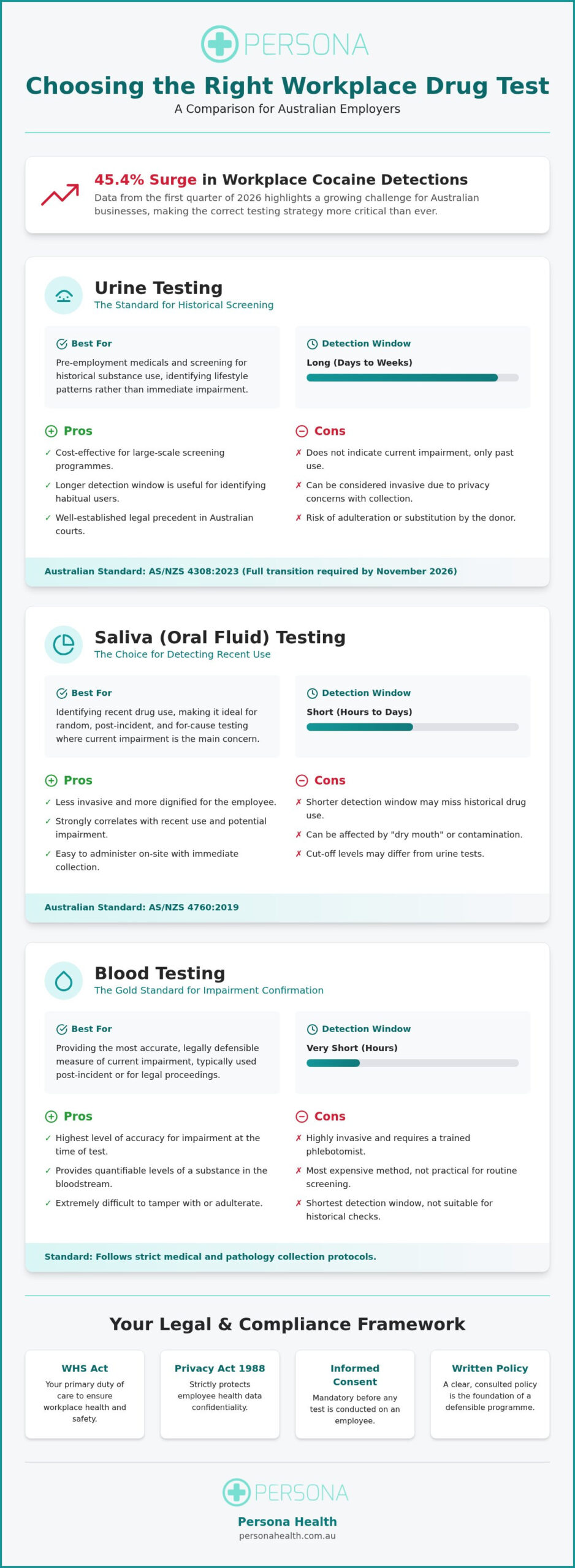
Did you know that cocaine detections in Australian workplaces surged by 45.4% in the first quarter of 2026? If you feel overwhelmed by the pressure to keep your site safe while staying on top of rapidly changing regulations, you are certainly not alone. Choosing between urine saliva blood testing is no longer just about picking a method; it is about understanding which window of detection actually protects your workers and your business in a shifting legal landscape.
We understand that the looming November 2026 deadline for the new AS/NZS 4308:2023 urine standard, combined with the strict requirements of the Privacy Act 1988, can create significant anxiety for employers. This guide provides a clear, professional framework to help you choose the right testing regime for your unique workplace needs. You will discover how to align your policies with SafeWork Australia guidelines, identify recent impairment effectively, and leverage modern tools like Persona Health’s digital reporting to reduce lost time injuries and ensure every team member returns home safely at the end of their shift.
Key Takeaways
- Navigate the transition to AS/NZS 4308:2023 and ensure your workplace remains compliant before the mandatory November 2026 deadline.
- Identify the most effective testing method for your specific safety goals by comparing the detection windows and accuracy of urine saliva blood tests.
- Protect your business and your employees by aligning your internal policies with the Privacy Act 1988 and SafeWork Australia standards.
- Reduce Lost Time Injuries by combining professional screening with InjuryQR, a free AI-powered triage tool for immediate incident management.
- Learn how to access expert support through Persona Health’s clinics in Sydney and Melbourne, or via our flexible mobile on-site testing services.
Workplace Drug Testing Standards in Australia: The Legal Framework
In Australia, the legal foundation for any screening programme is the Work Health and Safety (WHS) Act. Under this legislation, employers have a primary duty of care to ensure, as far as is reasonably practicable, the health and safety of their workers and others at the workplace. SafeWork Australia provides the national framework that guides businesses in managing risks associated with drug and alcohol use. It’s not about being punitive; it’s about creating a safe environment where everyone can perform their roles without unnecessary risk.
Before you introduce any urine saliva blood screening, you must have a comprehensive, written policy in place. This document should be developed in consultation with your employees to ensure transparency and buy-in. We often see confusion between a general “Fitness for Work” approach and specific Fitness for Duty assessments. While the former focuses on a worker’s overall capacity to be on-site, the latter is a targeted medical evaluation to determine if an individual can safely perform the inherent requirements of their specific role.
To better understand the differences between these testing mediums, watch this helpful video:
Australian Standards for Drug Testing
To ensure your results are legally defensible in Australian courts or Fair Work Commission hearings, you must strictly adhere to the relevant Australian Standards. For many years, AS/NZS 4308:2008 was the benchmark for collection and detection in urine. However, the updated AS/NZS 4308:2023 is now the mandatory standard, with a full transition required by November 2026. This update introduces lower cut-off levels for substances like cocaine and benzodiazepines, reflecting modern usage patterns in 2026.
Similarly, oral fluid testing is governed by AS/NZS 4760:2019. Understanding these different drug testing methods is vital because each standard dictates specific procedures for collection, storage, and confirmation. At Persona Health, our medical team ensures every test we conduct across our Sydney and Melbourne clinics meets these rigorous criteria, providing you with certainty and peace of mind.
Privacy and Employee Rights
Implementing a testing regime requires a delicate balance between collective safety and individual rights. The Privacy Act 1988 strictly protects an employee’s health information. This means that any data collected during the testing process must be handled with the highest level of confidentiality. Employers don’t have an automatic right to a worker’s medical history; they only have a right to know if the worker is fit for their duties.
Informed consent is the cornerstone of this process. Whether it’s a pre-employment medical or a random site check, the individual must understand what is being tested and how the results will be used. By prioritising a transparent, empathetic approach, you build trust within your team. This makes the safety programme feel like a shared commitment to wellbeing rather than an invasive oversight.
Comparing Urine vs Saliva vs Blood Testing: Which is Best?
Selecting the most appropriate method among urine saliva blood testing depends entirely on what you are trying to achieve. We understand that as an employer, you want to balance rigorous safety with a respectful, supportive environment for your team. Are you looking for a history of substance use during the hiring phase, or are you concerned about immediate impairment on a busy construction site? Each method serves a distinct purpose within the broader context of Australian workplace safety regulations. For industries like transport or heavy manufacturing, the choice of test can mean the difference between a safe shift and a catastrophic incident. You can find more detail on how we implement these in our Drug and Alcohol Testing Pillar.
Urine Testing: Pros and Cons
Urine testing remains a staple in Australian occupational health. It offers the highest accuracy for detecting substances used several days prior, providing a clear picture of an individual’s recent history. This makes it the preferred method for Pre-Employment Medicals where you need to identify potential risks before a candidate joins your organisation.
- Pros: Excellent accuracy, longer detection window, and cost-effective for large-scale screening.
- Cons: Requires private collection facilities and can be susceptible to sample tampering.
We manage these challenges through strict chain-of-custody protocols and secure digital reporting. If you are unsure if this is the right fit for your site, our team at Persona Health can help you organise a testing programme that meets the new AS/NZS 4308:2023 standards.
Saliva Testing: The Modern Alternative
Oral fluid testing is rapidly becoming the standard for random on-site screening. It is non-invasive and incredibly difficult for a donor to subvert. Because the detection window is shorter, usually 24 to 48 hours, it specifically identifies recent use that might lead to immediate impairment. This is why it is the primary choice for roadside testing by police and for high-risk environments where fitness for work is the immediate priority. It provides a practical, dignified solution for mobile on-site testing without the need for specialised plumbing or private bathrooms.
Blood Testing: The Final Verdict
Blood testing is the most accurate method available because it provides the exact concentration of a substance in the bloodstream at that very moment. However, it is invasive and requires a clinical setting. We generally reserve this for complex cases, such as post-accident investigations or clinical confirmation. An Occupational Physician might recommend a blood test to confirm a not-negative result from another method or to provide forensic evidence during legal proceedings. It represents the gold standard for accuracy but is rarely the first choice for routine workplace screening.
Choosing the right mix of urine saliva blood testing ensures your safety programme is both fair and effective. Our team at Persona Health provides these services across our clinics in Parramatta, Rosebery, and Craigieburn, as well as through our national mobile network. If you need help tailoring a strategy, our experts are ready to assist.
Detection Windows: How Long Do Drugs Stay in the System?
One of the most frequent sources of confusion for Australian employers is why a worker might pass an oral fluid test but return a “not-negative” result in a urinalysis. The answer lies in the detection window. Each method within the urine saliva blood spectrum offers a different perspective on a person’s recent history. While saliva testing is designed to catch recent use, urine testing provides a broader look at an individual’s lifestyle over several days or even weeks. Understanding how the body processes these substances is vital for maintaining a fair and effective safety programme.
When a person consumes a substance, the body begins to break it down into metabolites. Most drug tests are designed to look for these metabolites rather than the “parent” drug itself. However, saliva tests often detect the parent drug that remains in the mouth shortly after consumption. This is why saliva is so effective at identifying potential impairment during on-site health surveillance checks. In contrast, urine tests wait for those metabolites to pass through the kidneys, which takes more time but leaves a trail that lasts much longer.
Common Substances and Their Detection Windows
The detection window for cannabis (THC) is perhaps the most complex. In saliva, THC is typically detectable for only 1 to 12 hours, making it a reliable indicator of very recent use. However, because THC is fat-soluble, it can remain in a person’s urine for 1 to 30 days depending on how frequently they use it. This discrepancy is a common point of discussion during pre-employment medicals, where a candidate may have used a substance weeks before their appointment.
- Stimulants: Substances like methamphetamines and cocaine clear the system relatively quickly. They are usually detectable in saliva for 1 to 48 hours and in urine for 2 to 4 days.
- Alcohol: While breathalysers are the standard for immediate site access, alcohol can be detected in blood or urine for a short period after consumption to confirm recent intake.
Factors Influencing Detection
No two bodies process substances in exactly the same way. An individual’s metabolism, body mass index (BMI), and even their hydration levels play a significant role in how long a drug remains detectable. Because THC is stored in fat cells, individuals with a higher BMI may retain detectable levels for longer periods than those with a lower BMI. Similarly, chronic use leads to a “build-up” effect in the system, significantly extending the detection window in urinalysis compared to a one-off user.
The potency and purity of the substance also matter. With cocaine detections rising by 45.4% in early 2026, the higher concentrations found in modern samples can sometimes lead to longer detection times than previously expected. At Persona Health, our medical team uses modern digital reporting to help you interpret these results accurately, ensuring your workplace remains safe and compliant with current Australian Standards.
Implementing an Effective Workplace Drug and Alcohol Policy
Successful drug and alcohol management is not simply about catching people out; it is about fostering a culture of safety where every employee feels supported and valued. While the clinical choice between urine saliva blood testing is a technical decision, the way you implement your policy determines its long-term success. A well-crafted policy provides clear guidance on how your business manages risk while ensuring you remain compliant with the Privacy Act 1988 and various state-specific WHS legislation. Integrating these checks into your broader on-site health surveillance programme ensures that safety becomes a standard part of your operational rhythm rather than an occasional interruption.
When a worker returns a not-negative result, your policy must dictate a fair, evidence-based response. This typically involves standing the worker down from safety-critical duties while a confirmatory test is conducted at a NATA-accredited laboratory. Our experienced medical team at Persona Health handles these sensitive situations with clinical precision and empathy, helping you navigate the complexities of employee relations while prioritising site safety. We recommend regular policy reviews to stay aligned with current Australian Standards, ensuring your framework remains legally defensible and practically effective.
Random vs Pre-Employment Testing
Your first line of defence is a robust pre-employment screening process. Identifying potential risks before an individual steps onto your site is the most effective way to prevent future incidents. However, pre-employment checks only provide a snapshot in time. To maintain a truly safe environment, a regular random testing schedule acts as a powerful deterrent. For workers in high-risk sectors, such as those requiring Cat 3 Rail Medicals, these regular checks are often a mandatory requirement under national transport safety laws. A consistent, transparent approach to random testing builds trust and ensures that safety remains top of mind for all staff.
Incident Management and Triage
Despite our best efforts, accidents can still happen. When they do, your post-incident protocol must be rapid and accurate. We empower businesses to take control of these moments through InjuryQR, a free AI-powered triage service. In the event of an injury, workers simply scan a QR code on a poster or magnet. No app is required. They describe the incident by voice, and the AI provides immediate, guided next steps, such as self-care, telehealth, or emergency direction.
This system not only streamlines incident reporting but can also issue Certificates of Capacity immediately where appropriate. To support your on-site safety culture, businesses can order free physical InjuryQR assets, such as posters and magnets, to ensure the service is always within reach for your team. By combining rapid triage with for-cause drug testing, you can significantly reduce Lost Time Injuries (LTIs) and ensure your reporting is accurate and timely. To ensure your team is prepared for any situation, book a fitness for duty assessment with our occupational health experts today.
Professional Occupational Health Services with Persona Health
Managing a safe and compliant workplace is a significant responsibility that requires more than just a checklist. It requires a partnership with experts who understand the nuances of Australian industry. At Persona Health, we provide a comprehensive suite of screening solutions designed to protect your most valuable asset: your people. Whether your specific site requirements call for urine saliva blood testing or a more integrated health surveillance programme, our approach is always tailored to your unique operational needs. We combine clinical authority with an empathetic, user-centred approach to ensure that every interaction, from a routine screen to a complex medical assessment, is handled with care and precision.
Our experienced medical team, which includes Occupational Physicians, is dedicated to providing fast turnaround times and accurate, evidence-based reporting. We know that in a fast-paced business environment, waiting days for results is not an option. That is why we have invested in modern digital reporting systems that deliver clear, actionable data directly to your management team. This efficiency allows you to make informed decisions quickly, reducing downtime and maintaining the momentum of your projects. For businesses with remote or high-pressure sites, our mobile on-site services bring our expertise directly to your gates, ensuring minimal disruption to your daily operations.
Our Clinic Locations
We believe that high-quality occupational health services should be accessible and convenient. Persona Health operates several strategically located clinics across Australia’s major hubs. In Sydney, you can find our professional teams in Parramatta, Rosebery, Gregory Hills, and Dee Why. For our Victorian partners, we provide comprehensive services at our Cairnlea and Craigieburn clinics in Melbourne. This local presence is backed by an extensive affiliate network of over 100 clinics nationwide, ensuring that no matter where your team is located, Persona Health can provide a consistent standard of care. This wide reach allows us to support national contracts with the same level of personal attention we give to local small businesses.
Why Partner with Persona Health?
Choosing Persona Health means choosing a partner who understands the specific risks associated with your industry. Beyond drug and alcohol screening, we offer a full range of specialised assessments, including Crystalline Silica medicals and Asbestos medicals. These targeted evaluations are essential for meeting your health surveillance obligations under state WHS legislation. Our focus is always on the individual, ensuring that every worker feels supported throughout their health journey.
We also provide expert support for workplace injury management and return-to-work programmes. By integrating these services with modern tools like InjuryQR for immediate triage, we help you create a safer, more resilient workplace. Our goal is to help you manage risk effectively while fostering a culture where safety and wellbeing are naturally prioritised. When you partner with us, you gain more than a service provider; you gain a dedicated team of professionals committed to the long-term health of your workforce.
Securing Your Site with Professional Screening
Navigating the complexities of Australian Standards and WHS legislation doesn’t have to be a source of stress for your business. By understanding the distinct roles of urine saliva blood testing, you can implement a safety strategy that protects your workers while respecting their privacy and dignity. Whether you’re preparing for the mandatory November 2026 urine testing deadline or looking to enhance your random on-site screening, the right approach balances rigorous compliance with an empathetic, supportive culture.
At Persona Health, our Occupational Physicians provide the professional oversight needed to ensure every result’s accurate and legally defensible. We pride ourselves on delivering fast turnaround times and modern digital reporting across our Sydney and Melbourne clinics, as well as through our flexible mobile services. Partnering with a specialist team ensures your workplace remains safe, productive, and fully compliant with AS/NZS 4308 and AS/NZS 4760 standards. We’re here to guide you through every step of the process, from policy development to incident management with tools like InjuryQR.
Contact Persona Health today to discuss your workplace drug testing requirements and take the next step toward a healthier, more resilient workforce. We look forward to helping you achieve your safety goals with confidence.
Frequently Asked Questions
What is the difference between a non-negative and a positive drug test result?
A non-negative result, referred to as “not-negative” under the AS/NZS 4308:2023 standard, means the initial screen detected a substance, but it hasn’t been confirmed by a laboratory yet. A positive result is only issued after NATA-accredited lab testing confirms the presence of the drug above the Australian Standard cut-off levels. This two-stage process ensures accuracy and protects workers from false positives caused by cross-reactivity or common medications.
Can a person fail a drug test from second-hand smoke or certain foods?
It is highly unlikely for passive exposure or common foods to trigger a positive result that exceeds the Australian Standard cut-off levels. While poppy seeds can contain trace amounts of opiates, modern laboratory confirmation is designed to distinguish between dietary intake and illicit use. Our Occupational Physicians at Persona Health review these cases carefully to ensure the integrity of the results and maintain fairness for the individual during the screening process.
How long does it take for results to be returned to the employer?
Initial screening results are usually available within minutes during the appointment. If a sample returns a not-negative result and requires laboratory confirmation, the process typically takes 24 to 48 hours for the final report to be issued. Persona Health uses modern digital reporting systems to ensure these results are delivered to your management team as quickly as possible, minimising any operational downtime and allowing for swift safety decisions.
Is saliva testing more accurate than urine testing for workplace safety?
Both methods are highly accurate when conducted according to Australian Standards, but they serve different safety purposes. Saliva testing is often superior for immediate workplace safety because it detects very recent use and potential impairment. In contrast, urine testing is better for identifying historical use over several days. Choosing between urine saliva blood methods depends on whether your priority is current fitness for work or long-term lifestyle monitoring.
What are the legal requirements for drug testing in Australian high-risk industries?
High-risk industries, such as rail, transport, and construction, are governed by specific WHS legislation and national safety standards. For example, the Rail Safety National Law mandates specific testing protocols for rail safety workers. Employers must ensure their testing programmes comply with AS/NZS 4308 for urine or AS/NZS 4760 for oral fluid to remain legally defensible and meet their duty of care under SafeWork Australia guidelines and state-specific regulations.
Can an employee refuse to take a drug or alcohol test?
Yes, an employee can refuse, but your workplace policy should clearly state the consequences of such a refusal. In most safety-critical industries, refusing a test is treated as a breach of policy, often carrying the same weight as a positive result. This may lead to disciplinary action or immediate removal from the site. It is essential that your policy is communicated clearly during induction so that all staff understand their obligations.
How often should random drug testing be conducted in a workplace?
There is no single rule, but most effective programmes aim to test a representative percentage of the workforce annually. A common benchmark is testing 25% to 50% of staff over a twelve-month period to create a genuine deterrent. The frequency should be based on your specific risk profile and industry requirements, ensuring that every worker has an equal chance of being selected at any time to maintain a culture of safety.
What should I do if an employee tests positive after a workplace incident?
You should follow your established drug and alcohol policy immediately, which usually involves removing the worker from safety-critical duties. If an injury has occurred, use Persona Health’s InjuryQR service to manage the medical triage and report the incident accurately by voice. Our team can then assist with a formal fitness for duty assessment and guide you through the return-to-work process in compliance with Australian employment laws and the Privacy Act 1988.

Article by
Ian Nicholson
Ian is the Business Support Manager at Persona Health, where he plays a key role across IT, sales, marketing and business operations. With a broad skill set and a practical, solutions-focused approach, Ian helps drive the systems, communication and commercial strategy that support Persona Health’s continued growth across Australia.