

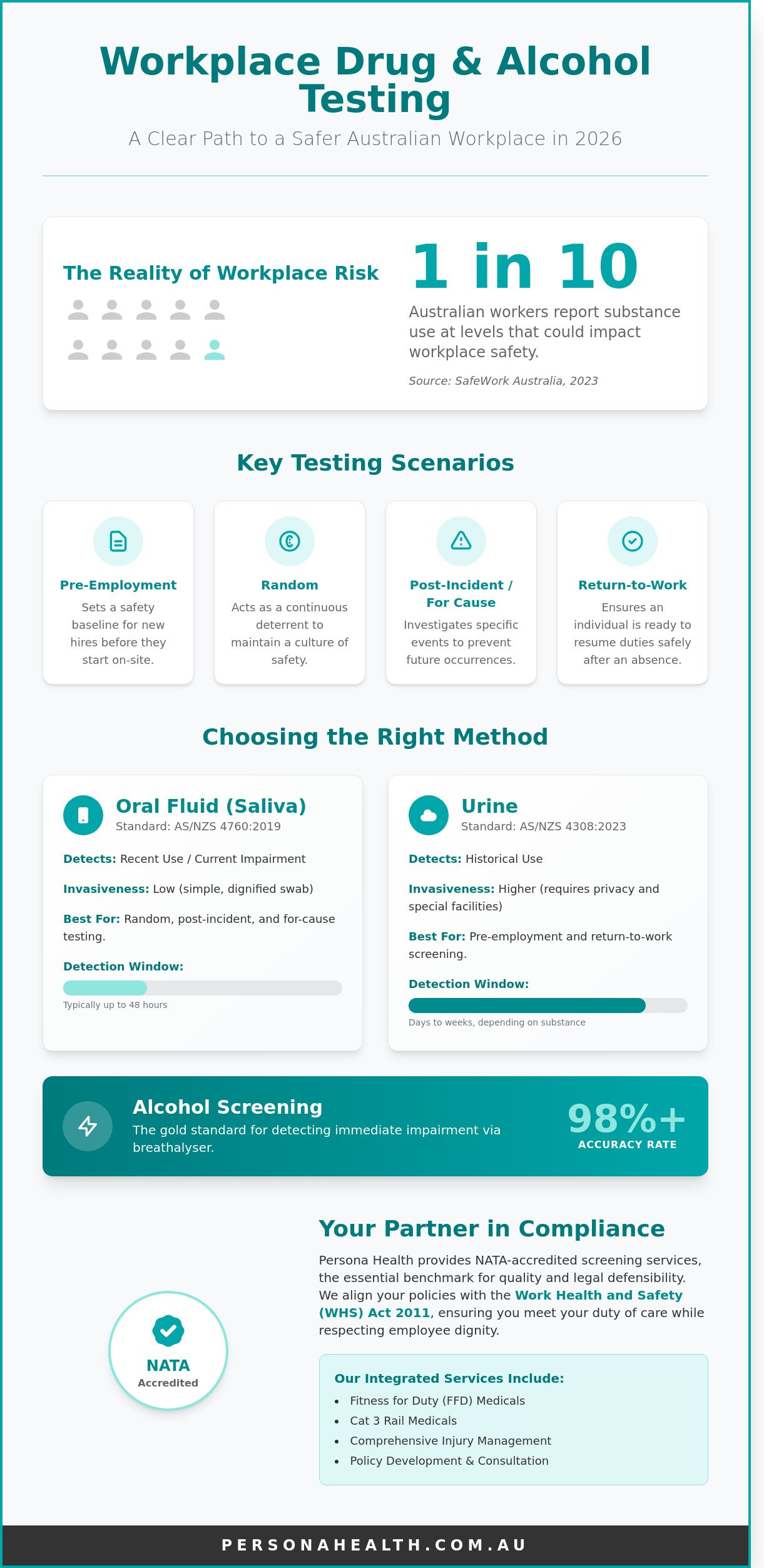
Did you know that according to SafeWork Australia data from 2023, nearly 1 in 10 Australian workers report using substances at levels that could impact workplace safety? You likely believe that a secure environment is the foundation of a healthy business, yet the technicalities of drug and alcohol testing often feel overwhelming. It’s natural to feel anxious about balancing strict regulatory compliance with the privacy and dignity of your employees. We’re here to help you bridge that gap with a supportive, expert perspective that prioritises the individual.
This 2026 guide provides a clear path through the complexities of workplace screening, ensuring your business meets Australian Standards AS/NZS 4308:2008 and AS/NZS 4760:2019 without losing the human touch. You’ll gain a thorough understanding of when to choose saliva over urine testing and how to implement policies that empower your workforce. Whether you’re operating in Sydney or looking for local expertise at our new Persona Health clinics in Cairnlea and Craigieburn, this roadmap ensures your safety protocols are as unique and professional as the people they protect.
Key Takeaways
- Learn how to align your workplace policies with SafeWork Australia standards to ensure a safe and legally compliant environment for your team.
- Understand the critical differences between urine and oral fluid drug and alcohol testing to choose the most effective method for your industry’s specific detection needs.
- Discover why NATA accreditation is the essential benchmark for screening providers and how to integrate these services with specialised Cat 3 rail medicals.
- Find out exactly what to expect during your appointment at our Sydney or Melbourne clinics, including our new professional spaces in Cairnlea and Craigieburn.
- Explore how Persona Health streamlines your occupational health by combining screening with comprehensive injury management programmes tailored to your unique requirements.
Understanding Drug and Alcohol Testing in the Australian Workplace
Safeguarding your team starts with a robust screening process. In 2024, SafeWork Australia reported that workplace fatalities in high-risk sectors remain a critical concern; this makes proactive measures essential for every responsible employer. Workplace drug and alcohol testing isn’t about policing employees. Instead, it’s a vital tool for identifying risks before they lead to catastrophic outcomes. By maintaining a sober workforce, you protect your people, your assets, and the community at large.
To understand the technical side of how results are measured and the standards applied during screening, watch this helpful video:
Every Australian employer operates under the Work Health and Safety (WHS) Act 2011. This legislation requires businesses to provide a work environment that’s without risks to health and safety. For industries like construction, which accounted for approximately 12% of work-related fatalities in recent years, regular screening is a non-negotiable standard. A clear Drug and Alcohol Policy (DAP) provides the necessary structure for these interventions. By partnering with experts like Core Integrity to foster trust and accountability, businesses can ensure every team member knows what to expect, creating a culture of transparency and mutual respect.
The Legal Duty of Care
Under the WHS Act, the responsibility to manage risks falls squarely on the employer. Implementing drug and alcohol testing helps mitigate liability by demonstrating that the organisation has taken “reasonably practicable” steps to ensure safety. This process is often integrated into fitness for duty (FFD) medicals for safety-critical roles. At our new clinics in Cairnlea and Craigieburn, we help Melbourne businesses navigate these requirements with clinical precision and an empathetic approach that puts the worker’s dignity first.
When is Testing Required?
The Science of Screening: Comparing Testing Methods
Choosing the right approach for drug and alcohol testing involves balancing accuracy with the specific needs of your workplace. While some industries require a broad look at historical use, others focus on immediate safety risks. Selecting an inappropriate method can lead to missed detection or unnecessary disputes with staff. Every body is unique, and our clinical approach ensures that testing protocols respect the individual while maintaining rigorous safety standards.
Breathalyser technology remains the gold standard for alcohol detection. Modern fuel-cell sensors provide immediate results with an accuracy rate of 98% or higher. These devices are essential for high-risk environments where any level of intoxication poses a direct threat to life. For businesses managing Workplace Health and Safety, integrating regular breath testing helps maintain a culture of accountability and care.
Urine Testing (AS/NZS 4308:2023)
Urine analysis is the most established method for detecting substances in industrial settings. It follows the AS/NZS 4308:2023 standard, which outlines strict protocols for specimen collection and detection. One primary advantage is the longer detection window; substances like cannabis or amphetamines can often be identified several days after consumption. This makes it ideal for fitness for duty medicals where understanding a candidate’s general health profile is the priority.
Maintaining a rigorous chain of custody is vital during this process. Every sample is tracked from the moment of collection to the final report to ensure it hasn’t been tampered with or swapped. We provide these comprehensive services at our new Melbourne clinics in Cairnlea and Craigieburn, ensuring local businesses have access to clinical-grade facilities that prioritise both accuracy and patient dignity.
Saliva Testing (AS/NZS 4760:2019)
Oral fluid testing is frequently chosen for roadside checks and on-site screenings because it is less invasive than urine collection. It focuses on recent use, typically identifying drug presence within the last 12 to 24 hours. The AS/NZS 4760:2019 standard specifies the requirements for the collection of oral fluid and the design, performance, and verification of on-site screening devices.
If an initial screen returns a non-negative result, laboratory confirmation is mandatory. Samples are sent to an accredited lab where mass spectrometry techniques verify the presence of the substance. This step protects both the employer and the employee by providing a scientifically irrefutable result. If you’re looking to implement a new program, our team can help you design on-site health surveillance protocols that fit your specific industrial requirements and support your team’s wellbeing.
Compliance and Safety Standards for Australian Businesses
Adhering to Australian standards isn’t just a legal necessity; it’s a commitment to your team’s wellbeing. NATA accreditation remains the gold standard for any testing provider. It ensures that every sample is handled with scientific precision and legal defensibility. By following industry best practices, businesses align themselves with the rigorous AS/NZS 4308:2008 and AS 4760:2019 benchmarks. This level of compliance is particularly vital when integrating drug and alcohol testing with other statutory assessments. For instance, workers in Sydney often combine these screens with cat 3 rail medicals to meet the National Standard for Health Assessment of Rail Safety Workers.
High-Risk Industry Requirements
In sectors like aviation, rail, and heavy vehicle transport, the margin for error is zero. Regulatory bodies like SafeWork Australia emphasize that substance screening is a pillar of risk management. In the construction sector, testing often complements crystalline silica medicals to provide a holistic view of a worker’s fitness for duty. There’s a clear financial incentive too. Companies that implement robust health surveillance programs often see a reduction in workers compensation premiums. Proactive monitoring significantly lowers the frequency of onsite incidents, which directly impacts your bottom line.
Maintaining Employee Dignity
At Persona Health, we understand that medical assessments can trigger anxiety. Our approach is clinical yet deeply empathetic. We don’t view the process as a simple collection task. Instead, we provide a supportive environment where every individual feels respected. If a non-negative result occurs, we don’t just hand over a report. We work with management to implement a supportive plan that focuses on safety and recovery. Whether you visit our Sydney sites or our new facilities in Cairnlea and Craigieburn, you’ll find a team dedicated to your unique health journey. We believe that professional drug and alcohol testing should empower your workforce, not intimidate them. Every person we see is treated as an individual, not just a number on a spreadsheet.
What to Expect During Your Appointment in Melbourne or Sydney
Walking into a clinic for a drug and alcohol testing appointment can feel daunting; however, our process is designed to be transparent and supportive. We follow strict Australian Standards, specifically AS/NZS 4308:2008 for urine and AS/NZS 4760:2019 for oral fluid, to ensure every result is legally defensible and fair. When you arrive, you’ll be greeted by a professional collector whose primary role is to guide you through the protocol while maintaining your privacy and dignity.
You must bring a valid form of government-issued photo identification, such as an Australian driver’s licence or a passport. Without this, the chain of custody is broken before it begins. Our collectors will ask you to declare any prescription medications or over-the-counter supplements you’ve taken in the last 14 days. This information is vital; it helps the Medical Review Officer (MRO) differentiate between legitimate medical use and potential substance misuse during the verification phase.
The collection itself is methodical. For urine samples, the collector must verify the specimen temperature is between 32.5 and 37.7 degrees Celsius within four minutes of voiding. This is a critical step to prevent tampering. If a sample falls outside this range or appears diluted, you may be asked to provide a second specimen under specific conditions. We aim to make this experience as stress-free as possible, ensuring you feel like a person, not just a number on a vial.
Preparing for Your Test
Preparation starts before you reach our doors. Drink plenty of water in the hours leading up to your visit, but avoid “water loading,” as excessively clear samples can be flagged as diluted. A diluted result often requires a follow-up test, which can delay your start date. If you’re taking medication for a chronic condition, bring the original packaging or a letter from your GP. We prioritise a respectful environment where your health history is handled with the highest level of clinical confidentiality.
Our Local Clinics
We’ve strategically expanded our reach to support the booming industrial and logistics hubs across Victoria and New South Wales. In Melbourne, our brand-new clinics in Cairnlea and Craigieburn offer easy access for workers in the northern and western suburbs. These sites are fully equipped to handle high-volume pre-employment drug and alcohol testing services, helping local businesses meet SafeWork Australia safety requirements without long commute times.
Our Sydney locations continue to provide the same premium care, ensuring that whether you’re in Parramatta or the CBD, professional screening is never far away. By choosing a local clinic, you reduce the logistical burden on your candidates and speed up the recruitment pipeline. Our 2026 service model focuses on getting your team on-site faster while keeping safety at the forefront of every interaction.
Ensure your workforce remains safe and compliant by booking a fitness for duty medical assessment today.
How Persona Health Simplifies Occupational Health Surveillance
Managing workplace safety shouldn’t feel like a clinical burden. At Persona Health, we’ve refined our approach to ensure that your compliance needs align perfectly with the wellbeing of your workforce. We understand that every business has a unique pulse; a construction site in Sydney faces different daily risks than a logistics hub in Melbourne. By choosing a specialised provider, you gain access to clinical expertise that goes beyond simple data collection. We provide a supportive environment where employees feel valued rather than scrutinised.
Our team integrates drug and alcohol testing into broader injury management frameworks to create a seamless safety net. If an incident occurs, our protocols ensure that testing and medical assessment happen concurrently. This reduces downtime and provides immediate clarity for both the employer and the individual. We utilise cutting-edge technology like InjuryQR to deliver streamlined health reporting. This tool allows managers to access vital health data and clearance statuses in real-time, replacing slow, paper-based systems with instant digital insights.
A Holistic Approach to Workplace Health
Partnering with Persona Health
Choosing a partner for occupational medicine means looking toward the future. As we move into 2026, regulatory requirements regarding psychological and physical safety are becoming more stringent. Our clinicians stay ahead of these legislative shifts to keep your business compliant and your workers safe. We pride ourselves on a patient-centred approach that reduces the anxiety often associated with workplace medicals.
We are excited to announce the expansion of our services with two new Melbourne locations. You can now book comprehensive sessions at our modern clinics in Craigieburn or Cairnlea. These sites are equipped with the latest diagnostic technology and staffed by professionals who understand the specific industrial needs of Melbourne’s northern and western suburbs. Whether you require a one-off screening or a customised, long-term health surveillance programme, our team is ready to guide you through every step of the process. Contact us today to secure your session and experience a more empathetic approach to occupational health.
Prioritising Safety in the Modern Australian Workplace
Navigating the complexities of SafeWork Australia compliance requires a partner who understands the unique demands of your industry. By 2026, staying ahead of safety standards means implementing robust drug and alcohol testing protocols that protect both your team and your business reputation. Whether you require the immediate detection of saliva screening or the comprehensive window of urine analysis, selecting the right methodology is essential for maintaining a secure environment in Australia’s busy industrial sectors.
Persona Health brings a person-centred clinical approach to occupational health. Our NATA accredited collection processes ensure every screening is conducted with precision and empathy. We’ve expanded our reach to better serve Melbourne’s growing workforce with new, state-of-the-art clinics in Cairnlea and Craigieburn, alongside our established specialist sites in Sydney’s primary industrial hubs. We’re here to simplify your compliance journey while treating every employee with the respect they deserve.
You don’t have to manage workplace surveillance alone. Book your workplace drug and alcohol testing at Persona Health today and experience a professional health partnership tailored to your unique needs. We’re ready to help you build a safer, more confident team.
Frequently Asked Questions
What shows up on a standard workplace drug test in Australia?
Standard screenings in Australia typically follow the AS/NZS 4308:2008 guidelines for urine or AS/NZS 4760:2019 for saliva. These tests identify five core substance groups: cannabinoids, cocaine, opiates, amphetamines, and benzodiazepines. At Persona Health, we conduct these screenings with clinical precision while ensuring you feel supported and respected throughout the entire process. Our clinicians focus on your unique needs to make the experience as stress-free as possible.
How long do drugs stay in your system for a urine test?
Detection periods vary significantly based on your body’s unique chemistry and the specific substance involved. For instance, cannabis can be detected in urine for up to 30 days in frequent users, whereas stimulants like MDMA often disappear within 3 days. We understand that every person’s physiology is different. Our team provides clear, evidence-based data to help you understand your results and support your personal health journey.
Can I refuse a drug and alcohol test at work?
You have the right to refuse a test, but this usually triggers serious disciplinary actions under your employment contract. SafeWork Australia guidelines state that refusing a test is often treated as a “non-negative” result in high-risk industries like construction or transport. We recommend reviewing your specific workplace policy to understand the legal implications of your choice. Our goal is to provide a safe, empathetic environment where you feel informed about every step.
What happens if I have a “non-negative” result during a screening?
A non-negative result is an initial finding that requires laboratory confirmation before any final decision is made. Your sample is sent to a NATA-accredited facility for Gas Chromatography-Mass Spectrometry testing to ensure 100% accuracy. We’re here to guide you through this process with professional clarity and empathy. We treat every individual with the care they deserve, ensuring the path forward is handled with the utmost confidentiality.
Is saliva testing as accurate as urine testing for workplace safety?
Saliva testing is highly effective for detecting recent impairment, typically within a 12 to 24 hour window. While urine testing provides a longer historical view of drug use, saliva is the preferred method for identifying current risk under AS/NZS 4760:2019 standards. Both methods meet rigorous Australian Standards when performed by our qualified clinicians. We’ll help you determine which method best suits your company’s specific safety requirements and culture.
How does medication affect my drug and alcohol test results?
Certain over-the-counter or prescription medications can trigger an initial “non-negative” during drug and alcohol testing. If this happens, our Medical Review Officer (MRO) will discuss your medical history privately to determine if the result is due to legitimate therapeutic use. We focus on your health and recovery, ensuring your treatment plan remains personal. You’re in expert hands, and we prioritise your privacy throughout the entire verification process.
How often should a business conduct random drug testing?
Most Australian companies in safety-sensitive sectors aim to test between 15% and 20% of their staff every year. This frequency helps maintain a culture of safety without creating an environment of distrust or anxiety. Persona Health can help you design a bespoke testing schedule that aligns with your specific industry regulations and risk profile. We believe in a holistic approach to workplace wellness that empowers both employers and employees.
Where can I find drug and alcohol testing services in Melbourne North?
You’ll find our expert teams at our new Melbourne North hubs in Cairnlea and Craigieburn. These locations provide a clinical yet calming space for all your drug and alcohol testing needs. Whether you’re an employer or an individual, our Cairnlea and Craigieburn clinics offer the personalised care you deserve. We’ve designed these sites to be accessible and supportive, ensuring you receive professional guidance in a modern, welcoming environment.

Article by
Ian Nicholson
Ian is the Business Support Manager at Persona Health, where he plays a key role across IT, sales, marketing and business operations. With a broad skill set and a practical, solutions-focused approach, Ian helps drive the systems, communication and commercial strategy that support Persona Health’s continued growth across Australia.
Pingback: Pre-Employment Medical: What Do They Check for in Sydney and Melbourne? - Occupational Health Blog
Pingback: Pre-Employment Medicals Truganina: Expert Occupational Health 2026
Pingback: What Happens After a Positive Drug Test at Work in Australia? A 2026 Guide
Pingback: Urine, Saliva, or Blood? A Guide to Workplace Drug Testing in Australia (2026)
Pingback: Pre-Employment Medical Check Cost Australia: 2026 Employer Guide