

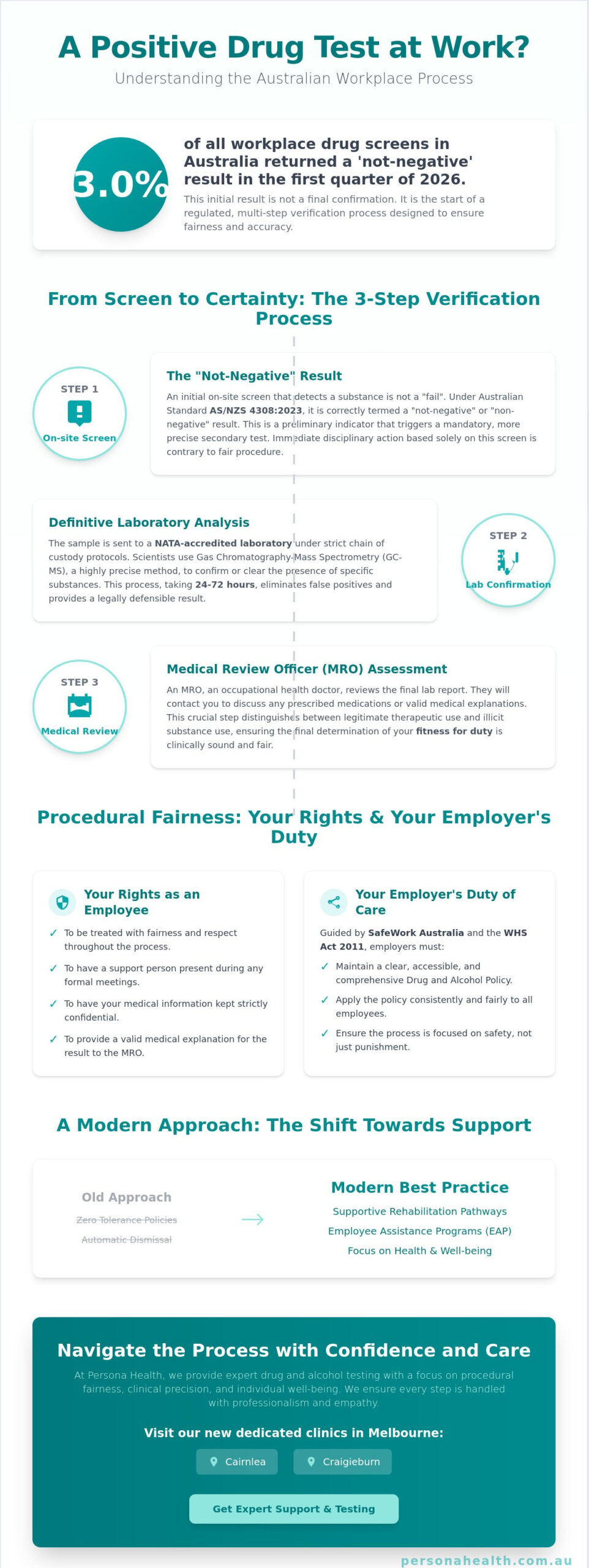
In the first quarter of 2026, 3.0% of all workplace drug screens in Australia returned a result indicating the presence of substances. If you find yourself in this position, the fear of immediate dismissal and confusion over privacy laws can be overwhelming. It is vital to understand what happens after a positive drug test at work australia, as the initial “not-negative” result is merely a procedural starting point under the latest AS/NZS 4308:2023 standards.
We understand that behind every test is a person who deserves a fair and transparent process. This guide clarifies the legal steps required by the WHS Act 2011 and SafeWork Australia, ensuring you know exactly where you stand. We will explore the mandatory laboratory confirmation process, your right to provide a medical explanation, and the shift towards supportive rehabilitation pathways. At Persona Health, we provide expert drug and alcohol testing and comprehensive workplace injury management with a focus on individual well-being. If you are in Melbourne, our dedicated teams at our brand-new Cairnlea and Craigieburn clinics are ready to guide you through these complex procedures with clinical precision and genuine empathy.
Key Takeaways
- Learn exactly what happens after a positive drug test at work australia, starting with the transition from a not-negative screen to formal laboratory confirmation.
- Understand your rights under SafeWork Australia guidelines, including why a clear and accessible workplace policy is essential for procedural fairness.
- Discover how to protect your interests during formal meetings by using support persons and ensuring your medical data remains strictly confidential.
- Explore the shift from zero-tolerance disciplinary actions toward supportive rehabilitation pathways and employee assistance programs.
- Find out how the professional teams at Persona Health’s new Cairnlea and Craigieburn clinics offer the clinical expertise required for accurate testing.
Understanding the Difference Between Non-Negative and Confirmed Positive Results
When an initial screen detects a substance, it’s often a moment of high stress for everyone involved. However, under the latest Australian standards, specifically AS/NZS 4308:2023, this result is legally termed “not-negative” or “non-negative” rather than positive. This distinction is crucial for procedural fairness. Understanding what happens after a positive drug test at work australia starts with knowing that a “not-negative” result is not an automatic “fail” or a confirmation of illicit drug use. It’s simply a preliminary indicator that requires further scientific investigation.
An on-site screen is a useful tool for immediate safety, but it lacks the forensic depth needed for disciplinary decisions. Taking immediate action, such as termination, before lab results return is generally considered inappropriate and can lead to significant legal risks under the Fair Work Act 2009. To ensure accuracy, the process shifts from simple immunoassay cups to sophisticated drug testing methodologies performed in a controlled environment.
To better understand this concept, watch this helpful video:
The Laboratory Confirmation Process
Once a sample returns a not-negative result, it’s transported under strict chain of custody protocols to a NATA-accredited facility. Here, scientists use Gas Chromatography-Mass Spectrometry (GC-MS) to identify specific molecules with absolute precision. This definitive verification typically takes 24 to 72 hours. It eliminates the ambiguity of the initial screen, providing a final report that either confirms or clears the presence of a substance based on specific cut-off levels. This step ensures that no one is unfairly penalised for a “false positive” result.
The Role of Clinical Oversight
A common concern is that everyday items, like certain poppy seeds or over-the-counter cold medicines, might trigger a result. This is why the Medical Review Officer (MRO) is a vital figure in the process. An MRO is an occupational health expert who reviews laboratory findings alongside your medical history and any current prescriptions. They can distinguish between illicit use and legitimate medication, helping to determine a person’s fitness for duty. This ensures the process remains clinical and objective rather than purely punitive.
At Persona Health, we believe this clinical bridge is essential for building trust in the workplace. Our new clinics in Cairnlea and Craigieburn provide this expert oversight, ensuring that what happens after a positive drug test at work australia is handled with the highest professional standards. We focus on the individual, making sure you’re treated with respect and clinical accuracy throughout the entire journey.
The Australian Regulatory Framework and Your Workplace Policy
Every Australian employer has a primary duty of care to ensure the health and safety of their workers. This obligation is enshrined in the Work Health and Safety (WHS) Act 2011. When considering what happens after a positive drug test at work australia, the answer is often found within the specific pages of your organisation’s Drug and Alcohol Policy. This document acts as a vital safety tool that balances Work Health and Safety (WHS) duties with the rights of the individual.
A written policy must be clearly communicated and accessible to all staff members. It’s not enough to have a document; it must be applied consistently. If an employer handles a positive result differently for various employees, they risk significant legal challenges. Consistency is the primary defence against unfair dismissal claims under the Fair Work Act 2009. By following a structured framework, businesses create a predictable environment where everyone knows what happens after a positive drug test at work australia, ensuring safety remains the priority.
Key Elements of a Compliant Policy
A robust policy does more than just list banned substances. It provides a roadmap for support and recovery. Effective policies include:
- Clear Definitions: Defining exactly what constitutes a breach and the specific disciplinary steps that follow.
- Self-Disclosure Provisions: Allowing employees to seek help for substance issues before a test occurs without fear of immediate termination.
- Regular Updates: Ensuring the policy reflects the latest standards, such as the mandatory shift to AS/NZS 4308:2023 by November 2026.
SafeWork Australia Standards
SafeWork Australia guidelines emphasize a risk-based approach. This means the response to a positive test often depends on the nature of the role. High-risk industries like construction or transport have much stricter regulatory requirements because the potential for harm is significantly higher. For example, those requiring Cat 3 Rail Medicals operate under stringent safety protocols where impairment is a critical risk. You can find deeper context on these regulations in our Workplace Drug and Alcohol Testing guide.
We see how confusing these legal layers can be for both employers and employees. Our teams at the new Cairnlea and Craigieburn clinics help businesses align their practices with these national standards. If you’re looking to strengthen your safety culture, consider our on-site health surveillance services to ensure your team remains protected and compliant.
Procedural Fairness: What Are Your Rights and Obligations?
Procedural fairness is the cornerstone of Australian industrial relations. It ensures that any disciplinary action is not harsh, unjust, or unreasonable. When navigating what happens after a positive drug test at work australia, both the employer and the employee must adhere to specific legal expectations. This process is not just about the final laboratory result. It is about the journey taken to reach a conclusion and the respect shown to the individual throughout that path.
The Fair Work Commission guidelines emphasise that an employee must be given a genuine chance to respond to any adverse findings before a final decision is made. This “right to be heard” is a fundamental principle of natural justice. Employers have a strict obligation to document every step of the post-test process, from the initial notification to the final clinical review. This creates a transparent record that protects both parties if a dispute arises.
- Right to a support person: Employees should always be offered the opportunity to have a colleague or union representative present during formal discussions.
- Right to explain: A “not-negative” result is not proof of wrongdoing. The individual must be allowed to provide context, such as recent medical treatments.
- Duty of confidentiality: Results are sensitive health information and must be handled with the highest level of discretion.
The Discussion Interview
This meeting should be handled with clinical objectivity and deep empathy. It’s a space for the employee to provide context. Employers should ask about prescribed medications or over-the-counter supplements that might have influenced the screen. It is vital that the employee understands the shift from a preliminary “not-negative” to the laboratory confirmation phase. Keeping the tone calm and professional helps reduce anxiety and ensures that the focus remains on safety and well-being. Our team can assist with injury management strategies if an underlying health issue is identified during this stage.
Privacy and Confidentiality
Medical data is highly sensitive. Information regarding a drug test should stay on a strict “need-to-know” basis, usually limited to HR and direct safety managers. Storing these records securely is a legal requirement under Australian privacy principles. Mishandling this data can lead to legal repercussions and a breakdown of workplace trust. At Persona Health, we prioritise these privacy standards in our fitness for duty assessments. Our new clinics in Cairnlea and Craigieburn are designed to provide a discreet, professional environment for these sensitive clinical processes.
Managing the Outcome: Disciplinary Action and Support Services
Once a laboratory confirms a result, the conversation moves from procedural verification to management and resolution. Determining the appropriate response is a critical decision for any Australian business. While some organisations maintain a strict zero-tolerance approach, many modern employers are moving toward supportive rehabilitation pathways. This shift acknowledges that addressing the root cause of substance use often leads to better long-term safety and employee retention. Understanding what happens after a positive drug test at work australia involves weighing the safety risks against the potential for professional recovery.
Disciplinary action can range from a formal written warning to termination of employment. The outcome depends heavily on the specific workplace policy and the nature of the employee’s role. For safety-critical positions, such as those in mining or logistics, a single positive test might lead to more severe consequences due to the inherent risks. However, for many workers, an Employee Assistance Programme (EAP) provides a vital first line of support; offering confidential counselling to address underlying issues.
Rehabilitation and EAPs
Supporting an employee through a recovery process can be a profound investment in your team’s culture. It sets clear expectations for future behaviour while providing the resources needed for genuine change. In some cases, substance use is a coping mechanism for physical pain or chronic conditions. Integrating your response with professional Injury Management can help identify if a workplace injury or musculoskeletal issue is contributing to the situation. This holistic view ensures that the individual receives the right care while the business maintains its safety standards.
Fitness for Duty Assessments
Before a staff member returns to their duties after a positive result, a formal clinical check is essential. This is where a Fitness for Duty Medical becomes the standard protocol. An occupational physician reviews the individual’s progress and determines if they are physically and mentally ready to resume work safely. This is especially vital for high-risk roles where impairment could have catastrophic results. A structured monitoring plan, often including follow-up testing for the first six months, provides the necessary oversight to ensure ongoing compliance and safety.
Our clinical teams at our new Cairnlea and Craigieburn facilities specialise in these transition periods. We help both employers and employees navigate the complexities of returning to work with confidence and clarity. If you need expert guidance on managing a positive result within your team, book a fitness for duty assessment today to ensure a safe and supportive workplace environment.
Professional Drug and Alcohol Testing at Persona Health Melbourne and Sydney
Persona Health stands as a dedicated clinical partner for businesses navigating the complexities of workplace health. When you are determining what happens after a positive drug test at work australia, having a partner who prioritises scientific accuracy and procedural fairness is essential. We don’t just provide results; we provide the clinical oversight necessary to manage sensitive situations with empathy and precision. Our methods align strictly with SafeWork Australia guidelines, ensuring your business remains compliant while your employees feel supported throughout the process.
We believe that every individual deserves a clinical experience that is objective and respectful. Our team of experts handles the entire testing lifecycle, from the initial “not-negative” screen to the final Medical Review Officer (MRO) verification. This rigorous approach reduces the risk of legal disputes and helps maintain a culture of safety and trust within your organisation. We’re here to guide you through the technical requirements of the latest Australian standards while keeping the human element at the forefront of our care.
Our New Melbourne Facilities
We are thrilled to announce the opening of our two newest clinics in Melbourne, located in Craigieburn and Cairnlea. These facilities are strategically placed to serve the rapidly expanding industrial hubs in Melbourne’s north and west. Whether you require clinic-based screenings or comprehensive on-site health surveillance, our local teams are equipped to handle everything from routine checks to complex follow-up testing. This regional expansion ensures that local employers have immediate access to high-quality medical services without the need for long-distance travel, making it easier to manage workplace safety protocols effectively.
Why Choose Persona Health?
Choosing the right partner means working with experts who understand the nuances of Australian industrial law and the importance of clinical integrity. We take a holistic approach to workplace wellness, which often begins long before a test is even administered. This includes our detailed guide to Pre-Employment Medicals, which help establish a baseline for safety from the very first day of a worker’s journey.
Our team is also highly experienced in specialised assessments, such as Cat 3 Rail Medicals and Asbestos Medicals, providing a one-stop solution for industrial health. While we grow in Victoria, our established facilities in Parramatta and the Sydney CBD continue to provide industry-leading support. We help you reduce operational risk while maintaining a supportive culture that values the individual. By integrating our clinical expertise with your specific workplace needs, we ensure that every step of the testing process is handled with the care and professionalism it deserves.
Take the Next Step Towards a Safer Workplace
Understanding what happens after a positive drug test at work australia is the first step in moving from uncertainty to a clear resolution. We have explored how the transition from a preliminary screen to laboratory confirmation ensures scientific accuracy while protecting your rights under SafeWork Australia guidelines. By focusing on procedural fairness and clinical oversight; you can ensure that every outcome is handled with the respect and professionalism it deserves.
Persona Health is here to support you through every stage of this process. With our accredited NATA laboratory partnerships and expert Medical Review Officers (MRO), we provide the clarity you need to maintain a safe and productive environment. Our brand new clinics in Cairnlea and Craigieburn are now open to provide local, accessible care alongside our established Sydney facilities. You don’t have to navigate these challenges alone; we are ready to help you build a stronger, healthier team.
Book a Professional Drug and Alcohol Assessment at Our New Melbourne or Sydney Clinics
Frequently Asked Questions
Can I be fired immediately after a non-negative drug test in Australia?
No, you generally cannot be fired immediately following an initial “not-negative” result. Australian industrial law and SafeWork Australia guidelines require procedural fairness; which means waiting for a NATA-accredited laboratory to provide a confirmed positive result. Dismissing someone before this verification can lead to successful unfair dismissal claims under the Fair Work Act 2009.
What is the difference between a screening test and a confirmation test?
A screening test is a preliminary on-site check that identifies the presence of a drug class; while a confirmation test is a forensic laboratory analysis. The screening result is termed “not-negative” under the AS/NZS 4308:2023 standard. The confirmation test uses Gas Chromatography-Mass Spectrometry to identify the exact substance and concentration with absolute scientific certainty.
Will my prescription medication cause a positive drug test result?
Yes, certain prescription or over-the-counter medications can result in a “not-negative” screen. This is a common part of what happens after a positive drug test at work australia. Our Medical Review Officers (MRO) at Persona Health review these results against your medical history to distinguish between legitimate treatment and illicit use.
How long does it take for a laboratory to confirm a drug test result?
Laboratory confirmation typically takes between 24 and 72 hours from the time the sample reaches the facility. This timeframe ensures the sample is handled under strict chain of custody protocols and undergoes rigorous testing. Our clinics in Cairnlea and Craigieburn work with leading laboratories to ensure results are returned as quickly as possible.
What are my rights if I want to dispute a positive drug test result?
You have the right to request that your secondary “B sample” be tested at an independent NATA-accredited laboratory if you disagree with the result. You also have the right to a support person during any formal meetings and the opportunity to provide a medical explanation for the findings before any disciplinary action is finalised.
Does my employer have to offer me rehabilitation after a positive test?
While Australian law does not strictly mandate rehabilitation, SafeWork Australia encourages employers to adopt supportive pathways such as Employee Assistance Programmes (EAPs). Many modern workplace policies prioritise recovery and behaviour change over immediate termination. This approach helps businesses retain skilled staff while maintaining a safe environment.
Who pays for the laboratory confirmation test in Australia?
Employers typically cover the cost of both the initial screening and the laboratory confirmation test as part of their WHS duty of care. If an employee disputes a result and requests that their “B sample” be tested independently; the employee may be required to pay for that specific test, though some company policies may reimburse this if the result is negative.
How is my privacy protected during the drug testing process?
Your privacy is protected by the Australian Privacy Principles and the specific confidentiality clauses in your workplace Drug and Alcohol Policy. Results are classified as sensitive health information and should only be shared with individuals who have a legitimate “need to know”; such as HR or safety managers. At Persona Health, we ensure all records are stored securely in compliance with national standards.

Article by
Ian Nicholson
Ian is the Business Support Manager at Persona Health, where he plays a key role across IT, sales, marketing and business operations. With a broad skill set and a practical, solutions-focused approach, Ian helps drive the systems, communication and commercial strategy that support Persona Health’s continued growth across Australia.