

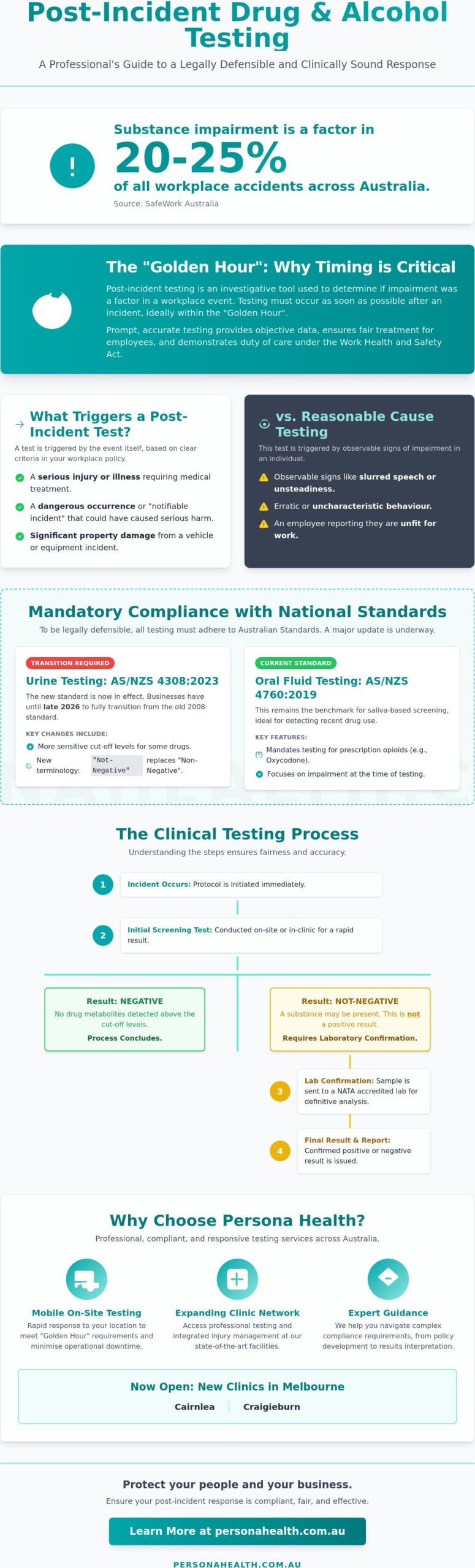
Did you know that substance impairment is a factor in approximately 20 to 25 per cent of all workplace accidents across Australia? When a serious incident occurs on your site, the immediate pressure to manage the scene while fearing potential repercussions from SafeWork Australia can feel overwhelming. It’s a stressful moment where the rights of your employees and the legal stability of your business are both on the line.
We understand that you want to act decisively but fairly. This guide provides a professional roadmap for post-incident drug testing sydney, ensuring your response is both legally defensible and clinically sound. You’ll learn how to manage workplace incidents with compliant protocols that protect your people and integrate with workplace injury management. We will explore the mandatory transition to the AS/NZS 4308:2023 urine testing standard, the necessity of rapid results, and how our expanding network, including our new clinics in Cairnlea and Craigieburn, is raising the standard for professional drug and alcohol testing.
Key Takeaways
- Understand how to align your workplace policies with SafeWork Australia guidelines and the mandatory AS/NZS 4308:2023 standard for urine testing.
- Discover why the “Golden Hour” is critical for post-incident drug testing sydney and how to choose between mobile on-site services or clinic-based assessments.
- Learn the clinical distinction between a “not-negative” screening result and a laboratory confirmation to ensure fair treatment of your employees.
- See how integrating workplace injury management into your protocol can streamline the recovery and return-to-work process.
- Access professional drug and alcohol testing across our network, including our newly opened clinics in Cairnlea and Craigieburn.
Understanding Post-Incident Drug Testing in Sydney
Post-incident drug testing is a reactive safety protocol designed to determine whether substance impairment played a role in a workplace event. Unlike random screening, which serves as a deterrent, incident-triggered testing is a specific investigative tool used after a safety breach or accident. By implementing post-incident drug testing sydney, businesses can move beyond guesswork and rely on clinical data to understand the factors contributing to an incident. This process is a fundamental pillar of a modern safety culture, ensuring that every individual on-site is protected by clear, evidence-based standards.
The accuracy of these results depends heavily on timing. In the clinical world, we often refer to the “Golden Hour,” which is the window immediately following an event when biological markers are most representative of an individual’s state at the time of the incident. Prompt drug testing not only satisfies regulatory expectations but also provides a layer of legal protection. It helps employers demonstrate that they have fulfilled their duty of care under the NSW Work Health and Safety Act 2011, while simultaneously protecting employees from unfair assumptions by providing objective proof of their fitness for duty.
To better understand how these protocols fit into the broader Australian safety landscape, watch this helpful video:
What Triggers a Post-Incident Test?
A “significant incident” is the primary trigger for this type of screening. According to SafeWork Australia guidelines, this typically includes events resulting in serious injury, illness, or a “dangerous occurrence” that could have led to a fatality. However, your policy should also account for significant property damage or near-misses where the potential for harm was high. It’s vital that your team knows exactly when to initiate the process. Clear triggers remove the burden of subjectivity from supervisors, making the request for a test a standard safety procedure rather than a personal accusation.
Post-Incident vs Reasonable Cause Testing
It’s easy to confuse post-incident requirements with reasonable cause testing. Reasonable cause is initiated when a worker displays observable signs of impairment, such as slurred speech, unsteadiness, or erratic behaviour. In contrast, post-incident drug testing sydney is triggered by the event itself, regardless of how the individual appears. Sometimes, both protocols are used together for maximum safety. Documenting the specific reasons for the test is essential for legal defensibility. Whether you are managing a site in NSW or visiting our new clinics in Cairnlea or Craigieburn, having a structured decision-making process ensures every person is treated with consistency and professional empathy. This structured approach is often a core component of comprehensive on-site health surveillance programs.
Compliance with SafeWork Australia and National Standards
SafeWork Australia provides the foundational framework for workplace safety, but the operational specifics of post-incident drug testing sydney are often governed by the SafeWork NSW guidelines. These guidelines emphasize that drug and alcohol testing is a control measure, not a disciplinary stick. For results to hold weight, they must adhere to rigorous national standards. The most significant shift currently facing Sydney businesses is the mandatory transition to the AS/NZS 4308:2023 standard for urine testing. By late 2026, any tests conducted under the older 2008 standard will risk being invalid. This update introduces more sensitive cut-off levels for substances like cocaine and benzodiazepines, while also changing clinical terminology from “non-negative” to “not-negative.”
For businesses preferring oral fluid testing, the AS/NZS 4760:2019 standard remains the benchmark. This standard is particularly relevant for post-incident scenarios as it focuses on recent use and mandates testing for prescription opioids like Oxycodone. Regardless of the method, if a screening result is “not-negative,” legal defensibility requires confirmation at a NATA-accredited laboratory. This ensures that the findings are scientifically verified before any management decisions are made. If you are looking to strengthen your safety protocols, our team can assist with comprehensive on-site health surveillance to ensure your facility remains fully compliant.
The Legal Framework for NSW and Victorian Workplaces
While the NSW Work Health and Safety Act 2011 provides the primary legal basis in Sydney, businesses with operations in Melbourne must also navigate Victorian safety regulations. A critical component for both regions is the “chain of custody.” This is a documented trail that proves the sample remained secure from the moment of collection to the final lab report. Without this, evidence is rarely admissible in a court or tribunal. Additionally, employers must handle all results in strict accordance with the Privacy Act, treating sensitive medical data with the same care as any clinical record to protect the individual’s dignity.
Implementing an Enforceable Drug and Alcohol Policy
A policy is only as good as its implementation. To be enforceable, your policy must be developed in consultation with workers and clearly outline the consequences of a “not-negative” result. It should also specify the types of testing used, such as pre-employment medicals or post-incident triggers. Your workforce should understand that post-incident drug testing sydney is a tool for mutual safety, not a breach of trust. Regular policy reviews are essential to keep pace with legislative changes and the opening of new clinical facilities. Our new sites in Cairnlea and Craigieburn are specifically designed to support Melbourne businesses in maintaining these high standards of fitness for duty.
Logistics of Post-Incident Testing in Sydney and Melbourne
Managing the immediate aftermath of a workplace accident is a high-pressure task. You need to secure the site, care for your people, and initiate safety protocols almost simultaneously. Choosing the right logistics for post-incident drug testing sydney is a critical decision that influences both the accuracy of the results and the legal standing of your business. While on-site mobile testing offers the fastest response, clinic-based assessments provide a controlled environment that can be beneficial for comprehensive clinical evaluations.
The “Golden Hour” rule is a central concept in post-incident logistics. Clinical evidence suggests that testing should ideally occur within two hours of the event. This timeframe ensures that biological markers are captured while they are most representative of the individual’s state at the time of the incident. Waiting too long can lead to “not-negative” results being contested or viewed as unreliable by SafeWork Australia. Swift action demonstrates that you take your duty of care seriously and prioritises the integrity of the investigation.
Coordination with medical care is the absolute priority when an injury has occurred. No test should ever delay life-saving treatment or essential first aid. We work closely with medical teams to ensure that samples are collected only when it is safe and appropriate to do so. This empathetic approach balances the need for data with the primary goal of worker recovery. It helps reduce the logistical stress that often follows a serious accident, providing a clear path forward for both the employer and the employee.
Using professional, external collectors is another way to protect your business. It removes the potential for internal conflict or accusations of bias that can arise when a supervisor tests their own team. A neutral, clinical approach prioritises accuracy and employee dignity. It ensures the process is seen as a standard safety procedure rather than a personal investigation, which is essential for maintaining a positive workplace culture during a difficult time.
Sydney Services and On-Site Response
In the Greater Sydney region, our services are tailored to the needs of complex infrastructure and transport hubs. By linking your incident response to pre-employment medicals in Parramatta and Sydney, you establish a clear, consistent standard for every employee. This systematic approach ensures that when an incident does occur, the logistical path is already well-defined and ready to be activated. It provides a seamless transition from hiring to active safety management, ensuring post-incident drug testing sydney is handled with maximum efficiency.
Melbourne Expansion: Cairnlea and Craigieburn Clinics
We are proud to bring our expertise to Victoria with the opening of our new clinics in Cairnlea and Craigieburn. These sites are strategically located to serve Melbourne’s northern and western suburbs, drastically reducing travel times for post-incident assessments. By integrating local WorkSafe requirements into our protocols, we ensure that Victorian businesses have access to the same rigorous, defensible standards found in our Sydney operations. This expansion means faster results and less logistical stress for your management team. If you require specialised support for ongoing safety, our on-site health surveillance programs offer a proactive way to manage risk across all your sites.
Managing Results and Integrating Injury Management
The delivery of a test result is perhaps the most sensitive stage of the entire safety process. It is vital to distinguish between an initial screening result and a final laboratory confirmation. A “not-negative” result on-site is a preliminary finding that requires further validation through NATA-accredited analysis. Handling these moments with professional empathy is what sets a modern safety culture apart from outdated disciplinary models. When a worker is already dealing with the shock of an accident, a supportive, clinical approach to post-incident drug testing sydney ensures the focus remains on health and safety rather than blame.
This intersection becomes particularly vital when dealing with workers’ compensation claims. Under Australian industrial laws, evidence of substance impairment can significantly impact the trajectory of a claim and the employer’s liability. However, the priority must always be the individual’s recovery and the restoration of their internal resources. Integrating the testing phase with a structured injury management program allows for a more holistic view of the employee’s needs. This ensures that regardless of the test outcome, there is a clear, tailored pathway for support and rehabilitation. If you need immediate support with a complex case, our workplace injury management experts are available to guide you through the clinical and regulatory requirements.
The Path to Recovery and Return-to-Work
Developing a return-to-work plan requires a balance of clinical objectivity and individual care. Following post-incident drug testing sydney, our team works to create a roadmap that prioritises safety while supporting the employee’s journey back to full productivity. This process often involves our Occupational Physicians, who play a crucial role in assessing fitness for duty. By utilising our dedicated facilities, including our new clinics in Cairnlea and Craigieburn, we provide a consistent standard of care that helps workers feel supported and valued throughout their recovery.
Addressing Misconceptions about Post-Incident Testing
Many employees fear that testing is a purely punitive measure. We must reframe this: testing is a diagnostic tool for root cause analysis. It helps identify whether impairment was a factor, or if environmental and systemic issues were the primary cause. Maintaining clinical objectivity during the stressful post-accident period is essential for building trust. When workers see that the process is fair and focused on preventing future incidents, they are more likely to engage with safety protocols. This transparent approach reduces the likelihood of future accidents and fosters a culture where every individual’s wellbeing is the highest priority.
Why Choose Persona Health for Post-Incident Testing?
Persona Health brings a clinical depth to post-incident drug testing sydney that transcends simple sample collection. We view every test as a critical medical data point within a broader safety ecosystem. By choosing a partner with deep medical expertise, you ensure that results are interpreted with clinical precision and sensitivity. Our approach integrates seamlessly with on-site health surveillance programs, allowing businesses to identify trends and address risks before they lead to serious accidents. It is about more than just compliance; it is about building a resilient workforce.
We don’t believe in siloed services. Our protocols are designed to support comprehensive fitness for work assessments, providing a 360-degree view of employee wellbeing. This holistic perspective is especially vital in high-stakes environments where safety is non-negotiable. With our established presence in Sydney and the recent opening of our state-of-the-art clinics in Cairnlea and Craigieburn, we offer the rapid response times and local expertise that modern businesses require to manage incidents effectively across both New South Wales and Victoria.
A Partner in Workplace Safety
We provide tailored solutions for the transport, rail, and construction sectors, where compliance with SafeWork Australia standards is a daily requirement. Our team understands that a workplace incident is a stressful time for everyone involved. That’s why we prioritise a professional, friendly service that respects employee dignity while maintaining strict clinical standards. For those navigating the complexities of the Victorian landscape, our experts offer clear guidance on occupational health services to ensure your operations remain safe, compliant, and supportive of your people’s long-term health.
Booking and Immediate Support
When an incident occurs, time is your most valuable resource. We’ve streamlined our booking processes to handle urgent post-incident drug testing sydney requests with minimal delay. Beyond emergency testing, our facilities provide a full suite of occupational medicals, including specialised Cat 3 rail medicals. This comprehensive service model means you have a single, reliable point of contact for all your workplace health needs. You can contact our Sydney or Melbourne teams today for expert policy advice or to discuss how our new facilities in Cairnlea and Craigieburn can support your Victorian sites with professional, clinically-backed care.
Building a Safer, More Resilient Workplace
Managing a workplace incident requires a delicate balance of regulatory precision and human empathy. By adhering to the mandatory AS/NZS 4308:2023 standards and the latest SafeWork Australia guidelines, you ensure your business remains legally protected while prioritising the wellbeing of your team. Professional post-incident drug testing sydney is most effective when it’s conducted within the “Golden Hour” and integrated into a holistic injury management framework. This approach transforms a stressful event into an opportunity for growth and systemic improvement rather than a purely punitive exercise.
As clinically-led occupational health specialists, we’re dedicated to supporting your safety journey across New South Wales and Victoria. Our expanding network, including our new clinics in Cairnlea and Craigieburn, provides the rapid response and clinical objectivity you need during critical moments. You don’t have to navigate these legal and logistical complexities alone. Secure your workplace today with Persona Health’s professional testing services. We’re here to provide the stability and expertise needed to ensure your people return home safely, every single day.
Frequently Asked Questions
How soon after an accident should post-incident drug testing occur?
Testing should ideally occur within two hours of the incident. This timeframe, often called the “Golden Hour,” ensures that biological markers accurately reflect the individual’s state at the time of the event. For specific roles governed by Transport for NSW, testing must be completed no later than three hours after the accident. Prompt post-incident drug testing sydney is essential for maintaining the clinical integrity of your safety investigation.
What happens if an employee refuses a drug test after an incident?
Refusing a test is typically treated as a serious breach of your workplace health and safety policy. Most Australian industrial agreements allow employers to treat a refusal as a “not-negative” result, which may lead to disciplinary action or a formal investigation into fitness for duty. It’s vital that your policy clearly outlines these consequences so every person on-site understands their obligations before an incident occurs.
Can an employer conduct a drug test without a written policy?
Conducting a test without a written policy is legally risky and generally discouraged by SafeWork Australia. A clear, consulted policy provides the essential legal framework for testing and ensures that the rights of both the employer and employee are protected. Without this documentation, any results may be deemed inadmissible in a court or tribunal, leaving your business vulnerable to significant legal challenges and repercussions.
What drugs are typically included in a post-incident screen in Australia?
Standard screens follow the panels outlined in Australian Standards AS/NZS 4308:2023 or AS/NZS 4760:2019. These include cannabis metabolites, cocaine, opiates, amphetamine-type substances, and benzodiazepines. Saliva testing under the 2019 standard also mandates the inclusion of Oxycodone. Our new clinics in Cairnlea and Craigieburn use these precise clinical panels to ensure comprehensive and compliant results for Victorian businesses and growth corridors.
Is a non-negative urine test grounds for immediate dismissal?
A “not-negative” result is a preliminary screening finding and is not grounds for immediate dismissal on its own. It must be verified through NATA-accredited laboratory confirmation to ensure the result is scientifically accurate. Once confirmed, an investigation into the root cause and a review of the individual’s fitness for duty should follow. This empathetic approach prioritises employee support and rehabilitation over purely punitive measures.
How do Australian Standards affect the validity of a drug test result?
Australian Standards ensure that test results are scientifically accurate and legally defensible in a professional setting. Adhering to the mandatory AS/NZS 4308:2023 standard for urine or AS/NZS 4760:2019 for oral fluid is a critical requirement for professional post-incident drug testing sydney. These standards define the collection procedures, chain of custody protocols, and cut-off levels required to meet the high scrutiny of regulatory bodies.
What is the role of a Medical Review Officer (MRO) in the process?
A Medical Review Officer is a registered physician who specialises in interpreting and evaluating drug test results. Their role is to determine if there is a legitimate medical explanation, such as a valid prescription, for a confirmed “not-negative” result. This adds an essential layer of clinical objectivity to the process, ensuring that employees aren’t unfairly penalised for legitimate medication use while maintaining site safety.
Does post-incident testing apply to subcontractors and visitors?
Testing can apply to subcontractors and visitors if your site safety policy and commercial contracts explicitly state this requirement. Under the NSW Work Health and Safety Act 2011, principal contractors have a duty of care to ensure the safety of every person on their site. Including all personnel in your drug and alcohol protocols creates a consistent safety culture and significantly reduces the risk of accidents for everyone involved.

Article by
Ian Nicholson
Ian is the Business Support Manager at Persona Health, where he plays a key role across IT, sales, marketing and business operations. With a broad skill set and a practical, solutions-focused approach, Ian helps drive the systems, communication and commercial strategy that support Persona Health’s continued growth across Australia.