

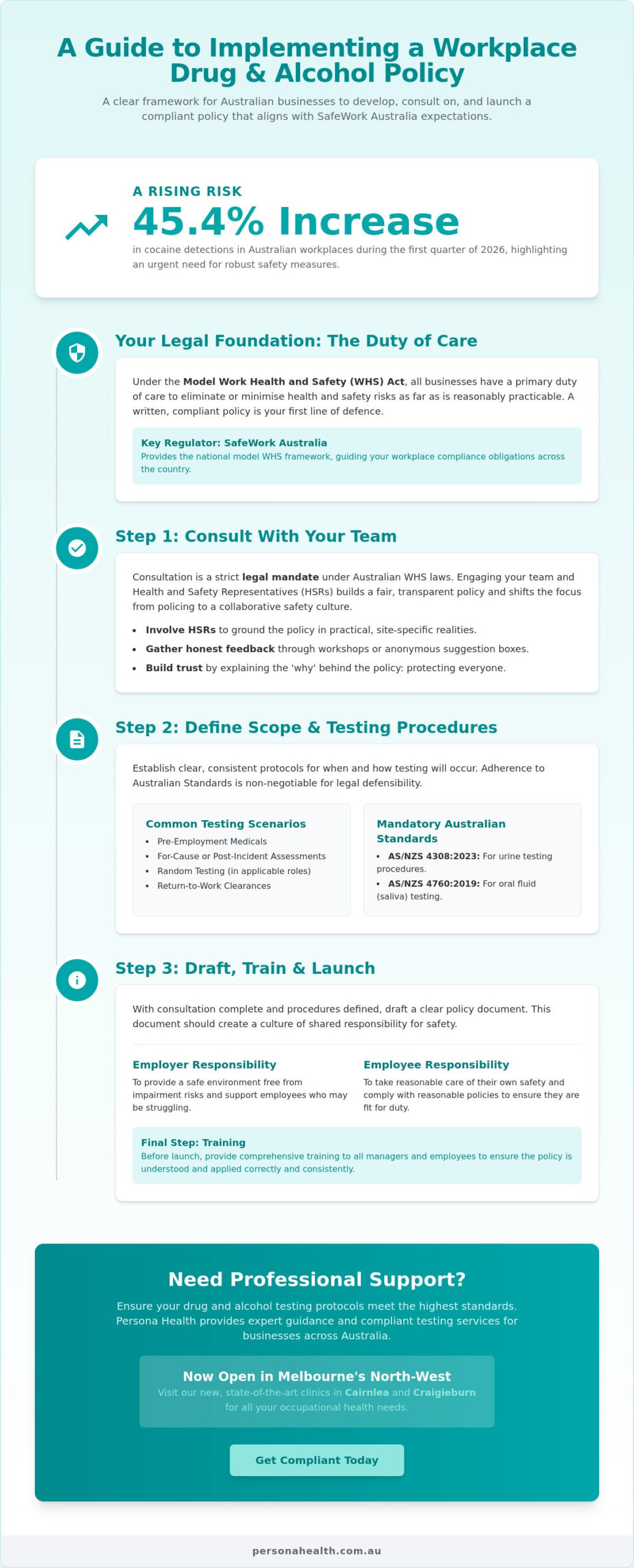
With cocaine detections in Australian workplaces rising by 45.4 per cent in the first quarter of 2026, the risks to your team’s safety have never been more visible. You likely recognise the urgent need for robust safety measures, yet the question of how to implement a drug and alcohol policy without triggering legal repercussions or employee pushback remains a significant concern. It is a delicate balance to strike between maintaining a clinical standard of safety and ensuring your staff feel supported rather than targeted during the process.
We understand that navigating the transition to the mandatory AS/NZS 4308:2023 standards can feel overwhelming. This guide provides a clear, step-by-step framework for Australian businesses to develop, consult on, and launch a compliant policy that aligns with SafeWork Australia expectations. We will explore everything from the latest testing sensitivities to the most effective consultation methods. Whether you are visiting our new Persona Health clinics in Cairnlea or Craigieburn or looking for a nationwide roadmap, this article ensures your workplace remains secure, compliant, and focused on the unique needs of your workforce.
Key Takeaways
- Understand your primary duty of care under the Model WHS Act and how SafeWork Australia standards guide your workplace compliance.
- Learn why engaging with your team and health and safety representatives is a legal requirement for building a fair and transparent policy.
- Discover the essential steps on how to implement a drug and alcohol policy that integrates seamlessly with your existing safety procedures.
- Establish clear protocols for different testing scenarios, including pre-employment medicals and for-cause assessments, to ensure consistency.
- Access expert guidance and practical drug and alcohol testing support at our new Persona Health clinics in Cairnlea and Craigieburn.
Understanding the Legal Framework and Duty of Care
Under the Model Work Health and Safety (WHS) Act, every Person Conducting a Business or Undertaking (PCBU) holds a primary duty of care. This legal obligation requires you to eliminate or minimise risks to health and safety so far as is reasonably practicable. In the context of substance use, this means managing the potential for impairment that could lead to workplace accidents. Understanding how to implement a drug and alcohol policy starts with recognising that safety is a shared responsibility, influenced by the broader National Drug Strategy framework which prioritises harm minimisation across the country.
A robust, written policy serves as your first line of defence against liability. Without a clear document, proving that you’ve met your WHS obligations becomes significantly harder if an incident occurs. For high-risk sectors like mining, rail, and heavy transport, the law is even more prescriptive; often mandating zero-tolerance limits or specific testing frequencies. For instance, rail workers must meet strict medical standards, such as those we assess during Cat 3 Rail Medicals, to ensure they remain safe behind the controls.
To better understand how these safety frameworks function in a professional setting, watch this helpful video:
The Role of SafeWork Australia and State Regulators
SafeWork Australia provides the national model, but state bodies like SafeWork NSW and WorkSafe Victoria enforce the specific regulations you must follow. While the model laws are consistent, local nuances exist in how testing is conducted in Melbourne or Sydney. Adhering to Australian Standards is vital; urine testing must meet AS/NZS 4308, while oral fluid testing follows AS 4760. Compliance is non-negotiable for infrastructure and transport projects where public safety is at stake. Proactive businesses in Victoria are already looking toward our new clinics in Cairnlea and Craigieburn to ensure their testing protocols meet these rigorous benchmarks and protect their workforce.
Employer vs. Employee Responsibilities
The legal bridge between management and staff is built on mutual duty. While the PCBU must provide a safe environment free from impairment risks, workers also have a duty to take reasonable care of their own health and safety. They must comply with any reasonable instruction or policy that the employer puts in place. A clear policy removes ambiguity; it tells the worker exactly what’s expected and tells the employer how to support a team member who might be struggling. This approach ensures everyone is fit for duty, creating a culture where individual wellbeing and collective safety are equally valued.
Consulting with Your Team to Build a Fair Policy
Under Australian Work Health and Safety laws, consultation isn’t just a professional courtesy; it’s a strict legal mandate. According to Safe Work Australia, you must consult with workers when identifying hazards or making decisions about how to manage risks. This requirement is especially critical when deciding how to implement a drug and alcohol policy, as it touches on personal boundaries and workplace culture. When you invite your team into the conversation, you move away from a “policing” mindset and toward a collaborative safety culture.
Involving Health and Safety Representatives (HSRs) in the drafting phase ensures the policy is grounded in the practical realities of your specific site. These representatives bridge the gap between management and the workforce, helping to identify potential friction points before the policy goes live. When employees see their representatives contributing to the document, the inherent anxiety surrounding drug testing often gives way to a sense of shared responsibility. Gathering honest feedback requires a gentle, transparent approach. Use anonymous digital suggestion boxes or facilitated workshops where the focus remains on “keeping our mates safe” rather than punishment. This transparency is your greatest tool for reducing anxiety and building the trust necessary for a successful rollout.
Establishing a Consultative Committee
A successful consultative committee should be a microcosm of your organisation. It needs senior management for authority, HR for policy alignment, and frontline workers for operational insight. The primary objective is to ensure the policy is workable in the real world. For example, a policy that works for an office in Melbourne might need adjustments for a construction site. By ensuring all voices are heard, you significantly improve policy “buy-in.” This collaborative effort makes the final document feel like a collective agreement rather than a top-down directive.
Addressing Privacy and Confidentiality Concerns
Personal health data is incredibly sensitive, and your policy must clearly state how this information is stored in accordance with Australian privacy laws. Shifting the narrative from “catching people out” to “prevention and support” helps ease privacy concerns. It’s vital to explain that testing is a tool for ensuring everyone returns home safely, not a way to intrude on private lives. A fair policy protects the individual’s right to medical privacy while prioritising the collective right to a workplace free from impairment risks.
If your team has questions about how professional monitoring integrates with their daily work, you might consider an on-site health surveillance review. This can help identify specific risks while demonstrating your commitment to a supportive environment. For businesses in Victoria, our new clinics in Cairnlea and Craigieburn are perfectly positioned to help you navigate these consultative steps with confidence and clinical expertise.
Defining the Scope and Testing Procedures
A robust policy document serves as the operational manual for safety within your organisation. It must be comprehensive yet clear; providing a definitive list of prohibited substances and the exact procedures for every testing scenario. Your policy should outline the roles of supervisors, the rights of the employees, and the specific cut-off levels used for detection. Aligning these details with Safe Work Australia’s guidance ensures your framework is legally sound and prioritises the wellbeing of every team member.
When considering how to implement a drug and alcohol policy, you must decide which testing types best suit your specific risk profile. Pre-employment testing establishes a baseline of safety before a worker even steps onto the site. Random testing acts as an ongoing deterrent, while for-cause or post-incident testing allows for immediate clinical intervention when safety is compromised. Each of these methods must be applied consistently to maintain fairness and transparency across the entire workforce.
Determining the Method of Testing
The choice between saliva and urine testing often depends on your industry’s specific needs and the detection windows required. Saliva testing is excellent for identifying recent use and immediate impairment; making it a popular choice for random roadside or onsite checks. Urine analysis, particularly when adhering to the new AS/NZS 4308:2023 standards, offers a broader window into historical substance use. For a detailed breakdown of these technical differences, you can explore Persona Health’s guide on workplace drug and alcohol testing. Our experts at the new Cairnlea and Craigieburn clinics can help you select the method that best aligns with your operational risks.
Disciplinary Actions and Support Pathways
A fair policy balances accountability with empathy. Creating a ‘fair play’ framework for first-time offences can prevent the loss of skilled workers while still addressing safety risks. Instead of immediate dismissal, many modern Australian workplaces now utilise Employee Assistance Programmes (EAPs) to provide a clear pathway for recovery. This supportive approach often yields better long-term safety outcomes; as it encourages employees to seek help before an incident occurs. By focusing on rehabilitation and internal support, you foster a culture where health is valued as much as productivity. This ensures that when someone is identified as needing help, they are guided through a clinical process that prioritises their long-term fitness for duty.
Training and Launching Your Workplace Policy
Launching a new safety initiative is a transformative moment for any organisation. Knowing how to implement a drug and alcohol policy involves more than just drafting the right words; it requires a structured rollout that respects the dignity of your team while upholding clinical standards. A successful launch ensures that every worker, from the warehouse floor to the executive suite, understands their role in maintaining a safe environment. This process begins with finalising the document and obtaining executive sign-off, which provides the necessary authority to move forward with confidence.
Once the policy is signed, you must conduct mandatory training sessions for all staff levels. This education is a core recommendation from SafeWork Australia to ensure the policy is understood and legally enforceable. Distribute the final version via employee handbooks and digital portals so it remains easily accessible. We strongly suggest allowing a grace period, perhaps one to three months, before active testing begins. This empathetic approach gives employees time to adjust and seek support if needed. Finally, commit to an annual review. This ensures your framework stays current with legislative updates, such as the transition to the AS/NZS 4308:2023 standards for urine testing.
Educating Managers on Reasonable Suspicion
Your leaders are the frontline of your safety culture. They need specific training to identify clinical signs of impairment, such as slurred speech, unsteadiness, or unusual behaviour, without becoming accusatory or confrontational. We teach managers the importance of documenting objective observations before ever requesting a test. Approaching an employee in a supportive, professional manner reduces conflict and reinforces the message that the goal is safety, not punishment. This clinical focus helps maintain trust even during difficult conversations.
Employee Awareness Sessions
Staff sessions should focus on clarity and support rather than fear. It’s vital to explain how prescription medications can impact workplace safety and the importance of disclosing these to a supervisor. You should provide clear resources for staff to self-report issues before they lead to an accident. Every worker must leave these sessions knowing their rights and their obligations. When employees understand the “why” behind the policy, they are far more likely to support it. If you are preparing for your launch, our team can help you integrate on-site health surveillance to ensure your procedures are practical and compliant. For those in Melbourne, our new clinics in Cairnlea and Craigieburn are ready to support your training and medical assessment needs with a localised, expert touch.
Professional Support for Implementation in Sydney and Melbourne
At Persona Health, we believe that the clinical execution of your safety strategy is just as important as the policy document itself. Understanding how to implement a drug and alcohol policy requires more than just legal knowledge; it demands a partner who can manage the practical complexities of testing with absolute impartiality. By using independent medical examiners, you ensure that every assessment is conducted without bias, protecting both the business and the individual employee’s rights. This objective approach is essential for maintaining the trust we discussed in earlier sections regarding consultation and fair play. Our clinicians act as an expert extension of your safety team, providing the stability and professional authority needed to navigate sensitive health issues with care.
On-Site Health Surveillance and Testing Services
For many large organisations, the logistical challenge of sending a workforce to a clinic can be a significant hurdle. We solve this through on-site health surveillance, bringing our team of clinical professionals directly to your facility. This model significantly reduces operational downtime while ensuring that testing conditions remain strictly controlled and compliant with Australian Standards. Whether you are operating a construction site in Melbourne or a logistics hub in Sydney, our mobile teams maintain the highest clinical standards in your workplace environment. It allows you to focus on your core business while we handle the technical precision of your drug and alcohol screening, ensuring no detail is overlooked in the protection of your team.
Booking Your Assessments in Melbourne and Sydney
Strategic safety management often begins before a worker ever starts their first shift. Integrating pre-employment medicals into your onboarding process is one of the most effective ways to manage long-term risk. In Sydney, we specialise in high-risk assessments, including Cat 3 Rail Medicals, ensuring that your transport team meets every regulatory benchmark set by SafeWork Australia.
We are also proud to announce our expansion in Victoria with the opening of two new clinics in Cairnlea and Craigieburn. These sites provide Melbourne businesses with local, professional support for every stage of their safety journey. If you are currently reviewing how to implement a drug and alcohol policy for your organisation, our team is ready to help you build a tailored medical assessment plan that fits your unique operational needs. Contact us today to secure your workforce’s health and ensure your business remains a leader in workplace safety.
Securing the Future of Your Workplace Safety
Building a drug and alcohol policy is about more than just checking a compliance box; it’s about fostering a culture of mutual care and clinical precision. By prioritising transparent consultation and adhering to the latest SafeWork Australia standards, you create a framework that protects both your employees and your business reputation. Understanding how to implement a drug and alcohol policy ensures you are prepared for the 2026 regulatory shifts while maintaining a supportive environment for your team.
Whether you require specialised Cat 3 Rail Medicals or comprehensive pre-employment medicals, our team is here to guide you. We’re excited to support Victorian businesses at our new clinics in Cairnlea and Craigieburn, alongside our established professional injury management and health surveillance services in Sydney. With the right clinical partner, you can navigate these complex safety requirements with total confidence and ease. Book your workplace drug and alcohol testing with Persona Health today and take the final step toward a safer, more resilient workplace.
Frequently Asked Questions
Is a drug and alcohol policy mandatory for all Australian businesses?
No overarching federal law mandates a policy for every business, but Work Health and Safety (WHS) legislation requires you to manage the risks of impairment. In high-risk industries like rail, mining, and heavy transport, specific regulations often make these policies a legal necessity. Even for lower-risk offices, having a clear framework is the best way to meet your primary duty of care under SafeWork Australia standards.
Can an employee refuse to participate in a drug or alcohol test?
An employee can refuse a test, but doing so usually carries significant disciplinary consequences if a valid policy is in place. Most Australian workplace agreements treat a refusal as a breach of policy, which can lead to the same outcomes as a “not-negative” result. It’s vital that your policy clearly outlines these consequences so workers understand the choice they are making during the testing process.
What is the difference between saliva and urine testing for workplace compliance?
Saliva testing is designed to detect recent consumption and immediate impairment, making it ideal for random onsite checks. Urine testing provides a much broader window into historical substance use, often reaching back several days. By November 2026, all workplace urine testing must comply with the new AS/NZS 4308:2023 standard. Our new clinics in Cairnlea and Craigieburn are fully equipped to help you navigate these technical requirements.
How often should a workplace drug and alcohol policy be reviewed?
You should review your policy at least once every twelve months to ensure it remains effective and legally compliant. Regular reviews allow you to incorporate new clinical data, updated Australian Standards, and shifts in how to implement a drug and alcohol policy within your specific industry. This proactive approach ensures your safety framework never becomes outdated or indefensible in a legal setting.
What happens if an employee tests positive for a prescribed medication?
A positive result for prescribed medication is handled as a confidential medical matter rather than a disciplinary one. The employee should disclose their medication to the testing officer, and an Independent Medical Examiner will then verify the prescription. The focus remains on whether the medication impacts the individual’s fitness for duty and if they can safely perform their specific role.
Can I perform random drug testing on my employees without a policy in place?
Performing random tests without a formal policy is highly risky and likely to be found unreasonable by industrial tribunals. A written policy provides the legal foundation required to conduct testing fairly and consistently. Without this document, you lack the “reasonable and lawful” basis needed to direct an employee to undergo a medical procedure, leaving your business vulnerable to unfair dismissal claims.
How do I handle a situation where an employee appears impaired but refuses a test?
If an employee appears impaired and refuses a test, you must follow the “reasonable suspicion” protocols defined in your policy. Document clear, objective observations of their behaviour and slurred speech before safely removing them from any high-risk duties. Treat the refusal as a breach of your safety procedures and proceed with the disciplinary framework you’ve established to ensure the ongoing safety of the entire site.
What role does an Employee Assistance Programme play in a safety policy?
An Employee Assistance Programme (EAP) provides a vital rehabilitation pathway that shifts the focus from punishment to support. Integrating an EAP into your on-site health surveillance strategy encourages workers to seek help for substance issues before an accident occurs. This empathetic approach helps retain skilled staff while ensuring that safety remains the absolute priority for everyone in the organisation.

Article by
Ian Nicholson
Ian is the Business Support Manager at Persona Health, where he plays a key role across IT, sales, marketing and business operations. With a broad skill set and a practical, solutions-focused approach, Ian helps drive the systems, communication and commercial strategy that support Persona Health’s continued growth across Australia.