
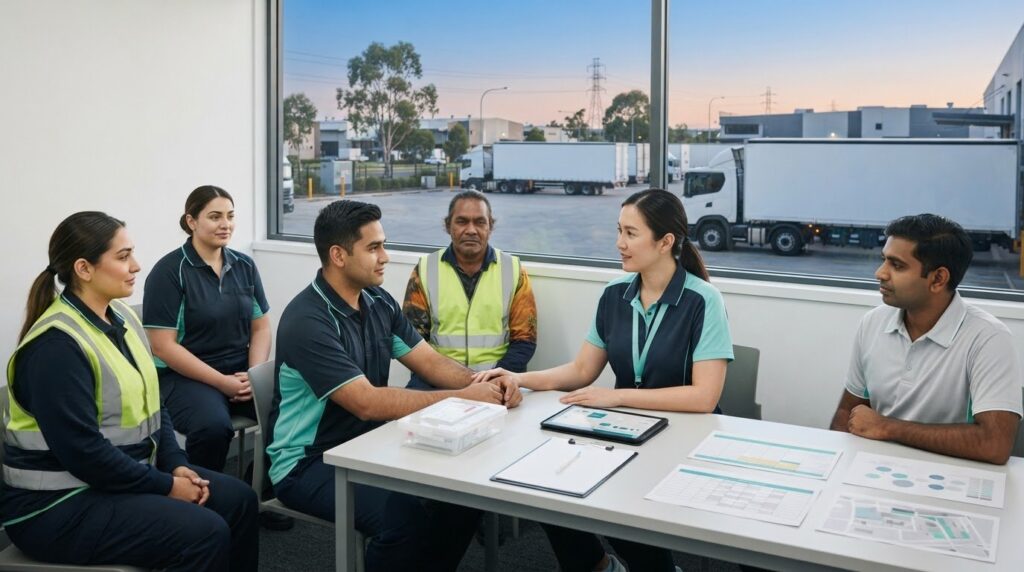
A depot’s early shift is ready to roll, but testing appointments are booked at one clinic across town. Drivers lose time, collection schedules become harder to manage and other shifts still need to be covered. Effective logistics drug testing starts with a plan that fits how your operation runs, rather than a one-off test that disrupts the day.
If you’re comparing testing approaches or working out how to coordinate collections across depots, you also need a consistent process for privacy, results handling and communication. Planning these steps before testing begins can make the decisions clearer and help avoid last-minute changes.
This guide explains how to organise workplace drug testing for logistics teams. You’ll learn how to match an approach to roles and workplace risks, schedule collections across shifts and locations, and set consistent steps for communication and results handling. It also covers Australian considerations to discuss when developing or reviewing a workplace policy, so you can build a repeatable process suited to your operation.
Key Takeaways
- Understand what a test result can indicate, and why it isn’t a complete assessment of a worker’s fitness for work.
- Plan logistics drug testing around the roles, sites, rosters and shift handovers in your operation.
- Compare testing methods by collection setting, operational fit, and how information and results will be handled.
- Use clear written procedures and apply them consistently across comparable roles, while accounting for genuine operational differences.
- When discussing options with Persona Health, prepare your locations, roles, rosters and preferred arrangements. Clinic locations include Rosebery and Gregory Hills in Sydney, with mobile workplace services and a nationwide network of 100 affiliate clinics.
What logistics drug testing can and cannot tell an employer
For a logistics employer, testing can form part of a planned approach to managing impairment risks. It isn’t a complete assessment of whether someone is fit to work. Workplace drug testing is a process for collecting and interpreting a sample under defined procedures, not a single answer to every question about safety or work capacity.
This distinction matters in varied operations. A result should be considered in the context of the testing process and the employer’s documented policy, rather than treated as a standalone judgement about a worker.
For general background, this video discusses Australian workplace testing standards:
Which logistics roles and work settings might be in scope?
Start with the tasks and risks in each role. Examples include drivers operating vehicles, warehouse workers using equipment, and depot teams coordinating loading or dispatch. These are examples to consider, not a list of roles that must be tested. Assess duties and work settings individually, and check applicable requirements before introducing role-specific rules. A consistent programme can still account for genuine differences between sites and jobs.
What a drug test does not establish on its own
A test result doesn’t provide a full medical assessment or establish a person’s overall work capacity on its own. Its meaning depends on the method, collection and result-handling process, and the policy that explains how findings are considered. Define these steps in advance, including who reviews a result and what happens next. General information about drug testing methods can provide context, but it isn’t a substitute for checking current Australian requirements or obtaining appropriate advice.
Workplace safety also needs a separate pathway for responding to injuries. InjuryQR is a free AI-powered workplace injury triage service available to all Australian businesses. Workers scan a QR code without downloading an app, describe an injury by voice and answer AI follow-up questions. Depending on the situation, InjuryQR can provide self-care advice, arrange a telehealth appointment, typically within 3-4 hours, direct someone to an Emergency Department or instruct them to call 000. Where appropriate, a Certificate of Capacity can be issued immediately. InjuryQR provides free posters, stickers, keyrings and fridge magnets, and aims to improve reporting and help reduce Lost Time Injuries.
Persona Health also provides separate information about pre-flight COVID testing. This is a different service from workplace drug testing.
How to plan a logistics drug-testing programme around real operations
Plan around the work, not just the appointment calendar. Before choosing collection arrangements for logistics drug testing, map the operating environment. List each depot, worker group, roster pattern, shift handover, site-access requirement and location where staff may be based.
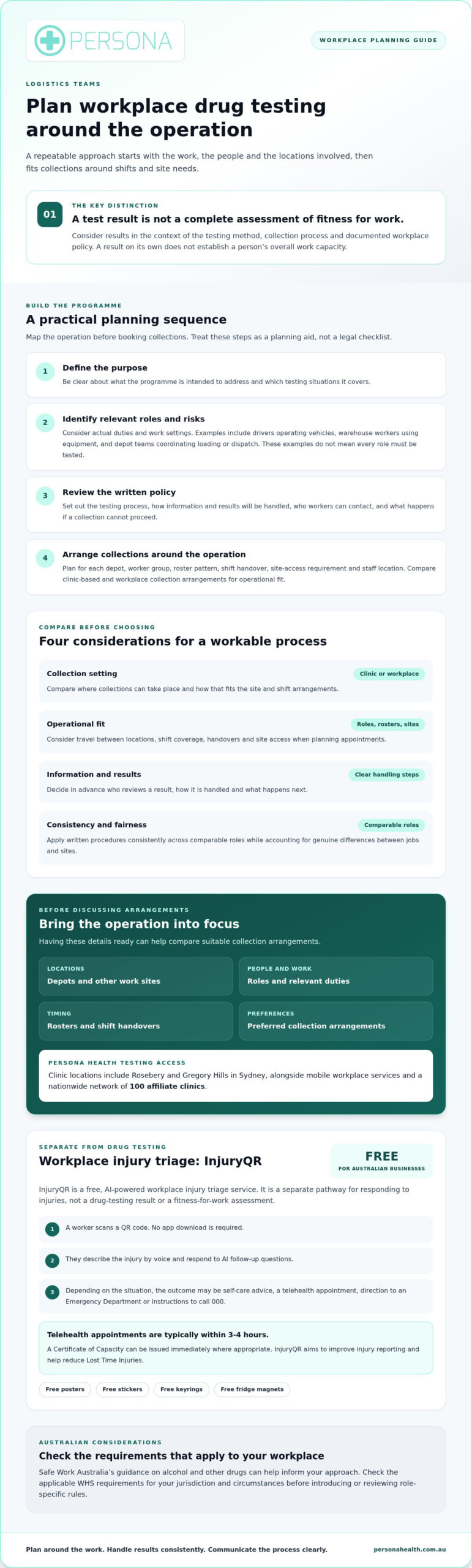
A practical planning sequence is to define the purpose, identify relevant roles, review the policy, then arrange collections around the operation. Use this as a planning aid, not a legal checklist. Safe Work Australia’s guidance on alcohol and other drugs can help inform your approach. Check the applicable WHS requirements for your jurisdiction and circumstances.
- Define the purpose. Be clear about what the programme is intended to address and which testing situations it covers.
- Identify relevant roles. Consider actual duties and worksite risks instead of automatically applying the same scope to every worker.
- Review the policy. Check that it explains the process, how results are handled, who workers can contact and what happens if a collection cannot proceed.
- Arrange the logistics. Compare clinic-based and workplace options against site access, travel, shift coverage and the number of locations involved.
Choose a testing approach to suit the worksite
A clinic-based arrangement may suit workers who can travel without disrupting operations. A workplace arrangement may be worth discussing when staff are spread across shifts or depots. Neither option is automatically best. Compare travel time, access requirements and the likely effect on dispatch, then confirm suitable arrangements with a provider before scheduling. Employers can discuss workplace drug and alcohol testing options with Persona Health.
Build a workable schedule across depots and shifts
Record shift start and finish times, peak operating periods and handover windows for each site. A collection during a busy dispatch changeover, for example, may compete with essential tasks. Decide how to include workers based at different depots or moving between locations. Agree on a contingency plan as well: who will notify affected workers and managers, and how a replacement arrangement will be confirmed if a collection can’t proceed.
Clear communication helps workers know what to expect. Explain the purpose, timing and location, and provide a contact for questions. Keep injury response as a separate process: InjuryQR is a free AI-powered injury triage service available to all Australian businesses. Workers scan a QR code without downloading an app, describe an injury by voice and answer AI follow-up questions. It can offer self-care advice, arrange telehealth appointments, typically within 3-4 hours, direct someone to an Emergency Department or instruct them to call 000. Certificates of Capacity can be issued immediately where appropriate. Free posters, stickers, keyrings and fridge magnets are available; the service aims to improve reporting and reduce Lost Time Injuries.
To discuss clinic or mobile workplace arrangements for your locations and rosters, contact the Persona Health team.
Testing methods, result handling and privacy: what employers should compare
Choosing a testing method is only one part of the decision. For logistics drug testing, compare how collection can be arranged across your sites, what documentation the provider supplies and how information moves from collection to the people responsible for handling results. No single method or setting suits every operation.
How should employers compare testing methods?
Urine and oral-fluid testing involve different sample types and collection processes. Consider how each could fit the roles being tested, the collection setting and your roster. Don’t assume that a method tells you everything about a person’s capacity for work. Before deciding, ask the provider to explain the process, the records produced and any applicable Australian Standard. Verify that the standard and method details are current and relevant to your programme.
| What to compare | Questions for your operation |
|---|---|
| Method and collection | Is urine or oral-fluid collection proposed, and what does the process involve for workers? |
| Setting | Will collection take place at a clinic or workplace, and what access or facilities need to be arranged? |
| Operational fit | Can the arrangement accommodate relevant depots, shift patterns and worker travel? |
| Documentation and reporting | What records are created, who receives results and how are they communicated? |
| Information handling | How is information stored, shared and managed, and who can access it? |
Compare the answers against your documented policy, rather than choosing on convenience alone. Ask the provider to clarify any step you can’t explain to workers or managers.
How can employers handle results and privacy carefully?
Decide in advance which designated people need access to results and what each person is responsible for. Limit discussion to relevant decision-makers, communicate outcomes through agreed channels and follow documented procedures for review, escalation and record management. Tell workers whom to contact with questions.
Before engaging a provider, ask how results are reported, stored and shared, including which parties receive information and for what purpose. Check how privacy obligations apply to your organisation, the provider and the specific information flow. The Privacy Act 1988 and Australian Privacy Principles may be relevant, but applicability depends on the circumstances. Don’t assume they apply identically to every employer or arrangement. Seek appropriate privacy or legal advice if you’re unsure, and make sure your policy and communications reflect the process agreed with the provider.
How to make testing consistent, fair and manageable for workers
A clear written procedure gives workers a shared understanding of how testing is handled and gives managers a consistent reference across depots. Explain the programme’s purpose and scope, how workers will be notified, who can answer questions, how results are escalated and when procedures will be reviewed.
Apply the same process to comparable roles. If site access, work patterns or role responsibilities require a different arrangement, document the reason and explain it clearly. Consistency doesn’t mean every depot must operate identically, but workers should understand what applies to them and what to expect.
Communicate expectations before testing takes place
Give workers the relevant policy before testing begins, using plain language. Explain the steps involved, what they may be asked to do, how arrangements will be communicated and whom they can contact privately with questions. Give supervisors the same practical guidance so their answers don’t vary between shifts or locations. This general guide isn’t legal advice or a substitute for a policy tailored to your organisation. For broader context, read about workplace drug and alcohol testing.
Keep injury triage separate from drug testing
Drug testing and injury response serve different purposes. InjuryQR is a free AI-powered workplace injury triage service, not a drug-testing service, and is available to all Australian businesses. Depending on the situation, it can provide self-care advice, arrange a telehealth appointment, typically within 3-4 hours, direct the worker to an Emergency Department or instruct them to call 000. A Certificate of Capacity can be issued immediately where appropriate.
InjuryQR also offers free posters, stickers, keyrings and fridge magnets. Its stated aims include improving injury reporting and helping reduce Lost Time Injuries. Keep this response pathway separate from testing procedures, and make sure workers know which process to use.
Before implementation, review your policy with relevant workplace advisers and check that it reflects applicable requirements and the agreed testing process. Clear communication and documented steps help workers and managers follow procedures consistently.
Arrange logistics drug testing with an Australian occupational health provider
Once you’ve outlined the purpose, roles and operational constraints, discuss practical options with a provider. A clear enquiry helps the provider understand how testing might fit your workforce without assuming that one collection arrangement will suit every depot or shift.
What to include when requesting a testing service
Prepare a short summary before making an enquiry. Include:
- Industry and roles: for example, transport, warehousing, drivers or depot-based teams.
- Locations: the number of sites and where workers are based.
- Roster details: shift patterns, handover periods and scheduling constraints.
- Purpose: what your programme is intended to address and which workers or situations it covers.
- Preferred arrangements: whether you want to explore clinic-based or workplace options.
Ask which collection and reporting arrangements may suit your workplace, what information the provider needs from you, and how results are communicated. Confirm current service coverage, clinic availability and practical site requirements directly before scheduling.
Local options for logistics employers
Persona Health provides drug and alcohol testing. Sydney enquiries can discuss options connected with Parramatta and Rosebery, as well as the drug and alcohol testing service in Parramatta and Sydney. Gregory Hills is another local area to ask about. For Melbourne enquiries, Persona Health’s listed locations include Cairnlea and Craigieburn. Check current clinic availability and arrangements with the team.
For workforces spread across locations, Persona Health states that it offers Australia-wide mobile workplace services and access to a network of 100 affiliate clinics. These options may help employers explore arrangements across different sites, but confirm suitability and coverage for the locations and roster involved.
Have your policy and operational requirements ready before agreeing to a programme. This gives you a clearer basis for comparing options and planning a process workers can understand.
Build a testing process that fits your logistics operation
Effective logistics drug testing is planned around the demands of your operation. Identify the purpose and relevant roles, then map sites, rosters and shift handovers before choosing a collection arrangement. Interpret test results through the agreed process and workplace policy. A result alone isn’t a complete assessment of fitness for work.
Clear written procedures help workers understand what to expect, how results will be handled and whom to contact. Compare collection options for operational fit, and check how providers manage reporting and personal information before making arrangements.
Persona Health provides drug and alcohol testing, with Australia-wide mobile workplace services and a nationwide network of 100 affiliate clinics. You can discuss options for your locations and workforce with the team.
A practical, consistent approach can support a safer and more organised workplace. Your next step can be a conversation about what suits your team.
Frequently Asked Questions
What is logistics drug testing?
Logistics drug testing is a workplace process for collecting and assessing samples under defined procedures and an employer’s policy. It may form part of a broader approach to managing risks in roles such as driving, warehousing or depot operations. A result doesn’t provide a complete medical assessment or establish a worker’s overall fitness for work on its own. Employers should clearly explain the programme’s purpose, scope and result-handling steps.
Do logistics companies in Australia drug test employees?
Some Australian logistics employers use workplace drug testing as part of their approach to managing safety risks, but there isn’t one national law that requires every company to test every employee. The appropriate approach depends on the work, relevant WHS requirements and the employer’s circumstances. Assess role-specific risks, check requirements in the relevant state or territory, and use a clear, consistently applied policy rather than assuming one rule suits all workers.
Which drug testing methods are used in Australian workplaces?
Urine and oral-fluid, or saliva, testing are among the methods used in Australian workplaces. The appropriate method depends on the programme’s purpose, collection arrangements and operational needs. Ask a provider to explain the process, documentation and any relevant Australian Standard, then verify that the standard and method details are current. A method or result shouldn’t be treated as a complete measure of impairment or work capacity without considering the testing process and policy.
Can drug testing be organised across multiple depots or shifts?
Yes, testing can be planned around multiple sites and rosters, subject to provider coverage and agreed arrangements. Start by listing depots, shift start and finish times, handover periods, site-access requirements and workers who move between locations. Then discuss clinic-based or workplace options with a provider. Confirm how workers will be notified, what happens if a collection can’t proceed, and how the process will remain consistent across comparable roles.
How should an employer handle drug test results and worker privacy?
Before testing, decide who is authorised to receive results, how they’ll be communicated, where records will be managed and who may access them. Limit discussion to people who need the information for their role, and follow documented procedures. Check privacy obligations for both the employer and provider, including how information is shared and stored. The Privacy Act 1988 and Australian Privacy Principles may apply depending on the organisation and circumstances.
What should an employer do if a drug test result needs further review?
Follow the documented testing procedure rather than making an immediate decision based on an unclear or preliminary result. Contact the provider to understand the result category, what review or confirmation steps are available, and who should receive further information. Apply the same escalation process to comparable cases, protect the worker’s privacy and keep communication factual. If the policy or applicable requirements are unclear, seek appropriate professional or legal advice before deciding next steps.
Can Persona Health provide drug testing for logistics workplaces?
Persona Health provides drug and alcohol testing for Australian workplaces. Employers can discuss their locations, roles, rosters and preferred arrangements with the team. Local enquiries can include Parramatta, Rosebery and Gregory Hills in Sydney, and Cairnlea and Craigieburn in Melbourne. Persona Health also states that it offers Australia-wide mobile workplace services and access to a nationwide network of 100 affiliate clinics. Confirm current clinic availability and service arrangements directly with the provider.

Article by
Ian Nicholson
Ian is the Business Support Manager at Persona Health, where he plays a key role across IT, sales, marketing and business operations. With a broad skill set and a practical, solutions-focused approach, Ian helps drive the systems, communication and commercial strategy that support Persona Health’s continued growth across Australia.