

What if a fitness for duty medical assessment isn’t a pass-or-fail test, but a way to understand how a person’s health relates to the real demands of their job? If you’re an employer arranging an assessment or a worker preparing for one, it’s understandable to have questions about what it is meant to establish, what information may be shared and how the outcome will be used.
A well-planned assessment focuses on the role’s requirements and the specific health questions that need answering. It doesn’t replace an individual medical consultation. Its findings should be considered in context, rather than treated as a simple label of “fit” or “unfit”. Health information also needs careful handling, including clear communication about consent and reporting, with relevant privacy obligations considered.
This guide explains when an assessment may help, what it can involve and how to prepare useful information and questions. You’ll also learn how Australian workplace health and safety considerations may shape the process, and what to look for in an occupational health provider. Whether you’re arranging an assessment in Sydney, Melbourne, Gregory Hills or Parramatta, a clear referral can help everyone understand the next steps.
Key Takeaways
- A fitness for duty medical assessment should be tailored to the referral question, the role’s demands and the individual’s circumstances.
- The clinician may consider relevant health history and functional factors, with the assessment scope guided by the referral and job requirements.
- Before the assessment, clarify consent, who will receive the report and what work-related information it is intended to provide.
- Employers can prepare by setting out the role demands and specific questions, while workers can ask how the findings will be used.
- Persona Health provides occupational health services in Sydney, Melbourne, Gregory Hills and Parramatta.
What is a fitness for duty medical assessment?
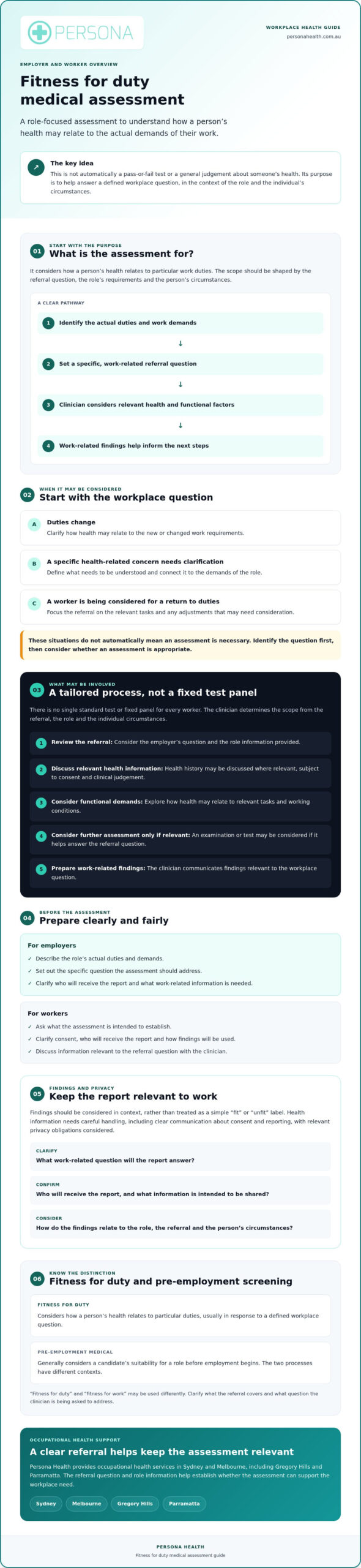
A fitness for duty medical assessment is an occupational health evaluation that considers how a person’s health relates to their ability to perform particular work duties. Its purpose is to help answer a defined workplace question, not to provide a general judgement about someone’s health or value as an employee.
The scope should reflect the role, the employer’s referral question and the individual’s circumstances. For example, relevant considerations for a worker operating machinery may differ from those for someone in a desk-based role. The assessment may consider only information relevant to the duties in question. It isn’t automatically a pass-or-fail examination, and an outcome shouldn’t be assumed before the assessment takes place.
This differs from recruitment screening, which generally considers a candidate’s suitability for a role before employment begins. A pre-employment medical and an assessment of an existing worker’s capacity have different contexts, although both may consider role-related health factors. For information about Persona Health’s lead medical assessments, see the relevant service page.
When might a fitness for duty assessment be considered?
An employer may consider an assessment when duties change, a specific health-related concern needs clarification, or a worker is being considered for a return to duties. These situations don’t automatically mean an assessment is necessary. The employer should identify the issue they need help understanding and connect it to the actual demands of the role.
A useful referral question is specific. Rather than asking whether someone is “fit for work” in general, an employer might ask whether the worker can safely carry out identified tasks, or whether adjustments should be considered. The clinician can then determine an appropriate scope based on the referral and role information.
How is it different from a fitness for work assessment?
Employers and clinical providers in Australia may use “fitness for duty” and “fitness for work” differently. The terms don’t always describe a standardised process, so clarify what the referral covers, what question the clinician will address and what information the employer needs. For a broader explanation, read this fitness for work assessment guide.
In an Australian workplace, the assessment should be framed around the actual duties and the question the employer needs answered. Clear role information helps the clinician focus on relevant work factors without treating the assessment as a general medical examination. The referral and the individual’s circumstances guide the scope.
For details about Persona Health’s occupational health services, contact the team to discuss the referral and whether they can support the assessment need. Clear role information and a well-framed referral help keep the assessment relevant to the question being asked.
What happens during a fitness for duty medical assessment?
There isn’t one standard test or fixed panel for every worker. The clinician determines the assessment’s scope from the referral question, the role and the individual circumstances. A fitness for duty medical assessment should gather information relevant to the work question, rather than defaulting to a broad examination or a predetermined outcome.
A typical process may include these steps:
- Review the referral: The clinician considers the employer’s question and the information provided about the role.
- Discuss relevant health information: The worker may be asked about health history relevant to the referral, subject to consent and clinical judgement.
- Consider functional demands: The clinician explores how the person’s health may relate to relevant tasks and working conditions.
- Decide whether further assessment is relevant: An examination or test may be considered if it helps answer the referral question. It shouldn’t be assumed to form part of every assessment.
- Prepare work-related findings: The clinician communicates conclusions relevant to the referral. The report format and detail can vary.
Appointment length, tests and outcomes depend on the individual referral and shouldn’t be assumed in advance. Employers can check these details with the provider when arranging an assessment.
What information may the clinician need?
A clear referral question and an accurate role description help the clinician focus the assessment. Employers should explain the tasks being considered, rather than relying on a job title alone. Workers may be asked about relevant health history or to provide supporting documents. If you’re unsure what to bring, ask the provider what information is appropriate. The clinician can clarify what may assist, taking consent and clinical judgement into account.
How do job demands shape the assessment?
The assessment should reflect the actual work. Relevant demands might include repeated lifting, extended periods of concentration, operating equipment or carrying out safety-sensitive duties. These are examples, not a mandatory checklist. Employers should confirm which demands apply to the role and describe them clearly, including any relevant working conditions. This helps avoid assessing a worker against duties they don’t perform or overlooking tasks that matter to the referral.
Workers can ask what the assessment will cover and raise questions about the process before attending. Employers arranging a role-related assessment may wish to discuss the referral with Persona Health, so the relevant role information and clinical question are clear from the outset.
How are fitness for duty findings used, and what about privacy?
The findings are intended to help address the referral question. A clinician may consider health information as part of the assessment, while the employer may need conclusions that relate to work, such as whether particular duties can be performed or whether further discussion is needed. There isn’t one universal report format, so don’t assume exactly what will be shared.
Before a fitness for duty medical assessment, employers and workers can reduce uncertainty by clarifying the purpose of the referral, the scope of the report, who is expected to receive it and how consent will be addressed. Disclosure arrangements depend on the circumstances, consent and applicable requirements. Employers should request information relevant to the work question, rather than clinical detail that isn’t needed for that purpose.
What might an employer need to know?
The employer’s practical question may concern specific duties, any relevant work restrictions or whether more information is required. What the clinician can report, and what the employer receives, depends on the assessment arrangements and context. Workers can ask what information may be provided and to whom. Employers can ask the provider to explain the intended scope before making the referral.
Questions to clarify before the assessment
| Who | Useful questions |
|---|---|
| Clinician | What question are you being asked to assess? What will the report address? |
| Worker | What information may be shared, who will receive it, and how will consent be handled? |
| Employer | What work-related information is needed to answer the referral question, and who should receive the report? |
Which Australian rules should employers check?
Privacy and workplace health and safety requirements can depend on the employer, jurisdiction and employment context. The Privacy Act 1988 and Australian Privacy Principles may be relevant, but their application shouldn’t be assumed without checking the specific circumstances. The Office of the Australian Information Commissioner (OAIC) provides guidance on health information and privacy.
For workplace health and safety guidance, start with Safe Work Australia and the relevant regulator, such as SafeWork NSW, WorkSafe Victoria or Comcare. WHS laws and guidance differ across jurisdictions and employment settings. Check current official sources, and seek appropriate advice where the situation requires it.
How can workers and employers prepare for an assessment?
Good preparation helps keep an assessment focused on the work-related question and makes the process clearer for everyone. Employers should provide accurate role information, while workers should feel able to ask what to expect and raise relevant personal concerns with the assessing clinician.
What should employers include in a referral?
Keep the referral specific and based on current information. Include:
- The assessment question: Explain what work-related issue needs clarification, without suggesting a preferred outcome.
- The role and duties: Describe the worker’s actual tasks, including relevant physical demands, safety-sensitive responsibilities or working conditions.
- Relevant workplace context: Provide information that helps the clinician understand the duties being considered.
- Report needs: Clarify what work-related information is being requested and who is intended to receive it.
A clear referral supports a more relevant assessment. Avoid requesting clinical details that aren’t connected to the question, or assuming a particular result before the clinician has assessed the individual.
What should workers ask before attending?
Before a fitness for duty medical assessment, contact the provider if you’re unsure about the appointment process or preparation. You can ask what the assessment covers, whether you should bring documents, how consent will be discussed, who may receive the report and how findings will be used. If the scope isn’t clear, raise that question with the provider.
You can also discuss relevant personal circumstances directly with the assessing clinician. Ask the provider how that information will be handled and what may be included in any report. Don’t assume every appointment has the same preparation requirements, documents or tests. Confirm what applies to your referral.
Where can InjuryQR support workplace injury reporting?
If the assessment relates to an injury or return to work, clear reporting and appropriate triage may also be part of the workplace response. InjuryQR is a FREE AI-powered workplace injury triage service available to all Australian businesses. A worker scans a QR code, with no app download required, describes the injury by voice and answers AI follow-up questions. The service can provide:
- Self-care advice
- A telehealth appointment, typically within 3-4 hours
- Direction to an Emergency Department
- Instructions to call 000
InjuryQR offers free posters, stickers, keyrings and fridge magnets. Certificates of Capacity can be issued immediately where appropriate. By making it easier to report an injury early and access guidance, InjuryQR may help improve reporting and reduce Lost Time Injuries (LTIs).
Employers in Sydney, Melbourne, Gregory Hills and Parramatta can contact Persona Health to discuss an assessment referral and clarify the relevant role information and clinical question.
Where can employers arrange a fitness for duty medical assessment?
Choose an occupational health provider that can understand the work-related question, communicate clearly about the referral process and explain what information may be included in the report. A well-framed assessment connects the worker’s circumstances with the actual requirements of their role, rather than relying on a generic checklist.
What should employers look for in an assessment provider?
Look for relevant occupational health experience and a clear process for referrals, assessment scope and reporting. Before proceeding, ask how to provide accurate role information, what the clinician needs to address the referral question and how findings will be communicated. Clear communication and support with coordinating the referral can also make the process more straightforward.
Turnaround can vary with the referral and assessment requirements. If timing matters for workforce planning, ask the provider about current timeframes rather than assuming a particular result or delivery date.
How can local services support coordination?
Persona Health provides occupational health services in Sydney, Melbourne, Gregory Hills and Parramatta. These locations may be relevant for employers arranging assessments or other occupational health services for their workforce. Confirm current service availability and suitability when discussing a referral.
Whether arranging services in Sydney, Melbourne, Gregory Hills or Parramatta, have the referral question and role information ready when speaking with a provider. Ask about the process for sharing relevant workplace details, expected reporting arrangements and current turnaround information. These practical checks help set clear expectations for both the employer and worker.
To discuss whether Persona Health can support your workplace health needs, contact the team about an assessment.
Take a clear, fair next step
A fitness for duty medical assessment is most useful when it addresses a clear question about the person’s actual work. A tailored assessment isn’t automatically a pass-or-fail test. Employers can support a fair process by describing role demands accurately, while workers can ask what the assessment covers, who will receive the report and how findings may be used.
Preparation matters. A focused referral, relevant workplace information and clear discussion of consent can help everyone understand the process. Confirm any documents or instructions with the provider rather than assuming every assessment follows the same steps.
Persona Health is an Australian occupational health specialist. Its services include pre-employment medicals, drug and alcohol testing, health surveillance for asbestos and crystalline silica, and workplace injury management. Employers in Sydney, Melbourne, Gregory Hills and Parramatta can contact the team to discuss their occupational health needs and confirm whether the service is suitable for a particular referral.
With the right information and a clear referral question, you can approach the next step with greater confidence and care for the individual circumstances involved.
Frequently Asked Questions
Who can request a fitness for duty assessment?
An employer may arrange an assessment where they need relevant medical information to address a workplace question, such as a proposed change to duties or a return to work. Whether a request is appropriate depends on the circumstances and applicable requirements, so employers should seek advice where needed. A worker can ask the employer or provider to explain the reason for the referral, its scope and how the findings are expected to be used.
Is a fitness for duty assessment the same as a pre-employment medical?
No. A pre-employment medical is generally arranged during recruitment to consider health factors relevant to a prospective role. A fitness for duty assessment usually concerns an existing worker and a specific question about their capacity to perform current or proposed duties. The processes may both consider role demands, but their purpose and context differ. If an assessment is requested, confirm which type is intended and what question the clinician has been asked to address.
Can an employer see my medical results?
What an employer receives depends on the referral, consent, context and applicable requirements. A report may focus on conclusions relevant to the work question, but you shouldn’t assume a universal format or that particular clinical details will always be shared or withheld. Before the assessment, ask who is expected to receive the report, what it may cover and how consent will be handled. Employers should clarify what information they need for the stated workplace purpose.
Can you fail a fitness for duty medical assessment?
It isn’t necessarily a pass-or-fail test. The clinician considers the referral question and relevant role demands, then provides findings based on the assessment. Those findings may identify that more information is needed or that particular duties require further consideration. No outcome should be assumed in advance. Employers should interpret the report in context and clarify any recommendations with the provider, rather than treating a label as a complete answer about a person’s capacity.
How do I prepare for a fitness for duty assessment?
Ask the provider what the appointment covers, whether you should bring documents and who may receive the report. Read any instructions supplied for your referral, and raise questions about consent or assessment scope before attending. Employers can help by providing a clear referral question, accurate role details and relevant workplace information. Don’t assume every assessment requires the same preparation, tests or documents. Confirm what applies to your circumstances directly with the provider.

Article by
Ian Nicholson
Ian is the Business Support Manager at Persona Health, where he plays a key role across IT, sales, marketing and business operations. With a broad skill set and a practical, solutions-focused approach, Ian helps drive the systems, communication and commercial strategy that support Persona Health’s continued growth across Australia.