

A blanket medical checklist can miss the risks that matter most on your production floor. The right health checks for manufacturing staff Sydney employers arrange should reflect the work people do and the exposures they may encounter, rather than applying the same tests to every role.
It’s understandable to worry about clinic appointments disrupting shifts, or about keeping health records and follow-up organised. A clear plan can help you coordinate assessments around operational needs while treating personal health information with care.
This guide explains how to match assessments to job roles and identified hazards, including when health surveillance may be appropriate. You’ll also learn how to organise appointments, manage reporting and plan follow-up without losing sight of privacy. Persona Health supports employers with relevant assessment pathways, including pre-employment medicals and health surveillance for asbestos and crystalline silica. We’ll also look at practical clinic and mobile service options, including Persona Health’s Rosebery and Gregory Hills locations, so you can consider what may suit your workforce.
Key Takeaways
- Start with each role’s tasks, exposures and existing controls to identify which assessments may be relevant.
- Understand how pre-employment assessments, fitness-for-work assessments and health surveillance serve different purposes before choosing a pathway.
- When comparing providers for health checks for manufacturing staff Sydney employers should ask about clinical scope, relevant experience, reporting and suitable clinic or on-site options.
- Use a clear planning sequence to coordinate staff, provider discussions, appointments and review of outcomes, while checking the NSW WHS requirements relevant to your workplace and hazards.
- Explore whether Persona Health’s Rosebery or Gregory Hills clinics, or its other Sydney locations, may suit your workforce and assessment needs.
What health checks for manufacturing staff in Sydney can help employers assess
Workplace health checks are assessments chosen for a defined work-related purpose, such as understanding whether a person can meet a role’s relevant requirements or monitoring health in relation to an identified workplace hazard. For employers arranging health checks for manufacturing staff Sydney, the starting point is the work itself: the tasks, exposure information and controls, not a standard test list applied to everyone.
Three pathways are often confused. A pre-employment assessment relates to the requirements of a role and the hiring process. A fitness-for-work assessment considers a worker’s capacity to undertake particular duties at a specific time. Health surveillance is the ongoing or periodic monitoring of workers’ health where it is relevant to an identified workplace hazard and exposure. It is not a general wellbeing check or a substitute for controlling exposure.
Before arranging an assessment, be clear about the decision it needs to inform. For example, are you considering a candidate’s capacity in relation to stated job demands, or responding to information about a workplace exposure? A defined purpose helps the provider discuss the appropriate scope and helps your organisation understand what the results can, and cannot, tell you.
For a short overview of pre-employment assessments, watch this video:
How do pre-employment checks differ from health surveillance?
A pre-employment medical helps consider a candidate’s health in relation to the stated demands of a particular job. Health surveillance instead relates to workers’ health and identified workplace hazards or exposure. Neither should be treated as a blanket screen: define the purpose first, share relevant job and exposure information with the provider, and confirm which assessment is suitable. See pre-employment medicals in Sydney and Parramatta for service-specific information.
Which manufacturing roles may need different assessment pathways?
Production, maintenance and site-based roles can involve different tasks and exposure profiles, even within one facility. A production worker may operate equipment on a regular shift, while a maintenance worker may enter different areas to service machinery. Site-based staff may have another pattern of work. Consider actual duties, exposure information and existing controls before discussing assessment needs. Don’t assume job title alone determines the right pathway.
A suitable assessment can inform a work-related decision, but it doesn’t diagnose every health concern or guarantee fitness for every task or prevent injury. Keep the purpose clear, and verify the applicable guidance for the workplace and hazard before arranging surveillance.
Match manufacturing health checks to tasks, hazards and worker needs
A useful assessment plan starts with evidence about the work, not assumptions based on a job title. Before arranging checks, map each role’s regular and occasional tasks, possible exposures, existing controls and any relevant exposure records. This helps distinguish a hiring-related question from a need to monitor health over time.
For example, note whether tasks involve operating machinery, maintaining equipment, working in areas where hazardous substances may be present, or moving between production zones. Then consider how controls such as isolation, ventilation, work procedures and personal protective equipment affect the work being assessed. A provider can use this information to discuss a suitable pathway, but employers should verify any surveillance requirements against current SafeWork NSW guidance and the workplace’s actual circumstances.
How should employers connect a role with an assessment?
Gather role descriptions, task observations and exposure records before speaking with a provider. Be clear about whether you’re assessing a candidate against relevant job requirements or considering ongoing monitoring because of an identified exposure. If the risk assessment identifies potential crystalline silica exposure, discuss whether a relevant medical pathway is appropriate and review Sydney crystalline silica medicals for service information.
The table below is a starting point for discussion, not a prescribed medical checklist. It shows how to connect work information to questions for a provider while leaving uncertain requirements open to verification.
| Example role | Work information to review | Assessment discussion |
|---|---|---|
| Production | Tasks, work area, machinery and any identified exposure | Is a hiring assessment relevant to the role? Is any exposure monitoring indicated? Verify against the risk assessment and applicable guidance. |
| Maintenance | Equipment serviced, locations entered and substances encountered during particular jobs | Clarify whether the question relates to role requirements or an identified exposure requiring health surveillance. Requirements need professional verification. |
| Site-based work | Work locations, changing tasks and available exposure records | Check whether the worker’s actual duties create a relevant exposure concern. Don’t infer a surveillance need from site access alone. |
When might health surveillance be worth discussing?
Review the workplace risk assessment for known hazardous-substance exposures, then check relevant SafeWork NSW guidance and applicable requirements. Asbestos or crystalline silica medical pathways should only be considered where the workplace risk assessment identifies a relevant risk. Health surveillance can support monitoring in that context, but it doesn’t replace the need to identify and control exposure. Confirm the appropriate scope with a qualified provider.
For health checks for manufacturing staff Sydney, a documented role-to-risk map gives the provider a clearer basis for discussing assessment options. If you’re unsure how to scope the conversation, contact Persona Health’s team to discuss the relevant work and exposure information.
How to compare providers for manufacturing staff health checks in Sydney
The right provider should be able to connect the assessment to your workforce’s actual needs and deliver it in a way that suits your site. For health checks for manufacturing staff Sydney, provider fit depends on clinical scope, relevant experience, access to a suitable clinic or on-site option, and clear reporting and follow-up processes.
Use the comparison below to guide discussions. Ask providers to explain their answers in relation to your roles and the information you supply, rather than relying on a general service list.
| What to compare | Questions to ask |
|---|---|
| Clinical scope | Which assessments may address the specific role requirement or identified exposure? What information do you need from us to advise on suitability? |
| Relevant experience | Have you worked with manufacturing roles or comparable workplace exposures? How do you tailor the assessment to job demands? |
| Location and access | Which clinic arrangements may suit our workers and site locations? Is a mobile workplace option available for this request? |
| Workforce coordination | Can you discuss arrangements for our workforce size and shift pattern? What should supervisors and workers know before attending? |
| Reporting and follow-up | What information is reported to the employer, how is it provided, and how are referrals or recommended follow-up communicated? |
What should employers ask before engaging a provider?
Share the role requirements and relevant risk information, then ask which assessments appear suitable and why. Confirm clinic or mobile arrangements, practical capacity for your workforce and the steps for organising appointments. Don’t assume every service can be delivered at every site or that a provider’s standard process will fit your shift pattern. Confirm the details for your request before scheduling.
Discuss privacy before sending employee information. Ask how personal health information is collected, stored, accessed and shared, and what consent or authority is needed for employer reporting. The Privacy Act 1988 and Australian Privacy Principles may be relevant, but their application depends on the circumstances. Verify the obligations that apply to your organisation and any relevant NSW requirements.
How can employers assess reporting and follow-up?
Ask whether reports separate work-relevant conclusions from confidential clinical details, and which authorised employer contacts receive them. Clarify how a referral or recommended follow-up will be communicated, and what the employer should do if further information is needed. Modern digital reporting can help make information easier to coordinate, but confirm the actual format, access arrangements and delivery process rather than assuming a particular platform or turnaround.
Persona Health’s employer-focused approach and modern digital reporting may be relevant considerations as you compare providers. To discuss your workplace requirements and assessment options, contact Persona Health’s team.
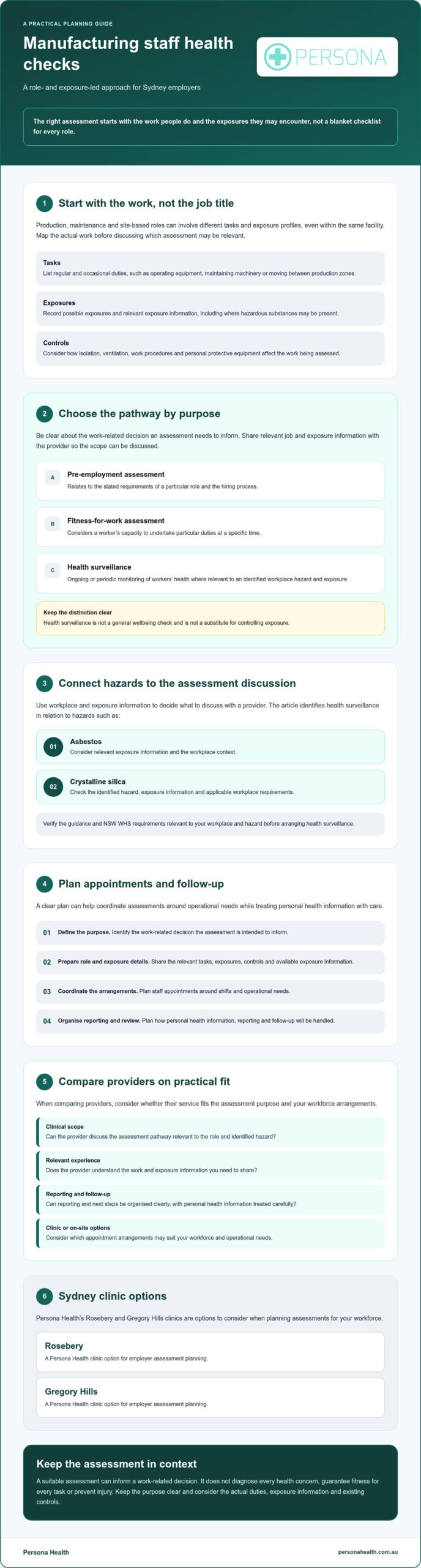
Plan health checks around Sydney manufacturing shifts, sites and WHS duties
A well-planned programme can make health checks easier to coordinate without treating production schedules as an afterthought. Use a simple sequence, and confirm the applicable NSW requirements for your actual workplace and hazards. If a legal duty or assessment requirement is unclear, seek advice from a suitably qualified professional or the relevant regulator.
- Confirm the purpose. Define whether you’re assessing role requirements, responding to a specific work-related question or considering surveillance linked to an identified exposure.
- Identify roles and workers. Use your role and risk information to determine who may need to attend, rather than booking a blanket assessment for the whole workforce.
- Consult the provider. Share relevant task and exposure information, then confirm the proposed scope and suitable delivery options.
- Schedule appointments. Plan around shift changes, site access and operational coverage, and agree how workers and supervisors will receive practical instructions.
- Review outcomes. Confirm how work-relevant recommendations and any necessary follow-up will be communicated to authorised contacts, while protecting confidential clinical information.
Check the Work Health and Safety Act 2011 (NSW), applicable regulations and relevant Codes of Practice against the workplace and hazard. Requirements can depend on the circumstances, so don’t rely on a generic checklist where the correct interpretation is uncertain.
How can checks be organised without disrupting production?
Discuss shift patterns, site access and appointment sequencing with the provider before confirming dates. Staggering attendance across shifts may help maintain coverage, but the workable approach depends on your operation and the provider’s arrangements. Compare clinic appointments with mobile workplace services based on worker location, assessment suitability and site logistics. Confirm availability and arrangements for your request rather than assuming a fixed appointment duration, capacity or report turnaround.
How should employers handle injury reporting and privacy?
For workplace injury triage, InjuryQR workplace injury triage is a free AI-powered service available to Australian businesses. A worker scans a QR code without downloading an app, describes the injury by voice, then responds to AI follow-up questions. Possible outcomes include self-care advice, a telehealth appointment typically within 3-4 hours, direction to an Emergency Department, or instructions to call 000. It isn’t a substitute for emergency care.
InjuryQR also provides free posters, stickers, keyrings and fridge magnets to help businesses make the service accessible at work. It can support timely injury reporting and may help reduce Lost Time Injuries by guiding workers towards an appropriate next step. Certificates of Capacity may be issued immediately where appropriate. Separately, handle health-check records confidentially: limit employer access to relevant information and verify which privacy obligations apply to your organisation.
Arrange manufacturing staff health checks with Persona Health in Sydney
Persona Health supports employers planning occupational medical assessments and relevant health surveillance around job roles, identified hazards and workplace logistics. Assessment options are needs-based: pre-employment medicals, drug and alcohol testing, and silica or asbestos medicals may be considered where they fit the role or identified risk. On-site health surveillance may also be discussed where appropriate.
Which Persona Health services may suit a manufacturing workforce?
For example, if your workplace has an identified asbestos-related risk, discuss whether an asbestos medical pathway is relevant. If you’re considering drug and alcohol testing, review the Sydney drug and alcohol testing service. Confirm the scope and suitability of any assessment with the team rather than assuming every worker needs the same checks.
Persona Health’s Sydney clinics are in Rosebery, Gregory Hills, Parramatta and Dee Why, with Rosebery and Gregory Hills among the locations to consider for your workforce. Its Melbourne clinics are in Cairnlea and Craigieburn. A network of 100 affiliate clinics nationwide and Australia-wide mobile workplace services may offer additional access options. Confirm which location or delivery arrangement suits your request.
What should employers prepare before making an enquiry?
Have role descriptions, site locations, relevant hazard information, workforce numbers and preferred scheduling windows ready. You can also ask about clinic or mobile options, report arrangements and the expected process for your assessment. Persona Health’s approach includes employer-focused support, responsive customer service, modern digital reporting and an emphasis on fast turnaround times. Confirm expected timing and reporting arrangements for your particular request.
Build a health-check plan that fits your workforce
A practical assessment plan starts with the role and its identified risks, then matches workers to an appropriate pathway. Keep hiring assessments distinct from health surveillance, and check applicable NSW requirements for the actual workplace and exposure. For health checks for manufacturing staff Sydney, this approach helps you plan relevant assessments without defaulting to the same checklist for every employee.
Persona Health provides employer-focused support and modern digital reporting. Sydney clinics include Rosebery, Gregory Hills, Parramatta and Dee Why, with Rosebery and Gregory Hills among the local options to consider. A nationwide network of 100 affiliate clinics and Australia-wide mobile workplace services may also help with workforce access. Confirm service suitability, location and reporting arrangements when you enquire.
Prepare role details, hazard information, site locations, workforce numbers and preferred scheduling windows. These details can help make the discussion about your organisation’s needs more focused.
A thoughtful plan can make the process clearer for workers, supervisors and HR. Start with the work, and take the next step with confidence.
Frequently Asked Questions
What health checks should manufacturing workers have in Sydney?
There isn’t one standard set of checks for every manufacturing worker. Choose assessments based on the role’s actual tasks, relevant job requirements and identified workplace exposures. A new production worker may have different assessment needs from a maintenance worker who enters several work areas. For health checks for manufacturing staff Sydney employers should first review role and risk information, then confirm suitable options with an occupational health provider.
Are health checks mandatory for manufacturing staff in NSW?
Not every manufacturing worker needs a routine medical check. Whether health surveillance or another assessment is required depends on the work, identified hazards and applicable NSW work health and safety legislation and regulations. Employers should check relevant SafeWork NSW guidance and Codes of Practice for their specific circumstances. If it’s unclear whether a duty applies or what assessment is appropriate, seek advice from a suitably qualified professional or the relevant regulator.
What is the difference between a pre-employment medical and health surveillance?
A pre-employment medical considers a candidate’s health in relation to relevant requirements of a particular job and the hiring process. Health surveillance monitors workers’ health where this is relevant to an identified workplace hazard or exposure. The two serve different purposes, so one shouldn’t automatically replace the other. Share the role requirements and exposure information with the provider to help clarify which pathway, if either, is appropriate.
Can manufacturing staff health checks be completed on-site?
Some assessments may be arranged at a workplace, but suitability depends on the assessment, site and provider arrangements. Ask whether mobile workplace services are available for your request, what site access or facilities may be needed, and how appointments could be organised around shifts. Persona Health offers Australia-wide mobile workplace services. Confirm the scope, location and scheduling options directly before planning attendance, as these details can vary for each request.
How should an employer choose a workplace health provider in Sydney?
Compare providers on clinical scope, experience relevant to your roles or exposures, clinic access, possible on-site arrangements, and how results and follow-up are managed. Ask how they use employer-supplied role and risk information to tailor assessments. Check how work-relevant reporting is separated from confidential clinical details, who receives reports, and how privacy is handled. Clarify service suitability and arrangements before booking, rather than assuming a general service list meets your needs.
Do all manufacturing workers need silica or asbestos medicals?
No. Silica or asbestos medicals shouldn’t be applied to every worker as a blanket check. Consider them only where the workplace risk assessment identifies a relevant hazard or exposure, then verify applicable requirements and guidance for the particular work. For example, a role’s title alone doesn’t establish exposure. Review task and exposure information, workplace controls and relevant SafeWork NSW guidance, and ask a qualified provider to discuss the appropriate pathway.
How is employee privacy managed during workplace health checks?
Employers should treat health information as confidential, explain how it will be used, and restrict internal access to people who need relevant information for work-related decisions. Ask the provider what information is shared, with whom, and how consent or authority is managed. The Privacy Act 1988 and Australian Privacy Principles may be relevant, but their application can depend on the organisation and circumstances. Verify your obligations and avoid circulating detailed clinical information unnecessarily.

Article by
Ian Nicholson
Ian is the Business Support Manager at Persona Health, where he plays a key role across IT, sales, marketing and business operations. With a broad skill set and a practical, solutions-focused approach, Ian helps drive the systems, communication and commercial strategy that support Persona Health’s continued growth across Australia.