

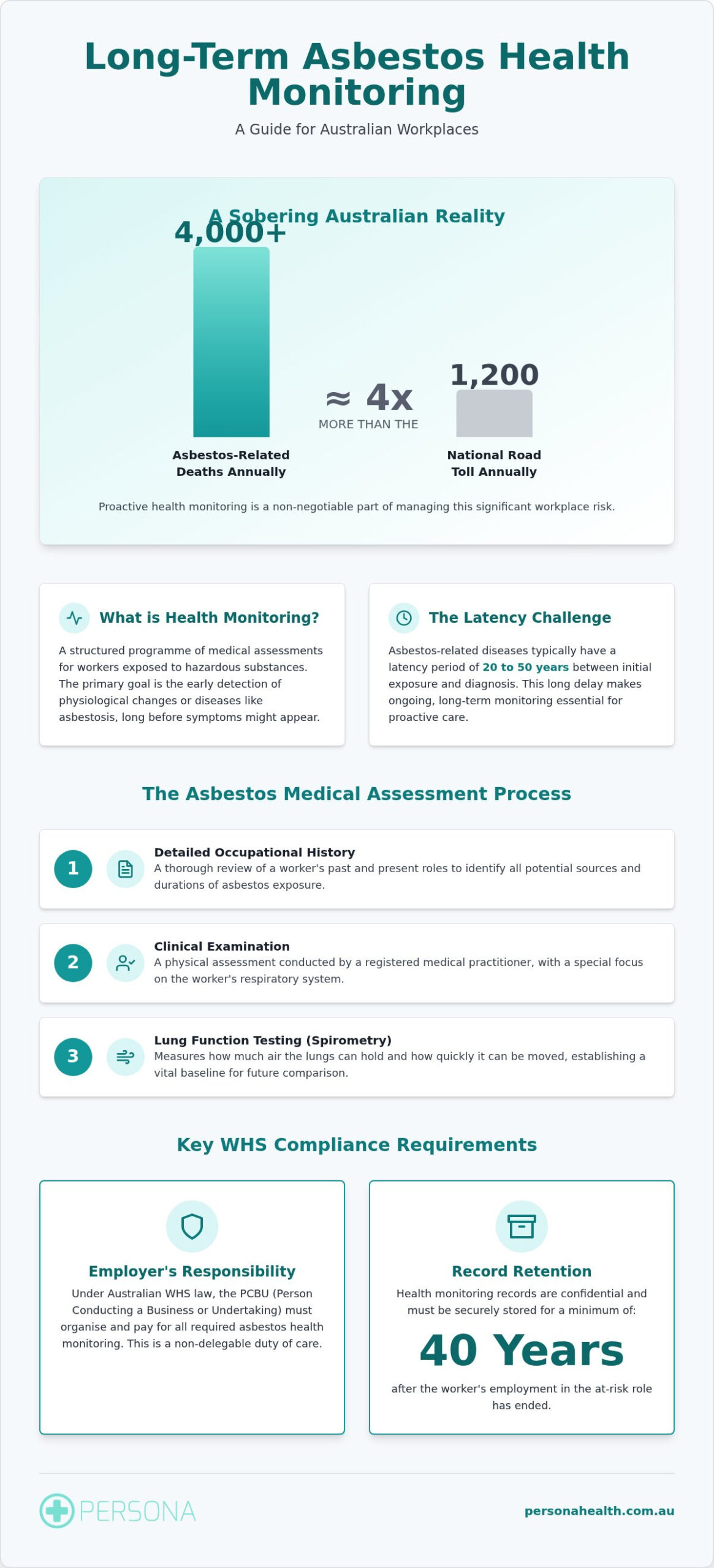
Did you know that asbestos-related diseases claim more than 4,000 Australian lives every year? This figure is nearly four times the annual national road toll, a sobering reminder of why proactive care is non-negotiable. If you or your employees have been exposed to these fibres, the long latency period often creates a persistent sense of unease about the future. It’s completely natural to feel anxious about what medical tests actually entail or confused by the complex web of employer obligations under the latest WHS regulations.
We understand that long term health monitoring for asbestos is about more than just ticking a compliance box; it’s about securing your peace of mind through expert clinical oversight. This 2026 guide provides a clear roadmap of the essential medical steps and legal requirements necessary to manage these risks effectively over the coming decades. We will explain the medical assessment process, clarify your responsibilities under SafeWork Australia standards, and show you how Persona Health’s tailored approach ensures you’re never navigating this journey alone.
Key Takeaways
- Understand why long term health monitoring for asbestos is a lifelong clinical commitment focused on the early detection of respiratory changes and disease.
- Navigate the latest Australian regulatory standards to ensure your workplace remains compliant with SafeWork Australia and state specific WHS requirements.
- Learn about the essential clinical components of an asbestos medical, including lung function tests and the importance of a detailed occupational history review.
- Discover the critical protocols for record keeping and monitoring frequency, including the legal obligation to retain health records for up to 40 years.
- Find out how expert medical oversight and modern digital reporting can simplify the health surveillance process for employers and workers alike.
What is long term health monitoring for asbestos?
Health monitoring is a structured programme of medical assessments designed to track the health of workers who may be exposed to hazardous substances. For those in the construction, demolition, or maintenance industries, long term health monitoring for asbestos involves specific clinical tests to identify any physiological changes early. This proactive approach is essential because the early detection of conditions like asbestosis or mesothelioma significantly improves management options and provides a clearer path for future care. For a broader asbestos overview, it’s helpful to understand how these naturally occurring minerals were historically used in Australia and why they pose such a persistent risk today.
To better understand how these fibres interact with the body over time, watch this helpful video:
Under Australian Work Health and Safety (WHS) legislation, this monitoring is a mandatory requirement for any worker at risk of exposure. It isn’t merely about compliance; it’s a vital safety net for individuals who have dedicated their careers to high-risk trades. By standardising these assessments, we can ensure that every worker receives the same high level of clinical oversight regardless of their specific job site.
The unique challenge of asbestos latency
Asbestos-related diseases are unique because they don’t appear immediately after the initial exposure. The latency period for these conditions usually ranges from 20 to 50 years, meaning a worker could remain healthy for decades before any symptoms arise. This long gap is exactly why establishing a clinical baseline early in a career is so important. By recording your lung function and general health status now, our medical team can more accurately track subtle changes over time. This ongoing surveillance through on-site health surveillance or clinic-based visits provides the peace of mind that comes from knowing your health is being professionally managed for the long haul.
Who is responsible for organising monitoring?
The primary responsibility for health monitoring lies with the Person Conducting a Business or Undertaking (PCBU). Under the WHS Act, the employer must organise and pay for all required medical assessments. This ensures that financial barriers don’t prevent workers from receiving life-saving surveillance. Monitoring should ideally commence before a worker begins any task involving asbestos to establish that essential baseline. This commitment to regular asbestos medicals protects both the worker’s health and the employer’s regulatory standing. It’s a collaborative process where the employer provides the access, and the worker provides the history, creating a complete picture of occupational health.
Australian regulatory standards and WHS compliance
The framework for long term health monitoring for asbestos is established by SafeWork Australia through the Model WHS Regulations. While these national guidelines provide a consistent blueprint, it’s vital to recognise state specific variations. In New South Wales, the Work Health and Safety Regulation 2025 commenced on 22 August 2025. This updated regulation introduces more stringent standards for high risk industries, particularly those involving asbestos removal and demolition. For businesses operating across borders, staying abreast of these shifts is essential to avoid significant legal exposure.
A critical component of compliance is the appointment of a “competent person” to oversee the surveillance programme. In most cases, this must be a registered medical practitioner with specific expertise in occupational health. This specialist ensures that the assessments are clinically sound and that any subtle changes in respiratory health are correctly interpreted. The Privacy Act 1988 also provides a robust layer of protection for workers. It mandates that sensitive medical data collected during surveillance is handled with the highest level of confidentiality, ensuring that personal health information is only used for its intended protective purpose.
Record keeping is another area where Australian states differ slightly. In New South Wales, employers are legally required to retain health monitoring records for 40 years. In Victoria, the requirement is 30 years. These lengthy durations reflect the long latency period of asbestos diseases discussed earlier, ensuring that a worker’s clinical history remains accessible even decades after they have left a specific job site.
Mandatory triggers for health surveillance
Health monitoring isn’t optional for roles where there is a “significant risk” of exposure. This threshold is typically met in demolition, renovation, and maintenance sectors where workers may encounter friable or non-friable asbestos. To ensure full compliance, many businesses now integrate these assessments into their initial pre-employment medicals. This establishes an immediate baseline, allowing the employer to fulfill their duty of care from day one and providing a clear starting point for the worker’s long term health journey.
Reporting and notification requirements
If an assessment indicates that a worker has contracted an asbestos-related disease or if the medical practitioner recommends specific remedial measures, the employer must notify the relevant state regulator. This notification is a legal priority. Workers must receive a copy of their health monitoring report as soon as practicable after the assessment. Failure to meet these timelines or neglecting to provide monitoring altogether can result in heavy penalties under Australian WHS laws. If you are uncertain about your current obligations, speaking with a specialist about asbestos medicals in Sydney can help clarify the necessary steps for your specific workforce.
Clinical components of an asbestos medical assessment
When you attend a medical assessment for long term health monitoring for asbestos, the process is designed to be as supportive as it is thorough. It isn’t just a series of clinical tests; it’s a comprehensive review of your unique health journey. Our medical team focuses on building a detailed picture of your occupational history to identify exactly when and how exposure may have occurred. This detective work is vital because it allows the doctor to understand the specific risks you’ve faced over your career. We also use standardised respiratory questionnaires, common in Australian clinical practice, to track symptoms like breathlessness or persistent coughs that might otherwise be overlooked.
A physical examination follows, where the doctor pays close attention to your respiratory system. They’ll listen for specific sounds, such as fine crackles at the base of the lungs, which can be an early clinical sign of asbestosis. The most critical part of this entire process is the comparison of new results against your previous clinical baselines. By looking at how your health has changed since your last asbestos medical, we can detect subtle trends that a single snapshot might miss. This longitudinal approach is what makes surveillance truly effective over several decades.
Spirometry and lung function testing
Spirometry is the cornerstone of respiratory surveillance. During this test, you’ll be asked to take the deepest breath possible and then blow out as hard and fast as you can into a machine. It measures the total volume of air you can exhale and the speed of that airflow. In some specialised cases, a DLCO (Diffusing Capacity of the Lungs for Carbon Monoxide) test may be required to see how well your lungs transfer oxygen into the bloodstream. Essentially, these lung function tests are used to detect early restrictive patterns where the lung tissue becomes less elastic, a common indicator of asbestos-related changes.
Diagnostic imaging: Chest X-rays and HRCT
Chest X-rays play a specific role in identifying pleural plaques, which are thickened areas on the lining of the lungs. While these plaques are often asymptomatic, they serve as a clear marker of past asbestos exposure. However, X-rays have limitations in detecting very early or fine tissue changes. This is where a high-resolution computed tomography (HRCT) scan becomes clinically justified. An HRCT provides much finer detail of the lung parenchyma, though doctors must always balance the radiation exposure risks with the clear benefits of early detection. We ensure that imaging is only ordered when it’s clinically necessary for your long term health monitoring for asbestos, following the most recent Australian diagnostic guidelines.
Managing the long term journey: Records and frequency
Consistency is the cornerstone of effective long term health monitoring for asbestos. While the initial baseline assessment is vital, the true value of surveillance lies in the regular follow up appointments. In most Australian jurisdictions, the recommended frequency for these medical reviews is every two years. However, your occupational physician may advise more frequent testing if your exposure history is particularly high or if specific clinical markers require closer observation. This biennial rhythm ensures that any changes in your respiratory health are captured early, allowing for timely intervention and better health outcomes.
Maintaining continuity of care can be a challenge when a worker changes employers. In the Australian construction and demolition industries, it’s common for tradespeople to move between multiple PCBUs over several decades. To manage this, workers should always request a copy of their health monitoring report after each assessment. This allows you to provide a complete clinical history to your next employer or medical provider, ensuring that your long term health monitoring for asbestos remains a continuous, unbroken record rather than a series of disconnected snapshots. Our modern digital reporting systems at Persona Health make this process seamless, providing fast and accessible results for both workers and employers.
Record keeping and the 40 year rule
Australian law takes the long latency period of asbestos diseases very seriously. In New South Wales, for example, health monitoring records must be retained for at least 40 years from the date the record was made. This lengthy duration is designed to match the typical 20 to 50 year window in which symptoms of exposure can manifest. Whether your records are stored in digital or physical formats, they must remain accessible and secure for four decades. Under the Privacy Act 1988, you have a permanent right to access your own health surveillance history. This ensures that even if a former employer has ceased trading, your medical data remains a part of your permanent health record, providing essential evidence should you ever need to make a claim or seek specialist treatment later in life.
Support for workers and emotional well-being
We understand that being on a long term surveillance register can be psychologically taxing. It’s common for workers to experience “scanxiety”, a form of stress that arises in the days leading up to a medical appointment or while waiting for results. The fear of the unknown is often worse than the reality of the clinical findings. To mitigate this, our medical team prioritises clear, plain-English communication. We explain your results in a way that is easy to understand, focusing on what the data actually means for your daily life and future well-being. By positioning the occupational physician as a supportive health partner rather than just a clinical examiner, we aim to reduce anxiety and empower you to take control of your respiratory health.
To ensure your organisation remains compliant with these complex retention and frequency requirements, you can book your team’s next round of asbestos medicals in Sydney at our Parramatta, Rosebery, Gregory Hills, or Dee Why clinics.
Persona Health: Expert asbestos medicals in Sydney and Melbourne
Persona Health understands that long term health monitoring for asbestos requires a clinical partner who balances technical expertise with a deeply human approach. We provide specialised asbestos medicals in Sydney and Melbourne, led by an experienced medical team that specialises in occupational health. By using modern digital reporting systems, we ensure that results are delivered quickly and accurately. This speed helps employers meet their WHS obligations without unnecessary delay. For businesses managing large teams, we also offer on-site health surveillance to minimise workplace downtime while maintaining a high standard of care.
Our clinic network and mobile services
Our physical clinics are conveniently located in Parramatta, Rosebery, Gregory Hills, and Dee Why in Sydney, as well as Cairnlea and Craigieburn in Melbourne. This local presence is supported by a robust 100-clinic affiliate network, providing comprehensive Australia-wide coverage for national workforces. Our employer-focused approach prioritises fast turnaround times and clear communication. We know that waiting for results can be stressful for workers and disruptive for businesses. Our systems are built to provide clarity as soon as the assessment is complete, ensuring that everyone involved has the information they need to move forward safely.
InjuryQR: Immediate triage for workplace exposure
Accidents happen, and when they involve potential asbestos exposure, immediate action is critical. We integrate InjuryQR into our safety protocols as a free AI-powered triage service. Workers simply scan a QR code on a poster or magnet; no app is required. They describe the incident by voice, and the AI provides immediate, guided next steps such as telehealth or emergency direction. This proactive tool helps reduce Lost Time Injuries (LTIs) and ensures that incident reporting is accurate and immediate. Where appropriate, the system can even facilitate the immediate issuance of Certificates of Capacity. Businesses can order free physical InjuryQR assets like posters to ensure their team is always prepared. By combining these modern tools with our long term health monitoring for asbestos, we provide a complete safety net for your workforce.
Securing your respiratory health for the years ahead
We’ve explored the critical importance of baseline assessments and the necessity of maintaining regular biennial reviews to stay ahead of asbestos risks. Understanding that record retention is a 40 year commitment in states like New South Wales ensures you remain compliant with local legislation while protecting your future well-being. It’s about creating a historical record that safeguards your health across every stage of your career, regardless of how many times you change job sites.
Effective long term health monitoring for asbestos is a partnership built on trust and clinical precision. At Persona Health, our experienced Australian Occupational Physicians provide the expert oversight needed to navigate these complex requirements with ease. Our comprehensive clinic network across Sydney and Melbourne, combined with fast turnaround times through digital reporting, ensures that your health surveillance is both thorough and efficient. Contact Persona Health today to book your asbestos health surveillance and gain the peace of mind that comes from professional, empathetic care. Taking this step today is the best way to ensure a healthy, active future for yourself and your team.
Frequently Asked Questions
How often should I have health monitoring for asbestos?
Health monitoring for asbestos is typically conducted every two years following your initial baseline assessment. This biennial frequency is the standard recommendation under SafeWork Australia guidelines, although your occupational physician might suggest more frequent reviews if your exposure history is extensive. Regular check-ups are essential to track subtle changes in lung function that may occur over several decades.
Can I choose my own doctor for an asbestos medical assessment?
The Person Conducting a Business or Undertaking (PCBU) generally selects the medical practitioner to ensure they meet the legal “competent person” requirement. While you may have a preferred GP, asbestos medicals must be overseen by a doctor with specific training in occupational health. This ensures the assessments are legally compliant and clinically rigorous enough to detect specific occupational respiratory conditions.
What happens if my health monitoring report shows a problem?
If an assessment identifies a health issue, the doctor will discuss the findings with you immediately and provide a detailed written report. Your employer is then legally required to notify the relevant state regulator, such as SafeWork NSW or WorkSafe Victoria. From there, we work with you to manage your health and ensure your workplace controls are reviewed to prevent any further risk to yourself or your colleagues.
Who pays for the long term health monitoring for asbestos?
The PCBU is legally responsible for all costs associated with long term health monitoring for asbestos. This includes the medical appointment, any required diagnostic imaging, and the time you spend attending the assessment during your regular work hours. You should never be out of pocket for mandatory health surveillance required under Australian WHS laws, as this is a fundamental employer obligation.
Do I need a chest X-ray every time I have a check-up?
You do not require a chest X-ray at every biennial check-up. While X-rays are useful for identifying pleural plaques or other changes, they are typically performed every five to ten years, or only when clinically indicated by your physician. This balanced approach minimises unnecessary radiation exposure while still ensuring that any significant changes in your lung tissue are detected through other means like spirometry.
What is the difference between health surveillance and a standard GP check-up?
Unlike a standard GP visit, health surveillance is a specialised programme designed to monitor the effects of specific workplace hazards. It focuses heavily on respiratory function and occupational history, comparing new data against your original clinical baseline. This allows for the early detection of restrictive lung patterns and other asbestos-related markers that a general health check might not specifically target or record.
How long are my asbestos health records kept in Australia?
In Australia, asbestos health records must be retained for a very long period to account for the disease’s long latency. In New South Wales, the requirement under the WHS Regulation is 40 years, while in Victoria, it is 30 years. This ensures that your clinical data remains available to you for your entire life, even if you move between different employers or industries.
Is asbestos monitoring mandatory if I only had a single exposure?
Mandatory long term health monitoring for asbestos is triggered when there is a “significant risk” to a worker’s health. While a single, low-level accidental exposure might not always necessitate ongoing surveillance, a high-level incident or regular work with asbestos materials will require a formal monitoring programme. If you have any concerns after an incident, an initial baseline assessment is always the safest first step to take.

Article by
Ian Nicholson
Ian is the Business Support Manager at Persona Health, where he plays a key role across IT, sales, marketing and business operations. With a broad skill set and a practical, solutions-focused approach, Ian helps drive the systems, communication and commercial strategy that support Persona Health’s continued growth across Australia.