
The doctor who has looked after your family for a decade might actually be the wrong person to handle your workers’ compensation claim. While your local doctor is excellent for general health, the debate of occupational physician vs gp comes down to specialised expertise in the Australian workforce. If you’re currently staring at a vague medical certificate that offers no clear path back to your desk or site, you aren’t alone. SafeWork Australia’s 2023 report shows that 127,800 serious claims were made in the 2021 to 2022 period. Many workers in Melbourne find themselves stuck in a cycle of slow recovery because their primary care provider doesn’t fully grasp the complexities of WorkSafe Victoria or SafeWork NSW regulations.
We understand how frustrating it feels when your recovery feels stalled by red tape and unclear medical advice. At Persona Health, we believe your journey back to work should be as unique as your clinical needs. This guide will help you understand the critical differences between general practice and occupational medicine to ensure you achieve better health outcomes and total workplace safety. We’ll explore how choosing a specialist at our new Cairnlea or Craigieburn clinics can lead to faster recovery and full compliance with Australian industrial laws. You’ll gain a clear roadmap for deciding which doctor to see to get your life back on track.
Key Takeaways
- Learn how to distinguish between an occupational physician vs gp to ensure you receive the most appropriate care for both personal health and professional requirements.
- Discover why specialised pre-employment medicals are essential for assessing a candidate’s fitness for specific roles beyond the scope of general practice.
- Understand the impact of expert injury management on reducing recovery times, with a focus on our new Melbourne clinics in Cairnlea and Craigieburn.
- Explore how proactive assessments and adherence to SafeWork Australia standards can identify ergonomic risks before they lead to long-term health issues.
- Find out how Persona Health supports your unique recovery journey through a premium and empathetic approach that balances clinical authority with your individual needs.
Defining the Roles: Occupational Physician vs GP in the Australian Context
Understanding the distinction in the occupational physician vs gp debate is vital for both workers and employers across Australia. While both are medically trained professionals, their objectives often diverge when a health issue intersects with a person’s livelihood. At Persona Health, we recognize that your health journey is unique. We aim to provide clarity so you feel empowered to make the right choice for your recovery and your career. Choosing the right path ensures you receive care that isn’t just effective, but also relevant to your daily life and safety.
The General Practitioner: Your Family Health Partner
A General Practitioner (GP) is the cornerstone of community health. They provide holistic care for families, managing everything from seasonal flu to mental health support and preventative screenings. Most GP consultations in Australia last between 10 and 15 minutes. This timeframe is often too short to conduct the deep dive required for complex injury management or industrial site risk assessments.
GPs focus on your overall life stages. They are excellent for non-work related issues, like a sports injury or managing a chronic disease. However, they might not be familiar with the specific physical demands of a warehouse in Craigieburn or a construction site in Cairnlea. Because they serve the patient’s general well-being, they don’t always have the tools to assess if a worker can safely operate heavy machinery under specific Australian safety regulations. Their expertise lies in the community, not the factory floor or the rail corridor.
The Occupational Physician: A Workplace Health Specialist
Occupational Physicians are specialists who have undergone extensive post-graduate training to understand the workplace as a clinical environment. They don’t just treat an injury; they evaluate how that injury interacts with your specific duties. This expertise is crucial for maintaining standards set by SafeWork Australia. Our team at Persona Health is expanding to better serve the Melbourne region, with dedicated experts now available at our new clinics in Cairnlea and Craigieburn.
These specialists focus on functional capacity. They ask whether a person can perform their tasks without risking themselves or their colleagues. This role involves:
- Conducting detailed fitness for duty medicals that align with national safety standards.
- Monitoring long term health risks such as crystalline silica exposure or asbestos.
- Providing employers with legally compliant, objective reports that facilitate a smooth return to work process.
While a GP is your partner for life, an Occupational Physician is your partner for work. They ensure that your health is protected within the specific context of your professional environment. This provides the specialized oversight that a general clinic isn’t equipped to offer, ensuring you are fit for the specific challenges of your job.
Comparing Expertise: Training, Qualifications, and Focus
Understanding the distinction between an occupational physician vs gp is essential for any business looking to manage workplace health effectively. A General Practitioner is a highly skilled medical professional who provides broad care for a wide variety of conditions. Their training covers everything from paediatrics to geriatrics, making them the first point of contact for personal health issues. Their focus remains on the individual patient, which is ideal for general wellness and managing acute illnesses in the community.
Occupational Physicians follow a different path. After their initial medical degree, they complete intensive post-graduate specialty training through the Royal Australasian College of Physicians. This training is dedicated specifically to the relationship between health and the work environment. While a GP’s approach is patient-centric, the specialist’s approach is tri-party. They manage the delicate balance between the patient, the employer, and the regulator. This ensures that medical advice isn’t just clinically sound but also practically applicable to the specific requirements of a job role.
At Persona Health, our specialists spend significant time on-site. We believe that a doctor cannot truly assess a worker’s capacity without understanding the physical demands of their role. This is particularly relevant for businesses near our new Melbourne locations in Cairnlea and Craigieburn, where industrial and logistics roles are common. These site visits allow our team to see the actual environment where a person works, from the height of a truck cab to the repetitive motions on a production line. This direct observation is a key part of the occupational physician vs gp comparison, as it informs more accurate return-to-work plans.
Specialised Knowledge of Industrial Hazards
Occupational Physicians are trained to recognise the subtle, long-term effects of hazardous substances that a GP might not encounter in daily practice. This includes managing risks like lead exposure, noise pollution, or chemical vapours. They have the specialized expertise required to interpret complex health surveillance data, which ensures early intervention for at-risk workers. For example, they conduct highly technical crystalline silica medicals for those in construction or manufacturing. These assessments are vital for meeting SafeWork Australia standards and protecting employees from irreversible lung damage.
Legal and Regulatory Compliance Expertise
The legal landscape of workplace health is complex. Occupational Physicians have a deep knowledge of the Workers Compensation Act and Victorian return-to-work protocols. They provide legally defensible medical opinions that are essential for insurance and tribunal matters. This expertise is especially important when conducting fitness for duty (FFD) medicals for high-risk sectors. These assessments determine if a worker can safely perform their tasks without risking themselves or others. If you want to ensure your workplace remains compliant while supporting your staff, our on-site health surveillance programs provide the expert oversight your business needs.
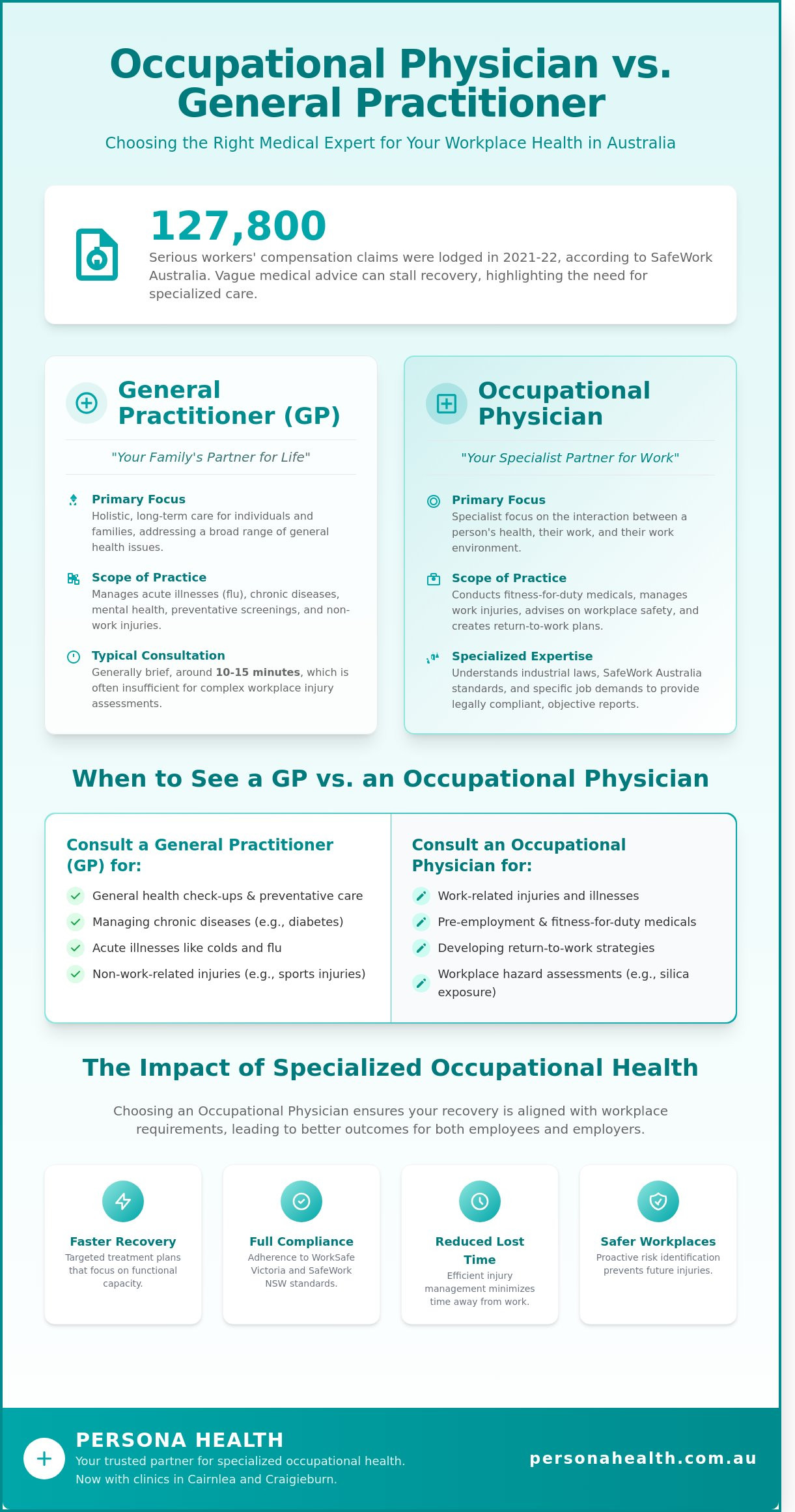
When to See a GP versus an Occupational Health Doctor
Deciding between an occupational physician vs gp depends largely on whether your health concern is rooted in your personal life or your professional environment. While both are medically trained professionals, their focus areas differ significantly. Your GP is your advocate for general wellness and long term family health. You should visit them for common illnesses like the flu, personal injuries sustained at home, or when you need prescriptions for chronic conditions. They provide a holistic view of your personal health history and can coordinate referrals to specialists like cardiologists for non-work issues.
In contrast, an occupational physician focuses on the relationship between a worker, their health, and their specific job tasks. This distinction is vital for employers and employees in Melbourne and Sydney. For instance, if you are hiring new staff, you should choose an occupational specialist for pre-employment medicals. At our new Melbourne clinics in Cairnlea and Craigieburn, we assess whether a candidate is physically capable of meeting the demands of a role, which reduces the risk of future workplace injuries. We also manage complex workplace injury management cases to ensure a safe and sustainable return to work that satisfies SafeWork Australia guidelines.
Scenarios for General Practice
General practitioners are the first point of call for health issues that exist independently of your employment. You should consult a GP for:
- Personal prescriptions and referrals to specialists for private health matters.
- Mental health care plans for issues that are not caused by workplace stressors.
- General health check-ups, vaccinations, and lifestyle advice for long-term wellness.
A GP provides the continuity of care needed for personal health journeys, but they may not always have the specific knowledge of industrial site requirements or the legal framework of WorkSafe Victoria or State Insurance Regulatory Authority (SIRA) regulations.
Scenarios for Occupational Medicine
Occupational medicine is required when legal compliance and workplace safety are at stake. Our doctors at Persona Health provide specialised care that a standard GP isn’t typically equipped to offer. Key scenarios include:
- Conducting specialised assessments such as Cat 3 rail medicals for transport workers to ensure public safety.
- Managing complex claims where a worker has multiple restrictions and needs a highly tailored return-to-work plan.
- Providing on-site health surveillance to monitor employee health trends and ensure compliance with mandatory health monitoring laws.
- Performing fitness for duty assessments to determine if an employee can safely perform their specific duties after a period of absence.
Understanding the occupational physician vs gp dynamic ensures that you receive the most relevant expertise. While your GP looks after you, the occupational physician looks after you within the context of your career. Our clinics in Cairnlea and Craigieburn are designed to bridge this gap, offering professional, empathetic care that respects the unique needs of every individual and every workplace.
The Impact on Recovery and Workplace Safety in Melbourne and Sydney
Choosing between an occupational physician vs gp can determine whether an employee returns to work in days or months. In the fast-paced industrial hubs of Sydney and Melbourne, specialist intervention significantly reduces the duration of work-related disability. Our teams at the new Cairnlea and Craigieburn clinics in Melbourne apply clinical expertise to ensure recovery is both safe and sustainable. By focusing on targeted injury management, these specialists look beyond the immediate symptoms to understand the physical demands of the worker’s specific role.
Occupational Physicians play a vital role in preventing future injuries by identifying ergonomic risks and hazardous exposures long before they lead to a claim. While a GP might treat a strained back, a specialist identifies that the strain resulted from a poorly configured workstation or incorrect lifting technique on a Sydney construction site. Workers feel more supported when their recovery is managed by someone who understands their specific job pressures. This empathy, combined with clinical authority, builds a culture of safety that protects both the individual and the organisation.
Clear communication between the specialist and the employer eliminates the ambiguity often found in standard GP certificates. A typical medical certificate might simply state a worker is unfit for duties for two weeks. In contrast, an occupational health report provides a detailed breakdown of what the worker can safely do, such as lifting limits or required postural breaks. This clarity allows Melbourne businesses to maintain productivity while the employee recovers.
Bridging the Communication Gap
Occupational health doctors translate complex medical jargon into actionable workplace adjustments that supervisors can actually implement. They facilitate essential discussions between HR, site managers, and the injured worker to build a foundation of trust. By ensuring strict compliance with safety protocols, they prevent the high costs associated with re-injury. In our Cairnlea facility, we focus on personalising these adjustments to the specific equipment and environments found in local Victorian manufacturing plants, ensuring every recommendation is practical and safe.
Supporting Local Industry Standards
Adhering to the specific requirements of the Sydney and Melbourne construction and rail sectors is a core part of our specialist service. We provide critical data for annual safety audits and regulatory reporting, helping firms stay ahead of SafeWork Australia requirements. This includes managing complex health surveillance such as crystalline silica medicals for stone workers or ensuring that rail medicals meet the latest National Standard for Health Assessment of Rail Safety Workers. These rigorous assessments ensure that safety standards are never compromised by a lack of industry-specific medical knowledge.
Protect your workforce and streamline your return-to-work processes by partnering with specialists who understand your industry. Book an injury management consultation at our Sydney or Melbourne clinics today.
Persona Health: Your Trusted Partner in Melbourne and Sydney
Deciding between an occupational physician vs gp often comes down to the complexity of the workplace environment and the specific health risks involved. At Persona Health, we bridge this gap by providing a premium, empathetic approach to occupational medicine across Australia. Our team prioritises clinical excellence while ensuring every process remains efficient and straightforward for both employers and staff. We understand that medical assessments shouldn’t feel like a hurdle; they should be a supportive step toward a safer workplace.
Our specialists handle a diverse range of requirements, from routine checks to highly technical crystalline silica medicals. We are proud to support the thriving industrial hubs of Sydney and Melbourne with expert care that balances regulatory compliance with genuine patient concern. By choosing Persona Health, you’re partnering with a team that views every worker as an individual rather than just a case number.
New Clinics in Cairnlea and Craigieburn
We are excited to announce the expansion of our services with new clinics in Cairnlea and Craigieburn. These state-of-the-art facilities are strategically located to better serve the growing industrial sectors in North and West Melbourne. Local businesses can now access full-service occupational health assessments without the need for long commutes into the city centre. Our Cairnlea and Craigieburn sites offer streamlined booking options, making it easier than ever for companies to secure reliable, local medical partners who understand the specific demands of the Victorian workforce.
Why Choose Persona Health for Your Business?
We recognize that no two workers or workplaces are identical. This is why our physicians develop personalised treatment plans tailored to the unique physical and psychological demands of your specific industry. Our focus is on reducing corporate risk and enhancing long-term productivity through proactive on-site health surveillance. By identifying potential health issues early, we help businesses maintain compliance with SafeWork Australia standards and prevent the escalation of costly claims.
When you work with us, you gain direct access to experienced physicians who are deeply familiar with the Sydney and Melbourne industrial landscapes. Our services include:
- Expert injury management cases that focus on safe and sustainable return-to-work outcomes.
- Comprehensive asbestos medicals and hazardous substance monitoring.
- Detailed fitness for duty assessments to ensure your team is capable of performing high-risk tasks safely.
- A holistic approach to recovery that empowers employees through clear communication and clinical authority.
Persona Health stands as a modern health partner that remains approachable and reliable. We don’t just provide a service; we provide a pathway to a healthier, more resilient workforce. Whether you are managing a small local team or a large-scale industrial operation, our clinics offer the stability and innovative mindset needed to navigate the occupational physician vs gp choice with total confidence.
Empower Your Recovery with Specialized Workplace Expertise
Choosing between an occupational physician vs gp is a decision that directly impacts your long-term health and workplace safety. While your local GP is excellent for general ailments, an Occupational Physician understands the specific physical demands and regulatory requirements of the Australian industrial landscape. Persona Health brings over a decade of experience in Australian workplace injury management to every assessment. We focus on your unique recovery journey, ensuring you meet the rigorous standards set by SafeWork Australia while receiving empathetic, clinical care. Our specialists are experts in high-risk screenings, including Cat 3 Rail Medicals and Crystalline Silica screenings, providing the precision your industry demands.
We’ve expanded our reach to better serve the Melbourne region with two brand-new, state-of-the-art clinics. Whether you’re navigating a complex injury or need routine compliance checks, our team in Cairnlea and Craigieburn is ready to support you. You don’t have to manage workplace health hurdles alone when you have a modern, reliable partner by your side. Book your expert occupational health assessment at our new Cairnlea or Craigieburn clinics today and take the first step toward a safer, more productive future. We look forward to guiding you through a personalized path to full recovery and professional confidence.
Frequently Asked Questions
Can my family GP perform a pre-employment medical for my new job?
Your family doctor can perform a pre-employment medical, but many Australian employers prefer a specialist clinic for these assessments. General practitioners often lack the specific equipment or knowledge of industrial environments required for high risk roles. At our Cairnlea and Craigieburn clinics, we provide specialised screenings that follow the 2024 SafeWork Australia standards to ensure you’re perfectly matched to your new role.
What happens if the Occupational Physician and my GP give different advice?
It is common for advice to differ because each doctor has a different focus for your care. Your GP prioritises your general health, while an occupational physician focuses on your functional capacity within a specific workplace. When comparing an occupational physician vs gp, the specialist’s advice usually takes precedence regarding workplace modifications. Our team at Persona Health works to bridge this gap, creating a holistic plan that respects both your medical needs and your career goals.
Is an Occupational Physician more expensive than a standard GP visit?
Specialist consultations generally involve higher fees than a standard GP visit due to the advanced level of training required. While a typical GP consultation in Melbourne might range from A$80 to A$110, specialist fees reflect the complex nature of workplace medicine. Most employers cover the cost of these assessments directly. You can find more details about our transparent pricing structures for our Melbourne based services on our dedicated page.
Do Occupational Physicians only work for the employer?
Occupational physicians are independent medical experts who owe a duty of care to you, the patient. Their goal isn’t just to serve the company, but to ensure your unique physical and mental wellbeing is protected at work. At Persona Health, we focus on empowerment and safety, ensuring that 100% of our recommendations are based on clinical evidence and your individual recovery needs.
How long does a typical occupational health assessment take compared to a GP appointment?
A standard GP appointment in Australia usually lasts between 10 and 15 minutes. In contrast, an occupational health assessment at our Craigieburn facility or Cairnlea clinic typically takes 45 to 60 minutes. This extended duration is necessary to conduct a thorough physical examination and discuss your specific job tasks in detail, ensuring a truly personalized approach to your health.
Can an Occupational Physician prescribe medication like a regular doctor?
Yes, they are fully qualified medical doctors who can prescribe medication, although their primary focus is usually on rehabilitation and workplace adjustments. In the debate of occupational physician vs gp, your GP remains the best person for managing long term prescriptions for chronic conditions. Our specialists focus on the clinical aspects of your recovery, ensuring any treatment supports a safe and sustainable return to your professional duties.
Why does my employer insist I see an Occupational Physician for a work injury?
Employers request these visits to comply with the 2024 Victorian WorkSafe regulations and to ensure your workplace is safe for your return. An occupational physician understands the specific mechanics of your job and can suggest precise modifications that a general doctor might overlook. Visiting our experts at Persona Health ensures you receive a tailored recovery plan that prevents re-injury and supports your long term health.
Are the medical records from an Occupational Physician shared with my GP?
We share your medical reports with your GP whenever you provide consent to ensure your care remains consistent. This collaborative approach is a cornerstone of our holistic philosophy at Persona Health. By keeping your regular doctor informed, we ensure that your recovery journey is seamless, whether you’re visiting us in Melbourne or continuing your care at your local family practice.

Article by
Ian Nicholson
Ian is the Business Support Manager at Persona Health, where he plays a key role across IT, sales, marketing and business operations. With a broad skill set and a practical, solutions-focused approach, Ian helps drive the systems, communication and commercial strategy that support Persona Health’s continued growth across Australia.