
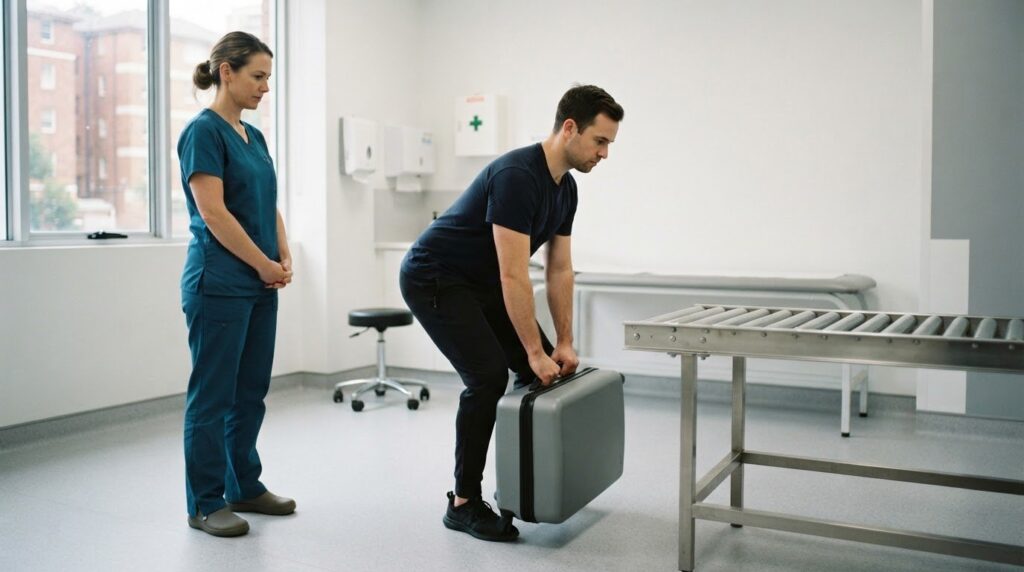
A job title alone doesn’t tell you what screening to expect. Pre-employment screening for aviation ground crew in Sydney depends on the employer and the role. Some positions require a medical assessment before starting, and Virgin Australia says roles with specific physical requirements may need a more comprehensive assessment. Certain operational roles may also involve drug and alcohol testing.
It’s understandable to want a clear picture before applying, especially because ground, baggage and aviation security roles can involve different duties. This article explains which roles may involve medical or drug and alcohol screening, what employers assess and what can affect approval. You’ll also learn how role-based pre-employment medicals help employers assess a candidate’s fitness for the job, making the process more predictable.
Key Takeaways
- Screening can differ between ramp, baggage and aviation security positions, so focus on the duties and requirements attached to the specific role.
- Some aviation roles require a pre-employment medical before starting, while positions with specific physical demands may involve a more comprehensive assessment.
- Certain operational roles may include drug and alcohol testing as part of the recruitment process.
- Understanding the required checks can help you anticipate what the employer may assess and why screening approval could take longer.
- Persona Health’s Pre-Employment Medicals can support employers assessing a candidate’s fitness for the demands of a role.
Which Sydney airport employers arrange and pay for ground crew screening?
The hiring organisation sets the screening process for each position. The airport named in an advertisement may be the worksite, not the employer. UAC Australia Pty Ltd advertised an Export Airfreight Licensed Security Screening role in Banksmeadow, while Certis Security Australia advertised a full-time Freight Security & Screening Supervisor vacancy in Mascot. These examples show who is recruiting for airport-related work, but do not establish that screening or payment arrangements are the same.
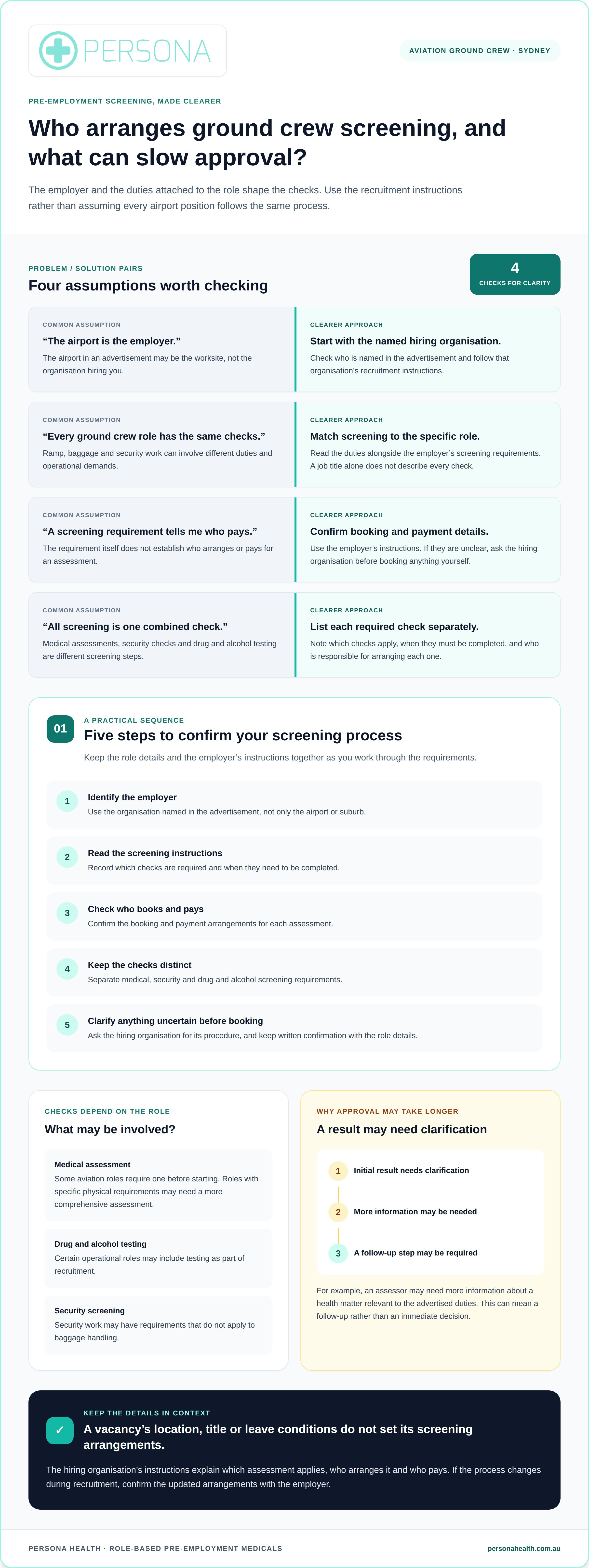
For employers, pre-employment screening for aviation ground crew in Sydney starts with the specific role. Check the employer named in the advertisement and follow its recruitment instructions. They should explain whether screening is required, which assessment applies, and who arranges and pays for it. A screening requirement alone does not determine who covers the cost. Don’t assume every airport worker books an assessment personally or that all employers use the same arrangement.
The duties help explain why screening may differ. Ramp and baggage roles can involve physical tasks, while freight security work has different operational demands. Security screening may also have requirements that do not apply to baggage handling. The job title is a starting point, not a complete description of the checks. Read the role description alongside the employer’s screening instructions.
Recruitment examples also show why the hiring organisation matters. A Western Sydney Airport ramp and baggage agent vacancy listed five weeks of annual leave and 15 days of personal leave. Those are employment conditions, not screening rules. Likewise, the full-time description for Certis Security Australia’s Mascot supervisor vacancy tells you about the role’s hours, not who pays for an assessment. Keep these details separate when reviewing an offer.
Some employers require a medical assessment before a successful candidate starts. Virgin Australia says some roles require a pre-employment medical assessment, and positions with specific physical requirements may need a more comprehensive assessment. Certain operational roles may also involve drug and alcohol testing. These examples show that checks can relate to the job, rather than applying uniformly to every aviation position.
To understand the arrangements for a specific Sydney vacancy, follow the recruitment process:
- Identify the employer. Use the organisation named in the advertisement, not only the airport or suburb.
- Read the screening instructions. Note which checks are required and when they must be completed.
- Check booking and payment details. The employer’s instructions should explain who arranges the assessment and who pays.
- Keep requirements distinct. A medical, security check and drug and alcohol test are separate screening steps.
- Clarify the process before booking. If instructions don’t explain payment or booking, ask the hiring organisation for its procedure.
This avoids a common mix-up: treating the airport, recruitment agency, contractor and employer as the same organisation. An advertisement for a Banksmeadow or Mascot role may name a company other than the airport operator. Use the named employer’s instructions to establish the process. If another organisation handles recruitment, confirm which party has provided the screening directions before making arrangements.
For applicants, pre-employment screening for aviation ground crew in Sydney depends on the employer’s process for the position. Local examples include UAC Australia Pty Ltd, Certis Security Australia and a Western Sydney Airport ramp and baggage role. Their locations and job titles alone do not determine screening costs. The written recruitment instructions set out the booking and payment steps for your position.
Use the organisation named in the advertisement when asking for clarification, and direct questions to its recruitment contact. Ask who books each required assessment, whether you need to pay any cost, and when the assessment must be completed. Get confirmation of the arrangements before booking anything yourself. If the instructions are unclear, ask for them in writing so you can distinguish a required screening step from a suggested next step. Keep the response with the role details and offer information, and check that it applies to the position you’re considering.
The Western Sydney Airport ramp and baggage agent vacancy listed 5 Weeks of annual leave and 15 days of personal leave. Those terms concern leave, not screening arrangements, so they do not establish who organises or pays for an assessment. Treat each detail in an advertisement according to what it actually describes. For a specific vacancy, rely on the hiring organisation’s instructions about screening rather than inferring payment responsibility from the worksite, job title, or employment conditions. If the process changes during recruitment, confirm the updated arrangements with the employer before proceeding.
What can delay or prevent aviation ground crew employment screening approval?
Screening follows the employer’s requirements for the position. For Sydney ground crew, the duties matter: ramp, baggage and security work can involve different demands. Virgin Australia says roles with specific physical requirements may need a more comprehensive medical assessment. Certain operational roles may also involve drug and alcohol testing. These requirements determine which checks apply and what information the employer needs to progress recruitment.
A medical assessment may take longer if an initial result needs clarification. For example, the assessor may need more information about a health matter relevant to the advertised duties. This can lead to a follow-up step rather than an immediate decision. The assessment considers the role’s requirements and the information available. The employer uses the outcome to decide whether the candidate can perform the work safely.
Physical requirements need to be considered in context. Baggage handling and ramp duties can involve different tasks, so an assessment should relate to the actual position rather than a general idea of airport work. If the employer requests a more comprehensive assessment, it is intended to consider specific role requirements. Clear referral information helps distinguish a follow-up assessment from a final recruitment decision.
Drug and alcohol screening is a separate process. Virgin Australia says certain operational roles may involve testing under a drug and alcohol management program. Screening can be delayed if a required step is incomplete or needs follow-up under the employer’s process. Don’t treat a medical assessment and a drug and alcohol test as interchangeable: each addresses a different part of recruitment screening.
Recruitment can also pause if the employer lacks information needed to proceed. An incomplete form, missing requested record or unclear response may prompt follow-up. A name or detail that differs across submitted documents may also need clarification. These are administrative issues, not necessarily a judgement about a candidate’s ability. Complete, consistent information helps the employer progress each required step.
Practical actions can help keep the process organised:
- Read each instruction carefully. Note every assessment requested for the role.
- Confirm the position being assessed. Ramp, baggage and security duties aren’t identical.
- Provide complete information. Answer assessment questions accurately and clearly.
- Attend requested appointments. Follow the employer’s directions for each screening step.
- Respond to follow-up requests. Provide relevant details through the stated process.
Medical history may need to be discussed during an assessment. A past injury or current condition does not, by itself, determine someone’s capacity for a particular job. The assessor considers how current capacity relates to the duties. For example, an assessment for physical tasks needs to take those tasks into account. Accurate information supports a role-specific evaluation and reduces unnecessary uncertainty.
Screening approval may be delayed if an assessment cannot reach a clear conclusion. The employer may need completed findings or further information before progressing recruitment. An extra question does not automatically prevent employment; it means more relevant information is needed to assess the advertised role. For pre-employment screening for aviation ground crew in Sydney, the employer’s referral and the position’s duties guide the medical assessment.
Workplace safety also involves responding appropriately when an injury occurs. InjuryQR is a FREE AI-powered workplace injury triage service available to all Australian businesses. It provides free posters, stickers, keyrings and fridge magnets. A worker scans a QR code without downloading an app, describes the injury by voice, then answers AI follow-up questions. The service can provide self-care advice, arrange telehealth, direct the worker to an Emergency Department or instruct them to call 000. Telehealth appointments are typically within 3-4 hours. Certificates of Capacity can be issued immediately where appropriate. This supports injury reporting and helps reduce Lost Time Injuries.
If the recruitment request involves a medical, understanding what happens during the assessment can help you prepare. Follow the employer’s written instructions and keep communication clear.
If you need help arranging an assessment, you can contact Persona Health about a pre-employment medical.
Airservices Australia says trainee air traffic controller training is approximately 12 months. That figure concerns training for a different aviation role, so it should not be treated as a screening approval estimate for ground crew recruitment.
For a ground crew application, follow the employer’s instructions about any outstanding assessment or information request. Ask the recruitment contact what step remains and whether you need to provide anything further. Keep your enquiry focused on the actual role rather than assuming another aviation pathway sets the timing.
Persona Health: Pre-Employment Medicals
Persona Health provides role-focused Pre-Employment Medicals, Australia-wide mobile workplace services, fast turnaround, responsive customer service and modern digital reporting. Its prominent Sydney clinics are in Gregory Hills and Rosebery, alongside Parramatta and Dee Why; Melbourne clinics are in Cairnlea and Craigieburn, with 100 affiliate clinics nationwide.
Assessments are guided by the role and employer’s referral. Persona Health’s pre-employment medicals in Sydney support this recruitment step. A medical assessment is separate from security checks and any distinct screening arranged by the employer.
If you’re arranging a role-related medical, contact Persona Health to discuss the next step.
Make the next screening step clear
For employers arranging pre-employment screening for aviation ground crew in Sydney, start by matching the assessment to the role. Give candidates clear instructions about the assessment, any required documents and how results fit into recruitment. This helps everyone understand the next step and keeps a medical assessment distinct from other employment checks.
Persona Health provides Pre-Employment Medicals, alongside Workplace Injury Management and Crystalline Silica Medicals for other workplace health needs. For an aviation candidate, the relevant service is a pre-employment assessment aligned with the employer’s role requirements. Clear referral information helps keep the assessment focused on the position.
A well-defined process makes recruitment requirements clearer for employers and candidates alike.
Frequently Asked Questions
What pre-employment checks are required for aviation ground crew in Sydney, Australia?
There is no single checklist for every Sydney aviation ground crew role. The employer sets the checks for each position, which may include a medical assessment, security checks or other recruitment steps. A pre-employment medical can assess medical history and physical capacity, with components selected for the role. Before attending, use the employer’s instructions to identify the required assessments and whether separate screening appointments are involved.
Are aviation ground crew required to pass drug and alcohol testing before employment?
Drug and alcohol testing is not automatically required for every aviation ground crew job. Virgin Australia says certain operational roles may involve testing under a drug and alcohol management program. The employer’s recruitment instructions determine whether it applies to your position and how it fits into screening. If testing is requested, follow the stated process and keep it distinct from a medical assessment, which considers health and capacity for role-related duties.
What medical fitness, hearing or vision checks do ground crew roles require?
The checks depend on the role and the employer’s referral. A pre-employment medical may include a medical history assessment, physical examination, musculoskeletal examination, and vision, hearing or respiratory tests. An optional cardiovascular fitness test may also be part of the assessment. These components are not automatically required for every ground crew position. The employer’s referral helps the medical professional focus on the vacancy’s specific duties and screening requirements.

Article by
Ian Nicholson
Ian is the Business Support Manager at Persona Health, where he plays a key role across IT, sales, marketing and business operations. With a broad skill set and a practical, solutions-focused approach, Ian helps drive the systems, communication and commercial strategy that support Persona Health’s continued growth across Australia.