

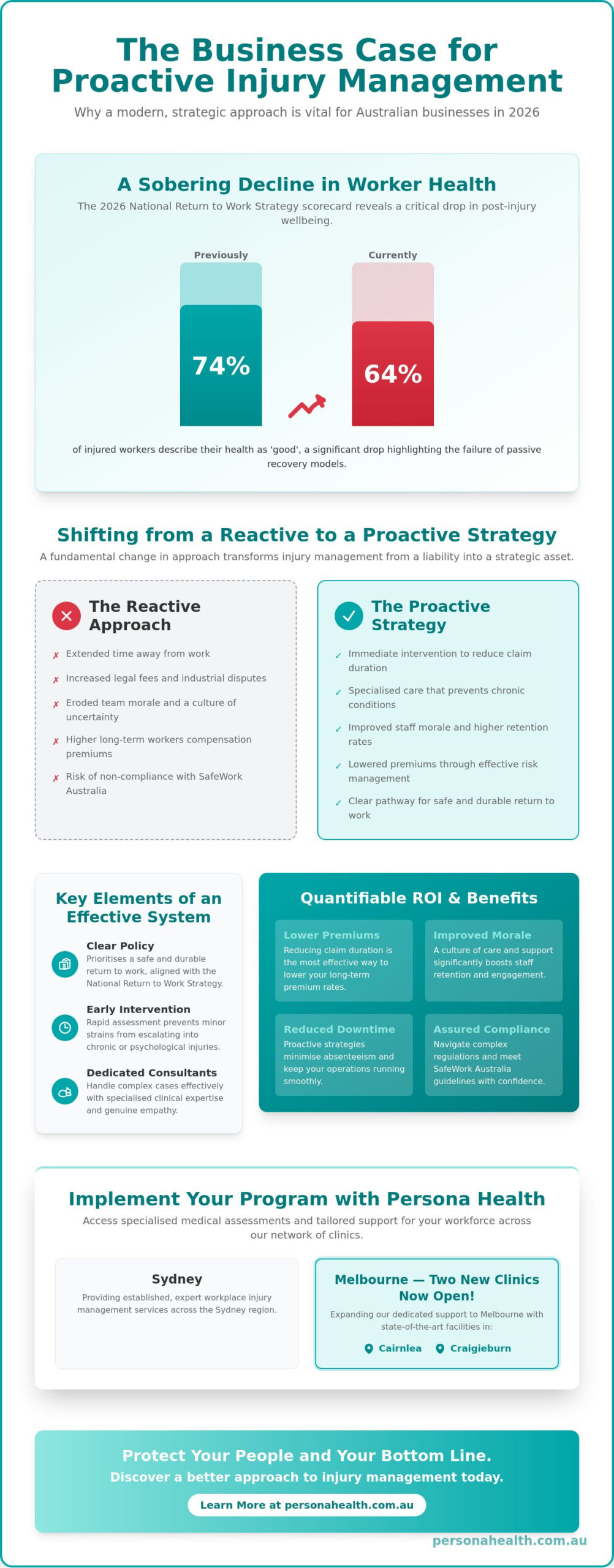
Did you know that the proportion of injured workers who describe their health as good has dropped from 74% to just 64% according to the 2026 National Return to Work Strategy scorecard? It’s a sobering statistic that highlights why a passive approach to recovery no longer works for modern Australian businesses. You’re likely facing the dual pressure of rising workers compensation premiums and the fear of falling short of SafeWork Australia standards. Developing a strong business case for injury management program is no longer just a compliance task; it’s a vital move to protect your people and your bottom line.
This guide shows you how a strategic program reduces operational downtime while fostering a culture of genuine care. We’ll examine the latest 2026 data, such as Victoria’s stable 1.8% premium rate and the significant legislative shifts in New South Wales. You’ll also learn how our specialized workplace injury management services at our new Cairnlea and Craigieburn clinics offer the clinical expertise and empathy needed to support individual recovery. We’ll provide a clear framework for ROI and improved employee morale, ensuring your business remains resilient in an evolving industrial landscape.
Key Takeaways
- Learn how to quantify the financial impact of workplace incidents and why reducing claim duration is the most effective way to lower your long term premiums.
- Navigate the latest 2026 regulatory updates from SafeWork Australia to ensure your business remains compliant across different state jurisdictions.
- Discover why a proactive health strategy that prioritises safe and durable return to work is essential for maintaining staff morale and retention.
- Build a compelling business case for injury management program by integrating a dedicated Injury Management Consultant to handle complex cases effectively.
- Explore how Persona Health’s specialised clinics in Sydney and our new Melbourne sites in Cairnlea and Craigieburn provide tailored support for your workforce.
Why Your Business Needs a Robust Injury Management Program in 2026
In 2026, the standard for Australian workplace safety has evolved far beyond simple compliance. A modern injury management program is no longer a reactive checklist used after an incident occurs. Instead, it serves as a proactive health strategy designed to support the unique needs of every worker while protecting the commercial interests of the employer. By viewing recovery through a clinical yet empathetic lens, businesses can ensure that an injury doesn’t become a permanent exit from the workforce. This shift in perspective is the foundation of a strong business case for injury management program development, as it directly addresses the 2026 National Return to Work Strategy findings that show only 64% of injured workers currently feel their health is at an optimal level.
The link between early intervention and reduced claim duration is undeniable. When a worker receives immediate, specialized care, the path to vocational rehabilitation becomes clearer and more efficient. Rapid assessment prevents minor physical strains from escalating into chronic conditions or secondary psychological injuries, which often carry much higher compensation costs. By integrating specialized medical assessments into your daily operations, you demonstrate a commitment to your team’s long term wellbeing. This approach is particularly vital in our new Melbourne clinics in Cairnlea and Craigieburn, where we focus on activating an individual’s internal resources for a faster, safer recovery.
To better understand how early intervention can transform your approach, watch this helpful video:
The High Cost of Doing Nothing
Relying solely on a general practitioner who may not understand your specific industry requirements often leads to extended time away from work. This delay doesn’t just increase legal fees and industrial disputes; it deeply erodes team morale. When colleagues see an injured peer struggling without a clear plan, it creates a culture of uncertainty. A structured workplace injury management plan ensures every step follows SafeWork Australia standards, providing a sense of security and predictability for everyone involved. Without it, the hidden costs of absenteeism and staff turnover can quickly outweigh any perceived savings from a “wait and see” approach.
Shifting from Reactive to Proactive Care
A truly effective business case for injury management program investment begins before a worker even starts their first shift. Integrating injury management with pre-employment medicals allows you to understand the baseline health of your workforce from day one. In 2026, this requires a digital-first approach to reporting, such as using InjuryQR to ensure data is captured accurately and instantly. Having a pre-defined medical provider network in place across Sydney and Melbourne ensures that when an incident does happen, your employees are immediately placed in expert hands. This level of preparedness transforms your injury management from a burden into a strategic asset that supports both individual recovery and corporate stability.
Key Elements of an Effective Injury Management System
A successful system relies on a clear policy that prioritises safe and durable return to work. It isn’t just about ticking boxes for compliance. It’s about creating a predictable environment where workers feel supported. Aligning your internal protocols with the National Return to Work Strategy ensures your business follows evidence-based principles that reduce the impact of injuries. This alignment strengthens the business case for injury management program investment by proving to stakeholders that your approach is grounded in national best practices. When workers know there’s a structured path back to their roles, it reduces the anxiety that often accompanies a workplace incident.
One practical tool is a library of suitable duties. Having pre-approved, light-duty roles ready for different departments means an injured worker can stay connected to the workplace. This prevents the isolation that often leads to secondary psychological claims. A solid business case for injury management program success also includes having a dedicated Injury Management Consultant for complex cases. These specialists navigate the medical and industrial hurdles that can stall progress. They act as a vital bridge, ensuring that the worker’s recovery goals align perfectly with the operational needs of your business.
The Role of the Occupational Physician
Specialised medical knowledge is superior to general practice for workplace cases because it focuses on functional capacity rather than just symptoms. An Occupational Physician understands the physical and cognitive demands of your specific industrial roles. They facilitate clear, clinical communication between the employer, the insurer, and the worker. This ensures that every medical assessment is tailored to specific job requirements. At our clinics in Sydney and our new Melbourne sites in Cairnlea and Craigieburn, we focus on these precise clinical details to build trust. This clinical authority helps resolve disputes before they escalate into costly legal battles.
On-Site Health Surveillance and Prevention
Prevention is a core pillar of any robust system. Implementing on-site health surveillance allows you to monitor hazardous exposures before they lead to a claim. Whether it’s monitoring for crystalline silica or assessing noise levels, regular health checks identify risks early. This data-driven approach helps you identify trends in workplace health, allowing you to update safety training where it’s needed most. Identifying these patterns early reduces the likelihood of long-term claims that can impact your premiums for years. If you’re looking to strengthen your workforce’s resilience, consider how fitness for duty medicals can provide the baseline data you need for a safer, more stable site.
Quantifying the ROI: The Financial Business Case for Injury Management
For many Australian boards, safety is often viewed as a line item expense rather than a strategic financial asset. However, a compelling business case for injury management program investment reveals that the cost of inaction is far higher than the cost of prevention. Your workers compensation premium isn’t a fixed tax. It is a variable cost influenced heavily by your claims experience. In New South Wales, for example, the premium increase capping for experience rated employers will be reduced to 25% for policies starting on or after 30 June 2026. This means businesses with poor claim performance face immediate and significant financial penalties, while those with robust systems can maintain much lower operational overheads.
One large claim doesn’t just impact your balance sheet today; it creates a multiplier effect that haunts your insurance profile for years. When a worker is away for 13 weeks or more, the likelihood of a successful return to work drops significantly. This triggers higher statutory payments and medical costs that inflate your future premiums. By proactively managing these cases through our specialized injury management services, you can prevent minor incidents from becoming long term liabilities. This financial stability is why we’ve expanded our reach to new clinics in Cairnlea and Craigieburn, helping Melbourne businesses protect their margins through better clinical outcomes.
Direct vs Indirect Cost Savings
Direct savings are the most visible, including reduced insurance premiums and lower medical costs. Yet, these are just the tip of the iceberg. Indirect savings involve the retention of skilled staff and the avoidance of recruitment fees, which can cost up to double an employee’s annual salary. When an incident occurs, the loss of productivity and the time spent by management on administrative hurdles create a heavy burden on the team. Research indicates that these indirect costs are often four times higher than direct costs. A structured program mitigates these hidden drains on your resources by ensuring a seamless transition back to full productivity.
Case Study: The Impact of Early Intervention
Consider the difference between a managed and unmanaged claim. According to 2022 Safe Work Australia data, the median compensation for a serious psychological injury was $55,270, compared to $13,883 for physical injuries. Without professional intervention, physical injuries often lead to secondary psychological distress due to isolation and financial worry. The “Stay at Work” model flips this script. By providing modified duties and clinical support from day one, you keep the worker engaged and valued. This accelerates physical recovery and prevents the escalation of claim costs. Our clinics in Sydney and Melbourne focus on this precise, individualised care to ensure that your business case for injury management program success is backed by measurable financial results.
Navigating Compliance and SafeWork Australia Guidelines
Meeting the national standards set by SafeWork Australia is a non-negotiable requirement for every Australian employer. While the overarching goal is always a safe return to work, the regulatory landscape varies significantly between states. For instance, the Workers Compensation Legislation Amendment (Reform and Modernisation) Act 2026 in New South Wales has introduced stricter thresholds for psychological injuries, raising the Whole Person Impairment (WPI) requirement to 25%. Failing to align your internal policies with these specific regional laws leaves your business vulnerable to litigation and administrative penalties. A robust business case for injury management program development must account for these regulatory nuances to ensure your documentation stands up to the closest scrutiny.
A written Injury Management System (IMS) is a legal necessity. It provides a clear, documented framework that outlines how your organisation will manage injuries from the moment they occur. By using professional medical providers to oversee this system, you ensure that every decision is backed by clinical authority. This is especially important when dealing with multi-state operations where you must navigate the different expectations of regulators in Sydney and Melbourne. Our new clinics in Cairnlea and Craigieburn are specifically positioned to help Victorian employers meet WorkSafe Victoria standards while maintaining national consistency. It’s about building trust through transparency and clinical excellence.
SafeWork Australia and Your Legal Obligations
The 2026 legislative environment demands a proactive pathway for returning injured workers to the workplace. If you fail to provide suitable duties or a clear recovery plan, you risk breaching your duty of care. SafeWork Australia provides resources to benchmark your program, but the implementation requires clinical expertise. A well-constructed IMS doesn’t just meet the law; it protects your reputation and financial stability. It ensures that every worker feels they are in expert hands, which is a key component of the business case for injury management program success. In an era of increased scrutiny on scheme sustainability, being compliant is your best defence against rising operational costs.
Fitness for Duty and Medical Compliance
Objective medical evidence is the cornerstone of any workers compensation case. Ensuring that fitness for duty assessments meet industrial standards is vital for making informed decisions about a worker’s capacity. These assessments must be conducted by specialists who understand the Australian health records acts and privacy requirements. Managing confidentiality while communicating functional capacity to the employer is a delicate balance. By using specialised providers, you ensure that your medical assessments are both legally compliant and clinically sound. If you need to verify that your current processes meet these 2026 standards, our injury management experts can review your documentation to ensure full compliance.
Implementing Your Program with Persona Health in Melbourne and Sydney
Moving from a reactive model to a proactive partnership is the final step in solidifying your business case for injury management program success. Many organisations find themselves trapped in a cycle of managing incidents only after they occur, which often leads to fragmented care and escalating costs. By partnering with Persona Health, you transition to a model where every industrial role is understood from a clinical perspective. We tailor our services to your specific industry needs, ensuring that whether you operate in heavy manufacturing or high volume logistics, your recovery protocols are fit for purpose. This bespoke approach ensures that your workforce remains resilient and your operational downtime is kept to an absolute minimum.
Our presence across both New South Wales and Victoria allows for a seamless management experience for firms with interstate operations. We understand that the local Australian industrial landscape is complex, with different regulatory nuances in every state. Having a partner that can navigate these differences while maintaining a consistent standard of care is a significant strategic advantage. It ensures that your internal documentation and return to work pathways are always aligned with the latest SafeWork Australia expectations, regardless of where your team is located. This consistency is vital for building trust with your employees and maintaining a stable corporate insurance profile.
Melbourne Focus: New Clinics in Cairnlea and Craigieburn
We are proud to announce the expansion of our reach within Melbourne’s growing industrial sectors. Our two new clinics in Cairnlea and Craigieburn are strategically positioned to provide faster access to care for businesses in the northern and western suburbs. Speed is a critical factor in any business case for injury management program because the sooner an assessment occurs, the less likely a claim is to become long term. These local facilities offer the same high standard of clinical excellence and empathetic support that our Sydney clients have come to rely on. By providing localised support, we help Melbourne employers reduce the logistical hurdles that often delay the start of an effective recovery plan.
The Persona Health Difference
Our approach to occupational medicine is built on a foundation of professional authority and deep empathy. We don’t see workers as claim numbers; we see them as individuals with unique physiological needs. This philosophy extends across our entire service suite, from conducting thorough pre-employment medicals to overseeing complex injury recovery. By integrating these services, we create a holistic health profile for your workforce that informs every stage of the employment lifecycle. This integrated model is why many of the most respected firms in Sydney and Melbourne choose us as their long term health partner.
If you’re ready to transform your workplace safety culture and protect your bottom line, it’s time to take the next step. Our team is here to help you activate the internal resources of your organisation and your people. We invite you to speak with an Injury Management Consultant today to discover how a tailored partnership can secure the future of your business.
Securing the Future of Your Workforce
Building a strong business case for injury management program investment is about more than just managing insurance costs. It is about creating a culture where every individual feels supported and every operational risk is carefully mitigated. By acknowledging that indirect costs are often four times higher than direct medical expenses, you can justify the shift toward proactive, clinical intervention. We have explored how 2026 regulatory changes make specialised oversight essential for maintaining compliance and protecting your bottom line.
Persona Health has been a trusted leader in Australian industrial health since 2016. With our specialised clinics now open in Cairnlea and Craigieburn, we provide localised support that combines clinical authority with deep empathy. Our expert Injury Management Consultants and Medical Examiners are ready to help you navigate the complexities of the modern industrial landscape. We focus on the unique needs of the human body to ensure every recovery is safe and durable.
Partner with Persona Health to build your injury management business case today. Together, we can transform your approach to workplace safety and ensure your business remains resilient for years to come.
Frequently Asked Questions
What is the primary goal of an injury management program?
The primary goal is to achieve a safe, durable, and early return to work for every injured employee. It focuses on the individual’s functional recovery while maintaining their vital connection to the workplace. By prioritising the worker’s physical and psychological wellbeing, the program ensures that the recovery process is both supportive and efficient. This approach minimises the long term impact of an injury on the person’s life and the business’s productivity.
How does an injury management program reduce workers compensation premiums?
It reduces premiums by significantly lowering the average claim duration and the total cost of medical expenses. Since workers compensation premiums in Australia are experience rated, fewer lost time injuries directly translate into lower future costs for the employer. Developing a robust business case for injury management program investment relies on this clear link between better clinical outcomes and the reduction of expensive, long term claims that drive up insurance overheads.
Is an injury management system legally required in Australia?
Yes, most Australian jurisdictions require employers to have a documented injury management system or return to work program in place. While specific requirements vary between states like New South Wales and Victoria, the overarching standards are guided by SafeWork Australia. Failing to maintain these systems can lead to significant penalties and non-compliance notices. It’s essential to have a written framework that outlines exactly how your organisation handles workplace incidents and supports worker recovery.
What is the difference between injury management and return to work?
Injury management is the broad, clinical process that includes medical treatment, rehabilitation, and administrative coordination, while return to work is the specific outcome or plan. Think of injury management as the entire journey of care that supports the individual’s healing. Return to work is the structured roadmap of duties and milestones that guides the worker back into their professional role. Both must work in harmony to ensure the recovery is successful and lasting.
How can a small business afford a formal injury management program?
Small businesses can access formal expertise by partnering with external providers rather than maintaining expensive in-house teams. By using specialised services at our clinics in Cairnlea or Craigieburn, smaller firms can access top tier medical knowledge on a per-use basis. This strategic partnership prevents the devastating indirect costs of unmanaged claims, such as lost productivity and high staff turnover. It allows smaller employers to provide the same level of care as large corporations.
What role does SafeWork Australia play in injury management?
SafeWork Australia is the national policy body that develops the frameworks and strategies used by state regulators to manage workplace safety. They publish the National Return to Work Strategy, which sets the benchmark for best practice across all Australian industries. While they don’t regulate individual claims, their guidelines inform the laws that employers must follow. Adhering to their evidence-based principles ensures that your internal injury management program remains compliant and effective at a national level.
Can I choose my own occupational physician for my business?
Yes, employers have the right to establish a relationship with a preferred occupational physician to ensure consistency in medical assessments. While an injured worker has the right to choose their initial treating doctor, having a preferred provider ensures the physician understands your specific workplace risks and suitable duties. This professional partnership leads to more accurate fitness for duty assessments. It ensures that medical decisions are always tailored to the unique physical demands of your specific industry.
How quickly should a worker be seen by a doctor after a workplace injury?
A worker should ideally be seen by a medical professional within the first 24 hours following an incident. Early clinical assessment is the most effective way to prevent a minor strain from escalating into a chronic condition or a complex psychological claim. Rapid intervention is a core pillar of a successful business case for injury management program implementation. It demonstrates immediate support for the individual and allows the recovery process to begin before complications arise.

Article by
Ian Nicholson
Ian is the Business Support Manager at Persona Health, where he plays a key role across IT, sales, marketing and business operations. With a broad skill set and a practical, solutions-focused approach, Ian helps drive the systems, communication and commercial strategy that support Persona Health’s continued growth across Australia.