
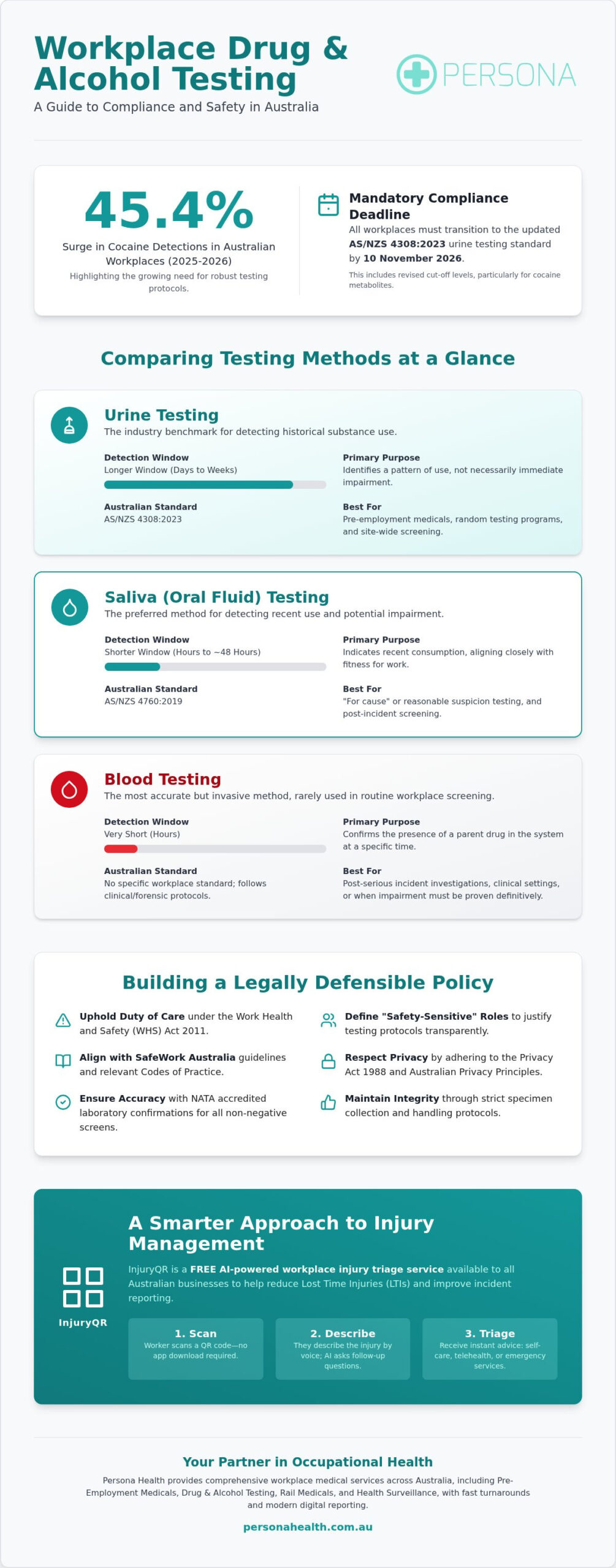
Did you know that cocaine detections in Australian workplaces surged by 45.4% between 2025 and 2026? This sharp increase, alongside the rising prevalence of amphetamine-type substances, means that a robust workplace drug testing policy australia is no longer just a compliance requirement; it’s a vital part of your primary duty of care. We understand that balancing safety with employee morale is a delicate task, especially with the mandatory 10 November 2026 deadline for the new AS/NZS 4308:2023 urine testing standard fast approaching. You deserve a professional partner who views your employees as individuals, not just data points.
At Persona Health, we believe that clarity leads to confidence. This guide will help you discover the critical differences between urine, saliva, and blood testing methods to ensure your workplace remains safe, compliant, and productive. We’ll provide a clear understanding of detection windows and WHS legislation, helping you choose the right approach for your specific industry. We’ll also touch on how tools like InjuryQR can support your broader safety strategy, giving you a practical roadmap to minimise risk while maintaining the supportive, healthy environment your team relies on.
Key Takeaways
- Learn about the mandatory compliance deadline for the new AS/NZS 4308:2023 urine testing standard and how revised cut-off levels affect your safety protocols.
- Understand the distinct detection windows of each method, including why saliva testing is preferred for recent impairment while urine remains the benchmark for historical use.
- Discover the essential steps to develop a legally defensible workplace drug testing policy australia that aligns with SafeWork Australia guidelines and privacy legislation.
- Gain insights into matching testing protocols with specific industry risks to address the significant 2026 increase in workplace stimulant detections.
- See how leveraging Persona Health’s national clinic network and the free InjuryQR triage service can streamline your risk management and reduce lost time injuries.
Drug and Alcohol Testing in the Australian Workplace
Ensuring every team member returns home safely at the end of their shift is the heartbeat of a robust workplace drug testing policy australia. Within the Australian occupational health landscape, testing isn’t about policing personal lives; it’s a proactive risk management tool designed to identify impairment that could lead to workplace incidents. Under the Work Health and Safety (WHS) Act 2011, Persons Conducting a Business or Undertaking (PCBUs) have a primary duty of care to ensure the health and safety of workers. Implementing a clear, empathetic screening process helps you meet this obligation while supporting a culture of wellbeing.
Different industries require different approaches. For high-risk sectors like transport or those requiring Cat 3 Rail Medicals, the margin for error is non-existent. Employers typically rely on various drug testing methods, including urine, saliva, and occasionally blood, to maintain site integrity. While blood testing is rare and usually reserved for clinical or post-accident hospital settings, urine and saliva remain the primary tools for day-to-day workplace safety.
The Role of Australian Standards
To remain legally defensible, your testing must align with specific Australian Standards. For urine-based screening, the benchmark is AS/NZS 4308. It’s vital to note that all Australian workplaces must transition to the updated AS/NZS 4308:2023 standard by 10 November 2026. This update includes revised cut-off levels, particularly for cocaine metabolites, which have been lowered to 150 ng/mL for screening. For oral fluid or saliva testing, we look to AS/NZS 4760:2019, which provides the framework for specimen collection and detection of drug classes like THC, opiates, and amphetamine-type substances. Choosing a partner that uses NATA accredited laboratory partners for confirmatory testing ensures that your results are accurate and stand up to scrutiny if challenged.
Duty of Care and WHS Legislation
The workplace drug testing policy australia you implement must balance the collective safety of the team with the individual’s right to privacy. SafeWork Australia provides guidance on managing risks, but the practical application often falls on identifying “safety-sensitive” roles. These are positions where impairment could result in significant harm, such as operating heavy machinery, driving commercial vehicles, or working at heights. In these instances, regular drug and alcohol testing becomes a critical safety barrier. By clearly defining these roles in your policy, you create a transparent environment where safety is prioritised and every individual feels supported in a secure, risk-aware workplace.
The Science of Detection: How Different Tests Work
To implement an effective workplace drug testing policy australia, it’s helpful to understand what happens inside the body after a substance is consumed. When drugs enter the system, the liver begins to metabolise them, breaking them down into secondary compounds known as metabolites. While some tests look for the “parent” drug, others specifically target these metabolites to confirm prior use. This distinction is vital because it determines whether a test indicates immediate impairment or historical consumption. We know that for many employers, the goal isn’t just to catch people out, but to ensure everyone is in the right headspace to perform their roles safely.
Integrity is the foundation of every screening we perform. In a clinical setting, such as during a pre-employment medical, our staff follow strict protocols to prevent sample tampering. We monitor specimen temperature and check for adulterants to ensure the results truly reflect the individual’s health status. This meticulous approach helps reduce the risk of false positives, which can cause unnecessary distress for workers and legal headaches for businesses.
Detection Windows for Common Substances
Choosing the right medium depends on the “window” you need to see. Urine testing is frequently used because it offers a broad detection window, typically ranging from a few days to several weeks depending on the substance and frequency of use. In contrast, saliva testing is excellent for identifying recent consumption, often within the last 12 to 24 hours. This makes it a preferred choice for random on-site checks where the focus is on immediate safety. While blood testing provides high-precision data, its invasive nature and very short detection window mean it’s usually reserved for hospital-based post-incident investigations rather than standard drug and alcohol testing.
Reliability and Confirmatory Testing
Most workplace programs begin with an initial immunoassay screen, which provides rapid results. If a “non-negative” result occurs, we move to laboratory-based Gas Chromatography-Mass Spectrometry (GC-MS). This secondary process is the gold standard for accuracy, as it can pinpoint specific molecules and eliminate interference from common over-the-counter medications. To ensure these results are legally robust, we adhere to a strict chain of custody. The chain of custody protocol is a meticulous documentation process that tracks a specimen from the point of collection to the final laboratory analysis to ensure the sample remains secure and untampered with. If you’re looking to refine your current approach, feel free to speak with our team for tailored advice on matching testing methods to your industry risks.
Comparing Urine, Saliva and Blood Testing Methods
Selecting the most appropriate screening method for your workplace drug testing policy australia depends largely on what you’re trying to achieve. Are you screening a new hire to ensure they don’t have a pattern of substance use, or are you conducting a random check on a factory floor? Each method offers distinct advantages in terms of detection windows and practical application. Understanding these nuances helps you build a policy that’s both fair to your team and rigorous in its safety standards. Most Australian businesses find that a combination of methods, tailored to specific scenarios, provides the most comprehensive risk coverage.
- Urine Testing: This remains the primary choice for drug and alcohol screening in Parramatta and Sydney. It’s cost-effective and provides a wide detection window, making it ideal for identifying long-term patterns of use during the onboarding process.
- Saliva Testing: Often preferred for on-site health surveillance, oral fluid testing is less invasive and focuses on recent consumption. It’s the go-to for random screening where immediate safety is the priority.
- Blood Testing: While it provides the most definitive evidence of drug concentration in the system, its invasive nature makes it impractical for most workplace settings. It’s typically reserved for clinical environments following a serious incident where legal evidence of impairment is required.
Pros and Cons for Employers
From a logistical perspective, saliva testing often wins on speed. Results are available almost immediately, which is crucial for maintaining business continuity in fast-paced environments. However, urine testing is often seen as more robust for pre-employment medicals due to its established history and lower cost per test. You should also consider employee morale. Some workers find urine collection intrusive, whereas saliva swabs are generally viewed as more respectful and less awkward. For businesses with remote operations, our network of 100 affiliate clinics ensures that regardless of the method chosen, your team has access to professional, clinical collection services Australia-wide.
Impairment vs Detection: The Key Difference
This is a critical distinction in Australian WHS law. A positive urine test indicates that a substance was consumed at some point in the recent past, but it doesn’t necessarily prove that the worker is impaired at the moment of the test. For example, THC can remain detectable in urine for days after use. In contrast, saliva testing has a much shorter detection window. It’s specifically designed to catch substances consumed within the last few hours, making it a more accurate proxy for current impairment. This distinction is vital when managing workers’ compensation claims or potential legal challenges. If a policy is too focused on historical use rather than current safety, it may face scrutiny under the Privacy Act 1988 or during industrial relations disputes. Balancing these factors ensures your policy protects the site without overstepping into your employees’ private lives.
Selecting the Right Testing Protocol for Your Business
Creating a robust workplace drug testing policy australia requires more than just picking a test; it requires a culture of transparency and trust. We recommend developing your policy in direct consultation with your workers and union representatives where applicable. This collaborative approach ensures that the program is viewed as a supportive safety measure rather than a punitive tool. When everyone understands the “why” behind the screening, compliance increases and the fear of legal challenges regarding privacy begins to fade. Consistency is your strongest shield against potential discrimination claims, so ensure your protocols are applied equally across all relevant roles.
Integrating screening into your pre-employment medicals is a logical first step for most Australian businesses. It allows you to identify potential risks before a candidate enters a safety-sensitive environment, protecting both the individual and their future colleagues. By establishing these expectations early, you set a clear standard for workplace conduct and safety from day one.
Industry-Specific Requirements
Different sectors face unique regulatory pressures that dictate the type of testing required. For example, the rail industry must adhere to the National Standard for Health Assessment of Rail Safety Workers, which often necessitates specific Cat 3 rail medicals. In the construction and infrastructure space, meeting SafeWork NSW or WorkSafe Victoria guidelines is essential for maintaining site access and insurance compliance. Similarly, the logistics sector relies on commercial driver medicals to ensure heavy vehicle operators meet the stringent health standards required by Transport for NSW and other state regulators.
Best Practice Implementation
A policy is only as effective as the people who manage it. Training your supervisors to recognise the subtle signs of impairment, such as changes in coordination, slurred speech, or unusual irritability, is vital. This training empowers them to trigger “for cause” testing with confidence and empathy when they have reasonable suspicion of a safety risk. It’s not about making accusations; it’s about checking in on a team member’s fitness for work. Managing the resulting data is equally important; all test results must be handled as sensitive health information in strict accordance with the Privacy Act 1988 and the Australian Privacy Principles. We provide modern digital reporting to help you manage this information securely and efficiently, ensuring your business remains compliant and your workers’ privacy is respected.
Professional Screening Solutions with Persona Health
Implementing a workplace drug testing policy australia is a significant step toward a safer environment, but the true value lies in how that policy is executed. At Persona Health, we provide tailored drug and alcohol testing solutions that respect the individual while protecting the collective. While we offer extensive support through our specialist clinics in Gregory Hills and Rosebery, our team also provides dedicated care at our sites in Parramatta and Dee Why in Sydney, as well as Cairnlea and Craigieburn in Melbourne. Whether you visit us in person or require access to our nationwide network of 100 affiliate sites, we ensure your team receives professional, clinical care. Our employer-focused approach means you get fast digital reporting and responsive customer service, allowing you to make informed decisions without delay.
Integrated Health Surveillance
Safety is rarely about a single factor. We often find that businesses achieve the best results by combining drug screening with comprehensive on-site health surveillance. This integrated approach allows us to monitor for a variety of occupational risks, from crystalline silica exposure to noise-induced hearing loss, all in one visit. For many of our clients, our Australia-wide mobile services are a practical solution. We bring the clinical expertise directly to your worksite, minimising downtime and ensuring your risk management strategy is both thorough and empathetic to your workers’ schedules.
InjuryQR: Triage Support for Australian Workplaces
Effective risk management doesn’t end when an incident occurs; it’s about how you respond in those first critical moments. To support our partners, we introduce InjuryQR, a free AI-powered workplace injury triage service available to all Australian businesses. We provide free posters, stickers, keyrings, and fridge magnets to ensure this service is easily accessible across your entire facility. When a worker scans the QR code, they describe their injury by voice, and the AI asks targeted follow-up questions to determine the best course of action. Outcomes include immediate self-care advice, a telehealth appointment (typically within 3-4 hours), or direction to an Emergency Department or 000 for serious cases.
This streamlined process is designed to reduce Lost Time Injuries (LTIs) and improve reporting accuracy across your organisation. Certificates of Capacity can be issued immediately where appropriate, ensuring the return-to-work process begins as soon as possible. By integrating these modern digital tools into your safety framework, you demonstrate a commitment to your team’s wellbeing that goes far beyond simple compliance. It’s about providing a safety net that is always available, ensuring every worker feels supported from the moment they start their shift until they return home safely.
Building a Safer, Compliant Future for Your Team
Choosing the right testing method isn’t just about meeting a legal requirement; it’s about creating a protective shield for your most valuable asset: your people. Whether you opt for the broad detection window of urine testing or the impairment-focused accuracy of saliva screening, your choice must align with a robust workplace drug testing policy australia. By transitioning to the new AS/NZS 4308:2023 standard before the November 2026 deadline, you ensure your protocols remain legally defensible and scientifically sound.
Our specialist clinics in Gregory Hills and Rosebery are ready to support your business with precise, NATA accredited laboratory results. We don’t just provide tests; we offer a partnership that includes modern digital reporting and our free InjuryQR triage service to manage post-incident risks effectively. You’re never alone in this process. Our team is here to guide you through the complexities of WHS legislation with empathy and clinical expertise.
Let’s work together to ensure every member of your team feels secure, valued, and safe every single day.
Frequently Asked Questions
How long do drugs stay in your system for a urine test?
Most substances remain detectable in urine for between two and five days, though factors like metabolism and frequency of use play a role. Chronic cannabis use can sometimes be detected for several weeks. This extended window makes urine screening the preferred choice for pre-employment medicals at our Gregory Hills and Rosebery clinics. It provides a reliable historical overview of substance use, helping you ensure that new hires align with your safety culture.
Is saliva testing as accurate as urine testing in Australia?
Saliva testing is highly accurate for its intended purpose: detecting recent drug use and potential impairment. When conducted according to AS/NZS 4760:2019, it provides reliable results for substances consumed within the last 12 to 24 hours. While urine testing covers a longer historical window, saliva is the benchmark for random on-site screening. It’s less invasive and offers a more immediate reflection of a worker’s current fitness for duty on the day of testing.
What substances are typically screened in a pre-employment drug test?
Standard workplace screenings in Australia typically target five main drug classes: cannabinoids (THC), opiates, amphetamine-type substances (including methamphetamines), cocaine, and benzodiazepines. Under the updated AS/NZS 4308:2023 standard, the screening cut-off for cocaine metabolites has been significantly lowered to 150 ng/mL. Our NATA accredited laboratory partners ensure that every screen is comprehensive and compliant with the latest regulatory changes, providing you with high-quality, defensible data for your recruitment decisions.
Can I refuse a drug test at work under Australian law?
You have the right to refuse a test, but doing so often constitutes a breach of your employment contract or safety obligations. If your employer has a clear workplace drug testing policy australia and you work in a safety-sensitive role, refusal is generally treated with the same severity as a positive result. This can lead to immediate stand-down or disciplinary action. It’s important to remember that these policies are designed to protect the safety of everyone on site.
How long does it take to get results from a workplace drug test?
Initial screening results are usually available within minutes of the specimen collection. If the initial result is “non-negative,” the sample must be sent to a laboratory for confirmatory testing, which typically takes between 24 and 72 hours. Persona Health prioritises fast digital reporting to ensure your business continuity isn’t disrupted. We understand that waiting for results can be a period of uncertainty for both the employer and the worker, so we focus on responsive communication.
What happens if a worker provides a non-negative result?
A non-negative result means a substance was detected during the initial screen, but it’s not yet a confirmed positive. The sample is secured under a strict chain of custody and sent to a NATA accredited laboratory for Gas Chromatography-Mass Spectrometry (GC-MS) analysis. This process identifies specific molecules and rules out interference from medications. During this time, the worker is usually moved to non-safety-sensitive duties or stood down until the final laboratory report is received and verified.
Are blood tests commonly used for random workplace screening?
Blood tests are rarely used for random workplace screening due to their invasive nature and the requirement for clinical venepuncture. They are impractical for the factory floor or construction site. Instead, blood testing is generally reserved for hospital-based investigations following a serious incident where a precise, definitive measurement of drug concentration is required for legal or medical reasons. For standard random or pre-employment screening, urine or saliva remains the professional and practical choice.
Does a positive saliva test mean a worker is currently impaired?
A positive saliva test indicates recent consumption, which serves as a strong proxy for potential impairment under Australian WHS guidelines. Unlike urine, which detects metabolites from days ago, saliva identifies the parent drug consumed within a very short timeframe. However, a clinical determination of impairment often involves observing physical signs alongside the test result. This ensures that safety decisions are based on a holistic view of the worker’s fitness for duty, maintaining a fair and empathetic workplace environment.

Article by
Ian Nicholson
Ian is the Business Support Manager at Persona Health, where he plays a key role across IT, sales, marketing and business operations. With a broad skill set and a practical, solutions-focused approach, Ian helps drive the systems, communication and commercial strategy that support Persona Health’s continued growth across Australia.