
If you believe your current safety protocols are sufficient to meet the new 2026 standards, the reality of upcoming regulatory shifts might come as a significant surprise. Under the updated Work Health and Safety Regulation, the January 1, 2026 deadline for mandatory audiometric testing in New South Wales is no longer a distant date; it is a critical milestone for every PCBU. Many managers feel a sense of unease when trying to define frequent PPE use or coordinating logistics for remote teams, especially with the threat of substantial penalties for non-compliance. Understanding the specific workplace hearing test requirements Australia mandates is the first step toward creating a safer, more resilient environment for your people.
We recognise that navigating these legal obligations can feel overwhelming, but you don’t have to manage this transition alone. This guide provides a clear roadmap for implementing a professional hearing health programme that meets SafeWork Australia standards while protecting your workforce from permanent damage. We will explore the mandatory two-year testing cycles, the importance of baseline assessments within three months of hiring, and how Persona Health’s mobile on-site services and digital reporting systems can streamline your health surveillance. By the end of this article, you’ll have the practical knowledge to secure your business against compensation claims and ensure your team’s long-term wellbeing.
Key Takeaways
- Understand the critical January 2026 deadline for mandatory audiometric testing in NSW and how these harmonised regulations impact businesses across all Australian states.
- Navigate the specific workplace hearing test requirements Australia mandates, including the necessity of conducting baseline assessments within three months of a new worker commencing their role.
- Identify the hidden risks of ototoxic substances, which can interact with industrial noise to significantly accelerate permanent hearing damage in your workforce.
- Learn the essential clinical preparation steps, such as the 16-hour quiet period, required to ensure your audiometric data is accurate and compliant with AS/NZS 1269.4:2014.
- Discover how to manage long-term health surveillance records securely, meeting the 30-year retention requirements set out by Australian WHS legislation and the Privacy Act 1988.
Understanding Audiometric Testing and Australian WHS Requirements
Audiometric testing serves as a precise clinical measurement of an individual’s hearing thresholds. It determines the quietest sounds a worker can hear at different frequencies, providing a clear picture of their auditory health. For Australian employers, this process is a foundational element of risk management. It isn’t merely about ticking a box; it’s about ensuring that the people who power your business aren’t losing one of their most vital senses.
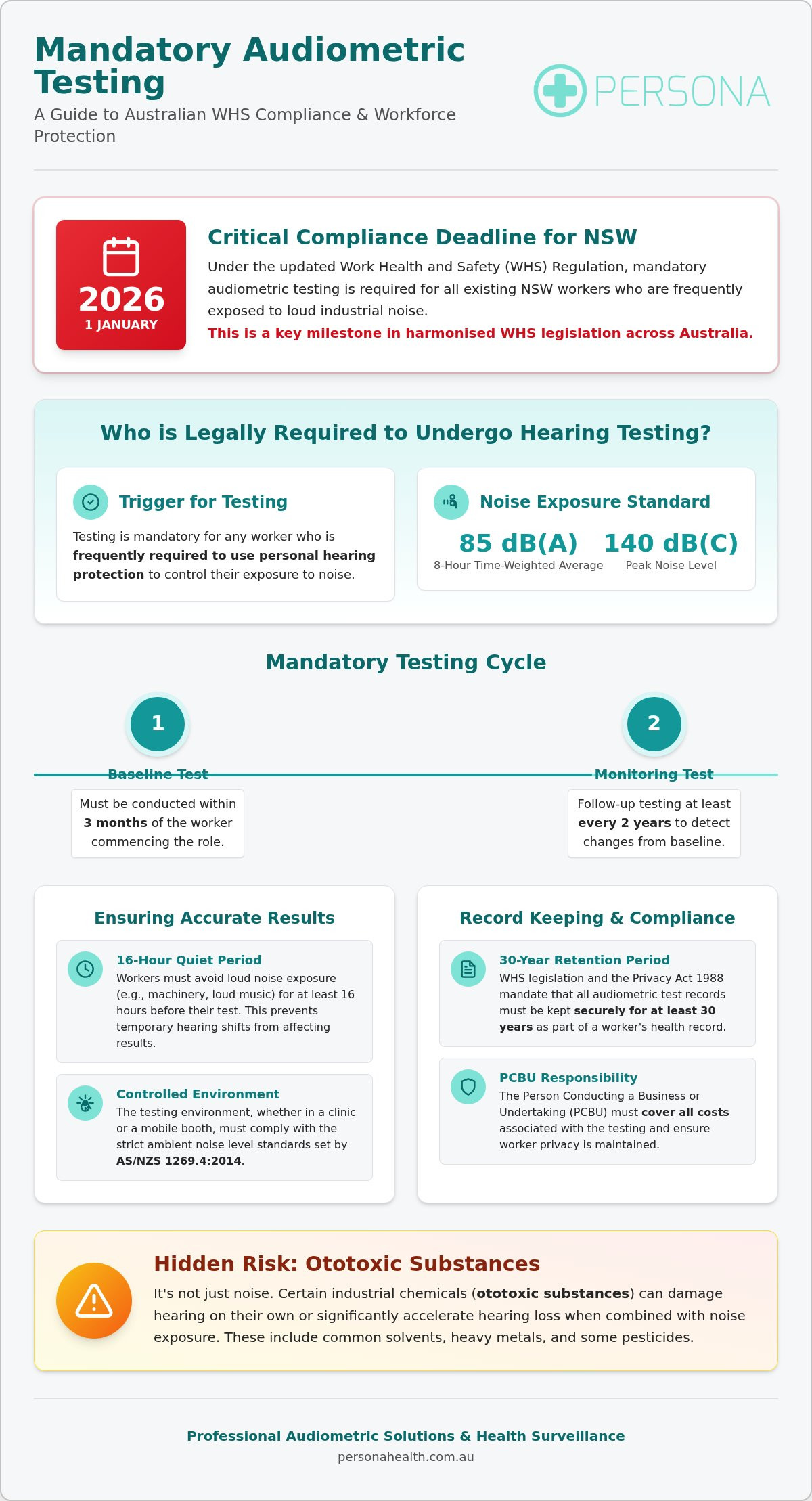
Clause 58 of the Work Health and Safety (WHS) Regulation sets out the specific legal framework for this monitoring. It mandates that a Person Conducting a Business or Undertaking (PCBU) must provide audiometric testing for workers at risk of noise-induced hearing loss. This duty includes a requirement for a baseline test within three months of a worker starting their role, followed by monitoring at least every two years. The PCBU must cover all costs associated with these tests, ensuring that financial barriers don’t prevent essential health surveillance.
To see how these requirements translate into a clinical setting, watch this helpful video:
Who is Legally Required to Undergo Hearing Testing?
The requirement for testing is triggered when workers are frequently required to use personal hearing protection to stay below the national noise exposure standard. This standard is defined as an eight-hour time-weighted average of 85 dB(A) or a peak noise level of 140 dB(C). If your team operates in high-risk sectors like construction, manufacturing, or transport, you’re likely already familiar with these thresholds. In New South Wales, the 2026 compliance deadline means that any existing worker who fits this criteria must have their testing completed by January 1, 2026. Failing to meet these workplace hearing test requirements australia can lead to significant corporate penalties, sometimes reaching up to A$3 million.
The Objective: Preventing Noise-Induced Hearing Loss (NIHL)
Noise-induced hearing loss is a permanent condition. Once the delicate hair cells in the inner ear are damaged by excessive noise, they don’t regenerate. This makes early detection through regular testing absolutely vital. By comparing follow-up results to the initial baseline, we can identify shifts in hearing before they become life-altering disabilities. These results also serve as a report card for your current noise controls. If tests show declining hearing health, it’s a clear signal that your PPE or engineering controls need adjustment. Integrating these checks into broader on-site health surveillance programmes ensures a holistic approach to worker wellbeing.
The Audiometry Process: What to Expect During a Test
Meeting workplace hearing test requirements australia depends heavily on the accuracy of the data collected during the initial assessment. For this reason, the process begins long before the worker puts on a pair of headphones. A vital prerequisite is the 16-hour quiet period. Workers must avoid exposure to high noise levels, such as loud music, power tools, or industrial machinery, before their appointment. This recovery time ensures that the audiometer measures permanent hearing thresholds rather than a temporary threshold shift, which is a transient dulling of hearing that occurs after noise exposure.
The testing environment itself must be carefully controlled. Whether using a sound-treated booth or a dedicated clinical room, the space must comply with the ambient noise levels specified in AS/NZS 1269.4:2014. Our technicians are trained to prioritise worker comfort, explaining each step to alleviate any apprehension. By following the Safe Work Australia guidelines, we ensure that every test is a reliable reflection of the individual’s hearing health and a solid foundation for future comparisons.
Step-by-Step Walkthrough for the Employee
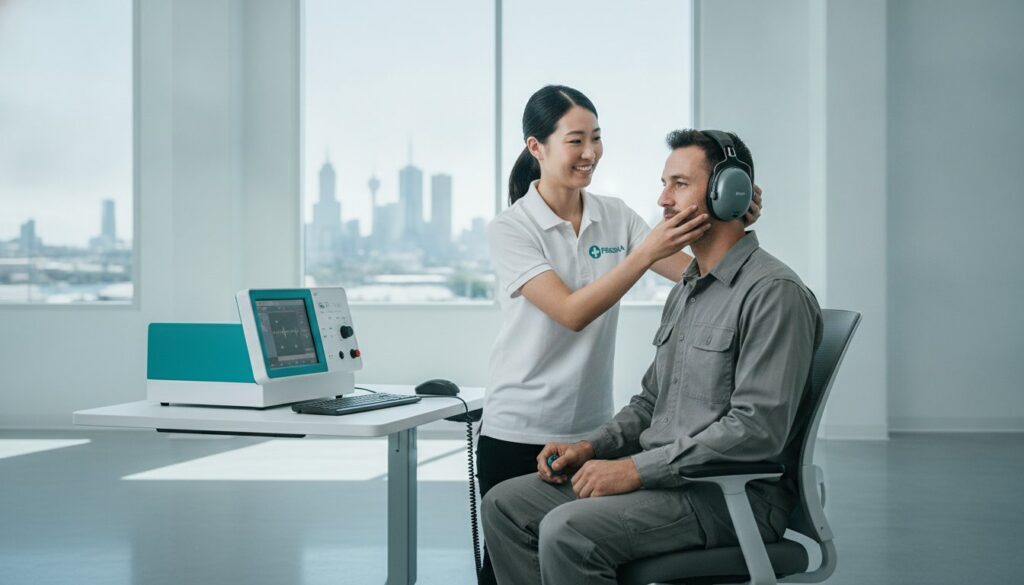
The experience is designed to be calm and methodical. After a brief instructional session, the technician fits specialised headphones. The worker is asked to respond to a series of tones, ranging from low to high frequencies, by pressing a response button. Each ear is tested independently. Most workers find the process quite relaxing, and it typically takes only 15 to 20 minutes to complete. This efficiency makes it easy to integrate into a standard workday, particularly when using on-site health surveillance services that come directly to your facility.
Screening vs Diagnostic Audiometry
Workplace testing is primarily a screening tool. Its purpose is to identify changes in hearing over time. If a standard screening reveals a shift in hearing thresholds, it doesn’t automatically mean there is permanent damage. Instead, it triggers a supportive referral process. The worker may be directed to an occupational physician or an audiologist for a diagnostic assessment. This more detailed examination helps determine the underlying cause of the shift, whether it’s related to workplace noise, age, or a treatable medical condition. Maintaining open communication during this stage helps reduce anxiety and reinforces the message that the company is invested in the long-term wellbeing of its people.
Noise Hazards and the Danger of Ototoxic Substances
While industrial noise is the most obvious hazard to a worker’s ears, ototoxic substances represent a hidden and often misunderstood threat to auditory health. The term “ototoxic” literally means ear-poisoning. These chemicals can cause permanent hearing loss or balance disorders, even in environments that don’t exceed standard noise thresholds. When workers are exposed to both loud noise and these substances, the damage is not just additive; it is synergistic. This means the combined effect is far more destructive than either hazard on its own. Understanding these interactions is a vital component of the workplace hearing test requirements australia enforces to protect workers in complex industrial settings.
PCBUs have a clear legal duty to manage these risks under current WHS regulations. This includes providing health monitoring when there is a significant risk to a worker’s health from chemical exposure. You can find more detail on the specific audiometric testing requirements through government resources, which highlight the importance of a comprehensive risk assessment that looks beyond the decibel meter. Failing to account for these substances can leave your workforce vulnerable to rapid, irreversible hearing decline.
Common Ototoxic Chemicals in Australian Workplaces
Many substances used daily in Australian workshops and factories are known to be ototoxic. Solvents such as toluene and xylene, frequently found in paints, adhesives, and degreasers, can directly damage the delicate nerve structures of the inner ear. Heavy metals like lead and mercury, often encountered in manufacturing, smelting, or battery recycling, also pose a significant risk. Even asphyxiants like carbon monoxide can impair hearing by depriving the auditory system of oxygen. These chemicals often enter the body through inhalation or skin absorption, making proper PPE and ventilation as important as earplugs for hearing conservation.
Integrating Hearing Health with Other Surveillance
Managing multiple health monitoring requirements can be logistically challenging for busy operations. To improve efficiency and reduce worker downtime, many businesses choose to coordinate audiometry with other mandatory assessments, such as crystalline silica medicals. This streamlined approach ensures all aspects of a worker’s health are assessed in a single, professional session, providing a more holistic view of their wellbeing.
A robust programme should also include regular air monitoring to quantify chemical exposure levels alongside hearing tests. Training your team to recognise the early symptoms of chemical-induced impairment, such as persistent tinnitus or sudden dizziness, is equally vital. By treating hearing conservation as a multi-faceted health priority rather than just a noise issue, you create a safer environment that truly values the long-term health of every individual. If you’re unsure which chemicals in your workplace might be affecting your team’s hearing, on-site health surveillance experts can help you identify these risks and implement a tailored monitoring plan.
Interpreting Results and Record-Keeping Compliance
Interpreting the data from an audiometric assessment requires more than just looking at a graph. A standard threshold shift occurs when there is an average change of 10 decibels or more at specific frequencies compared to the baseline test. For a PCBU, detecting such a shift is a critical moment for intervention. It indicates that your existing safety measures might need a closer look to prevent further, permanent damage. Communicating these results to your workers should always be handled with empathy and clarity, ensuring they understand the steps being taken to protect their hearing health.
Managing these medical records is a significant responsibility governed by the Privacy Act 1988. Because hearing health data is sensitive, it must be stored securely and access must be strictly limited to authorised personnel. Australian WHS legislation is quite specific about retention; you must keep health monitoring reports for at least 30 years. This long-term requirement ensures that if a worker develops issues later in life, a clear history of their workplace exposure and hearing health is available. Adhering to these workplace hearing test requirements australia mandates is not just about legal compliance; it is about maintaining a transparent and trust-based relationship with your workforce.
Taking Action After a Significant Change is Detected
When a test reveals a significant change, the first step is to review your workplace noise management plan. Is the hearing protection provided still suitable for the task? You might need to implement administrative controls, such as rotating workers into quieter areas to reduce their overall daily exposure. It’s also essential to ensure the worker receives a professional medical follow-up to rule out non-occupational causes. If you need assistance managing these outcomes, our team provides expert injury management services to help you navigate the next steps effectively.
Digital Reporting and Fast Turnaround Times
The shift toward digital reporting has transformed how businesses track health surveillance. Modern systems allow you to see long-term trends across your entire organisation, making it easier to identify high-risk areas before they result in a compensation claim. At Persona Health, we use advanced digital reporting to provide fast turnaround times, helping you meet your duty of care without unnecessary delays. These systems ensure that sensitive data is encrypted and secure, providing peace of mind for both the employer and the employee. To simplify your compliance journey and protect your team, we invite you to explore our on-site health surveillance solutions today.
Professional Audiometric Solutions with Persona Health
Persona Health understands that meeting the specific workplace hearing test requirements australia mandates is about more than just checking a box; it’s about protecting your most valuable asset. Our approach is built on a foundation of clinical excellence and a deep understanding of the Australian industrial landscape. Our pre-employment medicals ensure that every new hire begins their journey with a clear, accurate baseline audiometry test. This proactive step helps you manage future risks and provides the worker with a professional assessment of their initial hearing health status.
For businesses with large teams or complex logistics, we offer a highly convenient on-site mobile testing service. We bring our fully equipped clinical units directly to your factory, warehouse, or project site, minimising downtime and ensuring your entire workforce is assessed in a single, efficient window. Our experienced medical team is also expert in specialised assessments, such as Cat 3 rail medicals, which are essential for maintaining safety standards across the transport sector. This employer-focused approach combines fast turnaround times with modern digital reporting, giving you the data you need to make informed safety decisions quickly.
Sydney and Melbourne Clinic Network
We’ve strategically placed our clinics to support the major industrial and commercial hubs of Sydney and Melbourne. In Sydney, our professional teams are available at our Parramatta, Rosebery, Gregory Hills, and Dee Why locations. For our Victorian partners, we provide comprehensive services in Cairnlea and Craigieburn. If your operations extend beyond these cities, you can still access our high standards of care through an affiliate network of over 100 clinics across Australia. This extensive reach ensures that your workplace hearing test requirements australia are met consistently, regardless of where your team is located or how remote the site may be.
Innovative Injury Management with InjuryQR
True hearing conservation is part of a wider commitment to workplace safety. When injuries do occur, rapid intervention is the key to a successful recovery and a safe return to work. This is why we’ve introduced InjuryQR, a free AI-powered triage service designed for the modern Australian workplace. Workers don’t need to download an app; they simply scan a QR code and describe the incident by voice. The AI provides instant guidance, whether it’s self-care, telehealth, or emergency direction. By streamlining the reporting process and providing immediate Certificates of Capacity when appropriate, InjuryQR helps businesses reduce Lost Time Injuries (LTIs) and improve worker outcomes. You can even order free physical assets like posters and magnets to ensure your team always knows where to turn in an emergency.
Securing Your Workforce for the 2026 Compliance Deadline
The January 1, 2026 compliance deadline represents a significant shift in how Australian businesses must approach auditory health. By prioritising baseline assessments and recognising the synergistic risks of industrial noise and ototoxic chemicals, you’re doing more than just meeting the workplace hearing test requirements australia mandates. You’re building a culture of care that protects your workers’ quality of life for decades to come. Professional health surveillance is an investment in your team’s longevity and your company’s operational stability.
Persona Health acts as your expert partner in this journey. With our experienced occupational health medical team and flexible on-site or clinic-based testing options, we take the complexity out of compliance. Our modern digital reporting systems ensure you have fast, accurate data at your fingertips, making it simple to manage your 30-year record-keeping obligations. Don’t leave your compliance to chance as the 2026 deadline approaches. Book professional audiometric testing for your team with Persona Health and gain the peace of mind that comes with expert clinical support. We’re ready to help you create a safer, quieter, and more productive workplace today.
Frequently Asked Questions
How often is audiometric testing required in Australia?
Under the model WHS Regulations, follow-up monitoring must occur at least every two years. A baseline test is required within three months of a worker commencing employment if they are frequently required to use hearing protection. This cycle ensures any changes in hearing thresholds are identified early, allowing for timely intervention. Regular monitoring is also a key part of verifying that your current noise management strategies are working effectively for the individual.
Who is responsible for the cost of audiometric testing?
The Person Conducting a Business or Undertaking (PCBU) is legally responsible for the cost of all required health monitoring. This includes the organisation and payment for audiometric testing. Employers cannot pass these costs on to the worker. Providing these tests is a non-delegable duty that ensures the workplace hearing test requirements australia mandates are met without placing a financial burden on the employee, including any travel or time needed to attend.
What happens if a worker fails a hearing test?
If a screening test indicates a significant hearing shift, the worker should be referred to an occupational physician or audiologist for a diagnostic assessment. This isn’t a failure but a signal that further investigation is needed. The employer must also review current noise control measures, such as the effectiveness of PPE and administrative controls, to prevent any further deterioration of the worker’s hearing health and ensure the workplace remains safe.
Can a worker refuse to undergo audiometric testing?
Workers have a duty to comply with any reasonable instruction given by the PCBU to allow the business to comply with WHS laws. If hearing testing is a mandatory part of health surveillance for their role, a refusal could be seen as a breach of their safety obligations. It’s often best to address any concerns or anxieties through education and clear communication about how the test protects their long-term health and wellbeing.
Is on-site audiometric testing as accurate as clinic-based testing?
Yes, on-site testing is highly accurate when conducted in mobile units or rooms that meet the ambient noise standards of AS/NZS 1269.4:2014. Persona Health uses specialised equipment and sound-treated environments to ensure results are reliable and clinically sound. Mobile testing often reduces worker anxiety and minimises disruption to operations, making it an excellent choice for maintaining full compliance across large or remote teams without sacrificing the quality of the data.
What is the 16-hour quiet period before a hearing test?
The 16-hour quiet period requires workers to avoid exposure to loud noises, such as industrial machinery, loud music, or power tools, before their test. This prevents a temporary threshold shift from masking their true hearing ability. Without this period of auditory rest, the test results may show a false decline in hearing, leading to unnecessary concern and potentially inaccurate longitudinal health records that don’t reflect the worker’s actual permanent hearing status.
What are ototoxic substances and why do they matter for hearing?
Ototoxic substances are chemicals, such as solvents, heavy metals, and some asphyxiants, that can cause permanent hearing damage. They are particularly dangerous because they can work synergistically with noise, significantly accelerating hearing loss. When managing workplace hearing test requirements australia, it is vital to identify these substances in your Safety Data Sheets and include exposed workers in your regular audiometric monitoring programmes to ensure their hearing is fully protected from chemical risks.
How long must an employer keep audiometric test records?
Employers must keep confidential health monitoring records for at least 30 years after the worker’s employment ends. This long-term retention is a legal requirement under Australian WHS regulations. It ensures that a worker’s exposure history is available if a health issue arises later in life. Digital reporting systems are particularly useful for managing these records securely and ensuring they remain accessible and protected for the full mandatory duration required by the law.

Article by
Ian Nicholson
Ian is the Business Support Manager at Persona Health, where he plays a key role across IT, sales, marketing and business operations. With a broad skill set and a practical, solutions-focused approach, Ian helps drive the systems, communication and commercial strategy that support Persona Health’s continued growth across Australia.