

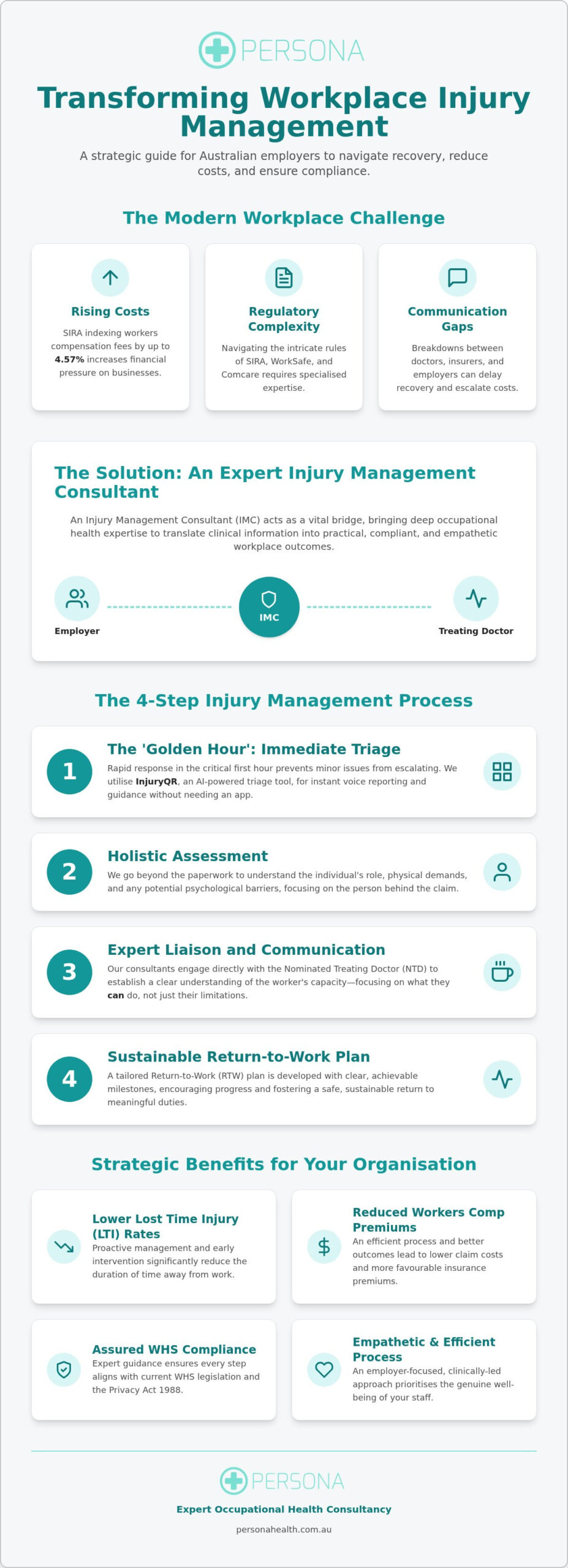
With SIRA indexing workers compensation fees by 4.57 per cent in 2026, the financial stakes for managing workplace claims have reached a critical turning point. You likely feel the pressure of rising premiums and the frustration of navigating complex WorkSafe or SIRA regulations while trying to support an injured team member. When communication between doctors and the workplace breaks down, an experienced injury management consultant becomes the vital link that prevents delayed return-to-work outcomes and mounting costs.
This guide shows you how the Persona Health approach to recovery can transform these challenges into a streamlined, empathetic, and compliant process. You will discover how modern strategies, including AI-powered triage like InjuryQR and individualised clinical oversight, can lower your Lost Time Injury (LTI) rates. We will also outline the essential steps to ensure your business remains fully aligned with current Australian WHS legislation while prioritising the genuine well-being and unique recovery needs of your staff.
Key Takeaways
- Understand how an injury management consultant acts as a professional facilitator to navigate complex SIRA and WorkSafe regulations while improving recovery outcomes.
- Learn the strategic benefits of clinical-strategic partnerships that significantly lower Lost Time Injury (LTI) rates and reduce workers compensation premiums.
- Explore the importance of the “golden hour” in incident response and how immediate assessments ensure workers receive the right care at the right time.
- Discover how to integrate AI-powered triage tools like InjuryQR to simplify incident reporting and provide instant guidance for staff without the need for complex apps.
- Identify how a personalised, employer-focused approach across Sydney and Melbourne creates a more empathetic and efficient return-to-work process.
What is an Injury Management Consultant in the Australian Context?
An injury management consultant acts as a specialised facilitator within the Australian workers compensation system. Unlike a standard administrator, they bring a deep understanding of Occupational and Environmental Medicine (OEM) to the table. This medical expertise is vital because it allows the consultant to interpret clinical reports and translate them into practical workplace outcomes. They don’t just look at a certificate of capacity as a piece of paper; they see it as a roadmap for a safe and sustainable return to work.
While a Return to Work (RTW) Coordinator often focuses on the internal logistics of an employee’s return, an IMC provides high-level strategic advice. They bridge the gap between the insurer, the treating doctor, and the employer. This role is essential for navigating the complex web of WHS legislation, ensuring that every step taken is both medically sound and legally compliant. By involving an expert from Persona Health, businesses gain access to a professional who understands both the clinical nuances of an injury and the commercial realities of the workplace.
To better understand the practical impact of this role, watch this helpful video:
Regulatory Frameworks: SIRA, WorkSafe, and Comcare
In New South Wales, IMCs operate under the State Insurance Regulatory Authority (SIRA) framework. SIRA has indexed workers compensation fees by up to 4.57 per cent as of February 2026, making expert oversight more valuable than ever for controlling costs. In Victoria, WorkSafe guidelines dictate how injury management should proceed, requiring a methodical approach to claims. Regardless of the state, an injury management consultant ensures all medical data is handled in strict accordance with the Privacy Act 1988. This builds a foundation of trust and professional integrity throughout the recovery journey, protecting both the worker and the organisation.
When Should a Business Appoint an IMC?
You should consider appointing an IMC when a claim becomes complex or when recovery has plateaued. This often happens when a worker’s progress has stalled despite ongoing treatment, or when there’s a lack of clarity regarding their actual capacity. Disputes between a treating doctor and the workplace regarding suitable duties are another clear signal. By acting as a neutral third party, the IMC can rebuild trust that may have eroded during a long absence. They provide an objective perspective that focuses on the individual’s capacity rather than their limitations. This shift in focus is a hallmark of the Persona Health approach, where we prioritise the unique needs of the human being behind the claim to ensure a smoother, more empathetic recovery process.
The Step-by-Step Injury Management Process
Effective recovery begins the moment an incident occurs. In the occupational health industry, we often refer to the ‘golden hour’ of injury reporting. This is the critical window where immediate, accurate triage can prevent a minor strain from escalating into a long-term, complex claim. By utilising digital tools like InjuryQR, workers can report an injury via voice and receive AI-guided instructions instantly. This rapid response ensures that the injury management consultant has high-quality data from the outset, allowing for a more precise initial assessment of the worker’s actual capacity.
Once the immediate clinical needs are met, the consultant conducts a thorough review. This isn’t a simple checklist exercise; it’s a holistic look at the individual’s role, their physical requirements, and any potential psychological barriers to recovery. By understanding the person behind the injury, the consultant can liaise effectively with the Nominated Treating Doctor (NTD) to clarify work restrictions. This professional dialogue ensures that medical certificates reflect what the worker can safely do, rather than just listing their limitations. It’s about creating a sustainable Return to Work (RTW) plan with clear, achievable milestones that encourage progress.
Liaison and Medical Coordination
Medical reports are often dense with clinical jargon that can be difficult for employers to translate into workplace actions. The IMC acts as a professional bridge, turning complex medical language into clear, actionable tasks. A vital part of this coordination is the case conference. Bringing the doctor, employer, and worker together in one conversation aligns everyone’s expectations and reduces the risk of miscommunication. It’s during these sessions that we negotiate suitable duties that match the worker’s functional capacity, ensuring their transition back to the workplace is both safe and productive. If you need support with these complex discussions, our team offers expert workplace injury management across our Sydney and Melbourne clinics.
Fitness for Duty and Functional Assessments
As recovery progresses, it’s essential to validate that the worker is physically ready for the increased demands of their role. We use fitness for duty medicals to provide this validation. These assessments, often supported by Functional Capacity Evaluations (FCEs), provide objective data on a worker’s strength, range of motion, and endurance. This evidence-based approach moves the conversation away from guesswork and ensures that the injury management consultant can adjust duties in real-time. By providing this clinical oversight, we ensure the worker is genuinely ready for the specific physical demands of their job, which significantly reduces the risk of re-injury and helps maintain lower LTI rates for the business.
Strategic Benefits: Why Injury Management is a Worthwhile Investment
Investing in professional injury management isn’t just about compliance; it’s a high-impact corporate strategy that protects your most valuable asset and your bottom line. When an injury management consultant oversees a claim, the focus shifts from passive observation to active, clinical intervention. This proactive stance significantly reduces claim durations, which is the primary driver of workers compensation premiums. With SIRA indexing fees by 4.57 per cent in 2026, the financial benefit of closing claims faster has never been more apparent to Australian business owners.
Beyond the direct costs, minimising Lost Time Injuries (LTIs) improves your overall safety performance metrics. High LTI rates can affect your ability to win tenders or maintain a positive reputation in your industry. By implementing structured recovery plans, you demonstrate to your workforce that you value their health as much as their productivity. This commitment fosters a resilient organisational culture where staff feel secure, knowing that if the unexpected happens, they’ll be supported by experts who prioritise their unique recovery journey.
Financial Impact and Premium Control
One of the most significant hidden costs in workers compensation is the development of secondary psychological claims. When a physical injury is poorly managed, the resulting stress and uncertainty can lead to mental health complications that extend the claim indefinitely. An injury management consultant mitigates this risk by providing clear communication and setting realistic expectations from day one. By ensuring the worker feels heard and supported, we prevent the ‘claimant’ mindset from taking root. IMCs reduce employer liability through early intervention by resolving clinical disputes before they escalate into costly legal battles or long-term absences.
Supporting the ‘Whole’ Person
The Persona Health philosophy balances clinical authority with deep empathy, recognising that every human body and every recovery path is different. We move away from ‘one-size-fits-all’ processes to address the specific anxieties and uncertainties that often accompany a workplace injury. This holistic approach ensures that the person feels valued throughout their regeneration process, rather than just being a number in a system. For more detailed insights on implementing these strategies, you can refer to our best practice injury management guide. By focusing on the ‘whole’ person, we don’t just return an employee to work; we restore their confidence and their connection to your organisation.
Leveraging Technology: InjuryQR and AI in Modern Injury Management
In 2026, the traditional paper-based incident report is no longer sufficient for high-performing businesses. Digital transformation has introduced tools like InjuryQR, which revolutionises the way we handle the immediate moments following a workplace incident. By removing the friction of complex apps or lengthy forms, this technology ensures that every injury is triaged accurately from the very start. For an injury management consultant, this real-time data is invaluable, as it provides a clear, unvarnished account of the incident before memories fade or narratives shift.
The process is intentionally simple to ensure high adoption rates among staff. A worker simply scans a QR code on a poster or magnet, describes their injury using their voice, and receives immediate, AI-guided next steps. This might include self-care instructions, a telehealth consultation, or a direction to the nearest emergency department. For minor incidents, the system can even facilitate the immediate issuance of Certificates of Capacity. This rapid response reduces administrative delays and ensures that the recovery process begins within minutes rather than days, which is a significant factor in preventing long-term disability.
Immediate Triage and Incident Reporting
Many claim escalations occur because of a ‘wait and see’ approach that allows symptoms to worsen and anxiety to build. InjuryQR eliminates this risk by providing 24/7 access to clinical guidance, ensuring that workers are never left wondering what to do next. This immediate care is a cornerstone of an empathetic workplace culture, showing staff that their wellbeing is a priority even outside of standard office hours. Businesses can easily integrate this tool into their safety protocols by ordering free physical assets, such as posters and magnets, to be displayed in high-traffic areas like lunchrooms or site offices. If you want to modernise your approach, you can enquire about our injury management services to see how technology and clinical expertise work together.
Data-Driven Decisions for Employers
Beyond individual care, these digital systems provide employers with powerful insights into workplace safety trends. By tracking data across multiple sites, a business can identify high-risk areas or recurring incident types that may require targeted intervention or additional training. This level of detail is essential for maintaining compliance with WHS legislation and performing well during SafeWork Australia audits. When an injury management consultant integrates these AI-driven insights into your broader strategy, they can move from reactive claims management to proactive injury prevention. This data-backed approach ensures that your safety programmes are effective, targeted, and capable of delivering long-term reductions in your workers compensation premiums while fostering a safer environment for everyone.
Partnering with Persona Health for Expert Consultancy
Persona Health provides a sophisticated alternative to traditional, administrative-heavy providers. When you engage an injury management consultant from our team, you aren’t just hiring a coordinator; you’re gaining access to a dedicated clinical partner. Our approach is built on the foundation of individualised care, moving away from generic recovery templates to focus on the unique physiological and psychological needs of each worker. This “Persona” method ensures that every return-to-work plan is as unique as the individual it supports, leading to more sustainable outcomes and higher staff morale.
Our internal medical team, which includes highly qualified occupational physicians, provides the clinical authority required to handle even the most complex claims. This expertise is backed by a robust infrastructure, including a 100-clinic affiliate network and Australia-wide mobile services. This ensures that your organisation receives the same high standard of care regardless of location. We have extensive experience in high-risk sectors such as rail, transport, and infrastructure, where we provide customised solutions that align with specific industry standards and WHS requirements. Our modern digital reporting systems provide you with the transparency and speed needed to make informed decisions in real-time.
Local Expertise in Sydney and Melbourne
We understand that proximity matters when managing a recovery journey. Persona Health operates physical clinics in key hubs across Sydney, including Parramatta, Rosebery, Gregory Hills, and Dee Why. For our Victorian clients, our facilities in Cairnlea and Craigieburn offer local support tailored to the Melbourne healthcare landscape. Having an injury management consultant who understands the local network of specialists and treating doctors in these areas provides a distinct advantage. It allows for more direct communication and faster turnaround times for medical reporting, ensuring your team member is never left waiting in a system they don’t understand. This local knowledge is vital for navigating the nuances of state-specific regulators like SIRA and WorkSafe Victoria.
Getting Started with Professional Injury Management
The transition from reactive claims handling to proactive health management is a journey we navigate with you. By moving towards structured health surveillance and early intervention, you can significantly reduce the frequency and severity of workplace injuries. We help you move beyond simple compliance to create a culture of wellness and safety. If you’re ready to lower your LTI rates and improve your organisational resilience, you can book our injury management services or request a tailored quote for your specific requirements. Our team is ready to help you build a safer, more empathetic workplace through evidence-based consultancy and modern, employer-focused care.
Building a Resilient Workplace for the Future
Effective recovery in 2026 is no longer about just filling out forms; it’s about a strategic partnership that prioritises the individual. By engaging an experienced injury management consultant, your business can successfully navigate the complexities of Australian WHS laws while significantly lowering workers compensation costs. Integrating AI-powered tools like InjuryQR ensures your team receives immediate support from the golden hour of an incident, while a clinical approach ensures that every return-to-work plan is both safe and sustainable.
Persona Health is here to support your organisation with fast turnaround times for all medical reports and an expert team of Australian occupational health professionals. We provide free InjuryQR triage for all our partner businesses to ensure no incident is left unmanaged. Our employer-focused approach across Sydney and Melbourne provides the clinical authority and empathy needed to protect your staff and your bottom line.
Contact Persona Health today to discuss your injury management requirements. We look forward to helping you create a safer, more productive environment for your entire team.
Frequently Asked Questions
What is the difference between an Injury Management Consultant and a Case Manager?
An injury management consultant is a clinical professional who facilitates the recovery and return-to-work process, whereas a Case Manager typically works for an insurer to manage the administrative and financial aspects of a claim. The consultant focuses specifically on the worker’s physical capacity and workplace adjustments. They bridge the gap between medical advice and operational requirements, ensuring that clinical recommendations translate into safe, productive tasks for the individual.
Is it mandatory for Australian businesses to use an injury management consultant?
While not every minor claim requires one, using an injury management consultant is often a regulatory requirement under SIRA guidelines for complex or long-term claims in New South Wales. Even when not strictly mandatory by law, it is considered best practice for Australian businesses to ensure full compliance with WHS legislation. Engaging a consultant early helps prevent the 4.57 per cent indexed fee increases from impacting your premiums through prolonged claim durations.
How can an IMC help if a worker’s doctor refuses to clear them for light duties?
If a doctor is hesitant, the consultant initiates a clinical case conference to discuss the specific physical demands of the workplace. By providing objective data on suitable duties, the IMC can often reassure the doctor that the environment is safe. This professional-to-professional dialogue focuses on the worker’s abilities rather than their limitations, which often leads to a more collaborative and successful return-to-work outcome for everyone involved.
What are the costs associated with hiring an injury management consultant?
In the Australian system, many IMC fees are regulated by state bodies like SIRA or WorkSafe Victoria. For instance, as of February 2026, SIRA has indexed workers compensation fees by up to 4.57 per cent. These costs are generally covered as part of the claim’s medical and related expenses. Investing in these services early usually leads to a significant reduction in the total cost of the claim by shortening the worker’s time away from the workplace.
Can an IMC assist with psychological or ‘stress’ related workplace claims?
Yes, an injury management consultant is highly effective in managing psychological claims by addressing the communication barriers that often exacerbate stress-related injuries. They provide a supportive framework that reduces the anxiety and uncertainty a worker feels during their absence. By focusing on an empathetic and structured recovery path, the consultant helps prevent the development of secondary psychological issues, which are a major driver of long-term claim costs.
How does InjuryQR integrate with existing injury management programs?
InjuryQR acts as the immediate triage point, feeding real-time data directly into the broader injury management program. When a worker scans the code and describes their injury, the information is instantly available for the consultant to review. This seamless integration eliminates the administrative delays that often occur with traditional reporting, allowing for clinical intervention to begin within the critical golden hour of the incident.
Does an injury management consultant work for the insurer or the employer?
An injury management consultant acts as an independent facilitator, though they are typically engaged by the employer or the insurer to manage a specific claim. Their primary responsibility is to ensure the recovery process is medically sound, legally compliant, and focused on the best outcome for the worker. This neutral position allows them to rebuild trust between all parties, ensuring that the return-to-work plan is fair and evidence-based.
How long does the injury management process typically take for a musculoskeletal injury?
The duration varies significantly based on the severity of the injury and the physical requirements of the role. A minor strain might see a return to modified duties within days, while more significant injuries require a phased approach over several weeks. The consultant’s role is to monitor this progress constantly, adjusting the plan as the worker’s capacity improves to ensure the recovery is as efficient and safe as possible.

Article by
Ian Nicholson
Ian is the Business Support Manager at Persona Health, where he plays a key role across IT, sales, marketing and business operations. With a broad skill set and a practical, solutions-focused approach, Ian helps drive the systems, communication and commercial strategy that support Persona Health’s continued growth across Australia.