
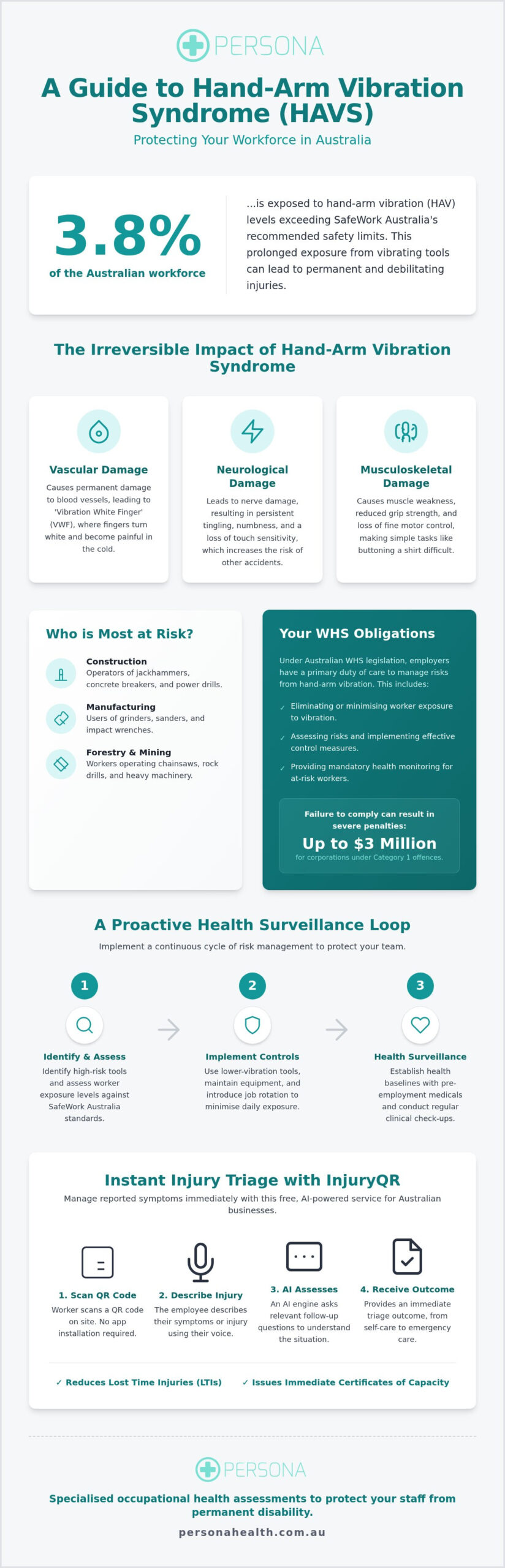
Did you know that an estimated 3.8% of the Australian workforce is currently exposed to levels of hand arm vibration that exceed the recommended safety action limit? If you are managing a busy site or workshop, it is often difficult to spot the subtle, early symptoms of vibration-induced injury before they progress into permanent disabilities. We recognise the weight of responsibility you feel in keeping your team safe while trying to navigate complex legal health monitoring requirements and SafeWork Australia standards.
This guide provides a comprehensive roadmap to understanding your obligations under Australian WHS legislation, ensuring your business remains compliant and your workforce stays protected. You will gain practical strategies to reduce daily exposure and learn how to implement effective, clinical health surveillance. We also explore how modern tools, such as the InjuryQR digital triage service and Persona Health’s specialised medical expertise, can help you detect early warning signs and manage workplace incidents with confidence and care.
Key Takeaways
- Learn to identify high-risk machinery and understand the permanent clinical impacts of Hand-Arm Vibration Syndrome (HAVS) on your workers’ long-term health.
- Navigate the latest SafeWork Australia exposure limits and clarify your legal health monitoring obligations regarding hand arm vibration in the 2026 workplace.
- Explore evidence-based control measures, including tool substitution and engineering modifications, to effectively minimise vibration-induced risks.
- Implement a robust clinical surveillance loop and leverage the InjuryQR system to provide immediate triage and support for workers reporting early symptoms.
- Benefit from specialised occupational health assessments at Persona Health clinics across Sydney and Melbourne to protect your staff from permanent disability.
Identifying Hand-Arm Vibration (HAV) in the Australian Workplace
Hand arm vibration is far more than a minor workplace nuisance; it’s a significant occupational hazard that requires careful clinical management. This physical hazard occurs when mechanical energy from vibrating tools or workpieces is transferred directly into the hands and arms of a worker. While the initial symptoms might seem like a simple tingling or numbness, prolonged and repeated exposure can lead to a debilitating condition known as Hand-Arm Vibration Syndrome (HAVS).
This condition, frequently referred to in clinical settings as Vibration white finger, involves permanent and progressive damage to the blood vessels, nerves, and joints of the hand. Once these delicate tissues are compromised, the damage is often irreversible. This makes early identification and the implementation of a proactive on-site health surveillance programme the only effective way to protect your workforce from life-long disability.
In the Australian regulatory landscape, SafeWork Australia and the various state-based WHS Acts provide the framework for managing these risks. Employers have a primary duty of care to ensure that workers are not exposed to vibration levels that exceed safety thresholds. Despite this, many businesses across the country still lack the clinical loop necessary to identify early symptoms before they become permanent injuries.
Who is Most at Risk of Vibration Injuries?
Industries involved in heavy manual labour are at the highest risk, particularly within the construction, manufacturing, and forestry sectors across Sydney and Melbourne. Workers such as road crews using jackhammers, carpenters using orbital sanders, and mechanics operating impact wrenches are on the front line of exposure. Because the damage from hand arm vibration is cumulative, establishing a clear health baseline through pre-employment medicals is a vital first step. This allows you to monitor changes in a worker’s health over time and intervene before a condition becomes chronic.
The Legal Obligations for Australian Employers
Your legal responsibility as a PCBU is to eliminate or, where that’s not possible, minimise the risk of vibration-induced injury. Australian WHS legislation requires you to provide health monitoring when there is a significant risk to a worker’s health. Failing to meet these obligations can result in severe consequences, including Category 1 penalties which, as of 2024, can reach up to $3 million for corporations. Beyond the risk of fines, the human and financial cost of a permanent disability claim can be staggering. To manage incidents effectively, tools like InjuryQR can be integrated into your safety strategy. This allows workers to scan a code and receive immediate AI-guided triage, ensuring that any reports of numbness or pain are captured and managed instantly, significantly reducing the likelihood of a Lost Time Injury (LTI).
The Clinical Impact of Hand-Arm Vibration Syndrome (HAVS)
Hand-Arm Vibration Syndrome (HAVS) isn’t a single injury, but rather a collective term for permanent damage that affects three distinct areas of the body: the blood vessels, the nerves, and the musculoskeletal system. When workers are exposed to hand arm vibration over long periods, the mechanical energy disrupts the delicate balance of these systems. This leads to a complex clinical picture where symptoms often overlap, making it difficult for the untrained eye to recognise the severity of the condition until it has progressed to a stage of permanent disability.
The sensory damage associated with HAVS is particularly concerning in a high-risk workplace. Losing the ability to feel fine textures or accurately sense heat and cold isn’t just a clinical symptom; it’s a significant safety hazard. A worker who cannot feel the grip of their tool or distinguish the temperature of a surface is at a much higher risk of secondary accidents. Additionally, musculoskeletal issues such as reduced grip strength and a loss of fine motor control can make even simple tasks, like buttoning a shirt or handling small components, frustratingly difficult for your employees.
Vibration-Induced White Finger (VWF)
One of the most visible signs of vibration damage is Raynaud’s Phenomenon of occupational origin, commonly known as Vibration-Induced White Finger. On a frosty Melbourne morning or a crisp Sydney dawn, workers may notice their fingers turning chalky white as the blood vessels constrict. This blanching often starts at the fingertips and progresses down the hand as the vascular damage worsens. For a detailed breakdown of these symptoms, the Safe Work Australia HAV information sheet provides essential guidance for identifying these early warning signs. It’s vital to realise that VWF is often misdiagnosed as simple poor circulation, which can delay the necessary workplace adjustments.
The Link Between Vibration and Carpal Tunnel Syndrome
There is a strong clinical link between prolonged exposure to hand arm vibration and the development of Carpal Tunnel Syndrome (CTS). The repetitive inflammation caused by vibration can compress the median nerve as it passes through the wrist, leading to intense pain, numbness, and weakness. Differentiating between general CTS and vibration-specific nerve damage is a complex process that requires specialised expertise. Ensuring your workers receive a clinical assessment by an experienced occupational physician is the best way to ensure an accurate diagnosis and a supportive return-to-work plan.
Early detection is the key to preventing these clinical symptoms from becoming life-altering disabilities. If you’ve noticed your team complaining of persistent tingling or “pins and needles” after their shift, it may be time to consider professional on-site health surveillance to assess the current risk levels within your workforce.
Assessing Vibration Risk Factors and Exposure Limits
Understanding the risks associated with hand arm vibration requires a move beyond simply listing dangerous tools. You must look at the interaction between the equipment, the environment, and the individual worker. While high-impact tools like jackhammers, grinders, chainsaws, and impact wrenches are the most obvious culprits, the actual risk is determined by a combination of vibration magnitude and trigger time. This is often measured as a Time-Weighted Average (TWA) over an eight-hour shift.
In Australia, SafeWork Australia provides clear guidance on these thresholds. The Exposure Action Value (EAV) is 2.5 m/s² A(8), which is the level at which you are legally required to implement control measures and consider health monitoring. The Exposure Limit Value (ELV) is 5.0 m/s² A(8). This represents a hard ceiling that no worker should exceed in a single day. Research indicates that roughly 3.8% of the Australian workforce currently exceeds the EAV, putting them at significant risk of developing permanent symptoms.
Tool maintenance is a frequently overlooked factor in risk assessment. A poorly maintained grinder with worn bearings or a chainsaw with a blunt chain can vibrate significantly more than its factory specifications suggest. Regular servicing isn’t just about operational efficiency; it’s a critical safety control. Environmental factors also play a major role. Cold and damp conditions, typical of early mornings in Melbourne or Sydney, cause peripheral blood vessels to constrict. This reduced circulation makes the hands and arms much more vulnerable to the damaging effects of mechanical vibration.
Common Tools and Their Vibration Levels
The vibration output varies wildly across different equipment. For example, a heavy hammer drill may produce high-intensity jolts, while a pedestal grinder might offer a more constant, lower-frequency vibration that workers tolerate for longer periods. It’s the total duration of use that often surprises employers. A tool with a high vibration magnitude might only be safe to use for fifteen minutes a day. Identifying vibration-reduced tools during your procurement process is one of the most effective ways to lower your team’s total daily exposure before they even step onto the site.
Individual Factors That Increase Vulnerability
Personal health choices and pre-existing conditions can drastically accelerate the onset of HAVS. Smoking is a primary concern because nicotine acts as a powerful vasoconstrictor, further restricting blood flow to the extremities. When combined with hand arm vibration, the vascular damage occurs much faster. Workers with diabetes or previous hand and wrist injuries are also at an elevated risk. To manage these complexities, many employers utilise fitness for duty medicals. These assessments ensure that individuals placed in high-risk roles have the physiological resilience required to perform their tasks safely without risking permanent injury.
Implementing Effective Control Measures and Health Surveillance
Controlling the risks of hand arm vibration requires a methodical approach that follows the hierarchy of controls. The most effective strategy is always elimination. If a task can be performed using a static machine or an automated process rather than a handheld vibrating tool, the risk to your workforce is removed entirely. Where elimination isn’t feasible, substitution with modern, vibration-reduced equipment is the next best step. Procurement teams should prioritise tools with built-in dampening systems and anti-vibration handles to lower the mechanical energy transferred to the user.
Administrative controls are equally vital in managing daily exposure. Implementing a strict job rotation schedule ensures that no single worker exceeds the recommended trigger time for a specific tool. This spreads the vibration load across the team, keeping individual exposure levels well below the safety thresholds. While many sites provide anti-vibration gloves, you shouldn’t rely on them as a primary defence. These gloves have significant limitations; they often provide minimal protection against low-frequency vibration and can sometimes force a worker to grip the tool more tightly, which actually increases the amount of energy absorbed by the hand.
The Health Surveillance Process
Clinical monitoring serves as your essential safety net, identifying early physiological changes before they progress to permanent injury. This process begins with a baseline assessment, which is often integrated into our pre-employment medicals. Establishing this starting point is crucial for tracking health over time. Regular reviews, typically conducted annually or biennially depending on the risk level, allow our medical team to perform standardised testing. These assessments include grip strength dynamometry, dexterity tests to check fine motor skills, and vascular reviews to detect early signs of blanching or reduced circulation.
Managing Exposure Records
Maintaining accurate vibration exposure logs for every worker is a core requirement for WHS compliance. These logs must be paired with clinical health records, which places a significant administrative burden on many businesses. Under the Privacy Act 1988, you are legally obligated to handle these sensitive medical records with strict confidentiality. Persona Health’s modern digital reporting systems take the stress out of this process. We provide secure, employer-focused reporting that streamlines your compliance while ensuring that all health data is managed professionally and ethically. Our team can help you build a robust clinical loop that protects both your workers and your business interests.
If you’re looking to establish a compliant monitoring programme for your team, you can learn more about our specialised on-site health surveillance services to get started.
Professional Occupational Health Support and Injury Management
A standard GP provides excellent general care, but they may lack the specific clinical training required to identify the subtle, early markers of Hand-Arm Vibration Syndrome (HAVS). Occupational health specialists understand the unique relationship between tool trigger time and physiological damage, ensuring that symptoms aren’t dismissed as simple circulation issues. At Persona Health, our experienced medical team focuses on this specific intersection, offering a level of clinical insight that generic clinics cannot match. With physical locations in Parramatta, Rosebery, Gregory Hills, and Dee Why across Sydney, as well as Cairnlea and Craigieburn in Melbourne, we provide accessible, expert care for your workforce.
Early intervention is the most effective way to protect your business and your employees. Encouraging a culture where reporting a slight tingle today is seen as a proactive safety measure prevents a permanent disability claim tomorrow. By integrating specialised Workplace Injury Management into your safety culture, you create a loop of continuous care that keeps your team healthy and productive. This approach not only ensures compliance with SafeWork Australia standards but also demonstrates a genuine commitment to the long-term well-being of your staff.
Instant Triage with InjuryQR
Modern safety management requires immediate action. When a worker notices symptoms related to hand arm vibration, they shouldn’t have to wait days for an appointment to receive guidance. InjuryQR provides a free, AI-powered triage service that bridges this gap instantly. Workers simply scan a QR code on a site poster or magnet; no app download is required. They describe their symptoms by voice, and the AI provides immediate, guided next steps. This might include self-care instructions, a telehealth consultation, or direction to the nearest emergency centre. For employers, this system ensures that incidents are reported in real time, reducing Lost Time Injuries (LTIs) and facilitating the immediate issuance of Certificates of Capacity where appropriate. You can even order free physical InjuryQR assets like posters and magnets to display across your site.
Booking On-Site Surveillance and Medicals
We understand that every workplace has unique requirements. Our team designs customised on-site health surveillance programmes that reflect the specific tools and vibration levels present on your site. Whether you are a local operation in Western Sydney or a national firm with multiple locations, we ensure consistency through our 100-clinic affiliate network and Australia-wide mobile services. This ensures that every worker receives the same high standard of clinical care, regardless of their location. Our employer-focused approach and modern digital reporting systems mean you receive fast turnaround times for all medical assessments.
If you are concerned about your team’s exposure levels or need to update your health monitoring protocols, contact the Persona Health team today for a comprehensive vibration risk consultation. Our experts are ready to help you navigate your WHS obligations and protect your workforce from the permanent effects of hand arm vibration.
Securing Your Workforce Against Vibration Risks
Managing the risks of hand arm vibration is a continuous commitment to both regulatory compliance and worker well-being. By identifying high-risk equipment early and implementing a clinical surveillance loop, you protect your team from the irreversible effects of HAVS. We’ve explored how a proactive approach, including the use of vibration-reduced tools and regular health monitoring, creates a safer and more productive site. This process isn’t just about meeting SafeWork Australia standards; it’s about valuing the unique physical health of every individual in your care.
Persona Health is here to support your business with a specialised occupational health team across Sydney and Melbourne. We offer fast turnaround times on medical reports and provide every client with free access to the InjuryQR triage system to manage incidents in real time. Our modern digital reporting ensures your records are always audit-ready and handled with the highest level of confidentiality. You don’t have to manage these complex health requirements alone, as our team is ready to guide you through every clinical step.
Take the next step in your safety journey and protect your workforce and book a vibration health surveillance consultation with Persona Health today. We look forward to helping you build a healthier, more resilient workplace.
Frequently Asked Questions
What are the early signs of Hand-Arm Vibration Syndrome (HAVS)?
Numbness and tingling in the fingers are usually the first indicators of damage. These “pins and needles” sensations often occur at the end of a shift after using powered tools. You might also notice the tips of the fingers turning white when exposed to cold or damp conditions. This is known as blanching. If your workers report these symptoms, it is a sign that the nerves and blood vessels are already under stress from hand arm vibration.
Is Hand-Arm Vibration Syndrome permanent?
Yes, HAVS is a permanent condition once the structural damage to nerves and blood vessels has occurred. There is currently no medical cure that can reverse the tissue damage. However, the progression of the syndrome can be halted if exposure to vibration is significantly reduced or eliminated. This is why early clinical intervention and regular health surveillance are so critical for the long-term well-being of your workforce.
What tools cause the most hand-arm vibration?
High-impact tools such as jackhammers, road breakers, and chainsaws generally produce the highest levels of vibration. Grinders, sanders, and impact wrenches are also significant contributors on most Australian worksites. The risk is not just the tool itself, but the total trigger time. Even a lower-vibration tool can be hazardous if it is used for several hours without adequate breaks or job rotation to manage the cumulative load.
Do anti-vibration gloves actually work?
Anti-vibration gloves provide only limited protection and should not be used as your primary control measure. While they can keep hands warm, which helps maintain circulation, they are often ineffective against the low-frequency vibrations that cause the most damage. In some cases, the bulkiness of the glove forces a worker to grip the tool harder. This actually increases the amount of vibration energy absorbed by the hand and arm.
How often should my employees undergo health monitoring for vibration?
Health monitoring frequency is determined by the level of risk, but an annual or biennial review is the standard for workers exposed above the action value. You must always start with a baseline assessment before a worker begins high-risk tasks. Persona Health clinics in Sydney and Melbourne can help you establish a compliant schedule that reflects the specific vibration levels and trigger times present on your particular site.
Can smoking make vibration-induced white finger worse?
Yes, smoking significantly increases the risk and severity of vibration-induced white finger. Nicotine acts as a powerful vasoconstrictor, which means it narrows the blood vessels and reduces peripheral circulation. When this is combined with the mechanical energy of hand arm vibration, the vascular system is compromised much faster. This leads to more frequent and painful blanching episodes, particularly during early morning shifts in colder climates.
What is the legal vibration exposure limit in Australia?
Australia follows the guidance of SafeWork Australia, which sets an Exposure Action Value (EAV) of 2.5 m/s² A(8) and an Exposure Limit Value (ELV) of 5.0 m/s² A(8). If your workers’ daily exposure exceeds the EAV, you are legally required to implement controls and provide health monitoring. The ELV is a maximum ceiling that should never be exceeded. These thresholds are essential benchmarks for maintaining WHS compliance and worker safety.
What should I do if a worker reports numbness in their hands?
You should initiate an immediate clinical review and use a tool like InjuryQR for instant triage. Have the worker scan the site QR code to describe their symptoms by voice and receive AI-guided next steps. Following this, an occupational physician should perform a formal assessment to determine the extent of the damage. You must also review the worker’s exposure logs and implement engineering or administrative controls to reduce their future risk.

Article by
Ian Nicholson
Ian is the Business Support Manager at Persona Health, where he plays a key role across IT, sales, marketing and business operations. With a broad skill set and a practical, solutions-focused approach, Ian helps drive the systems, communication and commercial strategy that support Persona Health’s continued growth across Australia.