

What if a single overlooked box on a medical form was the only thing standing between you and your dream contract in the Mediterranean? For many Australian seafarers, the path to the gangway is often blocked by the complexity of cruise ship medicals australia, where one missed pathology result or an incorrect AMSA certification can lead to costly delays. It is entirely natural to feel anxious about these assessments, especially when you are trying to navigate the overlap between Australian maritime regulations and the unique health standards of international cruise lines.
This guide provides the clarity you need to move forward with certainty. You will learn exactly how to prepare for your assessment, which tests are mandatory for the 2026 season, and how to organise your paperwork to avoid paying for the same test twice. At Persona Health, we specialise in bridging the gap between clinical requirements and your career goals. Whether you visit our modern clinics in Sydney or Melbourne, our goal is to provide a supportive, professional environment where your fitness for duty is confirmed efficiently, letting you focus on the journey ahead.
Key Takeaways
- Understand the critical difference between the mandatory AMSA Certificate of Medical Fitness and the specific Pre-Employment Medical Examination (PEME) required by individual cruise lines.
- Learn about the comprehensive testing involved in cruise ship medicals australia, ranging from vision and hearing assessments to complex pathology for infectious diseases and liver function.
- Discover how to avoid common delays by organising your vaccination history and obtaining specialist reports for any chronic health conditions before your appointment.
- Identify the specific health standards and BMI requirements that maritime authorities and commercial lines use to assess your fitness for duty in isolated environments.
- Access specialised maritime medical expertise at Persona Health clinics across Sydney and Melbourne to ensure fast turnaround times for your results and certificates.
Understanding Cruise Ship Medicals for Australian Crew
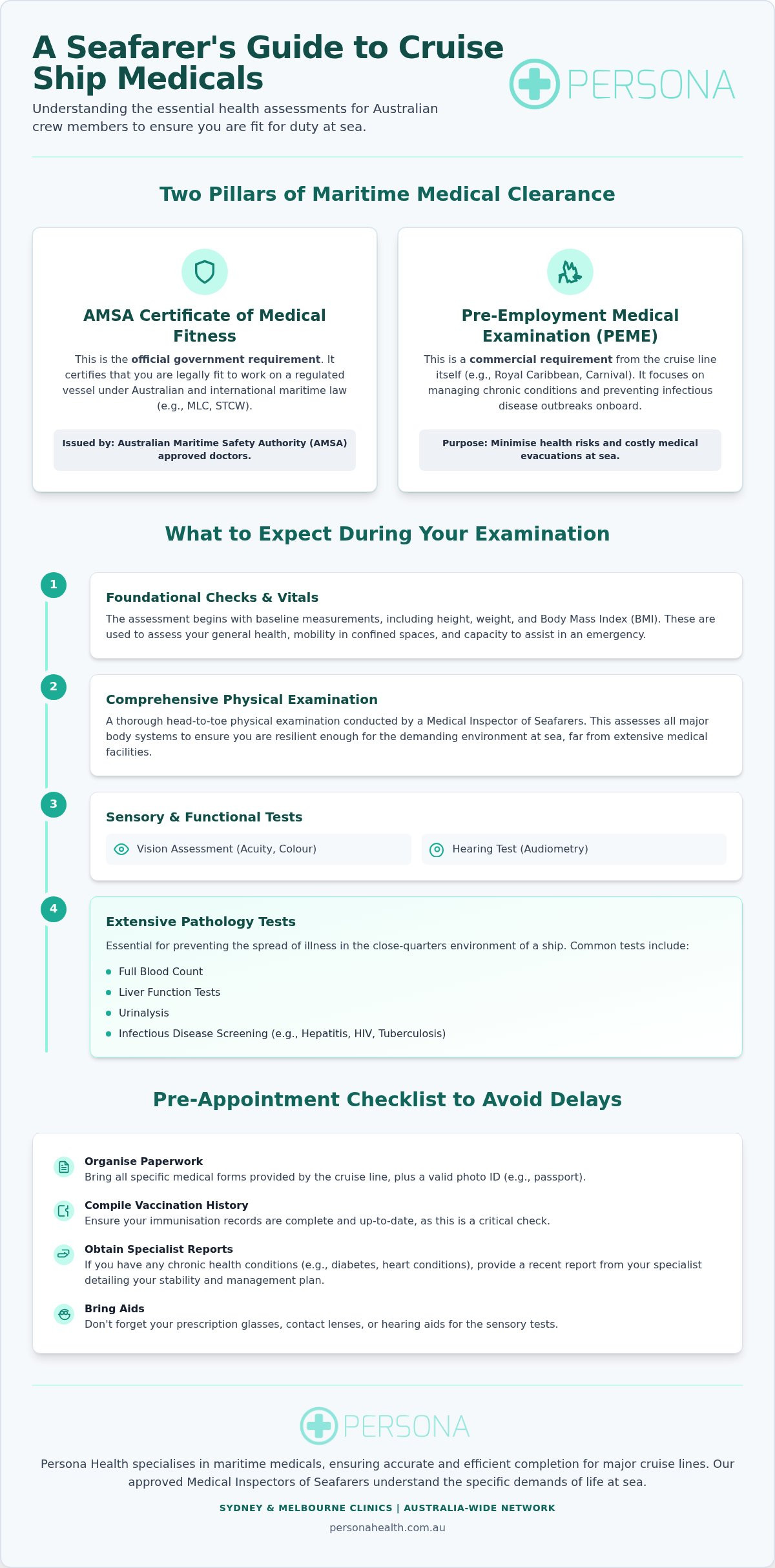
A cruise ship medical is a specialised health assessment designed to ensure seafarers are physically and mentally capable of performing their duties in the unique, often isolated environment of a vessel at sea. Unlike a standard office based role, working on a ship means you are far from the advanced medical infrastructure found in Australian cities. If a health crisis occurs in the middle of the Southern Ocean, the resources available are limited to the onboard infirmary. This isolation is why cruise ship medicals australia are significantly more rigorous than typical pre-employment checks. They act as a vital safety net for both the individual crew member and the entire vessel.
To better understand the reality of medical care at sea, watch this helpful video regarding the pros and cons of onboard medical centres:
These assessments are governed by international frameworks, primarily the Maritime Labour Convention (MLC) and the STCW Convention standards. These agreements ensure that every seafarer, regardless of their home country, meets a baseline of fitness. In Australia, this process is split into two distinct paths: regulatory certificates issued by the Australian Maritime Safety Authority (AMSA) and commercial Pre-Employment Medical Examinations (PEME) required by the cruise lines themselves. While AMSA ensures you are legally fit to work on a regulated vessel, the cruise line wants to ensure you won’t require an expensive medical evacuation due to a manageable chronic condition.
The Pre-Employment Medical Examination (PEME)
Major international brands like Royal Caribbean, Carnival, and Disney have developed their own highly specific medical templates. These forms are often dozens of pages long and require a deep dive into your clinical history. The focus here is heavily weighted toward chronic condition management and infectious disease prevention. Because crew members live in close quarters, a single case of an infectious illness can quickly escalate. A PEME differs from standard Australian occupational health checks by requiring extensive pathology, including screenings for conditions that might be stable on land but could become high risk under the physical demands of a seven day work week at sea.
The Role of the Medical Inspector of Seafarers
Not every GP can sign off on your maritime documents. AMSA requires that assessments be conducted by an approved Medical Inspector of Seafarers who understands the specific physical demands of life at sea. At Persona Health, our medical team is well versed in these international templates and the strict requirements of the world’s largest cruise brands. We manage the complex paperwork and pathology requirements across our clinics in Sydney and Melbourne, ensuring that your cruise line medicals are completed accurately the first time. This expertise reduces the risk of your application being rejected by a cruise line’s head office due to a minor administrative oversight or an incomplete test result.
What to Expect During Your Cruise Line Medical Examination
Walking into a clinic for cruise ship medicals australia is quite different from a standard GP visit. You aren’t there because you’re unwell; you’re there to prove your resilience. The assessment is a multi-stage process that looks at your body’s systems through the lens of maritime safety. Because you will be living and working in a self-contained community, the clinical team must ensure you don’t carry undiagnosed conditions that could jeopardise your health or the safety of the passengers and crew around you.
The physical examination begins with baseline measurements, including your Body Mass Index (BMI). While a high BMI isn’t an automatic disqualification, it is closely monitored because it can impact your mobility in tight ship corridors or your ability to assist in an emergency. Beyond physical stats, the doctor will conduct a thorough review of your mental health history. Long term isolation at sea, away from family and familiar support networks, requires a high level of psychological readiness. We take the time to discuss these aspects with you, ensuring you feel prepared for the lifestyle shift that comes with a life at sea.
Diagnostic imaging is another standard component. Most major lines require a chest X-ray to screen for tuberculosis. In the communal environment of a ship, respiratory health is paramount. These requirements align with the International Maritime Organization standards, which were significantly strengthened by the 2010 Manila Amendments to ensure all seafarers meet a global benchmark of health. If you have concerns about what your specific cruise line requires, you can speak with our maritime medical team to review your paperwork before your appointment.
Physical Fitness and Functional Testing
Your vision and hearing are the primary tools for maintaining safety on a vessel. Vision testing includes distance and near-sight assessments, along with colour perception checks. If you are working on the bridge or in technical roles, being able to distinguish between red and green navigation lights is a critical safety requirement. Audiometry is equally vital, particularly for those working in noisy engine rooms. We test your hearing across various frequencies to ensure you can hear alarms and verbal instructions over the hum of the ship’s machinery. Finally, we may assess your functional capacity to ensure you can physically manage emergency duties, such as climbing vertical ladders or participating in lifeboat drills.
Pathology and Drug Screening
The pathology component is often the most comprehensive part of the medical. We conduct a full blood count and check your cholesterol, glucose levels, and kidney function. We also screen for communicable diseases, including Hepatitis A, B, and C, as well as HIV. These tests provide a clear picture of your long-term health and your suitability for international travel. A key part of this process is the drug and alcohol testing, which is a non-negotiable requirement for maritime safety. Our clinics in Sydney and Melbourne use modern digital reporting systems to ensure these results are processed quickly, helping you meet your departure deadlines without unnecessary stress.
AMSA Certificates vs. Private Cruise Line Medicals
One of the most common points of confusion for those seeking cruise ship medicals australia is the distinction between a government-issued certificate and an employer-specific assessment. Essentially, you are navigating two different sets of expectations. The Australian Maritime Safety Authority (AMSA) requires a baseline level of fitness to ensure you can safely work on a regulated vessel. Meanwhile, the cruise line requires a deeper clinical dive to protect their commercial interests and your personal wellbeing during a long-term contract. It is not uncommon for seafarers to require both assessments simultaneously, especially when joining an international vessel from an Australian port.
Validity periods often cause administrative headaches for crew members. An AMSA Certificate of Medical Fitness is typically valid for up to 24 months. However, if you are under 18 or aged 55 and over, this validity drops to 12 months. In contrast, many private cruise lines demand a fresh Pre-Employment Medical Examination (PEME) every year, regardless of your age. This discrepancy exists because cruise lines operate under different risk management frameworks than national regulators. At Persona Health, we help you align these timelines so you don’t find yourself back in the clinic just months after your last check.
Marine Order 76 and Australian Standards
Australian legislation, specifically Marine Order 76 (Health – medical fitness), governs the standards for domestic maritime medicals. These regulations ensure that every seafarer meets the medical fitness requirements of the STCW Convention. This is the legal foundation of your career. Because these standards are so specific, AMSA medical examinations must be conducted by an approved medical inspector. Our team provides these specialised medicals across our Sydney and Melbourne clinics, ensuring your Form 303 is completed in strict accordance with Australian law.
Navigating International Cruise Line Templates
When you sign with a major brand like Disney Cruise Line, Carnival UK, or Norwegian Cruise Line, you will be issued a specific medical template. These are often designed for foreign-flagged vessels and can be incredibly detailed. The challenge for many Australian practitioners is interpreting these international requirements within our local clinical context. We frequently manage paperwork for various global brands, ensuring every infectious disease screen and specialist report meets their unique criteria. Getting this paperwork right the first time is essential. There is nothing more stressful than arriving at the gangway only to be told your medical form is missing a specific laboratory stamp or a doctor’s signature on a secondary page.
- AMSA 303: Focuses on immediate safety and regulatory compliance within Australian waters.
- Private PEME: Focuses on long-term health stability and reducing the risk of medical repatriation.
- Combined Assessments: Often the most efficient path for crew joining international fleets.
How to Prepare for Your Assessment and Avoid Delays
Preparation is the difference between receiving your fit-for-duty certificate on the day and facing weeks of “pending” status. When you book cruise ship medicals australia, the administrative work begins long before you step into our Sydney or Melbourne clinics. Most delays aren’t caused by health issues themselves; they’re caused by missing documentation that clinical teams need to verify your history. If you have a chronic condition, such as high blood pressure or asthma, bringing a recent report from your treating specialist is essential. This proactive approach allows our doctors to make an informed decision immediately rather than waiting for external correspondence.
Fasting and hydration are equally critical for clinical accuracy. Many cruise line PEMEs require a fasting blood glucose and cholesterol test. You should aim to fast for 8 to 10 hours before your appointment, though you must stay well hydrated with water. Dehydration can sometimes lead to abnormal kidney function results or concentrated urine samples, which might trigger unnecessary follow-up tests. To ensure your career stays on track and you avoid the high costs of re-testing, book your cruise ship medical with our experienced team today.
The Seafarer Vaccination Checklist
International maritime travel involves visiting diverse ports with varying health risks. Consequently, cruise lines and port authorities have strict immunisation requirements. You will likely need proof of vaccination for MMR (Measles, Mumps, and Rubella), Varicella (Chickenpox), and Hepatitis A. Depending on your itinerary, a Yellow Fever vaccination might also be mandatory. It’s vital to obtain an International Certificate of Vaccination or Prophylaxis (the “Yellow Book”) to document these shots. At Persona Health, we assist crew members with visa medicals and immunisations, ensuring all your international travel requirements are met in one location.
On the Day: Tips for a Smooth Medical
Your choices in the hours leading up to your assessment can impact your results. Avoid caffeine and nicotine for at least two hours before your appointment, as these stimulants can artificially inflate your blood pressure and heart rate. If you wear glasses or contact lenses, ensure you bring them with you. We need to test your vision both with and without correction to meet international standards. Finally, the importance of honesty in your medical history disclosure cannot be overstated. Withholding information about previous surgeries or chronic conditions can lead to legal complications or a revoked certificate if discovered later. Our clinicians are here to support your career; being transparent about your health allows us to manage any issues within the framework of maritime safety.
- Bring Your Passport: This is the primary form of identification required for maritime certificates.
- Specific Forms: Always bring the latest version of the cruise line’s medical template.
- Specialist Reports: Include any recent letters regarding stable chronic conditions.
- Medication List: Provide a clear list of any prescribed medications you currently take.
Why Choose Persona Health for Your Seafarer Medicals
Persona Health understands that your career depends on a successful medical outcome. Our team of experienced medical professionals is deeply familiar with the complex requirements of Carnival, Royal Caribbean, and Disney, ensuring your paperwork is handled with clinical precision. When you choose us for cruise ship medicals australia, you aren’t just getting a health check; you are partnering with a maritime health expert that understands both AMSA and PEME requirements. We prioritise fast turnaround times for complex pathology and imaging, recognising that tight departure dates leave no room for administrative delays. Our modern digital reporting systems streamline the process, providing clear, accurate results for both crew members and employers.
Beyond our physical presence in major cities, we provide a 100-clinic affiliate network and Australia-wide mobile services. This ensures that even remote seafarers can access the same high standard of care without needing to travel across the country for a single appointment. Whether you are a first-time cadet or a seasoned officer, our goal is to alleviate the anxiety of the assessment process through clear communication and professional authority. We treat every seafarer as an individual, ensuring your specific health needs and career goals are at the centre of our clinical approach.
Our Clinic Locations in Sydney and Melbourne
We have strategically placed our clinics to provide convenient access for seafarers across Australia’s major maritime hubs. In New South Wales, crew members can visit our facilities in Rosebery, Gregory Hills, and Dee Why. We also offer specialised Pre-Employment Medicals in Parramatta, which serves as a central hub for many NSW-based maritime workers. For those in Victoria, our Cairnlea and Craigieburn clinics provide comprehensive coverage across the Melbourne metropolitan area. Each location is equipped with the necessary diagnostic tools to complete your cruise line medical in a single visit, saving you time and reducing the cost of multiple appointments.
Safety Beyond the Medical: InjuryQR
Our commitment to your wellbeing continues long after you leave the clinic and head out to sea. We encourage all maritime employers and seafarers to utilise InjuryQR, a free AI-powered triage service designed for immediate workplace injury management. If an incident occurs on deck or in the engine room, workers simply scan a QR code with their smartphone. No app is required. By describing the injury via voice, they receive immediate AI-guided next steps, such as self-care instructions, telehealth consultations, or emergency directions.
For maritime businesses, this rapid response is invaluable for reducing Lost Time Injuries (LTIs) and improving the accuracy of incident reporting. The system can even issue immediate Certificates of Capacity where appropriate, ensuring compliance with Australian WHS legislation and SafeWork Australia standards. Employers can also order free physical assets, like posters and magnets, to ensure the service is always accessible to their crew. This modern approach to safety ensures that help is always available, even in the demanding environment of a cruise ship.
If you are ready to secure your medical clearance for the 2026 season, our team is here to help. Contact Persona Health today to request a quote or to speak with our specialists about your upcoming maritime assessment. We look forward to supporting your journey at sea.
Securing Your Future at Sea
Your journey toward a rewarding career on the water starts with a clear understanding of the regulatory and commercial health standards required in 2026. Successfully navigating cruise ship medicals australia involves more than just a physical check; it requires aligning AMSA statutory requirements with the specific pathology and vaccination mandates of your chosen cruise line. By gathering your specialist reports early and staying hydrated before your assessment, you can avoid common administrative delays that often hinder departure dates.
At Persona Health, our approved medical team is well-versed in the templates used by major global cruise lines, ensuring your results are processed with speed and clinical accuracy. With convenient clinic locations across Sydney and Melbourne and a dedicated focus on fast turnaround times for maritime pathology, we are here to ensure you are fit for duty and ready for the gangway. Don’t let paperwork stand between you and your next contract. Book your Cruise Line Medical with Persona Health today and take the final step toward your life at sea with confidence. We look forward to helping you reach your professional goals.
Frequently Asked Questions
Do I need an AMSA medical or a cruise line specific medical?
You will likely need both if you are an Australian seafarer joining an international fleet. The AMSA Certificate of Medical Fitness (Form 303) is a regulatory requirement for working on regulated vessels, while the Pre-Employment Medical Examination (PEME) is a commercial requirement set by the cruise line itself. Our team manages both assessments concurrently to ensure you meet every legal and employer-specific standard.
How long does a cruise ship medical take to complete in Australia?
The clinical consultation for cruise ship medicals australia typically takes between 60 and 90 minutes. However, you should allow three to five business days for pathology results and diagnostic imaging reports to be finalised. Persona Health provides fast turnaround times for these results, ensuring your completed paperwork is ready as quickly as possible to meet your departure date.
What happens if I fail my cruise ship medical assessment?
A “fail” is often a temporary status rather than a permanent disqualification. If a health issue is identified, you may be classified as “temporarily unfit” while you seek treatment or further specialist review. Once the condition is managed or a specialist provides a clearance letter, we can often reassess your fitness for duty and issue your certificate.
Can I go to my regular GP for a cruise line medical?
No, a regular GP cannot typically perform these assessments unless they are an AMSA-approved Medical Inspector of Seafarers. Cruise lines also require doctors who are familiar with their specific international templates and the unique physical demands of maritime work. Visiting a specialised occupational health clinic ensures your paperwork is accepted at the gangway without issue.
How much does a cruise ship medical cost in Sydney or Melbourne?
The cost of a medical assessment varies significantly based on the specific pathology and imaging requirements of your cruise line. A basic assessment is less expensive than one requiring extensive infectious disease screening and chest X-rays. We provide tailored quotes based on your specific cruise line forms to ensure you only pay for the tests you actually need.
Do I need to fast before my cruise line medical appointment?
Yes, most cruise lines require you to fast for 8 to 10 hours before your appointment. This is necessary for accurate blood glucose and cholesterol testing. You should continue to drink plenty of water during this time to stay hydrated, as this helps with the clinical examination and ensures your urine samples are within normal ranges.
What vaccinations are required for Australian cruise ship crew?
Standard requirements usually include MMR (Measles, Mumps, and Rubella), Varicella, and Hepatitis A and B. Depending on your ship’s itinerary, you may also need a Yellow Fever vaccination or updated COVID-19 boosters. We review your vaccination history during the assessment and can organise any missing immunisations to ensure you meet international maritime health standards.
How long is a cruise ship medical certificate valid for?
An AMSA medical certificate is generally valid for up to 24 months, though this is reduced to 12 months for those under 18 or over 55. Most private cruise lines require a new PEME every 12 months regardless of age. It’s essential to check your specific contract, as some lines may require more frequent checks for certain roles or pre-existing conditions.

Article by
Ian Nicholson
Ian is the Business Support Manager at Persona Health, where he plays a key role across IT, sales, marketing and business operations. With a broad skill set and a practical, solutions-focused approach, Ian helps drive the systems, communication and commercial strategy that support Persona Health’s continued growth across Australia.