

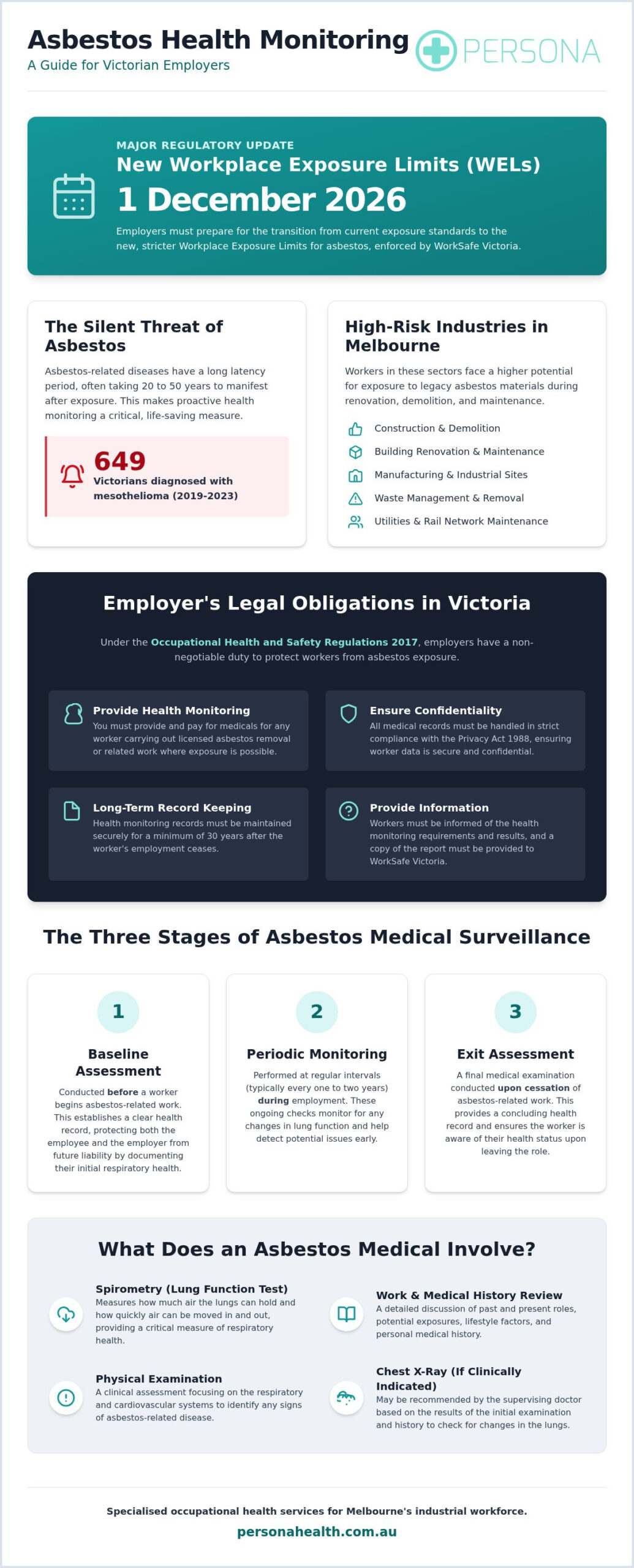
With over 1,900 asbestos-related worksite visits conducted by WorkSafe Victoria in a single financial year, the regulatory spotlight on employer responsibility has never been brighter. It is a sobering reminder that managing risk is about more than just paperwork; it is about the real-world safety of your workforce. Navigating the requirements for asbestos medicals melbourne can feel like a complex task, especially as we approach the implementation of new Workplace Exposure Limits (WELs) on 1 December 2026.
You likely feel the weight of this responsibility, balancing the need for strict compliance with a genuine desire to protect your employees from long-term health liabilities. We understand that the overlap between WorkSafe Victoria and SafeWork Australia guidelines often creates more questions than answers. This comprehensive guide provides the clarity you need to manage asbestos health monitoring with confidence. We will explore the essential medical processes, from spirometry to occupational history, and outline exactly how to meet your 2026 compliance obligations while maintaining a supportive, person-centred approach to worker well-being.
Key Takeaways
- Prepare for the transition from exposure standards to the new Workplace Exposure Limits coming into effect in Victoria on 1 December 2026.
- Understand the essential components of professional asbestos medicals melbourne, including lung function testing and medical history reviews to ensure worker safety.
- Identify your legal obligations under the Occupational Health and Safety Regulations 2017 to provide employer-funded health monitoring for at-risk staff.
- Learn the importance of baseline assessments in establishing a clear health record before exposure begins, protecting your business from future liability.
- Discover how local Melbourne clinics in Cairnlea and Craigieburn provide the specialised support and fast reporting required for modern industrial compliance.
Understanding Asbestos Exposure Risks in Melbourne for 2026
Asbestos remains a significant legacy issue for Melbourne’s industrial and residential landscape. This naturally occurring mineral fibre was once prized for its durability and heat resistance, leading to its widespread use in building materials across Victoria until the late 1980s. Understanding Asbestos and its properties is the first step in managing its risks. In Melbourne, these fibres are frequently found in “fibro” sheeting, insulation, floor tiles, and pipe lagging within older structures. While intact, these materials pose little risk; however, the danger changes the moment they are disturbed.
The primary risk occurs when materials are damaged. During demolition, renovation, or even routine maintenance, microscopic fibres can become airborne. If inhaled, they lodge deep within the lung tissue. Because they are chemically inert and physically indestructible, the body cannot easily expel them. Over time, this leads to severe conditions such as asbestosis, lung cancer, and mesothelioma. Statistics from the Victorian Cancer Registry show that 649 Victorians were diagnosed with mesothelioma in the four years leading to December 2023. Most of these individuals were men who had worked in construction or manufacturing, highlighting why asbestos medicals melbourne are a critical health priority for local industries.
Common Industries at Risk in Melbourne
Melbourne’s current infrastructure boom and the rejuvenation of inner-city suburbs like Richmond and Brunswick present unique challenges. Workers involved in large-scale demolition projects in the Melbourne CBD face high potential for exposure. Similarly, those maintaining the Victorian rail network or utility pipelines often encounter legacy asbestos in underground conduits and old station buildings. Industrial zones such as Cairnlea and Craigieburn also house manufacturing and waste management facilities where legacy materials may still be present. Ensuring these workers have access to on-site health surveillance is a vital part of modern risk management for Victorian businesses.
The Long-Term Impact of Exposure
The most challenging aspect of asbestos exposure is its latency period. Symptoms often do not appear for 20 to 50 years after the initial contact. This delay makes early detection through professional asbestos medicals melbourne absolutely vital. Cumulative exposure can gradually degrade a worker’s respiratory capacity, eventually impacting their fitness for duty and overall quality of life. For employers, the risks are not just clinical but also legal. Failing to provide adequate monitoring can lead to significant long-term liability. By implementing regular check-ups, businesses can protect their people while demonstrating a clear commitment to Victorian safety standards. If an accidental exposure or injury occurs on-site, using tools like InjuryQR can help manage immediate reporting and triage effectively, ensuring workers receive prompt guidance.
Victorian Legislative Requirements for Asbestos Health Monitoring
In Victoria, the legal framework for managing hazardous substances is governed by the Occupational Health and Safety Regulations 2017. These regulations place a clear, non-negotiable duty on employers to identify hazards and implement specific controls when workers are at risk. For businesses seeking asbestos medicals melbourne, the most critical trigger for action is when a worker is likely to be exposed to asbestos at a level that could harm their health. This is not merely a recommendation; it is a statutory requirement designed to ensure the long-term safety of your workforce.
The Victorian Legislative Requirements state that monitoring must be provided for any worker carrying out licensed asbestos removal or other asbestos-related work where exposure is possible. Crucially, the employer must bear all costs associated with these assessments. You are also required to maintain these health records for at least 30 years. This long-term record-keeping must adhere strictly to the Privacy Act 1988, ensuring that sensitive medical data is handled with the highest level of confidentiality and care.
WorkSafe Victoria Compliance Standards
Under the Victorian system, health monitoring must be supervised by an Appointed Medical Practitioner. This is a doctor with the specific expertise required to identify early signs of respiratory distress or disease. WorkSafe Victoria takes these duties seriously; in the 2023-24 financial year, inspectors conducted over 1,900 asbestos-related visits to Victorian worksites, issuing 210 compliance notices. Melbourne businesses that fail to meet these standards face significant penalties, including substantial fines and potential legal action. If you are unsure if your current safety register meets these standards, speaking with an experienced partner like Persona Health can provide the clarity you need.
National Standards vs Local Regulation
While SafeWork Australia provides a national framework, Victorian employers must remain focused on local WorkSafe mandates. As we move through 2026, the shift from “exposure standards” to the new “Workplace Exposure Limits” (WELs) on 1 December 2026 will require updated protocols. Persona Health ensures your compliance by aligning our clinical processes with both national best practices and specific Victorian regulations. Our on-site health surveillance services are designed to bring this expertise directly to your facility, minimising downtime while maximising worker safety. This proactive approach helps you stay ahead of regulatory changes and ensures your team remains fit for duty in an evolving legal landscape.
The Three Essential Stages of Asbestos Medical Surveillance
Effective health surveillance is a longitudinal process, not a snapshot in time. To truly protect your workforce and your business, you need a methodology that tracks health changes over decades. This is why professional asbestos medicals melbourne are structured into three distinct clinical stages. By maintaining consistency in testing methods, such as using the same calibrated spirometry equipment and clinical standards, we ensure that any subtle changes in a worker’s lung function are detected as early as possible. This structured approach moves beyond simple compliance, creating a protective health history for every individual in your care.
Baseline Pre-Employment Medicals
The foundation of any robust health monitoring program is the baseline assessment. This must occur before a worker begins any task involving potential asbestos exposure. A baseline check is essential because it establishes the individual’s “normal” respiratory state. Without this data, it’s impossible to determine if future health issues were caused by their time at your site or by previous roles. Integrating these checks into your standard pre-employment medicals provides a clear defensive record against prior-exposure claims. It also sets the benchmark for all future comparisons, allowing our medical team to monitor the unique physiological profile of every employee. According to WorkSafe Victoria’s guidance on asbestos medical checks, having this initial data is a cornerstone of a compliant safety system.
Ongoing Periodic Surveillance
In Victoria, periodic monitoring is typically required every two years for workers in high-risk roles. These regular check-ups aren’t just about ticking a box; they are an empathetic way to reassure your team that their health is being prioritised. For businesses with large workforces or tight project deadlines, managing these appointments can be a logistical challenge. Utilising on-site health surveillance allows you to maintain compliance without the disruption of sending staff off-site. If an assessment reveals abnormal results, such as a significant drop in lung capacity, a clear health management process must be triggered. This proactive care ensures that small physiological changes don’t become life-altering conditions.
The final stage is the exit medical. When a worker leaves a high-risk role or your employment, a final assessment captures their health status at the point of departure. This “closing the loop” is vital for long-term liability management. It provides documented evidence of their health status when they left your care, which is particularly important given the long latency periods associated with asbestos-related diseases. This ensures that both the worker and the employer have a clear, final record of the individual’s respiratory health.
What Happens During an Asbestos Medical Assessment?
When a worker arrives for their asbestos medicals melbourne, our primary goal is to make the process as transparent and stress-free as possible. Understanding what to expect can significantly reduce the anxiety some employees feel regarding clinical environments. The assessment is a thorough, evidence-based review that typically takes about 45 to 60 minutes. It is designed to evaluate current respiratory health while identifying any early indicators of change that might require further investigation. This is a supportive process focused on the long-term well-being of the individual.
The Spirometry (Lung Function) Test
The core of the medical is the spirometry test. This involves the worker blowing into a specialised machine that measures the volume and speed of air they can exhale. Accuracy is paramount here. We use high-quality, regularly calibrated equipment and our technicians are specifically trained to guide workers through the process to achieve the most reliable results. To ensure the test is as accurate as possible, workers should avoid smoking for at least one hour prior and should not have consumed a heavy meal. This data becomes the baseline we discussed previously, allowing us to track respiratory capacity over many years. It is a vital tool for detecting the early signs of restrictive or obstructive lung patterns.
Physical Examination and History
A qualified occupational health professional conducts a physical examination, with a specific focus on the chest and respiratory system. They will listen to the lungs for any unusual sounds, such as crackles or wheezing, which could indicate underlying issues. We also spend significant time reviewing the worker’s medical and occupational history. This includes an honest discussion about smoking history. Smoking acts as a compounding factor, significantly increasing the risk of lung cancer when combined with asbestos exposure. We use this time to provide education, empowering the worker with knowledge about correct PPE usage and safe work practices.
In some cases, a chest X-ray is required. These are not standard for every biennial check but are often triggered by the duration of exposure or clinical findings. When performed, these images are coded to the ILO International Classification of Radiographs of Pneumoconioses. This ensures that the results are standardised and can be compared against international health benchmarks. If an incident occurs on-site where a worker is accidentally exposed or injured, tools like InjuryQR provide immediate AI-powered triage to guide them through the next steps. To ensure your workforce remains safe and compliant, book your asbestos medicals with our Melbourne team today.
Why Partner with Persona Health for Melbourne Asbestos Medicals
Choosing the right occupational health partner is a strategic decision that affects your operational efficiency and your workers’ long-term safety. At Persona Health, we provide specialised support for asbestos medicals melbourne through our locally accessible clinics in Cairnlea and Craigieburn. Our presence in these key industrial hubs ensures your team has convenient access to expert care without excessive travel time. For businesses with regional Victorian operations or staff spread across the country, our network of over 100 affiliate clinics and mobile health services provides a consistent, high-quality solution wherever your projects take you.
We understand that in the construction and demolition sectors, time is a critical resource. Our modern digital reporting systems are designed to deliver fast turnaround times, ensuring you have the necessary compliance documentation to keep your projects moving forward. This employer-focused approach combines clinical excellence with administrative efficiency, allowing you to focus on your core business while we manage the complexities of health surveillance. We treat every worker as an individual, ensuring their specific health history and concerns are addressed with empathy and professional authority.
Proactive Injury Management with InjuryQR
In any high-risk environment, the speed of response to an incident is vital. This is why we have integrated InjuryQR into our service offering. This free, AI-powered triage service allows workers to scan a QR code on-site using their smartphone, with no app download required. They simply describe the injury or respiratory concern by voice, and the AI provides immediate, guided next steps. This ensures that the individual feels heard and supported from the very first moment of a workplace incident.
This process ensures that workers receive the right care at the right time, whether it’s self-care instructions, a telehealth consultation, or direction to emergency services. For employers, the benefits are clear. InjuryQR helps reduce Lost Time Injuries (LTIs) by ensuring minor issues are managed effectively and providing immediate issuance of Certificates of Capacity where appropriate. It also streamlines incident reporting, creating a safer and more transparent workplace. You can even order free physical InjuryQR assets like posters and magnets to display at your Melbourne sites to ensure this resource is always within reach.
Booking Your Asbestos Medicals
Organising health surveillance for a large workforce shouldn’t be a source of stress. We specialise in managing bulk bookings for Melbourne businesses, providing a single point of contact to coordinate assessments across our clinic network. Our team maintains a clear, empathetic communication style, ensuring that both you and your employees feel supported throughout the process. We don’t just provide a service; we act as a modern professional partner in your safety journey.
Whether you are preparing for the 2026 regulatory updates or need to establish a baseline for a new project, we are here to help. Our experienced medical team is ready to provide the professional guidance required to keep your business compliant and your people safe. To discuss your specific requirements or request a quote, contact us regarding asbestos medicals melbourne and discover the Persona difference. We look forward to helping you build a healthier, more resilient workforce.
Securing Your Workforce for 2026 and Beyond
As we approach the regulatory transition on 1 December 2026, the focus on worker respiratory health has never been more critical. By establishing clear baseline data and maintaining consistent periodic surveillance, you protect both your employees’ futures and your business’s long-term stability. Managing these obligations doesn’t have to be a source of uncertainty. With our clinics in Cairnlea and Craigieburn, we provide local expertise that simplifies the process of asbestos medicals melbourne for Victorian employers.
Our team offers specialised ILO X-ray reporting and modern digital results to keep your projects on track. We also provide all our clients with free access to InjuryQR, ensuring that any on-site concerns are met with immediate, AI-powered triage. This holistic approach ensures that your safety standards remain as high as your project goals. We’re here to support you in creating a workplace where health is prioritised and compliance is seamless. Book your Melbourne Asbestos Medicals with Persona Health today and take the next step in your safety journey with a partner you can trust.
Frequently Asked Questions
How often do employees need asbestos medicals in Melbourne?
Typically every two years for workers in high-risk roles. This periodic monitoring allows for the early detection of subtle respiratory changes over time. Remember that a baseline assessment is also required before any potential exposure begins. This ensures a clear health history is established for every individual in your workforce, moving beyond simple compliance to genuine care.
What is the difference between a standard chest X-ray and an ILO X-ray?
An ILO X-ray is interpreted using the International Labour Organisation Classification of Radiographs of Pneumoconioses. Unlike a standard diagnostic X-ray, this specific coding system allows for a standardised comparison of lung abnormalities caused by mineral dusts like asbestos. This specialised reporting is essential for tracking disease progression and is a core component of high-quality health surveillance programs in Victoria.
Does a worker need to fast before an asbestos medical assessment?
No, fasting is not required for a standard asbestos medical. However, workers should avoid eating a very heavy meal or smoking for at least one hour before the appointment to ensure the accuracy of the spirometry test results. We also recommend that workers wear comfortable, loose-fitting clothing that allows them to breathe deeply and move easily during the physical examination.
Who is responsible for the cost of asbestos health monitoring in Victoria?
The employer is legally responsible for all costs associated with health monitoring in Victoria. This includes the medical examination, any required tests like spirometry or X-rays, and the time the worker spends attending the appointment. Under the Occupational Health and Safety Regulations 2017, these costs cannot be passed on to the employee as it’s part of your duty of care.
Can asbestos medicals be conducted on-site at a Melbourne construction project?
Yes, asbestos medicals melbourne can be provided on-site through mobile health services. This approach is often more efficient for large workforces, as it minimises project downtime while ensuring all staff meet their WorkSafe Victoria compliance obligations. Our team can bring specialised equipment directly to your site, making it easier to manage health surveillance for workers on tight construction schedules.
What happens if a worker spirometry test shows a decline in lung function?
If a decline is detected, the Appointed Medical Practitioner will review the results against the worker’s established baseline. The employer must be notified of the result’s impact on the worker’s fitness for duty, while maintaining medical confidentiality. A specialist referral or a thorough workplace risk assessment may be recommended to identify if additional protective measures or role changes are necessary.
Is asbestos health monitoring required for all demolition workers?
Monitoring is mandatory for workers performing licensed asbestos removal or where exposure is likely to exceed the exposure limit. A professional risk assessment should determine if demolition workers are at risk of disturbing asbestos-containing materials before work commences. Even if not strictly mandatory, providing baseline and periodic checks for all demolition staff is a proactive way to manage long-term business liability.
How long are employers required to keep asbestos health monitoring records?
Victorian employers must retain these health records for at least 30 years. Given the long latency period of asbestos-related diseases, these records are vital for future health reviews and protecting the business against long-term legal liability. This requirement ensures that a worker’s health history remains accessible decades after their initial exposure, providing a clear record of your commitment to their safety.

Article by
Ian Nicholson
Ian is the Business Support Manager at Persona Health, where he plays a key role across IT, sales, marketing and business operations. With a broad skill set and a practical, solutions-focused approach, Ian helps drive the systems, communication and commercial strategy that support Persona Health’s continued growth across Australia.