
Here’s a question worth sitting with: could your hiring process be exposing your business to serious legal and safety risks before a new employee even starts their first shift? If you’re responsible for workforce safety, you already know the answer isn’t straightforward. Pre-employment drug and alcohol testing services sit at the intersection of workplace health law, privacy obligations, and practical HR logistics, and getting it wrong can be costly in more ways than one.
You’re not alone in feeling the pressure. Many employers share the same concerns: what if a result is inaccurate? What if the testing process leaves the business vulnerable to an unfair dismissal claim or a privacy breach under the Privacy Act 1988? And how do you manage consistent, compliant testing across multiple sites without it becoming a logistical headache?
This guide is here to cut through the complexity. By the time you’ve finished reading, you’ll understand exactly how to build a robust alcohol and other drugs (AOD) screening programme that meets Australian Standards, aligns with your WHS obligations, protects your people, and keeps your hiring process moving without unnecessary delays. We’ll cover everything from the legal framework and testing methods to choosing the right provider and avoiding the most common compliance pitfalls.
Key Takeaways
- Choosing the right pre employment drug and alcohol testing services requires understanding the differences between urine, saliva, and breathalyser tests — each method detects substances across different timeframes and suits different roles and risk levels.
- Australian employers have a legal Duty of Care under WHS legislation, meaning a well-documented AOD screening programme is not just best practice — it is a critical part of your compliance obligations.
- How you communicate testing requirements to candidates before their appointment can significantly reduce delays, disputes, and the risk of non-compliance further down the line.
- Navigating state and federal regulatory bodies, including SafeWork Australia and relevant state authorities, is essential to building a screening programme that holds up under scrutiny.
- Persona Health’s network of Sydney clinics and 100-clinic affiliate programme means consistent, employer-focused testing is available across Australia — without the logistical headaches that often derail multi-site hiring programmes.
Understanding Pre-Employment Drug and Alcohol Testing Services
At its core, AOD screening in the Australian recruitment context is a structured process for determining whether a job candidate is free from the influence of alcohol or other drugs at the time of assessment, and in some cases, whether recent substance use could affect their capacity to perform their role safely. It’s not a punitive exercise. Done well, it’s a proactive health and safety measure that protects both the individual and the people they’ll work alongside.
Pre-employment drug and alcohol testing services sit within a broader pre-employment medical assessment framework. A candidate might complete a musculoskeletal assessment, a functional capacity evaluation, and vision and hearing checks as part of the same appointment. The AOD screen is one component of that picture, but it’s often the one that carries the most weight in safety-critical environments. You can read more about how these components fit together in Persona Health’s guide to pre-employment medicals.
The primary goal is straightforward: confirming that a candidate is genuinely fit for work before they step onto a site, into a cab, or onto a vessel. For roles where impairment could result in serious injury or death, that confirmation isn’t optional. It’s a foundational part of your duty of care under Australian WHS legislation.
The Business Case for AOD Screening
The safety argument is compelling on its own, but the business case extends further than accident prevention. Employers who implement consistent AOD screening as part of their hiring process typically see measurable benefits across several areas:
- Reduced workplace accidents and Lost Time Injuries (LTIs): Identifying at-risk candidates before they start work directly lowers the likelihood of substance-related incidents on site.
- Lower workers compensation premiums: Insurers and scheme managers recognise proactive risk management. A documented, consistent AOD programme demonstrates due diligence and can positively influence your risk profile over time.
- Protecting company reputation: A single serious incident involving an impaired worker can attract regulatory scrutiny, media attention, and lasting reputational damage. Prevention is considerably less costly than recovery.
- Cultural consistency: Applying the same screening standards to every new hire reinforces a workplace culture where safety is non-negotiable, not situational.
Industries Where Testing is Essential
While AOD screening is valuable across most sectors, certain industries carry an elevated obligation. In transport and logistics, drivers operating heavy vehicles have a direct responsibility to public safety. Commercial driver medicals routinely incorporate drug and alcohol screening as a standard requirement, aligned with National Heavy Vehicle Regulator (NHVR) standards.
In construction and infrastructure, SafeWork NSW and WorkSafe Victoria both expect employers to demonstrate active management of impairment risks on site. This expectation is particularly acute on projects involving working at heights, operating plant and machinery, or managing hazardous materials.
The rail and maritime sectors operate under some of the most stringent requirements in Australia. Cat 3 Rail Medicals mandate AOD screening as part of the fitness-for-duty assessment process, while the Australian Maritime Safety Authority (AMSA) applies its own standards for seafarers. In these environments, pre-employment drug and alcohol testing services aren’t simply good practice. They’re a regulatory baseline.
Methods of Screening: Urine, Saliva, and Breathalyser Tests
Not all drug and alcohol tests are created equal. The biological sample collected, the technology used to analyse it, and the Australian Standard it must conform to will all determine what a test can actually tell you about a candidate’s fitness for work. Understanding these differences is essential before you commit to a screening method, because choosing the wrong approach for your role type or industry can leave gaps in your safety programme that you simply can’t afford.
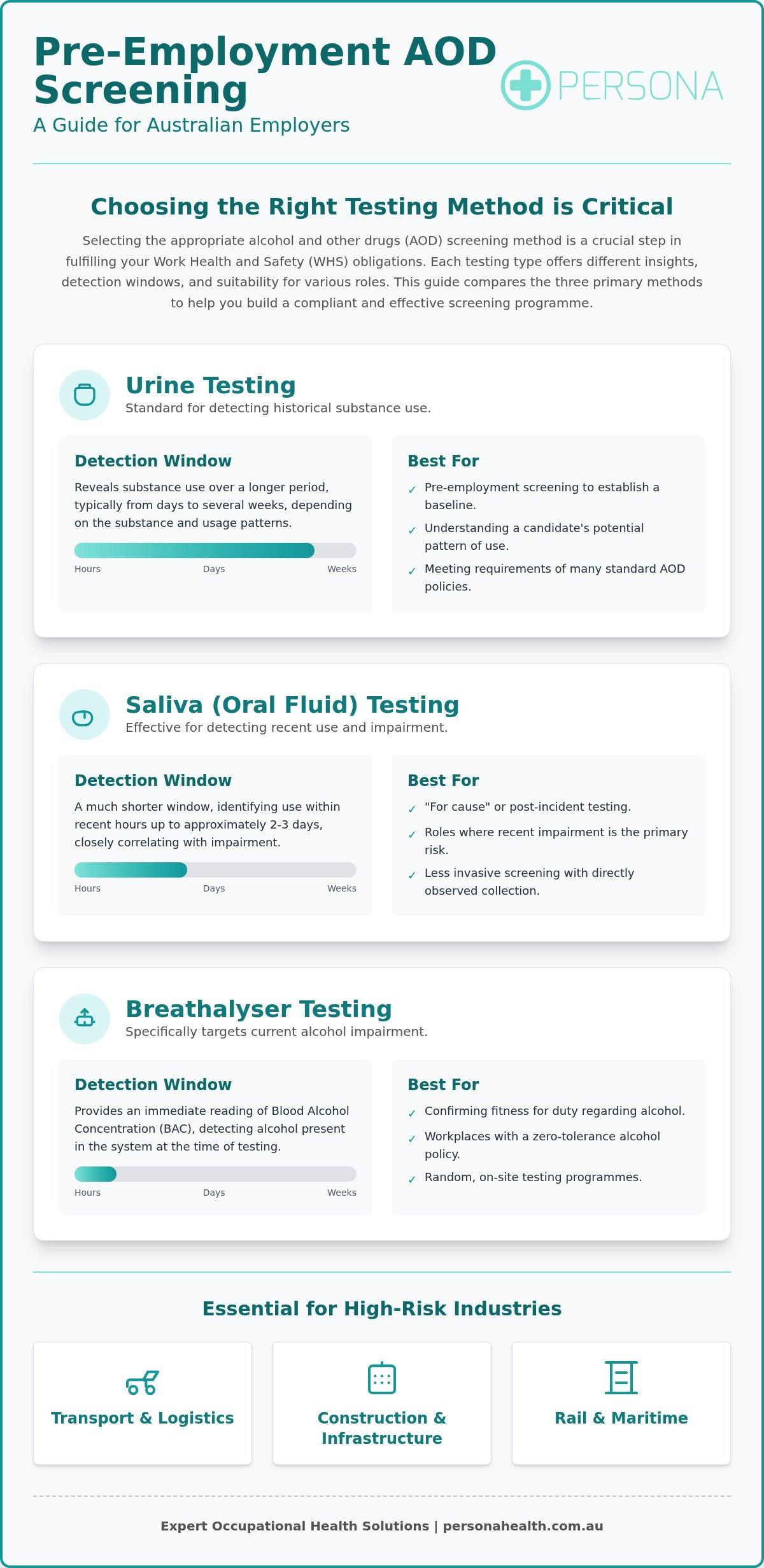
There are three primary testing methods used in Australian workplaces: urine, oral fluid (saliva), and breathalyser. Each has a distinct detection window, a different level of invasiveness, and a specific regulatory standard it must meet to be legally defensible.
- Urine testing is governed by AS/NZS 4308:2008 and can detect a broader range of substances over a longer historical window, typically several days to weeks depending on the substance and frequency of use.
- Oral fluid (saliva) testing is governed by AS/NZS 4760:2019 and is designed to detect recent use, generally within the past 24 to 48 hours, making it highly relevant to current impairment.
- Breathalyser testing is used exclusively for alcohol and reflects blood alcohol concentration at the precise moment of testing. It’s the most immediate measure available and is widely used in transport, construction, and mining environments.
The detection window distinction matters more than many employers realise. A urine screen might identify cannabis metabolites from use that occurred well before the candidate’s appointment, raising questions about historical lifestyle rather than current impairment. A saliva test, by contrast, is more closely aligned with whether someone is actually impaired right now. Neither approach is universally superior; the right choice depends on what your duty of care requires for a given role.
Instant Urine vs. Laboratory Analysis
Point-of-care (instant) urine testing uses immunoassay technology to produce a rapid result, often within minutes. This speed is genuinely valuable when you’re making time-sensitive recruitment decisions across multiple candidates. A negative result from a point-of-care screen is typically sufficient to clear a candidate and allow the hiring process to move forward without delay.
A “non-negative” result is a different matter entirely. It doesn’t mean a candidate has definitively tested positive; it means the screen has flagged something that requires confirmatory laboratory analysis using gas chromatography-mass spectrometry (GC-MS). This confirmatory step, conducted by a NATA-accredited laboratory, is what transforms a preliminary screen into a result that can withstand legal scrutiny.
Critically, the integrity of that process depends on chain of custody protocols. From the moment a sample is collected, every transfer, storage step, and analytical procedure must be documented. Without a verified chain of custody, a positive result can be challenged and potentially rendered inadmissible in an unfair dismissal proceeding or a WHS investigation. Any credible provider of pre-employment drug and alcohol testing services will have these protocols embedded into their standard operating procedures, not treated as an optional add-on.
Oral Fluid (Saliva) Testing Benefits
Saliva testing has grown in acceptance across Australian workplaces, and it’s not hard to understand why. Collection is straightforward, observed, and considerably less invasive than urine collection, which reduces candidate discomfort and the logistical complexity of providing supervised collection facilities. Higher candidate acceptance also means fewer disputes at the point of testing.
The focus on recent impairment rather than historical use is another practical advantage. For many employers, particularly in safety-critical environments, the question isn’t what a candidate did three weeks ago; it’s whether they’re safe to operate equipment or supervise others today. Oral fluid testing is well-suited to answering that specific question, which is why it’s frequently the method of choice for on-site random testing programmes and rapid pre-employment checks where turnaround time is a priority.
Selecting the right method for your context is exactly the kind of decision where experienced occupational health guidance pays dividends. Persona Health’s clinical team can help you match the appropriate testing protocol to your industry obligations and role risk profile, ensuring your programme is both compliant and practical from day one.
Compliance and Legal Requirements for Australian Workplaces
Understanding the legal landscape around pre-employment drug and alcohol testing services isn’t optional. It’s the foundation on which every other element of your screening programme rests. Get the compliance framework wrong, and even a well-intentioned AOD policy can expose your business to unfair dismissal claims, privacy breaches, or regulatory action from SafeWork authorities.
The legislative picture in Australia is layered. At the federal level, the Work Health and Safety Act 2011 (Cth) establishes the primary duty of care framework, requiring persons conducting a business or undertaking (PCBUs) to eliminate or minimise health and safety risks so far as is reasonably practicable. State and territory legislation mirrors this obligation: SafeWork NSW, WorkSafe Victoria, SafeWork SA, and their counterparts each administer their own WHS Acts, which, while harmonised in most jurisdictions, can carry state-specific nuances in enforcement approach and guidance material. Comcare administers WHS obligations for Commonwealth employees and certain federal licence holders, adding another layer for employers operating across those sectors.
Your duty of care doesn’t begin on a worker’s first day. It begins the moment you’re making decisions that affect whether someone is fit to perform a role. That’s precisely why pre-employment screening sits squarely within your WHS obligations, not outside them.
Developing a Robust AOD Policy
A workplace drug and alcohol policy is the document that makes your screening programme legally defensible. Without one, a positive test result becomes difficult to act on. With a well-drafted policy, you have a clear, consistent framework that every candidate and employee has been made aware of before testing takes place.
Your policy should address several key elements:
- Definition of a “positive” result: Specify the cut-off thresholds that constitute a positive under AS/NZS 4308:2008 or AS/NZS 4760:2019, and define what actions follow, whether that’s withdrawal of a job offer, referral for a confirmatory laboratory analysis, or an opportunity for the candidate to provide a medical explanation.
- Pre-employment disclosure: Candidates must be informed that AOD screening is a condition of employment before their appointment. This isn’t just courtesy; it’s a fundamental requirement for the process to hold up under scrutiny. Provide written notice in the letter of offer or candidate information pack.
- For Cause and post-incident testing provisions: A pre-employment screen is only one component. Your policy should also address the circumstances under which current employees may be tested, including reasonable suspicion and following a workplace incident. Documenting these provisions upfront prevents ambiguity later.
- Consequences and support pathways: Clearly articulate what happens after a non-negative result, including any Employee Assistance Programme (EAP) referral options, so the process is proportionate and transparent.
Critically, the policy must be communicated, not simply filed. Every prospective employee should receive it, acknowledge it in writing, and have a genuine opportunity to ask questions before testing proceeds.
Privacy and Confidentiality in Medical Reporting
Drug and alcohol test results are sensitive health information and are protected under the Privacy Act 1988 (Cth) and the Australian Privacy Principles (APPs). This has direct practical implications for how results are collected, stored, shared, and retained.
Results should be communicated only to those with a legitimate need to know, typically the occupational health provider, the employer’s designated HR or safety contact, and the candidate themselves. Sharing results more broadly, even within the organisation, without appropriate authorisation can constitute a breach of the APPs.
Persona Health manages candidate health data through modern digital reporting systems that maintain strict access controls and audit trails, supporting your obligations under the Privacy Act without adding administrative burden. Candidates also retain the right to dispute a result. If a non-negative screen proceeds to confirmatory GC-MS laboratory analysis, the candidate should be informed of this process and given the opportunity to provide relevant medical information, such as a prescription for a medication that may have influenced the result, before any final determination is made.
One area that catches some employers off guard is the question of what happens when a candidate refuses to test. In safety-sensitive industries, refusal to undergo AOD screening can be treated as equivalent to a positive result, provided this consequence is clearly stated in your policy and the candidate has been informed of it in advance. Without that documented disclosure, acting on a refusal becomes legally precarious. This is where a clearly written, well-communicated policy does the heavy lifting that no test result alone ever could.
Preparing Your Workplace and Candidates for Testing
One area where many employers quietly lose ground is in how they prepare candidates for the testing process itself. The clinical side of pre-employment drug and alcohol testing services gets plenty of attention. The human side, far less so. Yet how you communicate with candidates before their appointment directly shapes the outcome: the accuracy of results, the smoothness of the process, and the impression your organisation leaves on someone who may well become a valued team member.
Clear, written communication should go out at the same time as the appointment confirmation. Candidates need to know what the test involves, why it’s required, what they need to bring, and what happens next. Ambiguity at this stage breeds anxiety, and anxious candidates are more likely to arrive unprepared, which causes delays and, in some cases, results that require repeat collection.
Candidate Preparation Checklist
Send every candidate a simple checklist alongside their appointment details. It removes uncertainty and demonstrates that your organisation runs a professional, considered process. At minimum, the checklist should cover:
- Valid photo identification: A current Australian Driver Licence or passport is required to verify identity before any sample is collected. Expired documents are not acceptable. Candidates should be told this explicitly in advance.
- Prescription medication disclosure: Certain medications, including some antidepressants, opioid-based pain relief, and benzodiazepines, can produce a non-negative result on an immunoassay screen. Candidates should bring a copy of their prescription or a pharmacist’s letter for any relevant medications. This isn’t about disqualifying anyone; it’s about ensuring the confirmatory process, if triggered, has the context it needs to produce an accurate outcome.
- Hydration for urine samples: Candidates should arrive normally hydrated. Excessive water consumption in the hours before testing can dilute the sample to a point where it fails validity criteria, requiring a repeat collection. Equally, arriving dehydrated after a long commute can cause delays. A simple note about normal fluid intake ahead of the appointment is worth including.
Handling Non-Negative Results with Care
A non-negative result isn’t a confirmed positive, and treating it as one before confirmatory laboratory analysis is complete is both premature and potentially damaging to your candidate relationship. The right approach is to pause the process professionally, communicate calmly, and allow the confirmatory GC-MS analysis and any medical review to run its course before any hiring decision is made.
Candidates who provided a prescription disclosure upfront will already understand the pathway. For those who didn’t, a brief, private conversation explaining the next steps, conducted by your HR contact or the clinic’s medical team, goes a long way toward preserving trust. The goal is a process that’s firm on standards and respectful of the individual.
Integrating AOD screening into a broader fitness for duty framework reinforces this balanced approach. When candidates understand that drug and alcohol testing is one component of a comprehensive health assessment, rather than a standalone interrogation, the process feels proportionate and purposeful.
Managing Incidents with InjuryQR
Even with rigorous pre-employment screening in place, substance-related incidents can occur with existing workers. When they do, the speed and quality of your initial response matters enormously, both for the worker’s wellbeing and for your LTI record.
InjuryQR is a free, AI-powered triage service designed for exactly these moments. Workers scan a QR code displayed on a poster or magnet in your workplace, no app required, then describe what’s happened by voice. The system delivers AI-guided next steps immediately, whether that’s self-care advice, a telehealth consultation, or direction to emergency services. Where appropriate, a Certificate of Capacity can be issued without delay.
The practical benefit is significant. Rapid, structured triage reduces the window between incident and appropriate care, which is directly linked to better recovery outcomes and fewer Lost Time Injuries. Businesses can order free physical InjuryQR assets, including posters and magnets, to ensure the service is visible and accessible at every point on site.
If you’d like support building a candidate communication process that’s clear, compliant, and professionally delivered, speak with the Persona Health team about how their employer-focused approach can take the complexity out of your pre-employment screening programme.
Persona Health: Expert Occupational Health Solutions Across Australia
There’s a meaningful difference between a testing provider that processes samples and one that genuinely understands your workforce obligations. Persona Health sits firmly in the second category. The clinical team brings together Occupational Physicians and specialised occupational health nurses who understand not just the mechanics of AOD screening, but the regulatory environment, the employer’s duty of care, and the human dimension of every assessment. That combination of clinical authority and genuine care for each individual is what shapes every interaction, from the moment a candidate walks through the door to the moment a result reaches your inbox.
Why Employers Choose Persona Health
Speed matters in recruitment. A delayed result holds up an entire hiring decision, and across high-volume programmes, those delays compound quickly. Persona Health’s employer-focused reporting model is built around fast turnaround times, with clear, actionable outcomes communicated through modern digital reporting systems that give your HR and safety teams the information they need without unnecessary complexity.
The reporting itself is designed for decision-makers, not clinicians. Results are presented in plain language, with a clear fit-for-work determination and, where relevant, guidance on next steps. There’s no ambiguity to navigate and no follow-up calls required to decode what a result actually means for your hiring process.
Clinic Locations and National Reach
Persona Health operates clinics across Sydney and Melbourne, giving employers in both major markets direct access to consistent, high-quality pre-employment drug and alcohol testing services. Sydney locations include Parramatta, Rosebery, Gregory Hills, and Dee Why, covering the greater metropolitan area and Western Sydney growth corridors. In Melbourne, clinics at Cairnlea and Craigieburn serve employers across the city’s northern and western suburbs.
For organisations operating beyond these locations, Persona Health’s 100-clinic affiliate network extends that reach nationally. Whether you’re onboarding workers in regional Queensland, South Australia, or Western Australia, the same employer-focused standards apply. Mobile on-site testing services are also available for high-volume hiring events or remote site requirements, removing the logistical barriers that often make consistent screening difficult across multi-site operations.
Comprehensive Occupational Health Services
AOD screening doesn’t exist in isolation, and neither does Persona Health’s service offering. Pre-employment testing integrates seamlessly with on-site health surveillance programmes, ensuring that the baseline established at hiring is maintained and monitored throughout employment. Specialised assessments, including Cat 3 Rail Medicals, Crystalline Silica Medicals, and Asbestos Medicals, are available within the same clinical framework, so your workforce health programme is cohesive rather than fragmented across multiple providers.
When incidents do occur, professional injury management and rehabilitation support is available through the same team, ensuring continuity of care and a coordinated return-to-work pathway. It’s a genuinely integrated model, built for employers who want one trusted partner across the full spectrum of occupational health obligations.
If you’re ready to build a compliant, consistent, and professionally managed AOD screening programme, speak with the Persona Health team today. Whether you need a single clinic appointment or a national multi-site solution, the team is ready to tailor an approach that fits your workforce, your industry, and your obligations. Contact Persona Health to get started.
Build a Screening Programme That Works as Hard as You Do
A well-designed AOD screening programme is one of the most practical investments you can make in workforce safety. When the legal framework is clear, the testing method is matched to your role risk profile, and candidates are prepared before they arrive, the entire process runs smoothly and delivers results you can act on with confidence.
The key is consistency. Pre-employment drug and alcohol testing services only deliver their full value when they’re applied uniformly, documented thoroughly, and backed by a provider who understands your industry obligations, not just the mechanics of sample collection.
Persona Health brings together fast digital reporting, a 100-clinic national affiliate network, and an expert medical team with deep knowledge of Australian workplace health requirements. Whether you’re screening one candidate or hundreds across multiple sites, the team is ready to build a solution around your specific needs.
Contact Persona Health for a quote on drug and alcohol testing and take the complexity out of your pre-employment screening from day one.
Frequently Asked Questions About Pre-Employment Drug and Alcohol Testing Services
What drugs are typically screened in a pre-employment test in Australia?
Most Australian pre-employment drug screens test for a standard panel of substances including cannabis (THC), cocaine, amphetamines and methamphetamines, opiates, and benzodiazepines. Some panels also include MDMA (ecstasy) and oxycodone, depending on the industry and the employer’s specific requirements. The exact panel is defined by your workplace AOD policy and should align with the substances most relevant to your risk profile and sector.
Alcohol is assessed separately, typically via breathalyser, and reflects blood alcohol concentration at the time of testing rather than historical use. If your workforce operates in transport, construction, or mining, your provider can help you determine whether an expanded panel is appropriate for your specific roles.
How long do drugs stay in your system for a workplace test?
Detection windows vary considerably depending on the substance, the testing method, and individual factors such as metabolism and frequency of use. For urine testing under AS/NZS 4308:2008, cannabis metabolites can be detectable for several days to weeks in regular users, while amphetamines and cocaine typically clear within two to four days. Opiates generally remain detectable for one to three days.
Oral fluid testing under AS/NZS 4760:2019 has a much narrower detection window, usually 24 to 48 hours, making it a closer indicator of recent impairment rather than historical use. This distinction is precisely why the choice of testing method should be matched carefully to your duty of care obligations for each role type.
Can a candidate refuse a pre-employment drug and alcohol test?
A candidate can decline to participate, but in safety-sensitive industries, a refusal can legitimately be treated as equivalent to a positive result, provided this consequence is clearly documented in your workplace AOD policy and the candidate was informed of it in writing before their appointment. Without that prior disclosure, acting on a refusal becomes legally precarious and may expose your business to challenge.
Where a candidate refuses on medical or privacy grounds, it’s worth having a brief, private conversation before drawing any conclusions. Occasionally, a refusal stems from anxiety about the process rather than anything more concerning, and a calm, professional explanation of what the test involves can resolve the situation without escalation.
What happens if a candidate has a “non-negative” result?
A non-negative result from a point-of-care screen is not a confirmed positive. It means the initial immunoassay has flagged something that requires confirmatory analysis using gas chromatography-mass spectrometry (GC-MS) at a NATA-accredited laboratory. No hiring decision should be made until that confirmatory process is complete and, where relevant, a medical review has considered any prescription medications the candidate may have disclosed.
The candidate should be informed promptly and professionally that the process is continuing, not that they’ve failed. If they provided prescription documentation at the time of testing, that information will be factored into the medical review. This staged approach is what makes pre-employment drug and alcohol testing services legally defensible and fair to the individual.
Is a saliva test as accurate as a urine test for workplace screening?
Both methods are accurate when conducted in accordance with their respective Australian Standards. Oral fluid testing under AS/NZS 4760:2019 and urine testing under AS/NZS 4308:2008 are each designed to produce reliable, defensible results within their intended scope. The more relevant question is which method is appropriate for your specific purpose, because they’re measuring different things.
Urine testing covers a longer historical window and detects a broader range of substances over time. Saliva testing is better suited to identifying recent use and current impairment. For many employers in safety-critical environments, a saliva screen answers the more operationally important question: is this person impaired right now? Your occupational health provider can advise on which approach best fits your risk profile.
Does a pre-employment drug test include prescription medication?
An immunoassay screen doesn’t distinguish between illicit substances and prescribed medications that share similar chemical properties. Certain opioid-based pain relief, benzodiazepines, and some antidepressants can produce a non-negative result on an initial screen. This is why candidates should be encouraged to bring a copy of their prescription or a pharmacist’s letter for any relevant medications before their appointment.
A disclosed prescription doesn’t automatically disqualify a candidate. The medical review process exists precisely to contextualise results like these. What matters is whether the medication affects the candidate’s capacity to safely perform the inherent requirements of the role, and that’s a clinical determination, not an administrative one.
How long does it take to get the results of a drug and alcohol test?
A negative point-of-care result, whether from a urine or saliva screen, is typically available within minutes of sample collection. For breathalyser testing, the result is immediate. These rapid turnaround times are one of the practical advantages of on-site or clinic-based pre-employment drug and alcohol testing services, particularly when you’re making time-sensitive recruitment decisions.
Where a non-negative result requires confirmatory GC-MS laboratory analysis, turnaround times depend on the laboratory’s processing schedule, but results are generally available within a few business days. Persona Health’s digital reporting systems ensure that confirmed results reach your designated HR or safety contact promptly and in a clear, actionable format, without requiring follow-up calls to interpret the outcome.
Do I need a workplace policy before I can start testing candidates?
Yes, and this point is non-negotiable. Testing candidates without a documented AOD policy in place leaves your organisation legally exposed. Without a policy, you have no established framework for what constitutes a positive result, what consequences follow, or how results will be handled, which means any action taken on the basis of a test result can be challenged. A policy also ensures candidates are properly informed before testing, which is a fundamental requirement for the process to hold up under scrutiny.
Your policy doesn’t need to be lengthy, but it does need to be clear, communicated in writing to every candidate before their appointment, and consistently applied across all new hires. If you’re building a programme from scratch, Persona Health’s clinical team can guide you through the key elements your policy should address before testing begins.

Article by
Ian Nicholson
Ian is the Business Support Manager at Persona Health, where he plays a key role across IT, sales, marketing and business operations. With a broad skill set and a practical, solutions-focused approach, Ian helps drive the systems, communication and commercial strategy that support Persona Health’s continued growth across Australia.