

What if a routine health check was the only thing standing between you and your next major rail contract? It is common to feel a sense of unease when your Rail Industry Worker (RIW) compliance rests on a clinical assessment, particularly if you are unsure whether you meet the specific hearing or vision standards. When you are searching for a reliable cat 3 medical near me, you need more than just a booking; you need the certainty that you are in expert hands.
At Persona Health, we understand that your livelihood depends on a smooth, efficient process. We agree that the complex requirements of the National Standard for Health Assessment of Rail Safety Workers can feel overwhelming, but the path to compliance is straightforward when you have the right partner. This guide provides everything you need to know about Category 3 Rail Medicals, from the physical benchmarks required for non-safety critical roles to securing an appointment at our clinics in Sydney or Melbourne. We will walk you through the assessment components and show you how our modern digital reporting ensures your results are processed without unnecessary delays.
Key Takeaways
- Understand why Category 3 assessments are vital for non-safety critical workers to ensure they can safely navigate the rail corridor and respond to warnings.
- Learn about the specific clinical components of the exam, including vision, hearing, and musculoskeletal tests designed to meet the National Standard.
- Clarify the differences between Category 1, 2, and 3 medicals to ensure you book the correct assessment for your specific role and risk level.
- Discover how to find a convenient cat 3 medical near me across our Sydney and Melbourne clinics to ensure fast turnaround times and RIW compliance.
- Find out what documentation you need to bring to your appointment to avoid delays and ensure a smooth, professional assessment process.
What is a Category 3 Rail Medical Assessment?
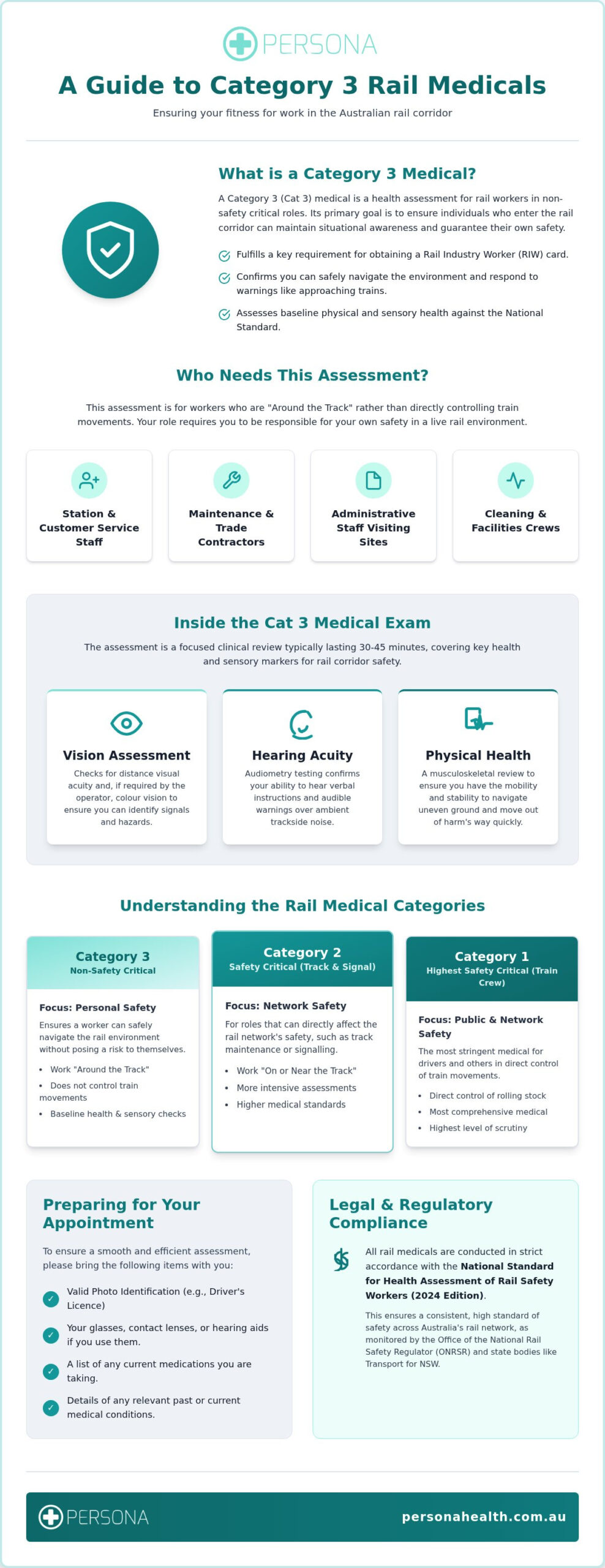
A Category 3 (Cat 3) medical assessment is a foundational health check designed for individuals whose work requires them to enter the rail corridor but does not involve controlling train movements or signalling. While it is often described as a non-safety critical medical, this term can be slightly misleading. Every person on a rail site has a responsibility to maintain a high level of situational awareness. The primary objective is to ensure you can safely navigate the complex environment of the rail corridor, hear approaching trains, and react promptly to warnings.
Securing a cat 3 medical near me is the first step for many contractors and employees looking to obtain their Rail Industry Worker (RIW) card. It sets a baseline for physical and sensory health, drawing on the long history of railway medical assessments that has evolved from basic injury treatment to modern, preventative safety standards. Today, these assessments are strictly governed by the National Standard for Health Assessment of Rail Safety Workers to ensure every person on the network meets the same rigorous health criteria.
Who is Classified as a Category 3 Worker?
The rail industry classifies workers based on the risk their health might pose to the public or the network. Category 3 workers are those who are “Around the Track” rather than “On the Track” in a controlling capacity. This means you are responsible for your own safety but your actions do not directly impact the safe movement of trains or the public. Common roles requiring this assessment include:
- Station staff and customer service officers
- Authorised officers and transit police
- Maintenance contractors who need unescorted access to the corridor
- Administrative staff visiting active rail sites
- Cleaning and facilities management crews
In these roles, you must have the physical mobility to move out of the way of oncoming traffic and the sensory acuity to notice alarms or verbal instructions in a noisy environment. It’s about ensuring you don’t become a hazard to yourself or others while performing your daily tasks.
The Legal Framework: The National Standard
Consistency is the backbone of rail safety in Australia. All assessments must follow the 2024 edition of the National Standard, which provides the clinical criteria for fitness for duty. This standard is not just a suggestion; it is a legal requirement monitored by the Office of the National Rail Safety Regulator (ONRSR) and state bodies like Transport for NSW and WorkSafe Victoria. This 2024 update ensures that medical assessments reflect modern health challenges and workplace environments.
When you book a cat 3 medical near me at a Persona Health clinic, you are being assessed by a health professional who is specifically trained in these requirements. Our team ensures that your results are recorded accurately and uploaded efficiently, helping you meet the compliance demands of the Privacy Act 1988 and relevant WHS legislation. This structured approach ensures that whether you are working in Sydney or Melbourne, the safety of the network remains uncompromised.
What Happens During a Cat 3 Rail Medical Exam?
A Category 3 assessment is a focused clinical review that usually takes between 30 to 45 minutes. It isn’t as intensive as the safety-critical assessments required for train drivers or signallers, but it remains a vital safeguard for anyone working near active lines. When you search for a cat 3 medical near me, you are looking for a provider who understands the specific environmental stressors of the rail corridor. At Persona Health, our accredited doctors follow standardised protocols to ensure every worker meets the requirements set out by the Office of the National Rail Safety Regulator.
Vision and Hearing Requirements
Sensory acuity is a core component of the Cat 3 exam. You need to be able to identify safety signals and spot oncoming trains from a distance, even in low-light conditions. The vision test includes checks for distance visual acuity and, in some cases, colour vision, depending on the specific requirements of the rail operator you are working for. Equally important is your hearing. Audiometry testing confirms you can detect warnings and verbal instructions over the ambient noise of a busy trackside environment. If you wear glasses or hearing aids, please bring them to your appointment to ensure the most accurate assessment of your functional capacity.
Physical and Musculoskeletal Health
The rail corridor is rarely a flat, paved surface. Walking on ballast, the crushed rock under the tracks, requires stability and joint mobility. During the exam, the doctor performs a musculoskeletal check to ensure you can safely navigate uneven terrain without an increased risk of falls or injury. We also review your general medical history. This part of the assessment is designed to identify conditions that could lead to sudden incapacity, such as uncontrolled epilepsy or severe cardiovascular issues. It’s a proactive measure to keep you safe on the job. If you have concerns about a previous injury, you might also find our fitness for duty medicals helpful for understanding how your health aligns with specific job demands.
Finding a cat 3 medical near me that offers both clinical excellence and efficiency is essential for modern contractors. We use modern digital reporting systems to record your results immediately. This allows for fast employer notification and ensures you can get on-site without the traditional paperwork delays. Our goal is to make the process as stress-free as possible, providing you with a clear understanding of your fitness for work while maintaining strict compliance with the Privacy Act 1988. If you’re ready to clear your compliance hurdles, you can book your assessment at one of our convenient locations.
Category 3 vs Category 1 and 2: Understanding the Differences
Determining which medical category you require is the most common source of confusion for new rail contractors. It isn’t just about your job title; it’s about the risk profile of the tasks you perform on the network. While Category 1 and 2 workers are classified as “Safety Critical”, those seeking a cat 3 medical near me are usually entering roles defined as “Non-Safety Critical” or “Around the Track”. This distinction ensures that the level of clinical scrutiny matches the potential risk a worker’s health poses to the public and the rail infrastructure.
At Persona Health, we provide all three categories of rail medicals across our clinic network in Sydney and Melbourne. Our medical team is well-versed in the nuances of each category, ensuring you are assessed against the correct criteria for your specific RIW card requirements. Whether you are a train driver requiring a comprehensive Category 1 exam or a station officer needing a Category 3 baseline, our processes remain consistent, professional, and employer-focused.
Risk Profiles in the Rail Industry
The Australian rail industry uses a tiered system to manage health-related risks. Understanding where you fit is essential for booking the right appointment:
- Category 1: This is the highest risk level. It applies to workers like train drivers who perform safety-critical tasks where sudden ill-health could lead to a major incident or loss of life.
- Category 2: These are safety-critical roles where sudden incapacity is less likely to result in a large-scale disaster. It often includes track workers who rely on others for their safety or work in less hazardous zones.
- Category 3: This category focuses on the worker’s own safety. The goal is to ensure you can hear warnings and move away from danger. It applies to those who need unescorted corridor access but do not control train movements.
Frequency of Assessments
Compliance is an ongoing commitment, not a one-off event. The National Standard dictates how often you must return for a review to maintain your fitness for duty. For Category 3 workers, the frequency of assessments is strictly based on age to account for the natural changes in sensory and physical health over time. Generally, if you are under the age of 40, you will only need to renew your cat 3 medical every five years.
Once you reach the age of 40, the interval shortens to every two years. This increased frequency allows our clinicians to monitor your vision and hearing more closely as you age. For those continuing their rail career beyond the age of 60, an annual assessment becomes mandatory. Staying ahead of these dates is crucial for avoiding a suspended RIW card, which can lead to costly downtime on projects. Our digital systems help employers track these expiries, providing a seamless way to manage a workforce across multiple sites.
How to Prepare for Your Rail Medical Appointment
Arriving at your appointment prepared is the best way to ensure your assessment is completed without unnecessary delays. When you have found a reliable cat 3 medical near me, the last thing you want is to be turned away because of missing documentation or simple oversights. First, ensure you have a valid form of photo identification, such as an Australian driver’s licence or passport. If you use corrective lenses for distance or reading, or if you rely on hearing aids, you must bring them with you. The clinician needs to assess your vision and hearing with these aids to determine your functional capacity under the National Standard. We also recommend wearing comfortable, loose-fitting clothing. You will be asked to perform basic physical movements to check your musculoskeletal health, and restrictive attire can hinder this process.
Medical Documentation and History
Transparency is key to a successful and stress-free assessment. You should bring a clear list of any current medications, including dosages and the conditions they treat. If you have a complex medical history involving previous surgeries or chronic illnesses, a brief letter from your GP can be incredibly helpful for our clinicians. The National Standard requires us to look specifically for conditions that could impact your safety in the rail corridor. For instance, you must disclose any history of sleep apnoea, cardiovascular issues, or any condition that might lead to sudden incapacity. Providing this information upfront prevents the need for follow-up appointments and helps us confirm your fitness for duty more quickly, keeping your project timelines on track.
Managing Workplace Injuries with InjuryQR
Safety doesn’t end once your medical is approved. If an injury occurs while you are on-site, Persona Health provides an innovative solution called InjuryQR. This free, AI-powered triage service allows workers to scan a QR code on a poster or magnet using their smartphone. There is no app to download; you simply describe the injury using your voice. The system then provides immediate, AI-guided next steps, which might include self-care instructions, a telehealth consultation, or direction to emergency services.
This system is a game-changer for reducing Lost Time Injuries (LTIs) and ensuring that incident reporting meets the requirements of SafeWork NSW or WorkSafe Victoria. It even allows for the immediate issuance of Certificates of Capacity where appropriate, getting you back to work safely and sooner. For employers, this integrates seamlessly with our broader Workplace Injury Management services, providing a modern, digital approach to worker well-being. If you’re ready to start your rail career with confidence, contact Persona Health today to book your assessment at a clinic near you.
Book Your Cat 3 Medical at a Persona Health Clinic Near You
Finding a cat 3 medical near me shouldn’t be the most difficult part of your work week. We’ve strategically placed our clinics to ensure you are never far from an accredited professional who understands the National Standard. Persona Health operates a network of modern facilities across Sydney and Melbourne, designed to provide high quality occupational health services with minimal disruption to your schedule. Our medical team is deeply familiar with the nuances of the rail sector, ensuring that your assessment is conducted with the professional authority required for RIW compliance. We know that every day spent waiting for a report is a day your team isn’t on-site, so we prioritise fast turnaround times without compromising clinical accuracy.
Our Sydney and Melbourne Locations
We have established physical clinics in key transport and industrial hubs to ensure maximum accessibility for local workers and contractors. In Sydney, you can visit our experienced teams in Parramatta, Rosebery, Gregory Hills, or Dee Why. For those based in Victoria, our Cairnlea and Craigieburn clinics provide the same level of clinical excellence and employer-focused care. You can access our Cat 3 Rail Medicals Sydney page for direct bookings and to find the specific location most convenient for your current project. This local presence is backed by a 100-clinic affiliate network, ensuring we can facilitate assessments even in regional areas when your work takes you beyond the major cities.
Why Choose Persona Health for Rail Compliance?
We provide a sophisticated, employer-focused approach that utilises clear, actionable digital reports. This modern system allows results to be shared and processed quickly, helping your team move through the compliance stages as efficiently as possible. Our services aren’t limited to our physical sites; we also offer Australia-wide mobile services for on-site health surveillance, which is particularly beneficial for large-scale infrastructure projects requiring the assessment of multiple workers at once. We understand that rail safety is a collective effort, and our role is to provide the clinical data you need to manage that risk effectively.
Many organisations find it highly efficient to integrate their Pre-Employment Medicals with these rail-specific requirements. This holistic approach ensures that every worker is not only fit for the rail corridor but also possesses the general health resilience required for their specific tasks. Whether you are an individual contractor seeking a cat 3 medical near me or a project manager overseeing a national workforce, our team is ready to assist. Contact Persona Health today to request a quote or to speak with our specialists about streamlining your transport and infrastructure health requirements.
Secure Your Compliance and Safety on the Tracks
Ensuring you are fit for duty is more than a simple compliance exercise; it’s a vital commitment to your personal safety and the integrity of the Australian rail network. We have covered the essential sensory and physical benchmarks of the 2024 National Standard, alongside the practical steps you can take to prepare for a smooth assessment. Finding a professional cat 3 medical near me is the final hurdle in securing your unescorted corridor access and maintaining your RIW status.
At Persona Health, we prioritise your time and professional goals. Our accredited medical team combines deep rail industry expertise with a supportive, clinical approach at our convenient locations across Sydney and Melbourne. By utilising modern digital reporting, we ensure your results are processed quickly, allowing you to focus on the work ahead. We are dedicated to providing a clear, accurate understanding of your fitness for work while helping you navigate the complexities of WHS legislation with ease.
Our team is ready to assist you in reaching your next career milestone with confidence and clarity. Book your Cat 3 Rail Medical with Persona Health today to experience a professional, employer-focused service that puts your health and safety first.
Frequently Asked Questions
How long does a Category 3 rail medical last?
The validity of a Category 3 medical depends on your age at the time of the assessment. If you are under 40, your medical is generally valid for five years; however, once you reach 40, the frequency increases to every two years. Workers over the age of 60 must undergo an annual assessment to maintain their RIW status and ensure they remain fit for the demands of the rail corridor.
What happens if I fail my rail medical hearing or vision test?
Failing a sensory component does not necessarily mean you are permanently barred from rail work. In many instances, you may simply need to obtain corrective lenses or a hearing aid to meet the functional standards required by the National Standard. Our medical team will provide clear guidance on your results and may refer you to an optometrist or audiologist to help you reach the necessary benchmarks for compliance.
Do I need to fast before my Cat 3 rail medical appointment?
Fasting is typically not required for a standard Category 3 assessment. This medical focuses primarily on your vision, hearing, and musculoskeletal health rather than the complex blood chemistry often required for safety-critical Category 1 roles. If your employer has requested additional pathology tests that require fasting, they will inform you of these specific instructions before you arrive at our clinic for your appointment.
Is a drug and alcohol test included in a Cat 3 medical?
A drug and alcohol screen is often performed during the same appointment, though it is technically a separate requirement from the clinical health assessment. Most rail operators require a clear drug and alcohol result before granting site access. When you are looking for a cat 3 medical near me, we recommend confirming with your employer if they want both components completed during your clinical session to ensure full compliance.
Can any GP perform a Category 3 rail medical assessment?
No, these assessments must be conducted by an appropriately qualified health professional who is familiar with the National Standard. The rail environment has unique risks that require a specific clinical understanding to assess correctly. At Persona Health, our doctors are accredited and experienced in rail-specific legislation, ensuring that your medical is legally sound and will be accepted by the Office of the National Rail Safety Regulator.
What is the difference between a Cat 3 and a pre-employment medical?
A pre-employment medical is a general review of your suitability for a role, whereas a Cat 3 medical is a regulated safety assessment for corridor access. While they share some similarities, the Cat 3 exam must adhere to specific sensory and physical benchmarks set out in the National Standard. We can often integrate these two assessments into a single session to streamline the onboarding process for new employees and contractors.
How much does a Cat 3 rail medical cost in Australia?
The cost of a rail medical varies depending on the complexity of the assessment and whether your employer requires additional tests like drug and alcohol screening. Because requirements differ between operators and projects, we do not provide a flat rate. We suggest contacting our team for a tailored quote that reflects your specific compliance needs and the location of your preferred clinic in Sydney or Melbourne.
What should I do if my RIW card is about to expire?
You should book your assessment immediately to ensure there is enough time for your results to be processed and uploaded. Searching for a cat 3 medical near me with fast digital reporting is the most effective way to avoid a lapse in site access. Our modern systems allow us to notify employers and update records quickly, helping you maintain your RIW card status and avoid any costly downtime on your project.

Article by
Ian Nicholson
Ian is the Business Support Manager at Persona Health, where he plays a key role across IT, sales, marketing and business operations. With a broad skill set and a practical, solutions-focused approach, Ian helps drive the systems, communication and commercial strategy that support Persona Health’s continued growth across Australia.