

Could a single misunderstood category on a medical form be the only thing standing between your team and the rail corridor? When you are racing against tight deadlines for RIW card approvals, the distinction between a cat 1 vs cat 3 rail medical can feel like a complex hurdle. We understand that the pressure to keep your workforce moving often clashes with the anxiety of clinical tests like ECGs or blood assessments. It is a high-stakes environment, especially following the significant updates to the National Standard for Health Assessment of Rail Safety Workers that came into effect in November 2024.
We recognise that navigating these safety categories isn’t just about ticking boxes; it’s about the wellbeing of your people and the integrity of the Australian rail network. This guide provides a clear roadmap to help you understand which category applies to specific roles and what the clinical components involve. You will learn about the critical differences in safety-critical designations, the new mandatory sleep apnoea screenings, and how to prepare for a seamless medical experience that ensures your team remains compliant and safe on the tracks.
Key Takeaways
- Understand how the 2024 National Standard determines whether your role is safety-critical or non-safety-critical to ensure you book the correct assessment.
- Identify the specific clinical requirements for a cat 1 vs cat 3 rail medical, including the necessity of cardiac and blood screenings for high-risk operators.
- Learn how the updated Australian Cardiovascular Risk Calculator and mandatory sleep apnoea screenings now affect Category 1 rail safety workers.
- Discover practical tips to prepare for your appointment to minimise downtime and ensure your results are uploaded to the RIW portal without delay.
- Recognise why Category 1 medicals prioritise the safety of the entire rail network while Category 3 focuses on your individual safety.
Understanding the National Standard for Rail Safety Worker Medicals
The National Standard for Health Assessment of Rail Safety Workers provides the essential framework for maintaining safety across the entire Australian rail network. As of 11 November 2024, a new edition of this standard has come into effect, requiring all health assessments to follow updated clinical protocols. These standards aren’t merely administrative hurdles; they are rigorous medical safeguards designed to protect the public, workers, and the environmental integrity of Rail transport in Australia. By ensuring that every individual on the tracks is physically and mentally fit for their specific duties, we minimise the risk of incidents that could have devastating consequences.
To maintain legal compliance and the highest safety standards, these assessments must be conducted by an Authorised Health Professional (AHP). These clinicians are specifically trained in the 2024 Standard and are registered with the AHP Program. Choosing the correct assessment level, such as a cat 1 vs cat 3 rail medical, depends entirely on the risks associated with a worker’s specific job description and the potential impact of their health on the wider network.
To help you visualise the differences in medical categories, please watch this helpful comparison:
Safety Critical vs Non-Safety Critical Work
The distinction between safety categories centres on the concept of sudden incapacity. Safety critical workers perform tasks where a sudden health event, such as a heart attack or seizure, could lead to a serious incident involving the public or the network. These roles require the more intensive Category 1 or Category 2 screenings. In contrast, non-safety critical workers primarily need to demonstrate that they can ensure their own safety. The primary question when deciding between a cat 1 vs cat 3 rail medical is whether the worker’s role involves controlling rail movements or if they simply need to be able to move to a place of safety and follow emergency instructions.
The Role of the RIW Card in Compliance
The Rail Industry Worker (RIW) card serves as the national backbone for competency and health tracking within the industry. It is a mandatory requirement for anyone seeking entry into the rail corridor. Once your assessment is complete, our AHPs upload the results directly to the RIW portal, allowing your employer to verify your fitness for duty instantly. Maintaining an active medical status is not just a best practice; it is a legal necessity. At Persona Health, we prioritise fast turnaround times for these uploads, ensuring that your workforce can move from the clinic to the site with minimal downtime and full confidence in their compliance status.
Category 1 Rail Medicals: Managing High-Level Safety Critical Risk
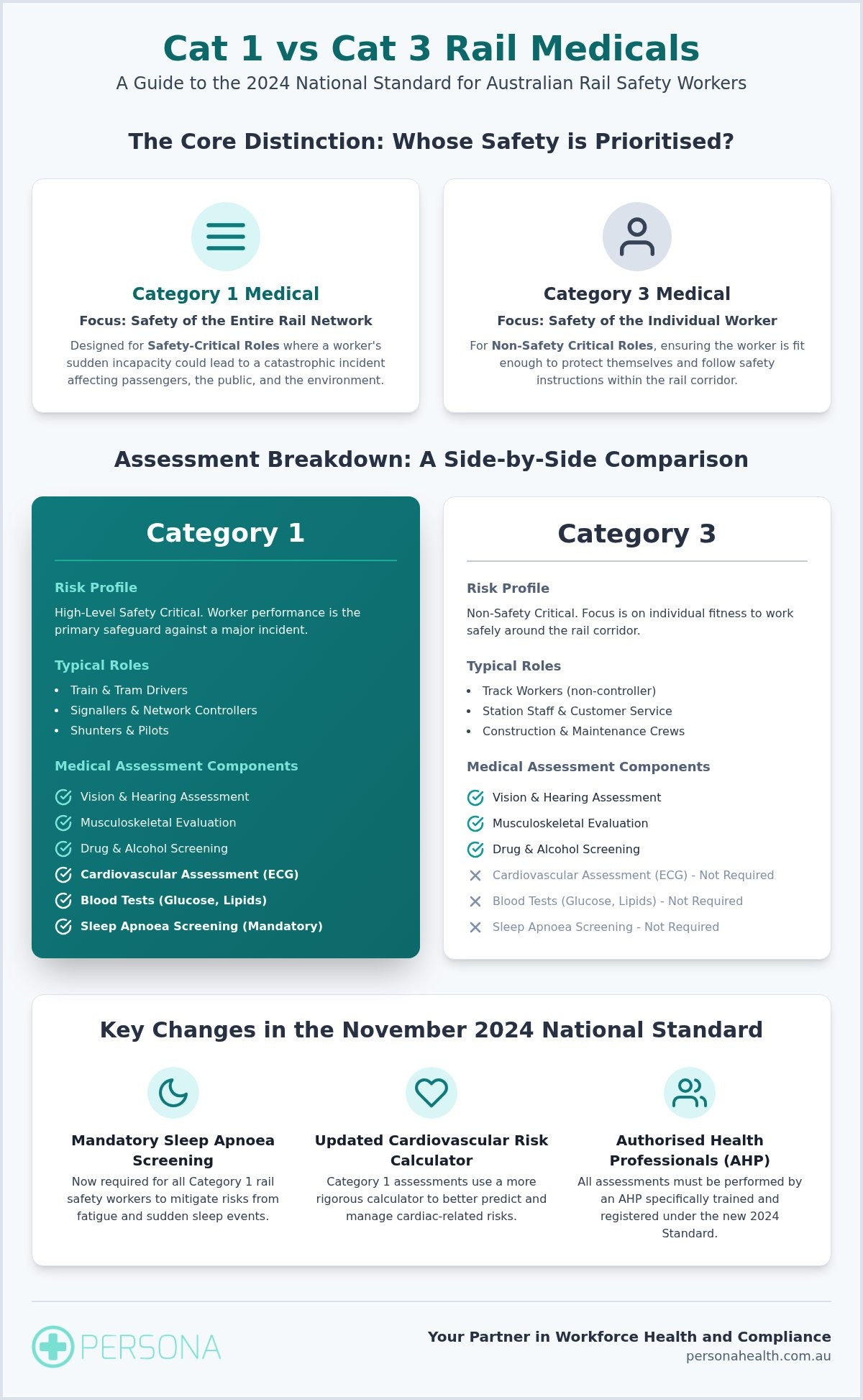
Category 1 assessments represent the peak of health surveillance in the rail industry. While a Category 3 medical ensures an individual can stay safe on site, Category 1 is about the safety of everyone else. If a train driver or signaller loses consciousness or suffers a sudden lapse in judgement, the results could be catastrophic for passengers and the community. This is why the Office of the National Rail Safety Regulator enforces such high standards through the National Law. These roles are designated as “safety-critical” because the worker’s performance is the primary safeguard against a major incident.
When comparing a cat 1 vs cat 3 rail medical, the depth of screening is the most obvious differentiator. We don’t just look at current fitness; we look for predictors of future health events. This involves a deep dive into medical history, sleep patterns, and lifestyle factors that might indicate a risk of sudden incapacity. Our clinicians focus on conditions like heart disease, diabetes, and sleep disorders that could compromise safety without warning.
Clinical Components of a Cat 1 Assessment
The clinical tests in a Category 1 medical are designed to catch silent risks. A resting Electrocardiogram (ECG) is mandatory because it helps us identify underlying cardiac rhythm issues that might not be apparent during a standard physical exam. Similarly, pathology testing for non-fasting blood glucose and cholesterol levels allows us to calculate a worker’s cardiovascular risk score using the updated 2024 Australian Cardiovascular Risk Calculator. This data-driven approach helps us predict the likelihood of a cardiac event over the next five years.
Beyond heart health, we conduct several specific screenings:
- Comprehensive vision tests, including colour perception, which is vital for reading signals correctly.
- Audiometry (hearing tests) to ensure workers can hear critical radio communications and track warnings.
- Musculoskeletal assessments to confirm the worker can physically manage cabin controls or emergency procedures.
- Mandatory sleep apnoea screening using the Epworth Sleepiness Scale to manage fatigue risks effectively.
Validity and Periodic Review for Cat 1
Because health can change as we age, the 2024 Standard mandates a sliding scale for reviews. If you are under 50, your medical is generally valid for five years. Once you reach 50, the risk of cardiac events naturally increases, so we need to see you every two years. For those over 60, annual medicals are the standard to ensure continued fitness for these safety-critical roles. Managing these complex requirements doesn’t have to be stressful. Our team at Persona Health specialises in providing these fitness for duty medicals with a focus on clear communication and fast reporting, helping you stay compliant without the headache.
Category 3 Rail Medicals: Ensuring Safety for Non-Critical Roles
Category 3 medicals serve as the essential baseline for any professional entering the rail corridor. While the Category 1 assessment focuses on those who control the movement of trains, a Category 3 medical is designed for the workforce that maintains the infrastructure, including labourers, tradespeople, and cleaners. These roles are classified as “non-safety critical” because a sudden health event for these workers would not typically result in a large-scale rail incident. However, the rail environment remains a high-risk setting where individual awareness is the primary defence against injury.
The primary objective of this assessment is to ensure you possess the physical and sensory capabilities to stay safe in a dynamic work zone. In the context of a cat 1 vs cat 3 rail medical, the Category 3 version is significantly less invasive. You won’t usually be required to undergo an ECG or pathology testing unless a specific clinical concern arises during the physical exam. Instead, the focus remains firmly on your ability to detect hazards and respond instantly to emergency instructions from safety-critical staff.
What is Included in a Cat 3 Medical?
Our clinical team at Persona Health conducts these assessments with a focus on practical site readiness. The vision testing ensures you can see oncoming trains, track signals, and potential trip hazards from a safe distance. Audiometry is equally vital; you must be able to hear warning whistles or radio commands over the significant ambient noise of power tools and machinery. We also perform mobility and agility screenings to confirm you can safely traverse uneven surfaces like track ballast without risk of falls. Maintaining this agility often requires a proactive approach to musculoskeletal health; for instance, integrative specialists such as a naturopathic doctor hillsboro or can help individuals manage recovery through a combination of natural medicine and physical therapy.
Drug and alcohol screening is a mandatory component of every rail medical. Consistent with the Rail Safety National Law, there is a zero-tolerance approach to substances that could impair your coordination or reaction times. These tests are vital for maintaining a culture of safety across the network.
Validity Periods for Category 3 Workers
Because the risks in Category 3 roles are lower than those in safety-critical positions, the review frequency is less demanding. Once you successfully complete your initial assessment, it is generally valid until you reach the age of 40. After this milestone, the 2024 Standard requires periodic renewals every five years. This ensures that as your physical health naturally changes over time, your ability to remain safe on site is regularly verified. Employers might request more frequent reviews if specific site risks change or if a worker returns to duty after a significant injury.
Maintaining safety on site goes beyond the initial medical. We recommend that rail operators implement InjuryQR as part of their safety toolkit. This free AI-powered triage service allows workers to scan a QR code on a poster or magnet and report an injury instantly using their voice. It provides immediate guidance, whether that’s self-care or a telehealth referral, helping to reduce Lost Time Injuries (LTIs) and streamline incident reporting. If you need to organise a cat 3 rail medical in Sydney or Melbourne, our team is ready to help you meet these compliance milestones quickly and professionally.
Key Differences: A Side-by-Side Comparison of Cat 1 vs Cat 3
Understanding the fundamental differences between a cat 1 vs cat 3 rail medical is essential for effective workforce planning. While both assessments share core elements like drug and alcohol screening and basic vision checks, their underlying philosophies diverge based on the level of risk the worker poses to the rail network. A Category 1 assessment is a deep dive into the worker’s long-term health stability, focusing on the safety of the entire network. In contrast, Category 3 is a functional check designed to ensure the individual can work safely within the corridor and get out of the way of danger.
A significant practical difference lies in the medical history review. For a Category 1 candidate, our clinicians must scrutinise every detail of their clinical background, from sleep patterns to chronic disease management. This level of detail is necessary because these workers are the primary safeguard for passengers and freight. If you are a worker moving from a non-safety critical role to a safety-critical one, please be aware that you cannot simply “top up” your current paperwork. A transition from Category 3 to Category 1 requires a completely new, comprehensive assessment to meet the 2024 National Standard.
Why the Cardiac and Metabolic Tests Matter
The requirement for cardiac and blood screening in Category 1 medicals exists to prevent sudden incapacity. Sudden cardiac arrest remains a primary concern for those operating heavy machinery or controlling rail movements. By using the updated Australian Cardiovascular Risk Calculator, we can identify risks before they become emergencies. Similarly, managing diabetes is critical. We look closely at blood glucose control to prevent hypoglycaemic episodes that could cause impaired judgement or loss of consciousness while on duty. At Persona Health, we provide expert interpretation of these results. Our goal is always to find a path to a fair outcome that balances the worker’s livelihood with the non-negotiable safety requirements of the rail operator.
Managing Fitness for Duty Outcomes
The 2024 National Standard has refined how we report results to provide greater clarity. The old “Fit for Duty (conditional)” category has been removed, replaced by more precise outcomes like “Fit for Duty (Subject to Review)”. This means a worker might be fit to work provided they meet certain ongoing requirements, such as regular specialist reviews or the use of corrective lenses. If an assessment does not go as planned, there is a clear process for appealing a result through an Authorised Health Professional. We support employers in managing these outcomes, ensuring that any workplace adjustments are practical and compliant with local WHS legislation.
Navigating these complexities requires a partner who understands both the clinical and regulatory landscape. If you need to clarify which assessment your team needs, you can book a cat 3 rail medical or speak with our experts about Category 1 requirements today.
Booking and Preparing for Your Rail Medical with Persona Health
Booking a health assessment shouldn’t be a source of stress for your workforce. We’ve designed our processes to be as supportive and efficient as possible, ensuring that every worker feels they are in expert hands. Whether you are coordinating a cat 1 vs cat 3 rail medical, our team at Persona Health provides a streamlined experience across our physical clinics in Parramatta, Rosebery, Gregory Hills, and Dee Why in Sydney, as well as Cairnlea and Craigieburn in Melbourne. For businesses with broader requirements, we also offer an extensive 100-clinic affiliate network and Australia-wide mobile services to bring compliance directly to your site.
We understand that the primary goal for any rail operator is to minimise downtime. Our modern digital reporting systems are built for speed, allowing for fast turnaround times and direct uploads to the RIW portal. This ensures your team can secure their RIW card approvals and get on site sooner, without the frustration of administrative delays. Our experienced medical team is well-versed in the 2024 National Standard, providing the professional authority needed to ensure your business remains fully compliant with current WHS legislation.
How to Prepare for Your Assessment
A successful medical starts with the right preparation. To ensure the process is smooth and your results are accurate, we recommend that all workers follow these practical steps before their appointment:
- Bring your documentation: Have your RIW number and government-issued photo identification ready for the Authorised Health Professional (AHP).
- Medical history: Bring a list of all current medications and any relevant specialist reports, particularly for cardiac or sleep conditions if you are undergoing a Category 1 assessment.
- Hearing protection: Avoid exposure to loud noises for at least 16 hours prior to your hearing test. This is vital for an accurate audiometry result.
- Physical comfort: Wear comfortable, loose-fitting clothing that allows for a full range of movement during the musculoskeletal screening.
- Corrective lenses: If you wear glasses or contact lenses for driving or reading, please bring them to the appointment for the vision screen.
Enhancing Rail Safety with InjuryQR
Our commitment to your team’s safety doesn’t end when they leave our clinic. Persona Health is proud to introduce InjuryQR, a free AI-powered triage service that represents a significant advancement in workplace injury management. This tool is designed to support rail operators in the crucial minutes following an incident. Workers simply scan a QR code on a poster or magnet, describe their injury using their voice, and receive immediate AI-guided next steps.
This system provides instant direction, whether that involves self-care, a telehealth consultation, or emergency care. By providing immediate support, InjuryQR helps reduce Lost Time Injuries (LTIs) and ensures that incident reporting is accurate and timely. Businesses can even order free physical assets like posters and magnets to place in staff rooms or vehicles. Integrating this technology alongside your pre-employment medicals creates a comprehensive safety culture that protects your most valuable resource: your people.
If you are ready to organise your next round of assessments, our team is here to help. You can book a cat 3 rail medical or contact us to discuss a bespoke health surveillance programme for your entire rail workforce.
Securing Your Future on the Australian Rail Network
Ensuring your workforce is compliant with the 2024 National Standard is about more than just obtaining an RIW card; it’s about fostering a genuine culture of safety and reliability. By understanding the critical differences in a cat 1 vs cat 3 rail medical, you can place your workers in the right roles with absolute confidence, knowing they are physically and mentally prepared for the unique challenges of the rail corridor. Whether you are managing high-risk drivers or essential maintenance crews, the right medical assessment is your primary safeguard against workplace incidents.
Beyond the medical assessment, maintaining physical conditioning is vital for long-term career longevity in the rail industry. For workers in Western Australia, Reformer Pilates Perth provides a community-focused environment to build the core strength and agility necessary to pass musculoskeletal screenings and stay safe on the tracks.
At Persona Health, we pride ourselves on being your dedicated occupational health partner. With our experienced Authorised Health Professionals (AHPs) and clinics across Sydney and Melbourne, we provide the fast reporting and clinical accuracy you need to keep your projects moving. From the initial assessment to ongoing safety with our integrated InjuryQR triage system, we are here to support your team every step of the way.
Book your Cat 1 or Cat 3 Rail Medical with Persona Health today to experience a seamless, professional approach to rail safety. We look forward to helping your workforce stay safe, healthy, and on track.
Frequently Asked Questions
Do I need a Cat 1 or Cat 3 medical for a rail labourer role?
A rail labourer role typically requires a Category 3 medical because it’s usually classified as non-safety critical work. This assessment ensures you can hear warnings and move to safety within the rail corridor. However, if your specific duties involve controlling rail traffic or operating heavy machinery, your employer may upgrade the requirement to a Category 1. It’s always best to check your specific job description before booking your appointment.
What happens if I fail the hearing or vision part of my rail medical?
Failing a specific component doesn’t automatically disqualify you from working on the rail network. Our AHPs will assess whether you can still perform your duties safely with aids, such as corrective lenses or hearing devices. In many cases, you may be issued a “Fit for Duty (Subject to Review)” status with specific restrictions. If you disagree with the clinical findings, you can initiate an appeal process through the rail operator’s medical panel.
How long does a Category 1 rail medical assessment take to complete?
A Category 1 rail medical usually takes between 60 and 90 minutes to complete due to its comprehensive nature. This timeframe allows for a detailed medical history review, resting ECG, pathology collection, and several sensory screenings. Because we understand the importance of your time, Persona Health prioritises efficient scheduling at our clinics to ensure you are back to your day as quickly as possible without sacrificing clinical thoroughness.
Is a drug and alcohol test always included in a rail medical?
Yes, a drug and alcohol screen is a mandatory component of every Australian rail medical assessment. The Rail Safety National Law requires all workers in the corridor to maintain a zero-tolerance status for prohibited substances. This testing is crucial for ensuring the safety of everyone on the network. Whether you are undergoing a cat 1 vs cat 3 rail medical, you’ll be required to provide a sample during your appointment.
Can my own GP perform a Category 1 or Category 3 rail medical?
Your regular GP can only perform a rail medical if they are a registered Authorised Health Professional (AHP) trained in the 2024 National Standard. Most family doctors don’t hold this specific accreditation. It’s essential to visit a specialised occupational health provider like Persona Health. Our AHPs are fully certified to conduct these assessments and upload results directly to the RIW portal to ensure your legal compliance and site access.
How much does a Cat 3 rail medical cost for an individual worker?
The cost of a Category 3 rail medical can vary depending on whether additional site-specific tests are required by your employer. While we don’t provide fixed pricing here, most assessments cover the standard physical, vision, hearing, and drug screening components. We recommend contacting our team for a tailored quote based on your specific location and the rail operator’s requirements to ensure you receive the most accurate and up-to-date information.
What is the “Z-score” in rail audiometry and why does it matter?
The “Z-score” is a statistical tool used in audiometry to compare your hearing ability against the average for your age and gender. It matters because it helps our clinicians distinguish between natural age-related hearing changes and noise-induced hearing loss. A high Z-score may trigger a requirement for more frequent reviews or specific hearing protection measures. This helps us preserve your long-term health while ensuring you can hear critical warnings on site.
How do I transfer my medical results to a new employer on the RIW portal?
Managing the transfer of your medical results is handled entirely through the Rail Industry Worker (RIW) portal. When you start with a new employer, they’ll send a request to associate with your profile. Once you approve this request, they can view your current medical status. Because your results are uploaded directly by the AHP, you don’t need to carry physical papers between jobs, which makes moving between projects much simpler.

Article by
Ian Nicholson
Ian is the Business Support Manager at Persona Health, where he plays a key role across IT, sales, marketing and business operations. With a broad skill set and a practical, solutions-focused approach, Ian helps drive the systems, communication and commercial strategy that support Persona Health’s continued growth across Australia.