
Key Takeaways
- Learn how to align your Victorian operations with the Rail Safety National Law and ONRSR regulations to ensure total site safety and compliance.
- Discover why partnering with an Authorised Health Professional is essential for valid rail industry drug testing melbourne and efficient RIW card uploads.
- Understand the technical differences between urine and saliva testing to determine which Australian Standard best fits your organisation’s specific safety requirements.
- Identify the core components of a Drug and Alcohol Management Program (DAMP) to proactively reduce workplace risk and support your staff.
- Explore how local clinical expertise in Cairnlea and Craigieburn provides the fast turnaround times required for high-pressure rail projects.
Understanding Rail Industry Drug Testing Requirements in Melbourne
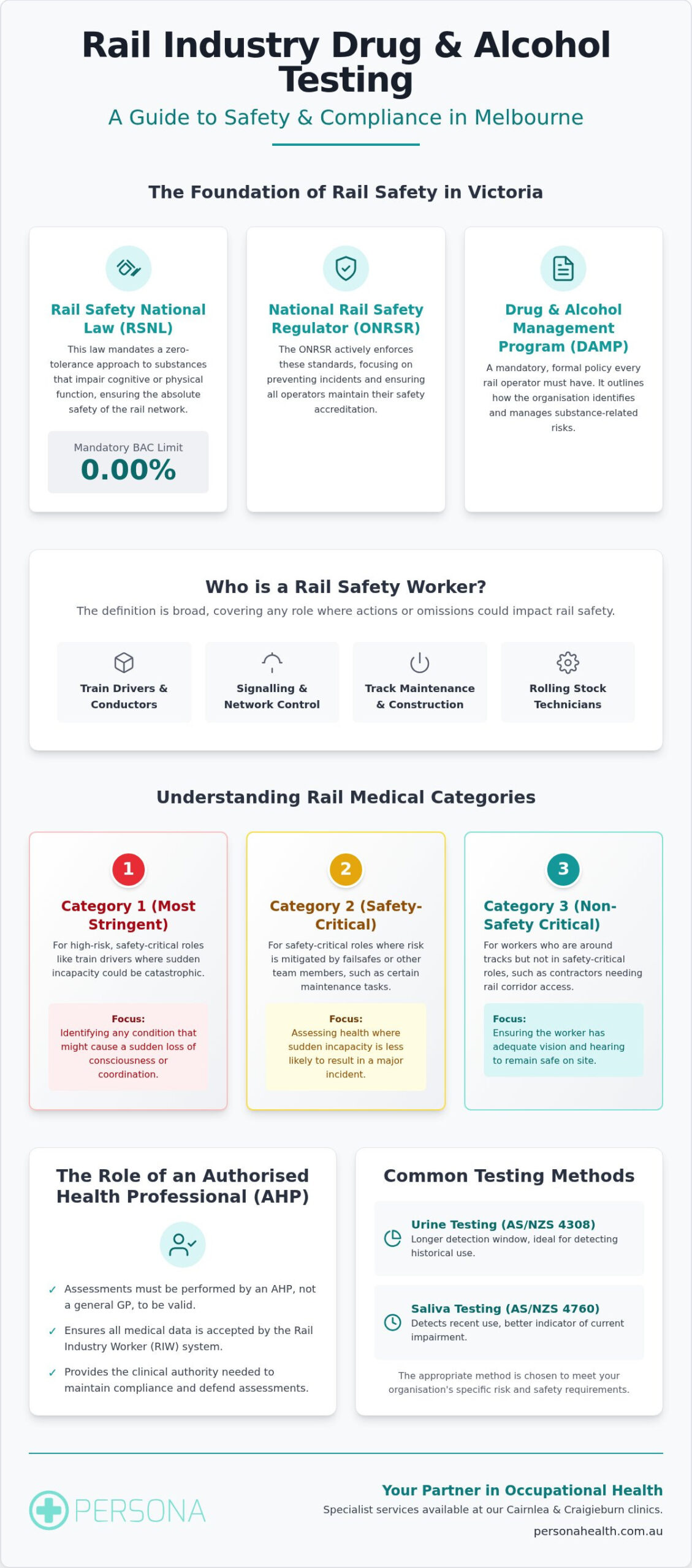
The regulatory landscape for rail operators in Victoria is defined by an unwavering commitment to absolute safety. Under the Rail Safety National Law (RSNL), drug and alcohol testing is a mandatory requirement that ensures every person on the network is fit for duty. The Office of the National Rail Safety Regulator (ONRSR) maintains these standards with a sharp focus on preventing incidents before they occur. For Melbourne operators, maintaining accreditation requires a robust Drug and Alcohol Management Program (DAMP). This program is a formal policy that must outline exactly how your organisation identifies and manages substance-related risks. This framework relies heavily on validated Workplace Drug Testing in Australia to maintain the integrity of the rail corridor and protect the public.
To see how technical standards apply within the sector, watch this helpful video:
The Role of the Rail Safety National Law
The RSNL adopts a zero-tolerance approach toward substances that impair cognitive or physical function. This isn’t a suggestion; it’s a strict legal mandate where a blood alcohol concentration (BAC) of 0.00% is the only acceptable level for rail safety workers. Failing to adhere to these protocols doesn’t just risk safety; it exposes operators to significant legal penalties and the potential loss of accreditation. At Persona Health, we ensure your testing protocols align perfectly with the 2024 National Standard, providing the clinical authority you need to stay compliant. Our team supports you through the complexities of Cat 3 Rail Medicals and higher, ensuring every assessment is defensible and accurate.
Who Qualifies as a Rail Safety Worker in Victoria?
Identifying who needs rail industry drug testing melbourne is the first step in your safety strategy. The definition is broad, encompassing anyone whose actions or omissions could directly impact the safety of rail operations. This covers a wide range of roles across the network, including:
- Train drivers, conductors, and station staff
- Signalling, network control, and dispatch personnel
- Track maintenance, construction, and electrical crews
- Rolling stock maintenance technicians and engineers
Correctly categorising these roles ensures you aren’t leaving gaps in your screening process. Whether your team is based at a major hub like Southern Cross or working on suburban maintenance, ensuring they meet the required health standards is vital. Our clinicians at Cairnlea and Craigieburn are well-versed in these distinctions, helping you navigate the categorisation process with ease and confidence.
The National Standard for Health Assessment of Rail Safety Workers
The safety of the Melbourne rail network relies on more than just high-tech signalling; it depends on the physical and mental readiness of every worker. The primary framework for this is the National Standard for Health Assessment of Rail Safety Workers. This standard ensures that anyone entering a rail corridor is fit for their specific role. A vital part of this process is rail industry drug testing melbourne, which is integrated into both initial pre-employment checks and the periodic medicals required to maintain a Rail Industry Worker (RIW) card.
Category 1, 2, and 3 Medicals Explained
The National Standard uses a tiered approach to manage risk, categorising workers based on how their health could affect the safety of the network. This ensures that the depth of the medical assessment matches the safety-critical nature of the job.
- Category 1: This is the most stringent level. It’s reserved for workers in safety-critical roles, such as train drivers, where sudden incapacity could lead to a major incident. The focus here is on identifying any condition that might cause a sudden loss of consciousness or coordination.
- Category 2: This applies to safety-critical roles where sudden incapacity is less likely to result in a catastrophic event. Examples include certain maintenance or signalling tasks where failsafes or other team members are present to mitigate risk.
- Category 3: These medicals are for workers who perform non-safety critical tasks but still need to work around the tracks. The assessment focuses on ensuring the worker has the vision and hearing necessary to stay safe on the line.
Persona Health specialises in providing Cat 3 Rail Medicals for contractors and staff who need to access the rail corridor safely and efficiently without the complexity of safety-critical assessments.
The Importance of Authorised Health Professionals (AHPs)
A general GP cannot sign off on these medicals. To ensure your worker’s data is accepted by the RIW system, the assessment must be performed by an Authorised Health Professional (AHP). These are medical practitioners who have completed specific training in the National Standard and understand the unique risks and requirements of the rail environment.
By using an AHP, you avoid the frustration of rejected medicals and slow turnaround times that can stall a project. Persona Health maintains a dedicated team of AHPs across our Melbourne clinics in Cairnlea and Craigieburn. This clinical expertise ensures that every medical is conducted to the highest standard, with results uploaded quickly to keep your operations moving. If you are unsure which category your team falls under, our experts can help you organise a compliant assessment that meets all current regulatory requirements.
Selecting the most appropriate method for rail industry drug testing melbourne depends entirely on your organisation’s Drug and Alcohol Management Program (DAMP) and the specific safety risks you need to mitigate. While both urine and oral fluid (saliva) testing are scientifically rigorous, they serve different strategic purposes within the rail corridor. At Persona Health, we work with you to implement the method that best aligns with your corporate policy and the legislative requirements of the Rail Safety National Law. Our goal is to ensure that your screening process is both legally defensible and operationally efficient.
AS/NZS 4308: The Standard for Urine Testing
Urine testing remains the most established method for pre-employment screening and periodic medicals across the Melbourne rail network. This process follows the strict AS/NZS 4308:2023 standard, which requires rigorous chain-of-custody protocols to ensure the integrity of every sample. By maintaining a controlled environment during collection at our Cairnlea or Craigieburn clinics, we prevent tampering or substitution, providing you with a result you can trust. It’s a reliable way to ensure a new worker’s health profile meets the high standards expected in the industry.
The primary advantage of urine testing is its wider detection window. It’s exceptionally effective at identifying historical drug use, which is vital when assessing a candidate’s long-term suitability for a rail safety role. For substances like cannabis or amphetamines, urine screening can detect metabolites for several days or even weeks after consumption. This makes it the preferred choice for Pre-Employment Medicals where a comprehensive understanding of a worker’s history is required.
AS/NZS 4760: The Standard for Oral Fluid Testing
In contrast, oral fluid testing, which follows the AS/NZS 4760:2019 standard, is increasingly favoured for random screening and post-incident investigations. Because saliva testing identifies the parent drug rather than its metabolites, it provides a much more accurate indication of “recent use” or potential impairment at the time of the test. This focus on immediate safety is why many Melbourne operators choose saliva for their daily or weekly random testing regimes.
This method is particularly practical for busy rail depots because it’s less invasive and can be performed quickly without the need for private bathroom facilities. Persona Health provides mobile testing units that can visit your Melbourne location, significantly reducing the downtime associated with sending workers off-site. This immediacy is crucial for maintaining safety during high-pressure maintenance windows or following a near-miss event. Integrating these rapid checks into your On-Site Health Surveillance programme ensures that your site remains a safe environment for everyone.
Implementing a Drug and Alcohol Management Program (DAMP)
A Drug and Alcohol Management Program (DAMP) serves as the strategic backbone of your safety operations. It isn’t merely a document for accreditation; it’s a living framework required by the Rail Safety National Law to manage substance risks systematically. To be effective, a Melbourne-based DAMP must combine worker education, supervisor training, and a consistent testing regime. Persona Health works alongside you to ensure your rail industry drug testing melbourne is not only compliant but also integrated into your site’s daily safety culture.
Education ensures your team understands the ‘why’ behind the rules. When workers are informed about how drugs and alcohol impact their reaction times and decision-making, the testing process becomes a shared safety goal rather than a hurdle. Much like how Morgan Polygraph clarifies misconceptions about lie detection, being open about the science of workplace screening helps foster a culture of honesty and compliance. This human-centric approach transforms a policy into a proactive safety shield.
Random, Post-Incident, and For-Cause Testing
Effective rail industry drug testing melbourne relies on three distinct screening triggers to maintain a safe environment. Random testing provides the strongest deterrent because it’s unpredictable. In New South Wales, operators are required to screen at least 25% of their rail safety workers annually. While Victorian requirements are tailored to individual DAMPs, this 25% figure remains a powerful benchmark for creating a genuine deterrent on site.
- Random Testing: Ensures every worker has an equal chance of selection during any shift, regardless of role.
- Post-Incident Testing: A mandatory step following any trackside mishap, helping you quickly rule out impairment and focus on root cause analysis.
- For-Cause Testing: Allows supervisors to intervene when they have reasonable suspicion that a worker’s fitness for duty is compromised.
Having these clear, defensible protocols in place protects your organisation and supports your On-Site Health Surveillance objectives.
InjuryQR: Modernising Post-Incident Response
In the high-pressure rail environment, the immediate response to an incident defines the recovery outcome. We recommend InjuryQR as a free, AI-powered triage tool that bridges the gap between an incident and clinical care. Workers simply scan a QR code, describe the event by voice, and receive instant guidance. No apps are needed, making it accessible for every contractor on site.
This technology helps Melbourne operators significantly reduce Lost Time Injuries (LTIs). By providing immediate advice on self-care, telehealth, or emergency direction, it ensures workers receive the right level of care instantly. It also supports faster incident reporting and can issue Certificates of Capacity where appropriate. You can even order free physical InjuryQR assets, such as posters and magnets, to keep this tool visible across your depots. Integrating this with your Workplace Injury Management plan ensures a streamlined path back to health for your team.
If you need to update your safety protocols, our experienced team can help you develop a compliant testing schedule that fits your specific project needs.
Why Choose Persona Health for Rail Medicals in Melbourne?
Selecting a provider for rail industry drug testing melbourne is about more than just finding a clinic; it’s about securing a partner who understands that every hour of downtime impacts your project’s bottom line. At Persona Health, we’ve designed our Victorian operations to meet the high-pressure demands of the Melbourne rail corridor. With clinics strategically located in Cairnlea and Craigieburn, we provide the local accessibility your team needs to stay compliant without unnecessary travel across the city. Our experienced medical team doesn’t just tick boxes. We understand the clinical nuances of the National Standard and the precise digital requirements for RIW card uploads, ensuring your workers are cleared for duty with speed and accuracy.
We pride ourselves on an employer-focused approach that prioritises clarity and efficiency. This means we focus on fast turnaround times for results and provide comprehensive data through our modern digital reporting systems. You’ll be able to track the fitness for duty of your entire workforce in real-time, giving you the oversight needed to manage site safety effectively under WorkSafe Victoria guidelines. We’re here to ensure you have the clinical support to make informed safety decisions every day.
Local Clinics and National Reach
While our Cairnlea and Craigieburn clinics offer deep local expertise, Persona Health’s reach extends far beyond Melbourne’s suburbs. We manage a robust network of over 100 affiliate clinics across Australia, making us the ideal choice for large-scale rail projects that span state borders. Whether your crew is moving between Melbourne and Sydney or working on regional Victorian lines, our national footprint ensures consistent testing standards and reporting. Our Melbourne facilities are equipped with advanced technology for audiometric and vision testing, ensuring every Category 1, 2, or 3 medical is thorough and meets the 2024 National Standard requirements.
Comprehensive Occupational Health Support
Our expertise doesn’t stop at drug and alcohol screening. We offer a full suite of services to support your workers throughout their entire career. This includes detailed Pre-Employment Medicals to ensure you’re hiring the right people from the start, as well as specialised Workplace Injury Management if an incident does occur. By centralising your occupational health needs with Persona Health, you gain a partner who understands your workforce’s health history and your specific safety requirements.
We’re here to take the stress out of regulatory compliance. Our goal is to provide a supportive environment where your workers feel cared for and your business feels secure. Contact our team today to organise your rail industry drug testing melbourne and experience a more streamlined, professional approach to rail safety.
Ensuring Long-Term Safety and Compliance on the Tracks
Navigating the technical requirements of the National Standard doesn’t have to be a burden on your operations. By integrating a clear Drug and Alcohol Management Program and utilising the latest testing standards, you’re building a culture of safety that protects your workers and the Victorian public alike. Choosing the right partner for rail industry drug testing melbourne is the final piece of the puzzle, ensuring that every medical assessment is legally defensible and operationally efficient.
Our Authorised Health Professionals (AHPs) at Cairnlea and Craigieburn are ready to support your team with the specific clinical expertise required for the rail environment. We focus on providing fast turnaround times for results and seamless RIW system uploads, so your projects stay on schedule without compromising on safety standards. Whether you need a one-off assessment or a comprehensive site-wide screening programme, we’re here to help you navigate the process with confidence and care.
Contact Persona Health to book your Melbourne rail drug testing today and take the first step toward a safer, more compliant workplace. We look forward to partnering with you to keep Melbourne moving safely.
Frequently Asked Questions
Is drug testing mandatory for all rail workers in Melbourne?
Yes, drug testing is mandatory for all rail safety workers in Victoria under the Rail Safety National Law. This requirement applies to anyone whose role could impact the safety of the network, including contractors and maintenance crews. Operators must ensure that rail industry drug testing melbourne is integrated into their accredited Drug and Alcohol Management Program (DAMP) to maintain compliance with ONRSR regulations and ensure a safe working environment.
What drugs are screened for in a standard rail industry test?
Standard testing screens for a range of substances specified in Australian Standards AS/NZS 4308 and AS/NZS 4760. This includes amphetamines, cocaine, cannabinoids, opiates, and benzodiazepines. Breath alcohol testing is also performed to ensure a 0.00% blood alcohol concentration. The 2024 National Standard also places strict prohibitions on the use of medicinal cannabis and psychedelics for all rail safety workers, regardless of their specific role or category.
How long does a rail medical assessment take to complete?
A standard rail medical assessment usually takes between 60 and 90 minutes to complete. The exact duration depends on the category of the medical being performed and the complexity of the worker’s health history. A Category 3 medical is often quicker as it focuses primarily on vision and hearing, while a Category 1 assessment for train drivers involves more extensive clinical checks to rule out any risks of sudden incapacity.
Can a worker refuse a drug test on a Melbourne rail site?
A worker has the right to refuse a test, but doing so carries significant consequences under the Rail Safety National Law. Most organisations’ DAMPs specify that a refusal is treated with the same severity as a positive result. This typically leads to immediate removal from safety-critical duties and may result in disciplinary action, the loss of site access, or the permanent cancellation of the worker’s RIW card.
What happens if a rail safety worker returns a positive drug test?
If a worker returns a non-negative result, they are immediately suspended from safety-critical duties to protect themselves and others. The sample is then sent to a NATA-accredited laboratory for confirmatory testing. If the lab confirms a positive result, the worker must follow the protocols outlined in their employer’s DAMP, which may include a mandatory fitness for duty assessment by an Authorised Health Professional before they can return to work.
How often do rail workers need to undergo periodic health assessments?
The frequency of periodic assessments depends on the worker’s age and their medical category. For Category 1 and 2 safety-critical workers, assessments occur every five years until age 50, then every two years until age 60, and annually thereafter. Category 3 workers generally require a new assessment every five years to ensure their vision and hearing remain at the required standard for track safety throughout their career.
What is the difference between a Cat 3 and a Cat 1 rail medical?
The primary difference lies in the safety-critical nature of the work being performed. Category 1 is the most comprehensive level, designed for roles like train drivers where sudden medical incapacity poses a high risk to public safety. Category 3 is for non-safety critical roles, such as track maintenance, focusing on ensuring workers have the physical capacity to hear and see track warnings to keep themselves and their colleagues safe.
Do Melbourne rail medicals include a hearing and vision test?
Yes, hearing and vision assessments are fundamental parts of all rail medicals in Melbourne. These tests ensure that workers can identify signals and hear audible warnings, such as train whistles or track sirens, in a busy rail environment. For those undergoing rail industry drug testing melbourne as part of a Category 3 medical, these sensory checks are the most critical clinical components to ensure they can navigate the rail corridor safely.

Article by
Ian Nicholson
Ian is the Business Support Manager at Persona Health, where he plays a key role across IT, sales, marketing and business operations. With a broad skill set and a practical, solutions-focused approach, Ian helps drive the systems, communication and commercial strategy that support Persona Health’s continued growth across Australia.