

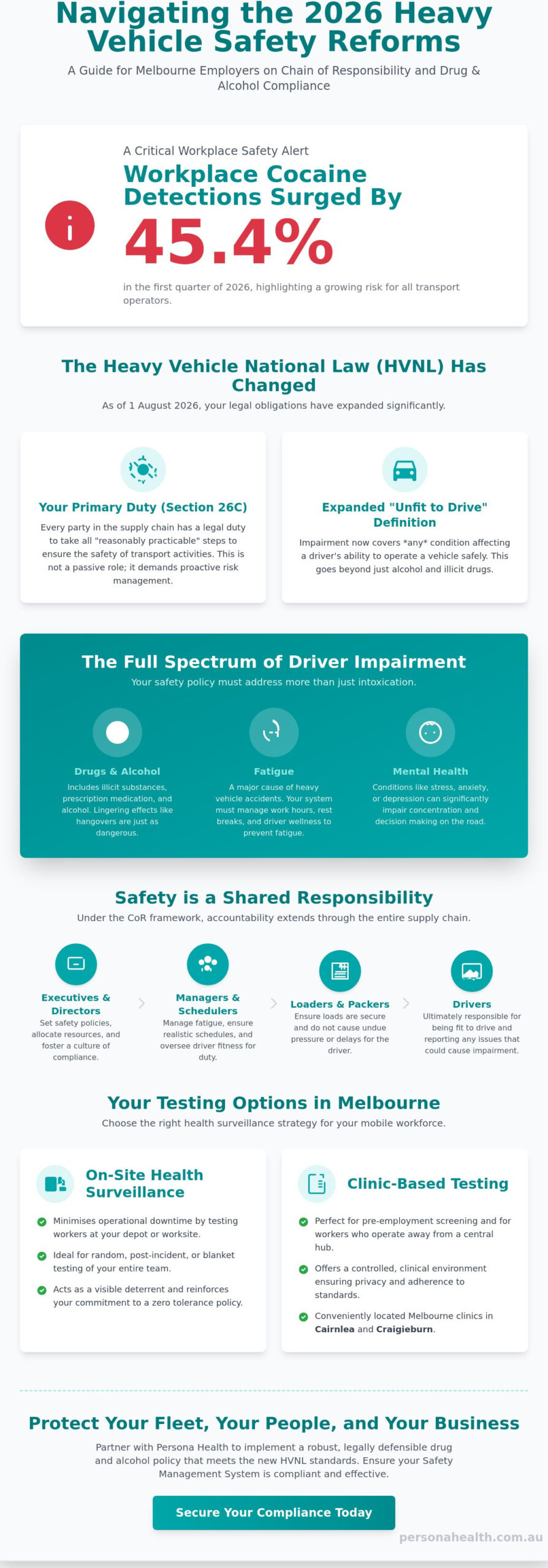
Did you know that cocaine detections in Australian workplaces surged by 45.4% in the first quarter of 2026? This sharp increase, paired with the August 1, 2026 Heavy Vehicle National Law reforms, means the pressure on Melbourne employers to maintain a safe fleet has never been higher. You’re likely concerned about the heavy penalties for non-compliance or how to manage a mobile workforce that’s constantly on the move through areas like Cairnlea and Craigieburn. It’s a lot to handle, and feeling uncertain about your primary duty under these new regulations is a common challenge for many local businesses.
This guide will help you navigate these changes by showing you how to implement a legally defensible drug and alcohol policy that meets the latest Australian Standards. You’ll learn how professional chain of responsibility drug testing melbourne can reduce your workplace safety risks and ensure your Safety Management System is truly effective. We’ll walk through the transition to the AS/NZS 4308:2023 standard and explore practical ways to keep your team healthy, focused, and ready for the road. By moving from a reactive approach to a proactive health surveillance framework, you can protect both your workers and your business reputation.
Key Takeaways
- Understand how the 2026 HVNL reforms expand your safety obligations to include any impairment that affects a driver’s ability to operate heavy vehicles safely.
- Learn to manage your primary duty under Section 26C by establishing a documented and auditable Safety Management System that meets NHVR requirements.
- Discover how professional chain of responsibility drug testing melbourne helps you mitigate risks and maintain compliance across your entire logistics supply chain.
- Explore the practical differences between mobile on-site health surveillance and clinic-based testing at our facilities in Cairnlea and Craigieburn.
- Gain the tools to develop a robust, legally defensible drug and alcohol policy that prioritises employee well-being and operational safety.
What is Chain of Responsibility Drug Testing?
Chain of Responsibility (CoR) is a legal framework designed to ensure that safety on our roads is a shared burden rather than a driver’s solo task. In the Australian transport industry, this means that anyone with influence over a transport activity, from directors to loaders, can be held accountable for safety breaches. If you manage logistics in Victoria, you have a primary duty to ensure your operations don’t compromise public safety. Understanding What is Chain of Responsibility? is the first step toward building a compliant and caring workplace culture.
In 2026, the landscape of workplace safety has evolved. With the Heavy Vehicle National Law (HVNL) reforms now in full effect, the definition of being “unfit to drive” has broadened to include various forms of impairment. Melbourne transport operators are prioritising detailed health assessments to manage these complex risks. Professional chain of responsibility drug testing melbourne serves as a vital tool to identify impairment before a vehicle ever leaves the yard. This process isn’t just about compliance; it’s about ensuring every member of your team returns home safely at the end of their shift.
To better understand the technical side of detection times and how they impact your fleet, watch this helpful video:
The Core Concept of CoR
The law no longer stops at the driver’s seat. Executives and managers now share a legal obligation to take “reasonably practicable” steps to prevent road risks. Within the fast-paced world of Victorian logistics, this means you cannot simply hope your drivers are fit for duty. You need a proactive system of on-site health surveillance to monitor and mitigate potential hazards. This shift toward proactive monitoring ensures that safety is treated as a continuous journey of care rather than a panicked reaction to an incident. If an accident occurs and it’s found that a driver was impaired, corporate liability can extend deep into the organisation if no preventative testing was in place.
Why Impairment Matters for Road Safety
Operating a heavy vehicle requires peak cognitive function and rapid physical responses. Alcohol and substances don’t just cause immediate intoxication; they have lingering biological effects that are often overlooked. A driver suffering from a hangover or the “come-down” from stimulants experiences significantly delayed reaction times and reduced spatial awareness. These impairments are just as dangerous as active use when navigating high-traffic areas in Melbourne. CoR drug testing is a mandatory safety barrier. By identifying these issues early, you protect your team from the physical and legal consequences of a workplace tragedy. Every individual’s physiology is unique, and our goal is to support that uniqueness with tailored safety solutions that keep your business moving forward safely.
Legal Obligations under the Heavy Vehicle National Law (HVNL)
Under Section 26C of the Heavy Vehicle National Law (HVNL), every party in the supply chain holds a “primary duty” to ensure the safety of transport activities. This isn’t a passive obligation; it requires you to take every reasonably practicable step to eliminate or minimise public risks. For Melbourne employers, understanding these Legal Obligations under the HVNL is essential to avoid the severe penalties associated with non-compliance. Since the August 1, 2026 reforms, the “Unfit to Drive” duty has been significantly expanded. It now covers any impairment that could impact a driver’s ability, including fatigue, mental health, and the presence of drugs or alcohol.
Failing to manage these risks doesn’t just invite fines; it places your entire corporate structure at risk of litigation. Implementing professional chain of responsibility drug testing melbourne provides the clinical evidence needed to prove you are fulfilling your due diligence. SafeWork Australia and the National Heavy Vehicle Regulator (NHVR) look for documented, auditable systems that show you are actively monitoring your workforce. Without a clear paper trail of medical assessments and testing results, demonstrating safety leadership becomes nearly impossible during a regulatory audit.
Primary Duty and Due Diligence
Executives must exercise due diligence to ensure the business complies with its safety duties. In 2026, this means your Safety Management System (SMS) must be “Present, Suitable, Operating, and Effective” (PSOE) to pass the new National Audit Standard. Regular health surveillance and clear records of testing are the backbone of this requirement. By prioritising these steps, you show that you value individual well-being as much as operational targets. You can explore our fitness for work assessments to build a stronger safety culture.
Regulatory Standards in Victoria
For heavy vehicle operators in Melbourne, compliance is measured against specific Australian Standards. The transition to AS/NZS 4308:2023 for urine testing is a critical 2026 milestone, introducing lower screening cut-off levels for cocaine metabolites. Oral fluid testing must also adhere to AS/NZS 4760:2019 to remain legally defensible. Adhering to these clinical benchmarks ensures your results withstand scrutiny in court. We suggest reviewing your protocols to ensure they align with these updated requirements. If you want to ensure your business remains fully compliant with these evolving standards, our team can help you implement a tailored on-site health surveillance program.
Implementing an Effective Drug and Alcohol Policy
Creating a structured approach to workplace safety is the most compassionate way to support your workforce. While the legal framework provides the “why”, your internal policy provides the “how”. A well-crafted document acts as a roadmap, guiding your team through the complexities of impairment management and ensuring everyone understands their role in maintaining road safety. Implementing an Effective Drug and Alcohol Policy is about more than just setting rules; it’s about building a culture where health and safety are non-negotiable priorities.
To be truly effective, your strategy must be multi-faceted. It should cover various testing scenarios to ensure comprehensive coverage. For example, integrating pre-employment medicals into your hiring process helps you identify potential risks before a driver even joins your fleet. Regular chain of responsibility drug testing melbourne then provides an ongoing safety net, while post-incident testing offers critical data in the event of a near-miss or accident. This layered approach ensures that your Safety Management System remains robust and responsive to the unique needs of your logistics operations.
Policy Development Steps
Your policy must set crystal-clear expectations for both drivers and supervisors. It should explicitly define what constitutes a safety breach and outline the clinical procedures for testing. We recommend including specific sections on the use of prescription medications, as these can often cause unintended impairment. Your document should also address fatigue management, as the 2026 HVNL reforms treat fatigue and substance use with equal gravity. Transparency is key here. By establishing a clear, fair process for disciplinary actions and support, you reduce uncertainty and build trust within your organisation. If a positive result does occur, having a pre-defined workplace injury management pathway helps you support the individual while protecting your business.
Consultation and Education
Involving your staff in the development process is essential for long-term success. Whether your team is based at our Sydney sites like Rosebery or operating across Melbourne, their input ensures the policy is practical and respected. Consultation isn’t just a legal requirement under the OHS Act; it’s a way to foster ownership of safety standards. You can enhance this by providing eLearning modules and regular resources that improve driver awareness about detection times and the biological impact of substances. Education transforms a static document into a living safety culture that empowers drivers to make better choices for themselves and the community. A policy is only as effective as its enforcement.
On-Site vs. Clinic-Based Testing in Melbourne
Deciding where and how to conduct your workplace assessments is a critical logistical choice that impacts both your bottom line and your team’s morale. We understand that in the fast-moving world of Victorian transport, every minute a truck sits idle is a minute of lost productivity. For large fleets, mobile on-site health surveillance is often the most compassionate and efficient path. It allows you to maintain the “surprise” element necessary for effective random testing while showing your drivers that you value their time. By bringing our clinical experts directly to your depot, we ensure that your safety obligations are met without compromising your operational rhythm.
While on-site visits are perfect for active fleets, clinic-based testing remains the gold standard for recruitment and pre-employment medicals. When you are bringing someone new into your organisation, a controlled clinical environment provides the depth and focus needed for a thorough evaluation. Professional chain of responsibility drug testing melbourne should be flexible enough to adapt to your specific needs, whether that means a high-volume testing day at your warehouse or a single appointment for a new hire at one of our dedicated facilities.
Melbourne Service Locations
Our presence in Melbourne is strategically designed to support the city’s major transport corridors. Logistics hubs in the western suburbs can easily access our facilities in Cairnlea, providing a convenient touchpoint for drivers operating near the Port of Melbourne or the industrial estates of Derrimut. Similarly, operators in the northern transport corridors can utilise our Craigieburn clinics to streamline their recruitment processes. For businesses managing hundreds of staff across multiple shifts, we recommend a hybrid approach that combines clinic visits with a scheduled on-site health surveillance program. This ensures that no matter where your team is located, their well-being and compliance are never more than a short distance away.
Choosing the Right Testing Method
Selecting the appropriate testing medium is about more than just checking a box; it is about choosing the right tool for a specific safety goal. Oral fluid (saliva) testing is increasingly popular for random roadside-style assessments because it excels at detecting recent impairment. It focuses on substances that are currently active in a driver’s system, making it a highly relevant choice for immediate road safety. In contrast, urine analysis is often preferred for pre-employment medicals because it offers a longer detection window, giving you a clearer picture of historical substance use. All our tests adhere strictly to the AS/NZS 4308:2023 and AS/NZS 4760:2019 standards, ensuring your results are clinically accurate and legally defensible. If you are ready to streamline your compliance and protect your workforce, you can book your next professional Drug and Alcohol Testing session with our team today.
Partnering with Persona Health for CoR Compliance
Safety is never a box-ticking exercise; it is an ongoing commitment to the people who keep our economy moving. At Persona Health, we understand that transport and logistics operators face unique pressures that require more than just standard clinical services. We provide a supportive partnership that integrates seamlessly with your operations, helping you manage the complexities of the 2026 HVNL reforms with confidence. Our approach to chain of responsibility drug testing melbourne is built on clinical accuracy and deep empathy for the individual, ensuring that your fleet remains safe and your legal liability is minimised. We believe that when you focus on the well-being of the driver, the safety of the entire supply chain follows naturally.
We don’t just offer isolated tests. We provide a holistic framework where drug and alcohol screening works alongside other essential health checks. For many operators, this means combining testing with Cat 3 Rail Medicals or commercial vehicle driver assessments to ensure a complete picture of fitness for duty. By centralising these health requirements, you reduce the administrative burden on your team and create a more consistent safety culture across your entire organisation. This integrated model is particularly effective for businesses managing diverse workforces across both Victorian and New South Wales transport hubs.
Tailored Occupational Health Solutions
Our services extend far beyond simple screening. We believe in managing the whole person, which is why we integrate testing with comprehensive workplace injury management. If a health issue or impairment is identified, our team is ready to guide both the employer and the employee through the necessary recovery or support pathways. For businesses with a presence in New South Wales, we offer full support at our clinics in Parramatta, Gregory Hills, and Dee Why. This multi-site capability ensures your workforce has access to the same high standard of care regardless of where they are stationed. You can learn more about our foundational approach in our pre-employment medicals guide, which outlines how to start every driver’s journey with a focus on long-term health.
Expert Support for Melbourne Operators
Navigating the regulatory landscape in Victoria requires specialised knowledge and reliable data. Our injury management consultants act as an extension of your safety team, providing the expertise needed to manage complex cases and return-to-work pathways. We prioritise streamlined, clear reporting for fleet managers and executives, ensuring you have the auditable data required by the NHVR and SafeWork Australia. This level of transparency is vital for demonstrating safety leadership and protecting your business from the heavy penalties associated with non-compliance. When you choose Persona Health for your chain of responsibility drug testing melbourne, you are choosing a modern professional partner dedicated to your long-term success. Contact our team today to develop a customised compliance strategy that prioritises the health of your people and the stability of your business.
Securing Your Fleet’s Future in 2026 and Beyond
Managing your primary duty under the 2026 HVNL reforms doesn’t have to be a source of stress. By moving toward a proactive health surveillance framework, you’re not just avoiding penalties; you’re actively investing in the longevity of your workforce. We’ve explored how a robust policy and the right choice between on-site or clinic-based assessments can transform your compliance from a legal burden into a competitive advantage. Reliable chain of responsibility drug testing melbourne ensures that your fleet remains safe while your business stays resilient against evolving regulatory scrutiny.
Our accredited occupational health specialists bring deep expertise in NHVR safety standards to every assessment. Whether you require on-site surveillance in Cairnlea and Craigieburn or clinic-based support in Parramatta, we are here to guide you through every step of the process. You can book your CoR drug testing at our Melbourne or Sydney clinics today to secure a safer tomorrow for your team. Taking this step shows that you value the unique contribution of every driver and are committed to their journey home.
Frequently Asked Questions
Is drug testing mandatory for Chain of Responsibility compliance in Australia?
Drug testing is a practical necessity for fulfilling your primary duty under the Heavy Vehicle National Law. While the law focuses on the outcome of safety, the National Heavy Vehicle Regulator (NHVR) expects operators to have a documented Safety Management System. Professional chain of responsibility drug testing melbourne provides the auditable evidence required to show you are taking reasonably practicable steps to eliminate road risks. It serves as a critical clinical barrier against impairment.
Can an employer be held liable for a drivers drug use under CoR?
Yes, employers and executives can be held legally liable if they fail to manage the risks of driver impairment. Under the Chain of Responsibility framework, your duty is non-delegable. If an incident occurs and it is found that you didn’t have active monitoring systems in place, you could face significant penalties. This is why many logistics firms in Victoria prioritise regular medical assessments and fitness for duty checks to protect their corporate structure.
How often should random drug testing be conducted for heavy vehicle fleets?
The frequency of random testing should be determined by your specific risk assessment and the size of your fleet. Most industry leaders conduct testing at least quarterly to maintain a credible deterrent and ensure ongoing safety. The goal is to create an environment where drivers understand that fitness for duty is monitored consistently. This proactive approach helps identify potential issues before they lead to workplace incidents or serious legal breaches.
What happens if a driver tests positive during a CoR medical assessment?
If a driver returns a not-negative result, they must be immediately removed from safety-sensitive duties to protect themselves and the public. You should then follow the specific disciplinary or support pathway outlined in your workplace policy. This often involves confirmatory laboratory testing and a formal return-to-work process. We recommend involving a workplace injury management consultant to ensure the process is handled with both clinical precision and empathy for the individual involved.
What is the difference between urine and saliva drug testing for transport?
Saliva testing is generally used to detect very recent substance use, making it ideal for random roadside-style checks. Urine testing has a longer detection window, which is why it is the preferred method for pre-employment medicals. Both methods must comply with the relevant Australian Standards, such as AS/NZS 4308:2023 for urine, to remain legally defensible. Your choice should depend on whether you are looking for immediate impairment or historical use patterns.
How do I book a CoR drug test in Melbourne suburbs like Cairnlea?
When you need to arrange chain of responsibility drug testing melbourne, you can contact our team to schedule an appointment at our Cairnlea or Craigieburn facilities. We also offer mobile on-site health surveillance for larger fleets across Melbourne to minimise operational downtime. Our booking process is designed to be straightforward and supportive, ensuring your drivers feel respected throughout their clinical experience. We will help you schedule testing that fits your unique transport timelines.
Does a drug and alcohol policy need to be reviewed annually?
Yes, we strongly recommend reviewing your drug and alcohol policy at least once a year. Regulatory requirements and Australian Standards, such as the 2026 HVNL reforms, change frequently. An annual review ensures your protocols remain legally sound and reflect the latest clinical best practices. It also provides an opportunity to consult with your staff at sites like Rosebery or Parramatta to ensure the policy remains practical, effective, and respected by the workforce.
Can prescription medication affect a drivers fitness for duty under CoR?
Prescription medications can significantly impact a driver’s cognitive function and reaction times, potentially leading to a breach of CoR duties. It is essential that your policy requires drivers to disclose any medication that might cause impairment, such as strong painkillers or sedatives. We can help you integrate medication management into your wider health surveillance program. This ensures that every individual is supported in staying safe while managing their personal health needs with total transparency.

Article by
Ian Nicholson
Ian is the Business Support Manager at Persona Health, where he plays a key role across IT, sales, marketing and business operations. With a broad skill set and a practical, solutions-focused approach, Ian helps drive the systems, communication and commercial strategy that support Persona Health’s continued growth across Australia.