
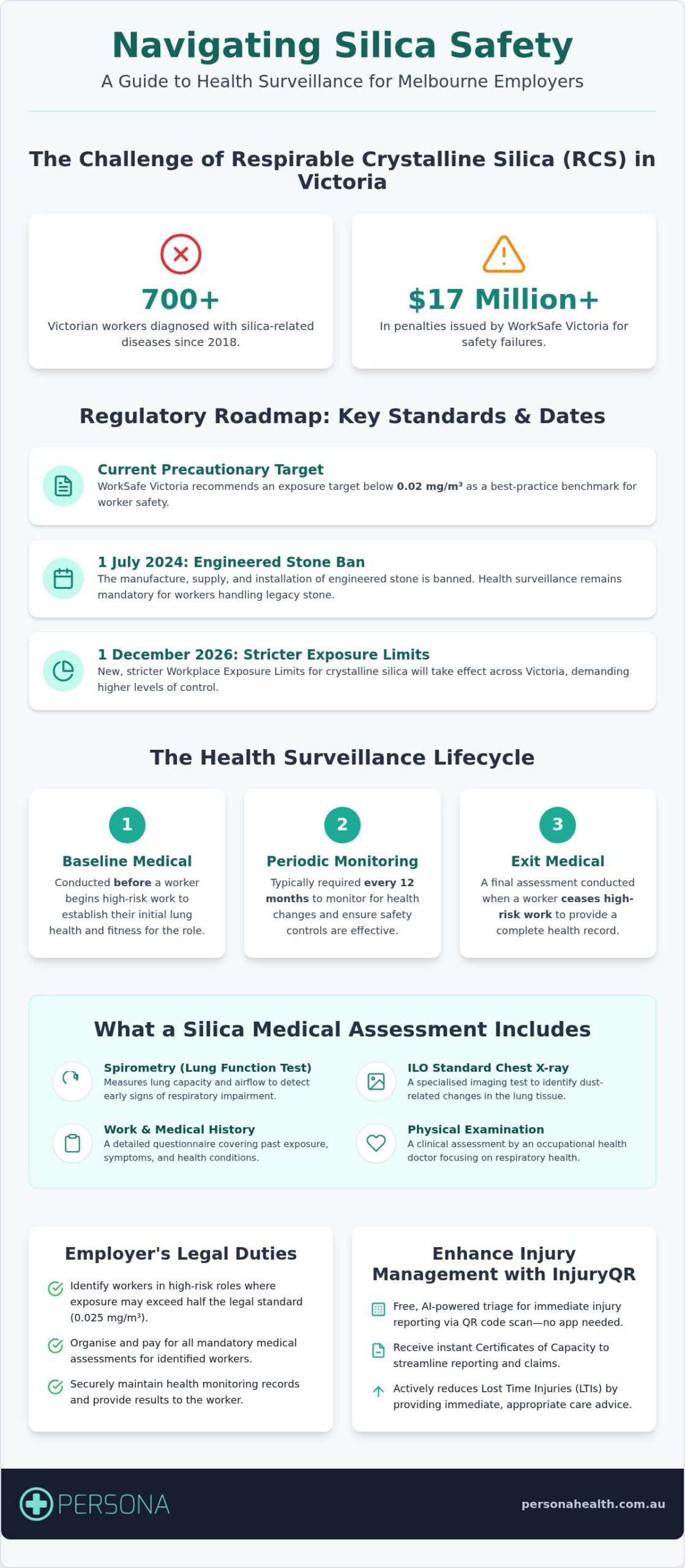
Since 2018, more than 700 Victorian workers have been diagnosed with silica-related diseases, and WorkSafe Victoria has issued over $A17 million in penalties to businesses failing to meet their safety obligations. You likely feel the pressure of these figures as you navigate the 2024 engineered stone ban and prepare for the stricter Workplace Exposure Limits arriving in December 2026. It’s a significant challenge to ensure your workplace injury management plan effectively addresses these invisible respiratory risks while managing complex health surveillance schedules for a large team.
We’re here to help you move from uncertainty to total compliance. This guide ensures your workforce remains safe by providing a clear, professional roadmap for silica health surveillance and medical assessments across Melbourne. You’ll gain a thorough understanding of mandatory tests like spirometry and X-rays, learn how to track long-term health data, and discover how our expert teams in Cairnlea and Craigieburn provide the fast turnaround times and clinical authority your business requires to stay ahead of WorkSafe regulations.
Key Takeaways
- Stay informed on the transition from current exposure standards to the stricter Workplace Exposure Limits taking effect in Victoria on 1 December 2026.
- Identify the essential clinical components of a silica medical, including spirometry and chest X-rays, to ensure your health surveillance meets Australian Standards.
- Learn how to align mandatory health monitoring with your workplace injury management plan to safeguard your employees and ensure full compliance with WorkSafe Victoria.
- Utilise InjuryQR for immediate, AI-driven injury reporting and triage, which helps your business reduce Lost Time Injuries and obtain instant Certificates of Capacity.
- Benefit from specialised occupational health services at our Cairnlea and Craigieburn clinics, designed to provide Melbourne employers with rapid results and expert guidance.
Understanding Crystalline Silica Regulations and WorkSafe Victoria Compliance
Respirable crystalline silica (RCS) is a silent risk found in common materials like concrete, bricks, and tiles. In Melbourne’s busy construction sector, workers are often exposed during everyday tasks like cutting, grinding, or drilling. When these microscopic particles are inhaled, they can cause irreversible scarring of the lung tissue. Understanding What is Silicosis? is the first step for any employer wanting to protect their team. Integrating silica safety into your broader workplace injury management plan isn’t just about ticking boxes; it’s about clinical precision and genuine care for your workforce.
The Occupational Health and Safety Regulations 2017 (Vic) set out clear duties for Victorian employers. You must ensure that exposure levels remain below the legal standard, but WorkSafe Victoria now recommends an even lower target of 0.02 mg/m³ as a precautionary benchmark. To better understand how a structured approach improves safety outcomes, watch this video on injury management programs:
Persona Health offers expert crystalline silica medicals to help Melbourne businesses navigate these strict standards. We focus on providing a seamless experience that balances regulatory demands with the individual needs of your employees.
The 2024 Engineered Stone Ban and Legacy Stone
The regulatory landscape changed significantly on 1 July 2024 when Victoria banned the manufacture, supply, and installation of engineered stone. This was a landmark decision to curb rising disease rates among tradespeople. However, your responsibilities don’t end with the ban. Many Melbourne sites still contain legacy stone installed before the cutoff. If your workers are involved in the removal, repair, or remediation of these existing materials, they’re still performing high-risk work. Health assessments remain mandatory for these employees to detect any early signs of respiratory changes.
When is Health Surveillance Legally Required?
You’re legally required to provide health monitoring if it’s reasonably likely that a worker’s health will be affected by silica exposure. In Victoria, work is classified as high-risk if dust levels are likely to exceed half the exposure standard, which is 0.025 mg/m³. This affects various industries across Melbourne, from tunnelling and demolition to roadworks and quarrying. As an employer, you must organise and pay for these medicals, ensuring they occur before work starts and at regular intervals thereafter. Aligning these requirements with your workplace injury management plan ensures no worker’s health is left to chance.
What a Crystalline Silica Medical Assessment Includes
A crystalline silica medical is a highly specialised clinical procedure designed to detect early physiological changes caused by dust exposure. Integrating these assessments into your workplace injury management plan ensures you aren’t just reacting to symptoms but actively preserving the health of your team. By following the guidance found in WorkSafe Victoria’s safety basics, you can establish a robust surveillance program that protects both your workers and your business. Our clinics in Cairnlea and Craigieburn provide the clinical authority needed to manage these schedules efficiently for Melbourne employers.
The health surveillance lifecycle consists of three critical stages:
- Baseline Medicals: These are conducted before an employee begins work in a high-risk environment. This establishes their starting lung health, which is vital for identifying any future changes.
- Periodic Monitoring: Typically required every 12 months for Victorian sites where workers handle silica-containing materials. This regular check-up ensures that control measures on site are effectively protecting the individual.
- Exit Medicals: These are essential when a worker leaves your company or moves to a non-exposed role. They provide a final clinical record of the employee’s health, protecting your business from future claims by proving no damage occurred during their tenure.
Respiratory Function Testing and Spirometry
Spirometry is the cornerstone of respiratory screening. It measures how much air a person can breathe out and how fast they can do it to detect early obstruction. At Persona Health, we use standardised protocols to ensure every test is accurate and repeatable. For workers with complex histories or high exposure levels, we may recommend DLCO (Diffusing Capacity of the Lungs for Carbon Monoxide) testing. This advanced screen measures how well the lungs transfer gases from inhaled air to the blood, often detecting issues before they show up on a standard spirometry chart.
ILO Chest X-Rays and HRCT Scans
Imaging is vital for identifying physical changes in lung tissue that cannot be heard through a stethoscope. We adhere to International Labour Organization (ILO) standards for chest X-rays, which involves a specific classification system for dust-related diseases. While a standard X-ray is the typical starting point, our physicians may recommend a High-Resolution Computed Tomography (HRCT) scan if results are inconclusive. HRCT provides much finer detail, allowing for the detection of early-stage silicosis that might be missed on a traditional film. We manage all referrals for specialised imaging across Melbourne to keep the process simple for your team.
If you need to organise a baseline or periodic review for your staff, you can view our full range of crystalline silica medicals to find a solution that fits your project schedule.
Employer Compliance and Health Surveillance Management
Managing the administrative side of health monitoring requires a clear workplace injury management plan that accounts for both legal compliance and worker wellbeing. When you receive a health monitoring report, it won’t contain a full medical history; instead, it provides a clinical determination of whether your employee is fit to continue their current duties. Following WorkSafe Victoria’s official guidelines ensures you understand your obligations when a report suggests a worker has been affected by silica exposure.
If a report returns an “unfit for work” or “fit with restrictions” result, you must act immediately. This might involve moving the employee to a different area of the site where they aren’t exposed to dust or providing enhanced respiratory protective equipment. It’s a delicate process that requires empathy and clear communication to maintain trust. Professional crystalline silica medicals provide the objective data needed to make these tough decisions with confidence.
Under Australian health and safety laws, records of health surveillance must be kept for at least 30 years. This is because silica-related diseases often have long latency periods, sometimes appearing decades after the initial exposure. Keeping organised, secure digital records is the only way to protect your business from future liability while ensuring workers can access their history if needed. Integrating these records into your broader workplace injury management plan allows for better long-term tracking of workforce health trends.
The Role of the Appointed Medical Practitioner
Engaging a doctor who understands the specific nuances of Victorian occupational medicine is vital. An appointed medical practitioner doesn’t just run tests; they interpret data within the context of your specific workplace risks. At Persona Health, we act as your partner in navigating complex WorkSafe Victoria claims, providing the clinical authority required to bridge the gap between medical findings and site-based safety actions. We focus on clear communication, ensuring you understand the practical implications of every medical result.
Privacy and the Privacy Act 1988
Handling sensitive health data requires strict adherence to the Privacy Act 1988. In a Victorian workplace, you must ensure that medical reports are stored separately from general personnel files and are only accessible by authorised staff. Employees have a legal right to access their own records at any time. Our digital monitoring platforms are designed with high-level security to ensure this information remains confidential, protecting the individual’s dignity while maintaining your company’s compliance. This secure approach builds a culture of trust where employees feel safe participating in mandatory screening.
Integrating InjuryQR for Immediate Workforce Protection
Traditional paper-based reporting is no longer sufficient for high-risk Melbourne sites. By incorporating InjuryQR into your workplace injury management plan, you provide your team with a 24/7 digital safety net. This AI-powered triage tool allows for the immediate capture of exposure incidents, ensuring that the gap between a suspected event and clinical review is closed within minutes. It’s a modern solution that respects the urgency of respiratory health while simplifying the reporting process for everyone involved.
Speed is the most significant factor in reducing Lost Time Injuries (LTIs). When a worker can report a concern instantly, your management team can implement controls or arrange medical reviews before the situation worsens. This proactive approach not only satisfies WorkSafe Victoria’s reporting expectations but also reinforces a culture where employee health is a visible priority. It’s about moving away from reactive management and toward a system that prioritises the individual’s wellbeing from the moment an incident occurs.
Voice-Activated Triage for On-Site Incidents
One of the biggest hurdles to incident reporting is the complexity of filling out forms while in the field. InjuryQR removes this barrier by using simple QR codes placed around the worksite. There is no app installation required. A worker simply scans the code and describes what happened using their voice. The AI then asks tailored follow-up questions to determine the severity of the exposure or injury, guiding them toward self-care, telehealth, or emergency intervention as needed. This is particularly useful in dusty environments where typing on a screen is impractical or difficult.
Immediate Certificates of Capacity and Telehealth
For Melbourne employers, the administrative benefits are just as significant. InjuryQR can generate immediate Certificates of Capacity, allowing you to manage return-to-work protocols without waiting days for a GP appointment. This seamless transition to clinical care is a cornerstone of injury management best practices. It ensures that every worker who suspects dust exposure receives the right level of attention exactly when they need it, reducing friction and ensuring that recovery begins immediately.
If you’re ready to modernise your safety protocols and improve your clinical outcomes, you can speak with our team about implementing InjuryQR on your Victorian sites today.
Persona Health: Melbourne Silica Medical Experts
Choosing a medical partner is a critical decision for any Victorian business operating under the strict OHS Regulations 2017. Persona Health provides the clinical authority and local presence required to keep your workforce safe and your projects moving. By integrating our specialised services into your workplace injury management plan, you gain access to a team that understands the unique pressures of the Melbourne construction and infrastructure sectors. We don’t just provide tests; we offer a supportive partnership that prioritises the individual needs of your workers while ensuring your business remains fully compliant with WorkSafe Victoria.
Our commitment to the HealthProtect philosophy means we look beyond the immediate medical results. We focus on long-term wellbeing, helping you identify trends and implement preventative measures that reduce future risks. This proactive approach is backed by fast turnaround times for reports, ensuring that you have the data you need to make site-based decisions without unnecessary delays.
Our Melbourne Locations and Infrastructure
We’ve strategically positioned our Melbourne clinics to serve the growing northern and western suburbs. Our facilities in Cairnlea and Craigieburn are equipped with the latest diagnostic technology, making it convenient for workers on major infrastructure projects to attend their assessments. For businesses with staff scattered across the state, our network of over 100 affiliate clinics ensures that quality silica medicals are available even in regional Victoria.
- Cairnlea Clinic: Convenient access for the western industrial hub and manufacturing sectors.
- Craigieburn Clinic: Serving the northern growth corridor and major road infrastructure projects.
- Mobile Services: On-site health surveillance capabilities for large workforces to minimise project downtime.
- Affiliate Network: Comprehensive coverage across Australia for regional or interstate teams.
Why Victorian Businesses Choose Persona Health
Our reputation is built on providing a professional, practical, and friendly service that removes the confusion surrounding silica compliance. We understand that navigating the aftermath of the engineered stone ban can be difficult, which is why our occupational health experts are always available to provide clear, evidence-based guidance. Whether you’re arranging pre-employment medicals or periodic silica monitoring, we ensure the process is seamless and respectful of the worker’s experience.
By choosing Persona Health, you’re investing in a system that reduces workplace risk and protects your most valuable asset: your people. Our focus on clinical precision ensures that every workplace injury management plan is supported by accurate data and expert interpretation, giving you the confidence to lead a safe and compliant Victorian workplace. Contact Persona Health today to request a quote or speak with our team about your specific health surveillance requirements.
Securing Your Workforce for 2026 and Beyond
Managing crystalline silica risks in Victoria requires more than just meeting the minimum requirements; it demands a proactive commitment to the long-term health of your team. By aligning your workplace injury management plan with the latest clinical standards and WorkSafe Victoria regulations, you protect your business from compliance failures while providing your workers with the highest level of care. From mandatory baseline assessments to the upcoming transition toward stricter exposure limits in December 2026, staying informed is your best defence.
Our clinics in Cairnlea and Craigieburn are ready to support your business with specialised medical expertise and fast report turnaround times. By integrating tools like InjuryQR, we offer a seamless, modern approach to safety that simplifies reporting and speeds up clinical intervention. You don’t have to navigate these complex regulations alone; our team is here to provide the clinical authority and empathetic support your organisation needs to thrive.
Take the next step in safeguarding your project’s future. Contact Persona Health today to book your crystalline silica medicals in Melbourne and ensure your workforce remains safe, compliant, and healthy.
Frequently Asked Questions
How often do Melbourne workers need silica medicals?
Melbourne workers performing high-risk crystalline silica work typically require health surveillance every 12 months. This periodic schedule ensures any physiological changes are detected early. However, your workplace injury management plan should also include a baseline medical before an employee starts in a high-risk role. The frequency can vary based on the specific level of exposure and the clinical recommendations of the appointed medical practitioner overseeing your workforce health.
Who pays for the crystalline silica health assessment in Victoria?
Employers are legally responsible for the full cost of crystalline silica health assessments in Victoria. Under the Occupational Health and Safety Regulations 2017, you must provide and pay for health monitoring if exposure is reasonably likely to affect a worker’s health. This includes the cost of the medical itself, any necessary travel, and the time taken for the worker to attend the appointment during their normal working hours.
What happens if a worker is diagnosed with silicosis during a medical?
If a worker is diagnosed with a silica-related disease, the medical practitioner must notify WorkSafe Victoria. As an employer, you’ll need to review your site’s dust control measures immediately and ensure the worker is moved to a safe, non-exposed role. This situation should be managed through your workplace injury management plan, ensuring the employee receives appropriate support and guidance through the Victorian workers’ compensation system while prioritising their clinical wellbeing.
Is an ILO chest X-ray mandatory for all silica medicals?
A chest X-ray classified to the International Labour Organization (ILO) standards is a mandatory component of silica health surveillance in Victoria. Standard clinical X-rays aren’t sufficient for detecting the specific patterns of dust-related lung disease. Our clinics in Cairnlea and Craigieburn ensure that all imaging meets these rigorous standards, providing the clinical accuracy required for a definitive health monitoring report that protects both the worker’s health and your business’s compliance.
Can a general practitioner (GP) perform silica health monitoring?
No, silica health monitoring must be conducted by an appointed medical practitioner who has specific experience in occupational medicine. A standard general practitioner typically lacks the specialised equipment, such as ILO-standard X-ray interpretation or calibrated spirometry, and the regulatory knowledge required by WorkSafe Victoria. Persona Health provides this specialised expertise, acting as your professional partner to ensure all medical assessments meet the strict legal requirements for Victorian workplaces.
What is the difference between a baseline and a periodic silica medical?
A baseline medical is conducted before a worker is exposed to silica dust to establish their starting health status. It serves as a vital reference point for all future tests. A periodic medical is the ongoing monitoring conducted at regular intervals, usually every year, to check for any changes against that baseline. This comparison is the only way to clinically determine if your site’s safety controls are effectively protecting your employees from long-term harm.
How long must a Victorian employer keep silica health records?
Victorian employers are required to keep health surveillance records for 30 years from the date of the last entry. This long-term requirement exists because diseases like silicosis can take decades to develop after the initial exposure. Storing these records securely and ensuring they are accessible for 30 years is a critical part of your compliance strategy. Using digital platforms helps you maintain this data without the risks associated with paper-based storage.
Does the engineered stone ban mean I no longer need medicals for my staff?
The 2024 engineered stone ban does not remove the need for silica medicals. While engineered stone is banned, silica is still present in many other common building materials like concrete, bricks, and natural stone. If your workers are involved in demolition, tunnelling, or roadworks that generate respirable dust, you still have a legal duty to provide health monitoring. The ban simply removed the highest-risk material, not the risk of silica exposure itself.

Article by
Ian Nicholson
Ian is the Business Support Manager at Persona Health, where he plays a key role across IT, sales, marketing and business operations. With a broad skill set and a practical, solutions-focused approach, Ian helps drive the systems, communication and commercial strategy that support Persona Health’s continued growth across Australia.