
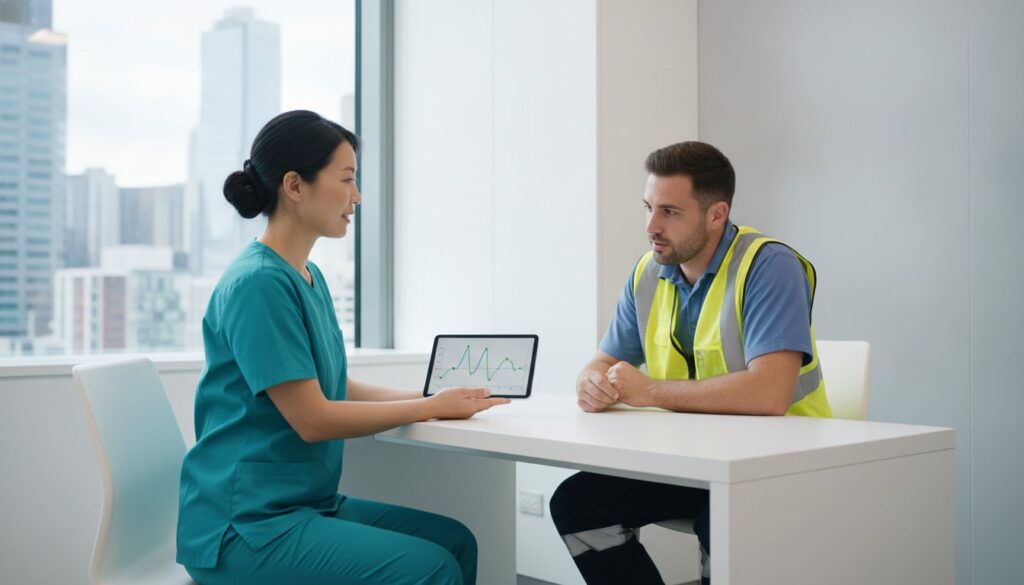
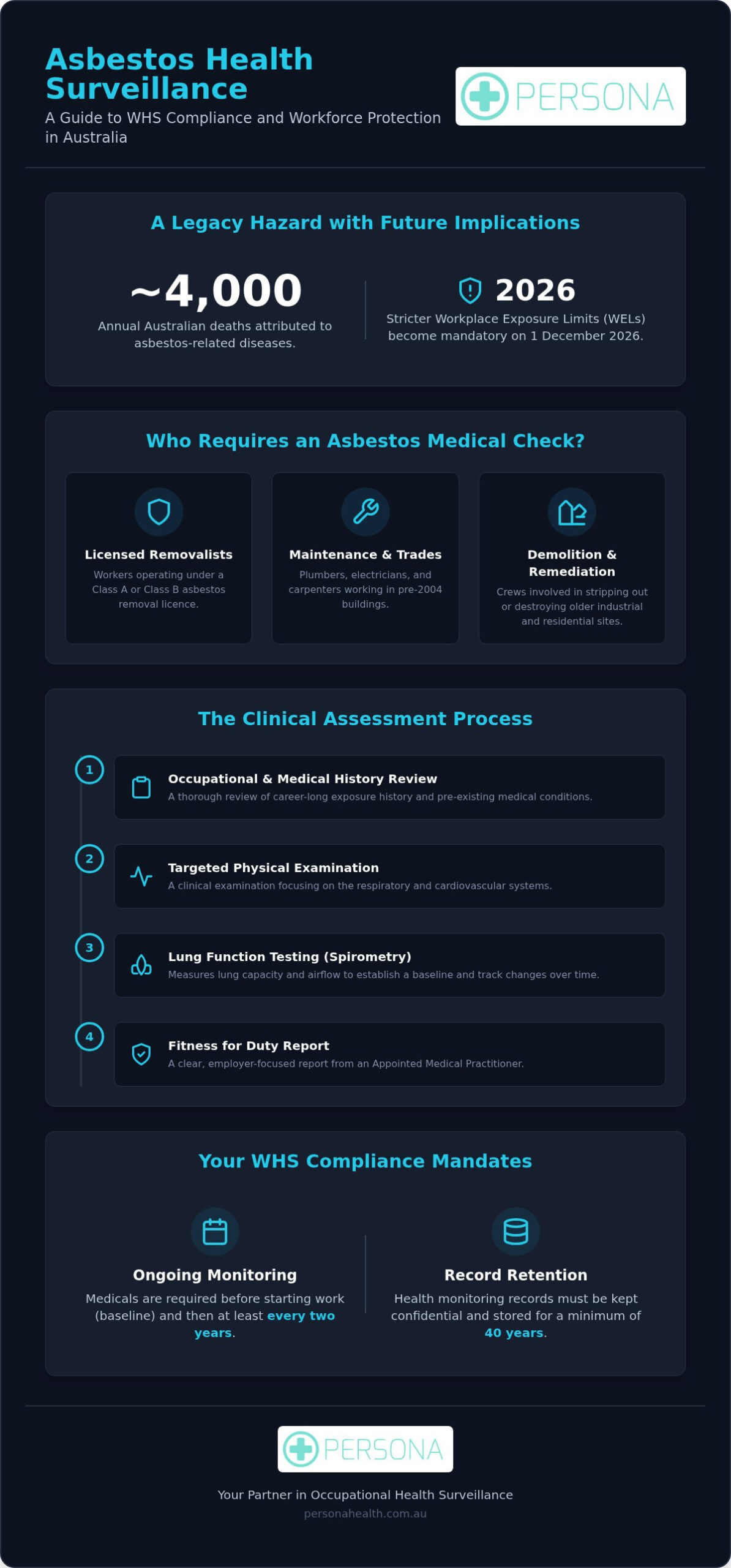
Did you know that approximately 4,000 Australians still lose their lives to asbestos-related diseases every year? Even with the transition to stricter Workplace Exposure Limits (WELs) on 1 December 2026, the legacy of this hazardous substance makes regular asbestos medicals a vital part of your safety culture. We understand the weight of responsibility you feel when managing a mobile workforce in high-risk environments. It’s often overwhelming to keep track of shifting SafeWork regulations across state lines while ensuring every worker is genuinely protected from long-term respiratory disease.
In this guide, you’ll learn exactly what to expect during a clinical assessment, how to meet your legal WHS obligations with confidence, and how to turn health surveillance into a proactive shield for your workforce. We will explore the mandatory components of a medical assessment, the critical 40-year record-keeping rule, and how the clinical expertise at Persona Health provides the clarity you need to stay compliant. From baseline testing to ongoing monitoring, we’ll help you navigate the path to a healthier, more protected team.
Key Takeaways
- Navigate the mandatory shift to Workplace Exposure Limits (WELs) and understand your legal obligations under SafeWork Australia regulations for 2026.
- Learn why baseline and biennial asbestos medicals are the most effective way to protect your team from long-term respiratory diseases like asbestosis.
- Gain clarity on the clinical process, including lung function testing and the specific criteria used to determine a worker’s fitness for duty.
- Understand the long-term compliance requirements, such as the non-negotiable 40-year health record retention period for all exposed workers.
- Discover how to manage medical results across a mobile workforce using a national clinic network and streamlined, employer-focused reporting.
What Are Asbestos Medicals and Why Are They Mandatory?
Asbestos medicals are a specialised form of health surveillance designed to monitor the respiratory health of workers who may be exposed to airborne fibres. To understand the necessity of these checks, it helps to revisit the question: What is Asbestos? These naturally occurring mineral fibres were used extensively in Australian building materials until a total ban in late 2003, but they remain a significant legacy risk in thousands of structures today. A formal medical assessment is more than a simple check-up; it’s a systematic clinical process used to identify early signs of respiratory impairment before they develop into life-threatening conditions.
The primary goal is the early detection of changes in lung function or structure. This is vital because diseases like asbestosis or mesothelioma often have long latency periods, sometimes taking decades to manifest. By the time symptoms appear, the damage is often irreversible. Regular monitoring allows for a proactive approach to workforce health, ensuring that any worker showing signs of exposure can be managed appropriately to prevent further harm. This proactive stance is even more critical as we move toward the new Workplace Exposure Limits (WELs) that become legally enforceable on 1 December 2026.
To better understand this concept, watch this helpful video:
Legal Obligations Under SafeWork Australia
Under the Model WHS Regulations, the Person Conducting a Business or Undertaking (PCBU) holds the primary duty of care. You’re legally required to provide and pay for health monitoring if a worker is carrying out licensed asbestos removal work or is at risk of exposure while performing other tasks. This isn’t just a recommendation; it’s a mandatory requirement enforced by bodies like SafeWork NSW and WorkSafe Victoria. Failure to comply can result in significant penalties and, more importantly, leaves your workers vulnerable to undetected health issues.
A crucial part of this process is engaging an ‘Appointed Medical Practitioner’. This must be a registered doctor with the appropriate skills and experience to manage health surveillance. At Persona Health, our doctors specialise in asbestos medicals, providing clear, employer-focused reports that help you manage your legal obligations across our clinics in Sydney and Melbourne, or through our 100-clinic affiliate network.
Who Specifically Needs an Asbestos Medical Check?
Determining who needs an assessment depends on the nature of the work and the likelihood of exposure. Common groups include:
- Licensed Removalists: Anyone working under a Class A or Class B asbestos removal licence must undergo regular medicals.
- Maintenance and Trades: Plumbers, electricians, and carpenters who frequently disturb materials in pre-2004 buildings.
- Demolition and Site Remediation: Staff involved in the strip-out or destruction of older industrial and residential sites.
While InjuryQR offers an excellent way to triage acute workplace injuries, long-term respiratory health requires the structured rigour of formal on-site health surveillance. A standard GP visit often lacks the specific equipment, such as calibrated spirometry, or the occupational context needed to meet Australian Standards.
The Clinical Process: What Happens During the Assessment?
Understanding what happens inside the clinic can significantly reduce the anxiety workers often feel about their health surveillance. An asbestos medical is a methodical evaluation tailored to identify the specific physiological impacts of fibre inhalation. We start with a deep dive into the worker’s medical and occupational history. This isn’t just paperwork; it’s a critical tool for mapping out cumulative exposure over a career. Because asbestos-related cancer risks are linked to historical exposure, we look for patterns that might suggest early-stage changes in respiratory health.
The physical examination is focused and clinical. The doctor will listen to the chest using a stethoscope to identify specific sounds, such as fine crackles at the base of the lungs, which can be an early clinical sign of asbestosis. This hands-on approach ensures that the assessment is personalised to the individual’s current physical state rather than just relying on data points. If you’re unsure whether your team’s current testing meets these clinical standards, you might find it helpful to review our approach to asbestos medicals in more detail.
Lung Function Testing (Spirometry) Explained
Spirometry is the cornerstone of the assessment. It measures how much air a worker can breathe out and how fast they can do it. We focus on two primary values: Forced Expiratory Volume in one second (FEV1) and Forced Vital Capacity (FVC). These metrics help our clinicians identify restrictive patterns, where the lungs become stiff and lose their capacity to hold air. Using calibrated equipment is essential for accuracy. If you’re managing a large team, our on-site health surveillance services can bring this specialised equipment directly to your workplace, ensuring consistent results without the downtime of off-site travel.
Imaging and Specialist Referrals
Chest X-rays are not always required at every biennial check but are essential for baseline assessments and for long-term workers. We utilise the ILO (International Labour Organization) classification system for reporting, which provides a standardised way to record the presence and severity of lung abnormalities. If an X-ray or spirometry result shows an abnormality, we don’t just hand over a report; we coordinate the next steps. This includes referrals to a respiratory physician for further investigation. Persona Health manages this entire workflow, from booking the imaging at a local centre to ensuring the specialist’s findings are integrated into a clear fitness for duty medical report.
Frequency and Compliance: Staying Within Australian Standards
Compliance with health surveillance is a non-negotiable duty for any PCBU dealing with asbestos. It isn’t just about ticking a box; it’s about creating a longitudinal health record that protects both the worker and the business. In Australia, the framework for asbestos medicals is built on consistency. Regular intervals ensure that even the most subtle changes in respiratory function are captured early. This approach is vital because it moves the focus from reactive treatment to proactive monitoring, aligning with the National Strategic Plan for 2024–2030.
A baseline assessment is the most critical document in this journey. It must be completed before a worker commences any asbestos-related tasks. This initial snapshot provides the clinical benchmark against which all future results are measured. Without it, it’s nearly impossible to determine whether a respiratory issue was pre-existing or caused by workplace exposure. This document serves as the foundation for your risk management strategy, providing peace of mind for both the employer and the employee.
Baseline vs Periodic Assessments
While baseline checks set the stage, periodic assessments are the ongoing safeguard. In most Australian jurisdictions, these are required at least every two years. These biennial checks track lung health over a worker’s entire career, allowing clinicians to spot trends that a single snapshot might miss. We often link these findings to pre-employment medicals to build a comprehensive health profile from day one. This historical data is invaluable if a workers’ compensation claim ever arises, as it provides a clear, evidence-based timeline of a worker’s health status.
Record Keeping and Privacy Compliance
Managing the paperwork is just as important as the clinical exam. Under Australian WHS laws, you must keep health monitoring records for a minimum of 40 years. This reflects the long latency period of asbestos-related diseases. If a former employee develops an illness decades after leaving your company, these records will be your primary evidence of compliance and duty of care. It’s a significant administrative burden, but it’s one that protects your business from long-term liability.
Handling this data requires strict adherence to the Privacy Act 1988. Health reports contain sensitive personal information and should only be shared with the worker, the relevant state regulator when mandatory, and the PCBU in a format that focuses on fitness for duty. At Persona Health, we ensure workers receive their reports promptly, empowering them to take ownership of their long-term health while keeping your business fully compliant with SafeWork requirements.
Managing Results and Workplace Safety Actions
Receiving the results of asbestos medicals is a critical moment for your safety management plan. A professional report shouldn’t just be a list of data; it must provide a clear recommendation on a worker’s fitness for duty. Most workers will receive a “Fit for Work” result, confirming their respiratory health is within normal parameters. However, if a clinician identifies a “Fit with Restrictions” outcome, it signals that adjustments are necessary to prevent further risk. This might involve limiting exposure to certain environments or ensuring the worker is not performing high-intensity tasks while wearing heavy-duty respiratory protection.
If a medical assessment identifies a suspected work-related illness, the PCBU has immediate legal obligations. You must notify your state regulator, such as SafeWork NSW or WorkSafe Victoria, and conduct a thorough review of your current control measures. This data is a powerful tool for improving on-site dust control. If a specific team or site shows declining lung function trends, it’s a clear indicator that your current suppression methods or PPE protocols need urgent revision. It’s about using clinical insights to drive real-world safety improvements.
Respirator Fit Testing and PPE
A medical check is only one part of the safety equation. It must be paired with professional mask fit testing to ensure that the chosen respiratory protective equipment (RPE) actually provides the intended seal. Our clinicians evaluate whether a worker is physically capable of wearing this equipment, as the added breathing resistance can be taxing on those with underlying conditions. We also focus on training your staff on the correct maintenance and storage of their PPE, as a compromised filter or a poorly stored mask can lead to accidental exposure. To ensure your team is fully protected, you can book your asbestos medicals and fit testing through our national clinic network.
Triage and Immediate Injury Support
While medicals focus on long-term health, acute on-site incidents require a different approach. We recommend integrating InjuryQR into your safety toolkit. This free, AI-powered triage service requires no app installation; workers simply scan a QR code and describe their injury by voice. The AI then asks follow-up questions to determine the best course of action, ranging from self-care and telehealth to emergency intervention. By providing immediate guidance and generating instant Certificates of Capacity, InjuryQR significantly reduces Lost Time Injuries (LTIs) and ensures your workers feel supported the moment an incident occurs. This 24/7 digital triage system is a vital safety net for mobile workforces in high-risk environments where immediate medical advice isn’t always around the corner.
Persona Health: Your Partner in Asbestos Health Surveillance
Choosing the right partner for your health surveillance is a strategic decision that impacts both your legal standing and your team’s wellbeing. At Persona Health, we move away from the factory-line approach to medicals. Our focus is on providing individualised care that acknowledges the unique respiratory health of every worker. We understand that in the construction and infrastructure sectors, time is a critical resource. That is why we have refined our processes to ensure fast turnaround times for medical reports, giving you the clinical clarity needed to keep your projects moving without compromising on safety.
Our reporting is practical and employer-focused. We don’t just provide a list of data; we offer actionable insights that help you manage your workforce effectively. Whether you are dealing with a small team of removalists or a massive infrastructure project, our occupational health experts provide advice tailored to the specific risks of your industry. By choosing us, you gain a partner who understands the nuances of Australian WHS legislation and the practicalities of on-site risk reduction. Our comprehensive services include asbestos medicals in Sydney and Melbourne, ensuring your team meets the highest clinical standards.
Our Clinic Locations and Mobile Services
We provide extensive coverage across Australia’s major metropolitan hubs and regional areas. For Sydney-based teams, our primary clinics are conveniently located in Parramatta, Rosebery, Gregory Hills, and Dee Why. Melbourne businesses can access the same high-quality care through our facilities in Cairnlea and Craigieburn. We also recognise that many contractors manage a mobile workforce. To support these national projects, we offer an extensive network of 100 affiliate clinics across the country. If bringing your team to a clinic isn’t feasible, our on-site mobile surveillance vans can travel directly to your project, performing asbestos medicals and lung function testing with minimal disruption to your daily operations.
Why Choose Persona Health for Your Compliance?
Our team consists of experienced occupational physicians who specialise in hazardous substance monitoring. They bring a deep understanding of state-specific codes of practice, ensuring your business remains compliant whether you are operating in NSW, Victoria, or across state lines. We believe that a medical assessment should be a supportive experience. Our friendly, professional staff are trained to make the process stress-free for your workers, which encourages a more open and honest dialogue about their respiratory health. By integrating workplace injury management with our health surveillance programmes, we provide a holistic strategy that protects your workforce from both acute incidents and long-term disease.
Securing Your Workforce’s Long-Term Respiratory Health
Managing the complexities of hazardous substance exposure requires a partner who understands both the clinical and regulatory landscape. By prioritising regular asbestos medicals, you aren’t just meeting a legal requirement; you’re building a culture of care that protects your workers long after they leave the site. This proactive approach, combined with the nationwide transition to stricter Workplace Exposure Limits on 1 December 2026, ensures your business remains at the forefront of Australian safety compliance.
At Persona Health, we make health surveillance straightforward and stress-free. Our employer-focused approach guarantees fast turnaround times on all medical reports, providing the clinical clarity you need to manage risk effectively. With primary clinics in Sydney and Melbourne and a network of 100 affiliate locations, we offer the national reach your projects demand. We also provide our corporate partners with free access to InjuryQR, ensuring your team has immediate AI-powered triage for any acute on-site incidents.
Book your team’s asbestos medicals with Persona Health today to ensure your workforce remains healthy, protected, and fully compliant. We look forward to helping you lead the way in occupational health excellence.
Frequently Asked Questions
Is an asbestos medical check mandatory for all construction workers?
No, it’s not mandatory for every worker, but it is required for those carrying out licensed asbestos removal or those likely to be exposed to airborne fibres above the Workplace Exposure Limit. If your team works in buildings constructed before 2004, the risk is significantly higher. Employers must assess the likelihood of exposure to determine if health surveillance is a legal necessity under SafeWork regulations and state-specific codes of practice.
How often do my employees need to have an asbestos medical?
Most jurisdictions require a baseline medical before a worker starts asbestos-related tasks. After this initial check, periodic asbestos medicals are typically conducted every two years. This interval allows clinicians to track respiratory health over time and identify subtle changes in lung function. We manage this schedule for our clients in Sydney and Melbourne, ensuring your workforce remains compliant with the latest 2026 health surveillance standards and legislative requirements.
What happens if a worker fails their asbestos lung function test?
If a worker shows abnormal results in their spirometry test, they aren’t simply “failed”. Our occupational physicians will review the findings and may issue a “Fit with Restrictions” report. We often coordinate a referral to a respiratory specialist for further investigation. The goal is to determine if the result is work-related and to adjust on-site safety measures or PPE to prevent any further decline in the worker’s lung health.
Who pays for the cost of asbestos health monitoring in Australia?
Under Australian WHS legislation, the Person Conducting a Business or Undertaking (PCBU) is legally responsible for all costs associated with health monitoring. This includes the medical assessment, any required testing like chest X-rays, and the time the worker spends attending the appointment. Employers cannot pass these costs on to the worker. It’s considered a fundamental part of your duty of care to ensure a safe and healthy workplace.
Can a regular GP perform a legal asbestos medical?
A standard GP check-up usually doesn’t meet the legal requirements for health surveillance. SafeWork Australia requires these assessments to be conducted by an “Appointed Medical Practitioner” with specific expertise in occupational health. These doctors use calibrated equipment and standardised reporting, such as ILO classification for X-rays. Persona Health provides this specialised expertise across our clinics in Parramatta, Rosebery, and Melbourne, ensuring your reports are legally robust and clinically accurate for compliance purposes.
How long do I need to keep asbestos medical records for my business?
You must keep health monitoring records for a minimum of 40 years. This exceptionally long period is due to the extended latency of asbestos-related diseases, which can take decades to appear. These records must be stored securely to comply with the Privacy Act 1988. If your business closes, you may be required to transfer these records to the relevant state regulator to ensure the worker’s health history is preserved for the future.
Does an asbestos medical include a chest X-ray every time?
Not necessarily. A chest X-ray is mandatory for the baseline assessment but is only included in periodic checks if clinically indicated by the doctor or required by specific state codes of practice. Our clinicians balance the need for imaging with the risks of radiation exposure. We coordinate these referrals seamlessly through our network, ensuring that X-rays are only performed when they provide meaningful value to the worker’s health surveillance profile.
What is the difference between an asbestos medical and a silica medical?
While both assess respiratory health, they target different hazardous substances. Asbestos medicals focus on risks like asbestosis and mesothelioma, whereas silica medicals monitor for silicosis caused by crystalline silica dust. The testing protocols also differ; silica surveillance often requires high-resolution computed tomography (HRCT) scans rather than standard X-rays. Persona Health manages both types of surveillance, helping you navigate the specific legislative requirements for each hazardous substance your team might encounter on-site.

Article by
Ian Nicholson
Ian is the Business Support Manager at Persona Health, where he plays a key role across IT, sales, marketing and business operations. With a broad skill set and a practical, solutions-focused approach, Ian helps drive the systems, communication and commercial strategy that support Persona Health’s continued growth across Australia.