

Did you know that cocaine detections in Australian workplaces surged by 45.4% in early 2026, marking what experts call an alarming new normal for employers? This sharp rise in substance detection suggests that relying on outdated safety protocols could leave your organisation vulnerable to significant operational and legal risks. Implementing a robust workplace drug and alcohol policy australia is a vital step in fulfilling your duty of care under WHS legislation, yet the path to compliance often feels clouded by technical jargon and conflicting advice.
We understand the pressure you face when trying to balance a safe environment with complex legal obligations. You might feel uncertain about the mandatory November 2026 deadline for the updated AS/NZS 4308:2023 urine testing standard or fear the repercussions of an unfair dismissal claim if your procedures are questioned. It is natural to seek clarity when the safety of your team and the stability of your business are at stake.
This guide provides a clear, professional framework to help you develop a policy that protects both your workers and your business interests. We will explain the practical differences between saliva and urine testing, outline how to manage mobile teams effectively, and show how clinical expertise ensures your workforce remains fit for work. You will also see how integrating tools like InjuryQR, a free AI-powered triage service, can streamline your response to workplace incidents, ensuring your safety culture is both compassionate and compliant.
Key Takeaways
- Understand your legal obligations as a PCBU and how to prioritise “fitness for work” to meet current Australian WHS requirements.
- Learn how to define prohibited substances and manage the complexities of prescribed medications within your workplace drug and alcohol policy australia.
- Identify the critical differences between urine and oral fluid testing standards to ensure your screening program remains compliant with the latest Australian Standards.
- Establish a clear response plan for positive test results that ensures procedural fairness and protects your business from potential unfair dismissal claims.
- Discover how professional clinical support and tools like InjuryQR can improve safety outcomes and help you manage workplace incidents with confidence.
Understanding Your Duty of Care under Australian WHS Laws
Under the Model Work Health and Safety (WHS) Act, the responsibility for safety rests with the Person Conducting a Business or Undertaking (PCBU). As a PCBU, your primary duty of care is to ensure, so far as is reasonably practicable, the health and safety of your workers while they are at work. This obligation isn’t just a box-ticking exercise; it’s a fundamental commitment to protecting the people who keep your business running. Addressing substance use isn’t about being intrusive, it’s about ensuring every person returns home safely by maintaining a “fitness for work” standard.
To better understand the regulatory standards that shape these requirements, watch this helpful video:
Regulators like SafeWork NSW and WorkSafe Victoria take a firm stance on impairment, particularly in safety-critical roles. In industries such as mining, transport, or construction, the risks are magnified. For instance, those operating under the Rail Safety National Law must adhere to strict health assessments, such as Cat 3 Rail Medicals, to ensure they can perform their duties without risk to themselves or the public. A clear workplace drug and alcohol policy australia provides the necessary structure to manage these high-stakes environments effectively.
The Role of the PCBU in Risk Management
Managing drug and alcohol use starts with identifying it as a legitimate workplace hazard. It’s your job to assess how substance use might impact specific tasks, from operating heavy machinery to managing remote sites. You’re legally required to consult with your workers when developing these safety measures. This collaborative approach doesn’t just satisfy WHS laws; it builds a culture of mutual trust. When workers understand that a workplace drug and alcohol policy australia exists for their protection, they’re more likely to support a drug-free environment.
Legislative Framework and Australian Standards
Your policy must exist within a broader legal landscape, including the Privacy Act 1988. Handling sensitive health data requires a delicate, professional touch to maintain worker confidentiality. By following specific Australian Standards for various drug testing methods, you ensure your processes are scientifically valid and legally defensible. Adhering to these standards, alongside state-specific WHS legislation, shields your business from liability and reduces the risk of costly legal disputes. It’s about creating a safe, predictable environment where everyone knows what’s expected of them.
Key Elements of a Robust Workplace Drug and Alcohol Policy
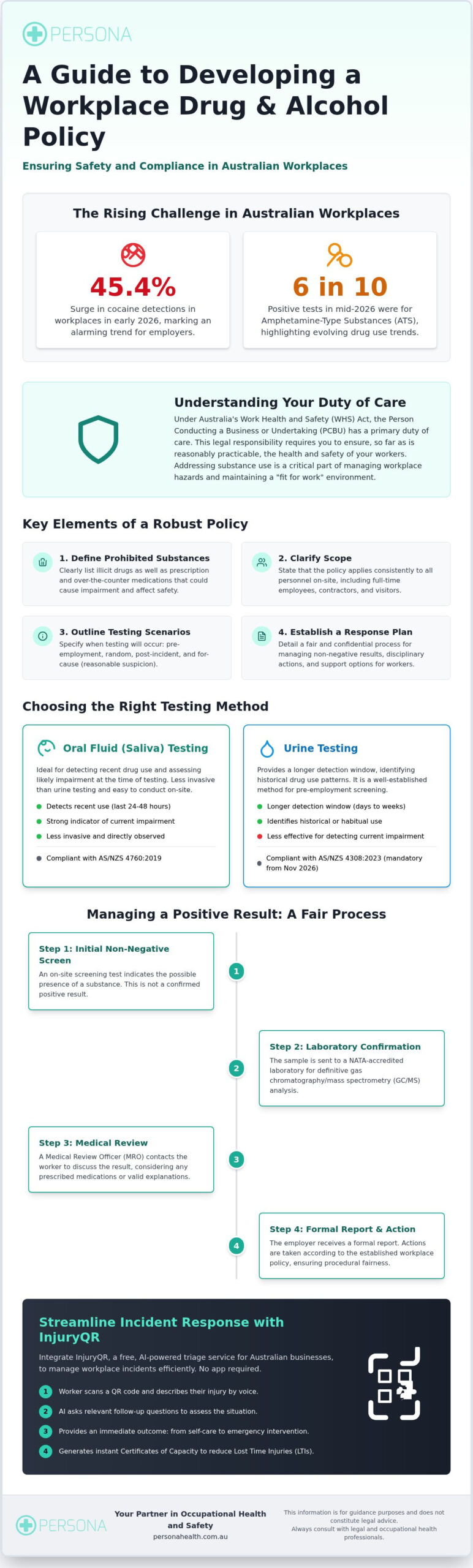
A comprehensive workplace drug and alcohol policy australia acts as the blueprint for safety within your organisation. It clarifies expectations and provides a structured response to potential impairment. To remain effective under Australian WHS laws, your policy must define what constitutes a prohibited substance clearly. This includes not only illicit drugs but also prescription and over-the-counter medications that may impair a worker’s ability to perform their duties safely. With Amphetamine-Type Substances (ATS) accounting for approximately 6 in every 10 positive tests in mid-2026, your policy must be broad enough to address these evolving trends.
The scope should be universal, applying to all employees, contractors, and visitors. Consistency is vital to avoiding claims of discrimination or unfair treatment. Your framework should outline when testing occurs, typically involving:
- Pre-employment screening: Identifying potential risks before a worker joins the team. Understanding what happens in a pre-employment medical can help you explain this process to candidates clearly.
- Random testing: Acting as a visible deterrent to maintain a safe environment across all sites.
- For-cause and post-incident: Essential for investigating specific concerns or following a workplace accident to determine if impairment played a role.
A clear disciplinary framework is equally important. It should detail the steps taken following a “not-negative” result, ensuring procedural fairness while maintaining the safety of the site. This structure protects the business from liability and ensures that every individual is treated with the same level of professional scrutiny.
Defining “Under the Influence” and Alcohol Limits
Your policy must specify Blood Alcohol Concentration (BAC) limits tailored to the risk level of each role. While a 0.00 limit is standard for safety-critical tasks in rail, transport, or mining, other roles might have different thresholds. Managing prescription risks is increasingly complex, especially with the prevalence of medicinal cannabis. The focus should remain on “fitness for work” rather than the mere presence of a substance. If a worker takes medication that causes drowsiness or delayed reactions, they have a duty to disclose this to ensure their tasks are adjusted safely to prevent harm.
Support and Rehabilitation Pathways
A modern safety approach prioritises the individual’s wellbeing alongside operational security. Integrating Employee Assistance Programmes (EAPs) into your policy encourages workers to seek help before an incident occurs. Establishing a clear pathway for self-reporting allows for a supportive recovery process rather than an immediate disciplinary outcome. This empathetic stance builds trust, making workers more likely to engage with the policy honestly. If you’re unsure if your current documentation meets these supportive standards, our team can help you align your health and wellbeing strategies with your broader safety goals.
Choosing the Right Testing Methods for Your Workplace
Selecting the appropriate testing method is a critical decision for any workplace drug and alcohol policy australia. It is not just about finding a result; it’s about using a method that is scientifically sound and legally robust. While “instant” DIY kits might seem convenient, they often lack the rigorous quality control and chain of custody required to withstand legal scrutiny. Professional clinical collection ensures that every sample is handled according to the strictest Australian Standards, providing peace of mind for both the employer and the worker. Understanding Your Duty of Care under Australian WHS Laws involves selecting the most effective tool for your specific risk environment.
Urine Analysis: The Gold Standard for Pre-Employment
Urine testing, governed by the updated AS/NZS 4308:2023 standard, remains the preferred method for assessing a candidate’s historical substance use. Because it offers a wider detection window, often several days for amphetamines and potentially weeks for chronic cannabis use, it provides a comprehensive view of a person’s recent history. This makes it an essential component of Persona Health Pre-Employment Medicals. To remain legally defensible, the collection must follow a strict chain of custody. This ensures the sample cannot be tampered with or misidentified, which is vital if a result is ever challenged in a tribunal. Employers should note that all workplace urine programs must comply with the 2023 standard by November 2026.
Saliva Testing: Detecting Recent Consumption
Oral fluid testing, under the AS/NZS 4760:2019 standard, is specifically designed to detect very recent drug use. It focuses on the presence of the parent drug rather than metabolites, making it a more accurate indicator of potential impairment at the time of the test. This method is highly effective for random on-site assessments or post-incident investigations where the primary concern is immediate fitness for duty. Saliva collection is non-invasive and can be performed under direct observation, which significantly reduces the risk of sample adulteration. While it has a shorter detection window compared to urine, its accuracy in identifying recent consumption of substances like THC and methamphetamines is invaluable for maintaining site safety. Using a professional service ensures that these tests are conducted with clinical precision, avoiding the pitfalls of unverified testing devices.
By choosing between these methods based on your specific safety goals, you create a more targeted and effective screening program. Whether you’re conducting a final check on a new hire or performing a random sweep of a mobile team, the right method ensures your policy is both fair and functional.
Managing Incidents and Policy Breaches
When a breach occurs, the immediate priority is safety, followed closely by procedural fairness. A “not-negative” result or a suspected impairment incident can be a high-stress moment for any manager. Your workplace drug and alcohol policy australia must outline a step-by-step response that is applied consistently across the entire workforce. This consistency is your best defence against claims of discrimination or unfair dismissal. Every action, from the initial removal of the worker from safety-critical duties to the final “fitness for duty” assessment by an occupational physician, must be documented with clinical precision to ensure the integrity of the process.
Immediate Post-Incident Response
Following a safety incident where substance use is suspected, immediate medical triage is vital. This is where InjuryQR becomes an essential tool for Australian businesses. It is a free, AI-powered triage service that requires no app installation. A worker simply scans a QR code and describes the incident or injury by voice. The AI then asks follow-up questions to determine the best course of action, whether it is telehealth, self-care, or emergency intervention. By providing immediate guidance, InjuryQR helps reduce Lost Time Injuries (LTIs) and can generate immediate Certificates of Capacity, ensuring the return-to-work process begins on the right foot with accurate medical data.
Disciplinary Action vs. Health Support
Deciding whether a breach warrants termination or a performance improvement plan is a complex legal and ethical challenge. In Australia, “fair” dismissal requires you to consider the circumstances of the breach and the worker’s history. Consulting with an Injury Management Consultant can provide the professional perspective needed to balance safety requirements with worker support. They help determine if the individual can be safely reintegrated into the workplace or if a different path is necessary. This balanced approach protects the business from liability while showing a genuine commitment to the wellbeing of your team. It is about finding a resolution that respects the individual’s needs without compromising the safety of the collective.
If you are currently navigating a complex incident or need to update your breach protocols, our team can provide expert workplace injury management and policy advice to ensure your business remains compliant and your people stay safe.
Professional Drug and Alcohol Services with Persona Health
Persona Health is more than just a testing provider; we are a dedicated partner in your safety journey. Our comprehensive solutions are designed to fit the unique rhythm of your business, providing the clinical authority required to support a robust workplace drug and alcohol policy australia. With clinics in Parramatta, Rosebery, Gregory Hills, and Dee Why in Sydney, plus Cairnlea and Craigieburn in Melbourne, we provide a high-quality, local presence. For organisations with teams spread across the country, our extensive network of 100 affiliate clinics and Australia-wide mobile services ensures consistency and compliance at every site.
We understand that time is a critical resource, which is why we focus on fast turnaround times to keep your recruitment moving. Our expertise extends to specialised requirements such as Category 3 Rail Medicals and transport sector assessments. This employer-focused approach ensures that your safety protocols are not just compliant but also practical and efficient.
On-Site Health Surveillance and Mobile Testing
Bringing clinical services to your doorstep is the most effective way to manage workforce health while minimising operational downtime. Our mobile testing units provide professional collection services directly at your worksite, which is ideal for large teams or remote projects. For businesses operating in Parramatta and Rosebery, our On-Site Health Surveillance services offer a streamlined way to monitor worker wellbeing. This proactive approach allows you to identify potential health risks early, maintaining a safer environment for everyone without the logistical burden of staff travel.
Partnering for Workforce Compliance
Developing a workplace drug and alcohol policy australia that is both legally defensible and empathetic requires expert guidance. Persona Health assists employers in drafting and implementing policies that align with current Australian Standards and WHS legislation. You can access our specialised occupational physicians for independent medical exams or complex fitness-for-duty consultations. If you need to discuss your specific compliance needs, our teams at the Cairnlea and Craigieburn locations are ready to help. We position ourselves as your modern professional partner, providing the stability and expert leadership needed to foster a resilient, healthy workforce.
Securing a Compliant and Safe Future for Your Workforce
Maintaining a safe environment requires more than just a static document; it demands a living strategy that evolves alongside your business needs. By aligning your workplace drug and alcohol policy australia with the latest Australian Standards and WHS legislation, you fulfill your primary duty of care while fostering a culture of trust and accountability. Whether you are managing the transition to the AS/NZS 4308:2023 urine testing standard or implementing random saliva screening for safety-critical tasks, professional clinical support ensures your processes remain legally defensible and scientifically sound.
Persona Health is here to guide you through these complexities with a professional, employer-focused approach. We pride ourselves on fast turnaround times for results and a vast national reach through our network of over 100 affiliate clinics. As specialists in high-stakes Rail and Transport medicals, we provide the stability and expert leadership your organisation needs to stay compliant and secure. Contact Persona Health for Professional Drug and Alcohol Testing today to discuss how we can support your specific occupational health requirements. We look forward to partnering with you to protect your workforce and your business.
Frequently Asked Questions
Is a drug and alcohol policy mandatory for Australian businesses?
While not explicitly mandated by name for every small business, a formal policy is essentially required to meet your primary duty of care under Australian WHS laws. SafeWork Australia emphasises that PCBUs must manage the risks of impairment to ensure a safe work environment. Without a written workplace drug and alcohol policy australia, you lack the legal framework to enforce safety standards or conduct testing, leaving your business vulnerable to liability and safety incidents.
Can an employer legally perform random drug testing in Australia?
Employers can legally perform random drug testing if it is deemed a “reasonable” management action, particularly in safety-critical industries like mining, rail, or construction. To be defensible, the testing must be clearly outlined in your policy and developed in consultation with your workers. It’s vital to follow the relevant Australian Standards for collection to avoid legal challenges or claims of unfair treatment under the Fair Work Act 2009.
What is the difference between AS/NZS 4308 and AS 4760?
The primary difference lies in the specimen type and the detection window. AS/NZS 4308:2023 governs the collection and quantification of drugs in urine, which is excellent for identifying historical use over several days. In contrast, AS/NZS 4760:2019 focuses on oral fluid testing, which detects recent consumption and is a better indicator of potential impairment at the time of the test. Each standard serves a distinct purpose in a comprehensive safety program.
How should an employer handle a positive drug test result?
You must follow the specific steps detailed in your workplace drug and alcohol policy australia to ensure procedural fairness. An initial “not-negative” result from an on-site screen should always be verified by an accredited laboratory before any disciplinary action is taken. It’s often beneficial to involve an Injury Management Consultant to determine if the worker requires health support or if the breach warrants a formal performance improvement plan or termination.
Do pre-employment drug tests show prescription medications?
Yes, standard screens can detect various prescription and over-the-counter medications that fall within the testing panels. Candidates are encouraged to disclose any legitimate medications to the medical professional during the assessment. If a substance is detected, the candidate may be asked to provide a letter from their prescribing doctor. This allows our occupational physicians to assess whether the medication impacts their fitness for work in a specific role or environment.
What are the BAC limits for rail and transport workers in NSW and Victoria?
For rail workers in NSW and Victoria, the standard Blood Alcohol Concentration (BAC) limit is 0.00 while on duty. This strict threshold is mandated under the Rail Safety National Law to ensure public and worker safety. In the broader transport sector, limits can vary between 0.00 and 0.02 depending on the vehicle type and state-specific regulations. It is essential that your policy reflects these legal requirements for your specific industry.
How does InjuryQR help after a workplace accident involving drugs or alcohol?
InjuryQR provides immediate, AI-powered triage following a safety incident, which is critical if substance use is a suspected factor. Workers scan a QR code and describe their injury by voice, allowing the AI to guide them toward the appropriate level of care. This rapid response helps reduce Lost Time Injuries (LTIs) and provides immediate documentation for the employer. It ensures that medical intervention begins immediately, even before formal drug testing results are finalised.
Where can I find drug and alcohol testing services in Sydney and Melbourne?
Persona Health offers professional testing services at our clinics in Parramatta, Rosebery, Gregory Hills, and Dee Why in Sydney. In Melbourne, you can visit our sites in Cairnlea and Craigieburn. We also provide mobile on-site testing for large workforces and have access to over 100 affiliate clinics across Australia. Our clinics specialise in employer-focused solutions, including Category 3 Rail Medicals and comprehensive injury management, ensuring your business stays compliant and your team stays safe.

Article by
Ian Nicholson
Ian is the Business Support Manager at Persona Health, where he plays a key role across IT, sales, marketing and business operations. With a broad skill set and a practical, solutions-focused approach, Ian helps drive the systems, communication and commercial strategy that support Persona Health’s continued growth across Australia.