

Why do so many Australian businesses struggle with vague medical certificates that offer no clear path for a return to work? While your local family GP is an expert in general health, they often lack the specific workplace context required to navigate the complexities of modern WHS legislation. It’s frustrating when a valued team member is sidelined and you’re left with more questions than answers about their actual capacity or specific restrictions.
You want what’s best for your employee’s recovery, but you also need to maintain productivity and meet your legal obligations under SafeWork NSW or WorkSafe Victoria. Understanding the distinction between an occupational physician vs gp is the first step toward reducing lost time injuries and ensuring your business remains compliant with the latest Australian Standards. Choosing the wrong clinical pathway can lead to delayed recovery and the high costs of lost productivity.
In this guide, we’ll explore how specialised medical expertise leads to faster return-to-work outcomes and legally defensible reports that protect both your workers and your bottom line. We will also look at how modern tools like InjuryQR are transforming the way businesses manage initial injury triage to ensure your workforce receives the right care from the very beginning.
Key Takeaways
- Understand the fundamental training differences in the occupational physician vs gp debate and why specialist fellowship qualifications matter for complex workplace cases.
- Learn how an Occupational Physician balances the health needs of the individual with the specific physical demands of their role to ensure safe, sustainable placements.
- Discover why the “recovery at work” philosophy used by specialists typically results in faster return-to-work timeframes than traditional rest-based approaches.
- Identify which scenarios require a specialist for statutory health surveillance, such as crystalline silica or rail medicals, to maintain strict legislative compliance.
- Explore how AI-powered triage through InjuryQR can provide immediate support and reduce the administrative burden of workplace injury reporting.
Understanding the Roles: What is an Occupational Physician?
An Occupational Physician is a specialist medical practitioner who has dedicated their career to understanding the intricate link between a person’s health and their work. While both OPs and GPs hold medical degrees, the distinction in the occupational physician vs gp debate comes down to the focus of their postgraduate expertise. An OP specialises in Occupational medicine, a field that examines how the workplace environment affects a worker and, conversely, how a worker’s health status impacts their ability to perform specific tasks safely.
In Australia, this expertise is formalised through the Fellowship of the Australasian Faculty of Occupational and Environmental Medicine (FACOEM). This qualification requires years of rigorous training beyond standard medical school. It ensures the physician is well-versed in WHS legislation, Australian Standards, and the specific physical demands of various industries. They act as a bridge between clinical medicine and the practical realities of the job site, ensuring that medical advice is always grounded in the context of the employee’s actual role.
To better understand the foundational role of general practice in our healthcare system, watch this helpful video:
The Specialist Training of an Occupational Physician
The path to becoming an OP involves intensive study in fields that are often only briefly touched upon in general practice. This includes toxicology to manage chemical exposures, ergonomics to prevent musculoskeletal injuries, and advanced rehabilitation techniques. OPs are trained to look beyond the immediate symptoms to find the root cause of a workplace issue. This specialised knowledge is essential for complex assessments, such as fitness for duty medicals, where a clear understanding of job-specific risks is mandatory for safety and compliance. They don’t just treat the injury; they analyse the mechanical and environmental forces of the job that contributed to it.
The General Practitioner: Australia’s Family Health Anchor
GPs are the primary point of contact for most Australians, providing vital care for a wide range of personal health concerns. They excel at holistic care, managing a patient’s wellbeing across their entire life. However, because their scope is so broad, they often lack the time or specific training to understand the nuances of a particular industrial role. A GP might see a worker for ten minutes in a suburban clinic, whereas an OP understands the vibration, noise, and physical strain that worker faces on a daily basis. This difference in context is why a GP might recommend total rest, while an OP can identify specific duties that allow for a safe, early return to work.
Clinical Focus: Why Specialisation Matters in the Workplace
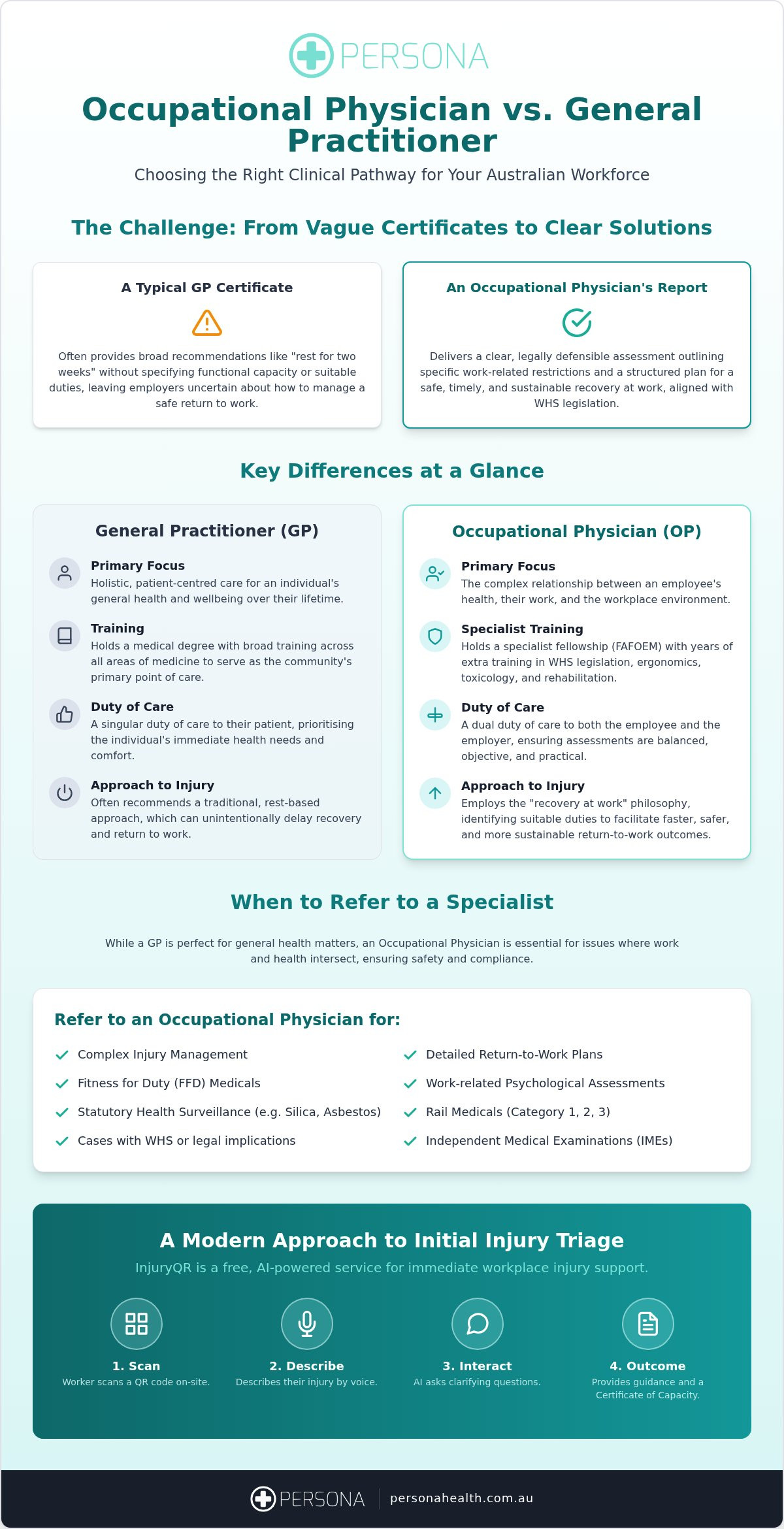
The primary clinical distinction between an occupational physician vs gp lies in the nature of the doctor-patient relationship. A family GP operates under a singular duty of care to the individual sitting in their consulting room. Their priority is the patient’s immediate comfort and long-term holistic health. While this is essential for general wellbeing, it can lead to a lack of objectivity when assessing work-related capacity. A family GP’s role in return to work is often patient-centric, whereas an Occupational Physician (OP) maintains a dual responsibility to both the worker and the employer. This ensures that medical assessments are practical, safe, and legally defensible.
This dual focus allows for a level of clinical objectivity that is often missing in general practice. By understanding the employer’s operational requirements and the worker’s physical limitations, an OP provides a balanced perspective that protects the business from risk while supporting the worker’s recovery. If you are looking for a more employer-focused approach to workforce health, our team can help bridge this gap. We ensure that medical outcomes align with the actual physical requirements of the job.
Assessing Fitness for Duty
Evaluating whether an employee is physically and mentally capable of performing their role is a complex task. Standard fitness for duty medicals conducted by a specialist involve a deep dive into specific job demands. For instance, an OP won’t just ask if a worker can lift; they will evaluate if the worker can safely lift 20kg repeatedly while working on an uneven surface in a high-risk construction environment. In industries like rail, where safety-critical decisions are made every minute, this level of scrutiny is vital for maintaining compliance with Transport for NSW or Comcare standards.
Health Surveillance and Hazardous Substances
General Practitioners are highly skilled at diagnosing common ailments, but they may miss the subtle, early indicators of occupational diseases. Conditions like silicosis or lead poisoning often present with vague symptoms that can be easily overlooked in a standard ten-minute consultation. OPs are trained to interpret complex Australian Standards for health monitoring, ensuring that crystalline silica medicals and other statutory checks are performed accurately. This specialised oversight ensures your business meets the strict requirements set by SafeWork NSW and WorkSafe Victoria, preventing long-term health issues and costly legal complications before they arise.
Key Differences: Occupational Physician vs GP in Injury Management
The core of the occupational physician vs gp debate often centres on a fundamental shift in philosophy: recovery at work versus recovery at home. Traditional general practice often defaults to recommending total rest for an injured worker. While well-intentioned, this approach can lead to “disability syndrome” where a worker loses confidence and their connection to the workplace. An Occupational Physician (OP) operates on the evidence-based principle that safe, modified work is actually a form of therapy. By keeping an employee engaged in the workplace, we see significantly better long-term health outcomes and a faster return to full duties.
Communication is where the OP truly shines as a professional partner. A GP rarely has the time or the specific industrial knowledge to call a WHS manager and discuss light duties. Conversely, OPs are trained to speak the language of both medicine and business. They provide clear, actionable advice that helps employers understand exactly what a worker can and cannot do. Choosing between an occupational physician vs gp for injury management is about more than just medical care; it’s about managing the entire ecosystem of the workers compensation claim to ensure stability for both the business and the individual.
Certificates of Capacity and WorkCover Compliance
Many employers feel the sting of “unfit for work” certificates that arrive with little explanation. This usually happens because the GP isn’t familiar with your specific worksite or the availability of modified duties. An OP takes a different path. We work within the legal frameworks of SafeWork NSW and WorkSafe Victoria to identify “suitable duties” that allow the worker to contribute while they heal. This proactive approach ensures your business remains compliant with relevant WHS legislation, keeping your premiums manageable and your team productive. It turns a static medical report into a dynamic roadmap for recovery.
Independent Medical Examinations (IME)
In cases where a claim becomes complex or recovery stalls, a standard GP report might not provide the clarity needed for a resolution. This is when engaging Independent Medical Examiners becomes critical. An OP acting as an IME provides an objective, third-party assessment of the injury, its relationship to work, and the worker’s future capacity. Their reports carry significant legal weight in Australian tribunals and courts because of their specialist status. For particularly disputed cases, involving an Injury Management Consultant can help resolve disagreements between the treating doctor, the employer, and the insurer, ensuring the focus remains on a safe and sustainable return to work.
When to Refer: Choosing Between a GP and an Occupational Specialist
Deciding between an occupational physician vs gp often depends on the risk profile of the role and the complexity of the medical situation. A standard GP is often perfectly suitable for basic health screenings for low-risk office roles where the physical demands are minimal. However, as the environmental risks increase, so does the need for specialist oversight. When your business deals with statutory health surveillance for substances like asbestos or lead, an Occupational Physician (OP) is essential. They understand the specific legislative triggers and biological monitoring requirements that a generalist might overlook, ensuring your business stays on the right side of SafeWork NSW or WorkSafe Victoria regulations.
Complexity also dictates the need for a specialist referral. If a worker is not progressing through their return-to-work plan as expected, or if there is a significant gap between their reported symptoms and clinical findings, an OP can provide the necessary clarity. In high-consequence industries, the choice is often made for you by legislation. Roles requiring Cat 3 Rail Medicals must be handled by practitioners who understand the National Standard for Health Assessment of Rail Safety Workers. Relying on a GP for these safety-critical assessments can lead to non-compliance and increased operational risk.
Pre-Employment Medicals: GP or Specialist?
While a GP can conduct a general physical, they often lack the context of your specific job descriptions. This can result in medical reports that are too broad or, conversely, contain private medical information that isn’t relevant to the role. By choosing specialised pre-employment medicals, you ensure the assessment is focused strictly on the inherent requirements of the job. This approach also helps your business remain compliant with the Privacy Act 1988. An OP knows how to provide a clear “fit” or “unfit” recommendation without disclosing sensitive, unrelated health history that a GP might inadvertently include.
The Role of Technology in Triage
In the critical moments following a workplace injury, the delay of a GP waiting room can be costly. This is where InjuryQR offers a modern, efficient alternative. It is a free, AI-powered triage service that requires no app installation. Workers simply scan a QR code and describe their injury by voice. The system then uses AI-driven follow-up questions to determine the best course of action, whether it is self-care, telehealth, or emergency intervention. This immediate response leads to faster Certificates of Capacity and a significant reduction in Lost Time Injuries (LTIs) by ensuring the worker enters the right care pathway from the very first minute.
If you need to ensure your high-risk roles are assessed with the highest level of clinical and legislative accuracy, contact our team to discuss our specialist medical services.
How Persona Health Supports Your Australian Workforce
Persona Health understands that the occupational physician vs gp decision is often driven by a need for efficiency and clinical clarity. We provide an employer-focused approach that prioritises both the health of your team and the operational requirements of your business. Our clinicians are experts in navigating the complexities of the Australian regulatory landscape, ensuring that every medical assessment is accurate, timely, and fully compliant with current WHS legislation. We act as a professional bridge, translating complex medical findings into actionable workplace advice.
Our commitment to fast turnaround times ensures that you aren’t left waiting for critical health data. We recognise that in the context of an occupational physician vs gp, the speed of communication can be the difference between a successful return to work and a prolonged, costly claim. By focusing on the specific inherent requirements of each role, we help you build a resilient workforce while meeting your obligations under SafeWork NSW, WorkSafe Victoria, and Comcare.
Strategic Clinic Locations and National Reach
We have established a strong presence in Australia’s major industrial hubs to ensure your workers have access to high-quality care when and where they need it. Our Sydney clinics are conveniently located to serve local businesses in:
- Parramatta
- Rosebery
- Gregory Hills
- Dee Why
For businesses operating in Victoria, our Melbourne clinics in Cairnlea and Craigieburn provide the same level of specialist expertise. Beyond our primary locations, we maintain an extensive network of 100 affiliate clinics across Australia. This is complemented by our Australia-wide mobile services, allowing us to bring essential health testing directly to your job site, no matter how remote your operations might be.
A Partnership for Better Health Outcomes
We don’t just provide medical reports; we build lasting partnerships with HR and safety teams to proactively identify and mitigate workplace risks. By understanding your specific industry challenges, we tailor our services to meet your unique needs. This includes the integration of on-site health surveillance, which minimises downtime by conducting assessments like hearing tests or lung function monitoring at your facility. This approach keeps your workers safe while keeping your operations running smoothly.
Whether you require a single pre-employment check or a comprehensive national health program, our team is ready to provide a tailored quote that aligns with your business goals and safety obligations. We focus on the individual’s unique health journey while never losing sight of the bigger picture of workforce stability and legislative compliance. Our goal is to ensure your workers are in expert hands, receiving care that is as unique as the roles they perform.
Securing a Safer Future for Your Australian Workforce
Choosing the right clinical pathway is more than a matter of convenience; it’s a strategic decision that impacts the safety of your people and the compliance of your business. While general practitioners provide essential community care, the occupational physician vs gp distinction highlights the necessity of specialist expertise in the workplace. By prioritising a “recovery at work” philosophy and maintaining a deep understanding of Australian Standards, you ensure that every medical assessment is both practical and legally defensible.
Our clinics in Parramatta, Rosebery, and Craigieburn are ready to support your business with fast turnaround times on all medical reports. With the inclusion of our free InjuryQR AI-powered triage service, you can provide immediate care to your team while significantly reducing lost time injuries. We invite you to speak with the Persona Health team regarding your occupational health requirements today to discover how a tailored partnership can enhance your workforce health. Your employees deserve care as unique as the roles they perform, and we’re here to guide you through every step of the process.
Frequently Asked Questions
What is the main difference between an occupational physician and a GP?
The fundamental difference in the occupational physician vs gp comparison lies in the physician’s dual responsibility to both the employer and the employee. While a GP prioritises the individual’s general health, an Occupational Physician focuses on the specific relationship between health and work. This specialist training ensures that medical assessments are directly aligned with the physical demands of the role, providing a more objective perspective for complex workplace health decisions.
Do I need an occupational physician for every workplace injury?
No, not every injury requires a specialist. For minor incidents, a GP provides excellent initial care. However, for complex cases or safety-critical roles, early specialist involvement is crucial. To help you decide, Persona Health provides InjuryQR, a free, AI-powered triage service requiring no app installation. Workers scan a QR code and describe their injury by voice, allowing for immediate, accurate direction to the most appropriate level of care.
Why do occupational physicians understand workplace risks better than GPs?
Occupational Physicians possess deep expertise in industrial hazards such as toxicology and ergonomics. Unlike GPs, who treat a broad range of general conditions, these specialists are trained to evaluate the long-term effects of workplace exposures. This knowledge allows them to identify subtle signs of occupational illness early, ensuring your business remains compliant with the latest WHS legislation and Australian Standards for health monitoring.
Can an occupational physician override a GP’s certificate of capacity?
While an Occupational Physician does not technically override a GP, their specialist opinion carries significant weight in disputed cases. If a GP’s certificate lacks clarity or doesn’t reflect the worker’s actual capacity for modified duties, an employer can request an Independent Medical Examination. These specialist reports are often preferred by insurers and regulators because they provide a more detailed analysis of the worker’s capacity within a specific industrial context.
How much does it cost to see an occupational physician in Australia?
The cost varies depending on the type of assessment required, such as a fitness for duty medical or a more comprehensive health surveillance check. Unlike standard GP visits, these services are typically not covered by Medicare and are instead funded by the employer or insurer. Persona Health provides transparent, tailored quotes based on your industry requirements and workforce size, ensuring you receive high-quality specialist care without hidden expenses.
What industries specifically require an occupational physician for medicals?
Industries involving high-risk activities or hazardous substances specifically require specialist medicals. This includes the rail industry for Cat 3 Rail Medicals, as well as sectors dealing with lead, asbestos, or crystalline silica. In these fields, general GP assessments often fall short of the strict statutory requirements set by SafeWork NSW or WorkSafe Victoria. Specialist oversight is mandatory to ensure both worker safety and full legislative compliance.
Is an occupational physician report legally binding for WorkCover?
An Occupational Physician’s report is not a legal verdict, but it serves as highly authoritative evidence in WorkCover and tribunal proceedings. Because these specialists are trained in the legal frameworks of the Australian compensation system, their reports are more robust and defensible than a standard GP’s notes. They provide the clinical clarity needed to resolve disputes regarding injury causation, work capacity, and the suitability of modified duties.
How quickly can I get an appointment with an occupational physician at Persona Health?
Persona Health prioritises fast turnaround times to keep your workforce moving. You can access appointments through our clinics in Parramatta, Rosebery, and Gregory Hills in Sydney, or Cairnlea and Craigieburn in Melbourne. We also maintain a network of 100 affiliate clinics across Australia. For immediate assistance, InjuryQR provides instant triage, helping to reduce lost time injuries by ensuring your team member enters the correct care pathway without delay.

Article by
Ian Nicholson
Ian is the Business Support Manager at Persona Health, where he plays a key role across IT, sales, marketing and business operations. With a broad skill set and a practical, solutions-focused approach, Ian helps drive the systems, communication and commercial strategy that support Persona Health’s continued growth across Australia.