

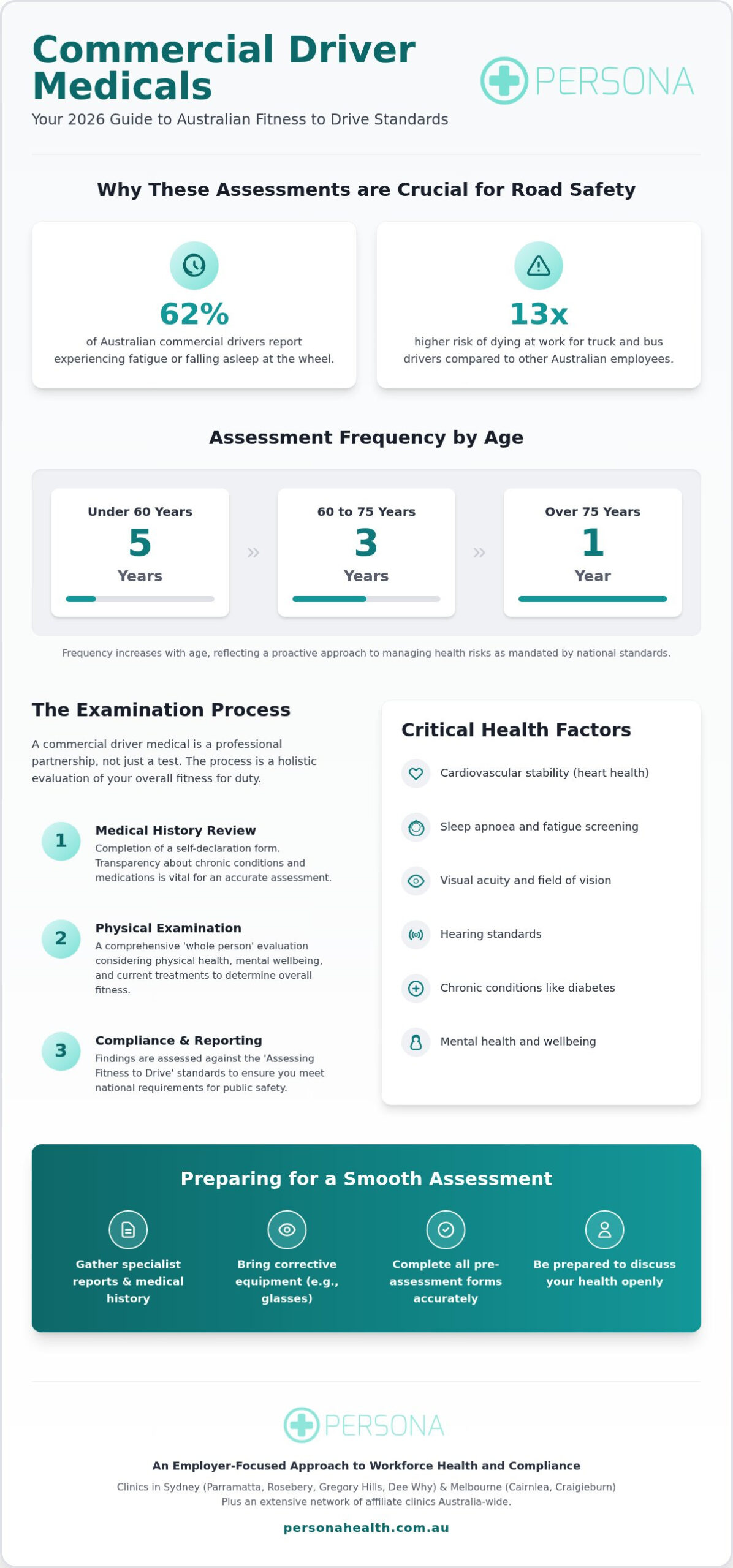
Did you know that 62% of Australian commercial drivers report experiencing fatigue or falling asleep at the wheel on a regular basis? This startling figure highlights why the commercial driver medical assessment remains such a vital safeguard for our roads. We know that for many bus drivers, the looming date of a medical check can bring a heavy sense of anxiety. It’s completely natural to feel concerned about how a health condition might affect your livelihood or to feel overwhelmed by the complex standards set by the National Transport Commission.
This guide is here to replace that uncertainty with professional clarity, helping you master the 2026 requirements of the Australian commercial driver medical assessment. You’ll learn exactly what to expect during the process, from the latest Austroads Assessing Fitness to Drive standards to the updated Transport for NSW assessment forms. Whether you’re visiting our clinics in Parramatta or Cairnlea, or using our national affiliate network, understanding these health requirements ensures a successful licence renewal with minimal downtime.
Key Takeaways
- Understand how the latest 2026 Austroads standards and updated Transport for NSW forms affect your specific licence requirements and assessment frequency.
- Learn exactly how to prepare for your commercial driver medical assessment by gathering specialist reports and ensuring your corrective equipment is in good working order to avoid delays.
- Identify the critical health areas, such as cardiovascular stability and sleep apnoea screening, that clinicians prioritise during the physical examination to ensure public safety.
- Discover how an occupational health approach helps both drivers and employers minimise downtime through streamlined bookings and faster turnaround times at our Sydney and Melbourne clinics.
- Gain insights into proactive health management strategies that protect your livelihood and ensure long-term compliance with national transport regulations.
Understanding the Bus Driver Medical Assessment Standards in 2026
A commercial driver medical assessment is a rigorous clinical evaluation designed to ensure that heavy vehicle operators meet the national health requirements for public safety. In Australia, these assessments are governed by the “Assessing Fitness to Drive” (AFTD) standards, a joint initiative by Austroads and the National Transport Commission (NTC). These guidelines provide a consistent framework that medical practitioners use to determine if a driver’s health could pose a risk to themselves or the community. As of 2026, the transport industry is operating under the 2022 edition of these standards, though the NTC is currently conducting a comprehensive review scheduled to run through 2028. The initial public consultation for this review closed on 17 July 2026, signalling future updates to how we manage driver health.
State regulators, such as Transport for NSW and VicRoads, use these clinical findings to make informed decisions about your licensing. In 2026, Transport for NSW introduced technical enhancements to their fitness to drive medical assessment forms. These updates aim to speed up processing times and reduce administrative errors, ensuring that your results reach the authority without unnecessary delay. Adhering to these Commercial driver’s license standards is essential, as the medical requirements for heavy vehicles are significantly more stringent than those for a standard private vehicle licence.
The Impact of the 2026 Heavy Vehicle National Law (HVNL) Reform
The 2026 reforms to the Heavy Vehicle National Law have placed a renewed focus on stricter health monitoring and reporting. This legislative shift is a response to the inherent dangers of the transport industry. Recent data reveals that truck and bus drivers face a 13-fold higher risk of dying at work compared to other Australian employees. Between 2013 and 2023, 430 truck drivers lost their lives in work related incidents, with the vast majority involving vehicle crashes. The HVNL reform aims to lower these statistics by mandating regular assessment intervals. For most operators under 60, a commercial driver medical assessment is required every five years. This frequency increases to every three years for those aged 60 to 75, and becomes an annual requirement once a driver reaches 75.
Commercial vs Private Standards: Key Differences
The distinction between private and commercial health standards is based on the risk profile of the vehicle and its passengers. While a private driver is responsible for their own safety, a bus driver manages the lives of dozens of passengers. A standard GP visit may focus on general wellness, but it often lacks the specific occupational focus required for heavy vehicle compliance. For example, commercial drivers must meet higher thresholds for visual acuity and hearing. They are also subject to stricter criteria regarding chronic conditions like diabetes or cardiovascular disease, which could lead to sudden incapacity. At Persona Health, our clinicians focus on these specific occupational risks to ensure you remain compliant with the latest AFTD requirements while supporting your long term career in the industry.
What Happens During the Bus Driver Medical Examination?
Walking into a clinical setting for your commercial driver medical assessment can feel like a high-stakes event. We view this process as a professional partnership rather than a hurdle to clear. The examination begins with a systematic review of your medical history. You’ll be asked to complete a self-declaration form. This is your opportunity to be transparent about chronic conditions or medications. Honesty here is vital. Failing to disclose a known condition can have serious legal implications if an incident occurs later. Our clinicians use these Assessing Fitness to Drive standards to evaluate how your health profile interacts with the unique demands of operating a heavy passenger vehicle.
During the consultation, the occupational health professional looks at the “whole person” rather than just a checklist. We consider how your physical health, mental wellbeing, and current treatments work together. This holistic approach helps us determine your overall Fitness for Duty, ensuring you can perform your role safely without putting yourself or the public at risk. If any issues are identified, we work with you to find a path toward compliance, which might involve further specialist input or specific management plans.
The Physical and Physiological Assessment
The physical portion of the exam is thorough but non-invasive. We monitor your blood pressure and pulse rate to identify any cardiovascular risks that could lead to sudden incapacity behind the wheel. A urinalysis is also a standard part of the process. This isn’t a drug test; it’s a screen for glucose and protein to evaluate kidney function and check for undiagnosed diabetes. Since bus driving involves repetitive movements and occasional physical demands, we also assess your general mobility. This includes testing your joint range of motion and grip strength to ensure you can safely operate all vehicle controls and assist passengers during an emergency. If you are feeling unsure about the clinical steps, you can learn more about specialised driver medicals in Sydney and how we support your ongoing compliance.
Vision and Hearing Requirements for Commercial Licences
Vision is perhaps the most critical sense for any transport professional. The standards for a commercial licence are much higher than those for private drivers. We test your distance visual acuity both with and without corrective lenses. Peripheral awareness is also strictly evaluated. A bus driver needs a wide field of vision to monitor cyclists, pedestrians, and merging traffic in busy urban environments. If you wear glasses or contacts, please bring them to the appointment. Similarly, hearing is assessed to ensure you can detect sirens and mechanical warnings. Drivers who use hearing aids are still eligible for a licence, provided they meet the specific criteria while using their devices. The goal is to establish a clear picture of your health, ensuring you can return to the road with confidence.
Critical Health Factors: Cardiovascular, Sleep, and Mental Health
While the physical exam covers many bases, certain health factors carry a higher weight during a commercial driver medical assessment because they directly relate to the risk of sudden incapacity. Cardiovascular health is our primary concern. A heart attack or stroke behind the wheel of a bus doesn’t just endanger the driver; it puts dozens of passengers and other road users at immediate risk. Given that national studies show nearly 30% of Australian heavy vehicle drivers manage three or more chronic health conditions, monitoring heart health is a non-negotiable part of maintaining your fitness for duty.
Diabetes management also requires careful clinical attention. If you’re managing diabetes with insulin or certain oral medications, we need to ensure your blood sugar levels are stable and that you aren’t at risk of hypoglycaemic episodes while driving. In many cases, the transport authority will require a recent report from your treating specialist or endocrinologist to confirm that your condition is well-managed and meets the stringent commercial standards. We recommend having these reports ready before your appointment to keep the process moving smoothly and avoid unnecessary delays in your application.
Managing Sleep Disorders and Fatigue Compliance
Fatigue contributes to an estimated 20 to 30% of fatal road accidents in Australia. During your assessment, we use tools like the Epworth Sleepiness Scale to gauge your daytime sleepiness levels. This screening is essential for identifying conditions like Obstructive Sleep Apnoea (OSA). If you have a diagnosed sleep disorder, you’ll typically need to provide data from your CPAP machine or a report from a sleep specialist. Our goal is to integrate these health findings with your workplace fatigue management plan, ensuring you’re getting the restorative rest needed for long shifts on the road.
Neurological and Psychological Wellbeing
Neurological conditions, particularly epilepsy or a history of seizures, are subject to very specific safety criteria. Even a single seizure can result in a temporary suspension of your commercial licence until a specialist can confirm the risk of recurrence is low. We also look closely at mental health. The isolation and high pressure of bus driving can take a toll on psychological wellbeing. We approach these conversations with empathy, focusing on how your mental health or any related medications might affect alertness and reaction times. Supporting your mental health is just as vital as checking your blood pressure, and we’re here to help you manage these factors so you can stay safe and productive in your career.
How to Prepare for Your Medical Assessment and Manage the Results
Preparation is the most effective way to reduce anxiety and ensure a fast turnaround for your licence renewal. When you arrive for your commercial driver medical assessment, being organised allows our clinicians to focus on your health rather than chasing missing paperwork. A smooth clinical experience starts days before you walk through our doors. By following a few practical steps, you can minimise the risk of being asked to return for a follow up appointment.
Your first step is gathering all current medications and relevant specialist reports. If you have a managed condition like heart disease or diabetes, our doctors need to see evidence that it’s stable. Arriving without these documents often results in a “pending” status while we wait for your treating specialist to provide a clearance letter. Secondly, ensure your corrective lenses or hearing aids are in good working order. If your glasses are scratched or your prescription is outdated, it could affect your visual acuity results. Finally, manage your lifestyle factors in the 24 hours leading up to the appointment. Avoid excessive caffeine or high salt intake, as these can temporarily spike your blood pressure, leading to a borderline result that requires further monitoring.
Essential Items and Documentation to Bring
To avoid administrative delays, please bring photo identification and your current Australian driver licence to your appointment. You also need the specific medical forms required by your state regulator. For example, drivers in New South Wales should have their Transport for NSW Fitness to Drive form ready. Having a comprehensive list of all prescription and over the counter medications is also vital. If you’re unsure about what a typical clinical session involves, you can read our guide on what happens in a medical assessment to feel more prepared.
Understanding Conditional Licences and Reviews
Once the assessment is complete, there are four possible outcomes: Fit, Unfit, Fit with Conditions, or Temporarily Unfit. Most drivers receive a “Fit” result. However, many transport professionals operate under a conditional licence. This simply means you’re safe to drive as long as certain criteria are met, such as wearing corrective lenses or attending more frequent reviews for a managed health condition. If you disagree with a clinical finding, you have the right to seek a second opinion from an occupational physician. Our goal is always to keep you on the road safely, and we’re committed to finding practical health solutions that support your career. You can find your nearest clinic through our network of over 100 affiliate locations across Australia.
Employer Solutions: Streamlining Transport Health and Safety
Managing a transport fleet involves balancing operational efficiency with a strict commitment to safety and compliance. For bus and coach operators, the commercial driver medical assessment is a foundational tool in this process. While many drivers might default to their local GP, there is a distinct advantage in partnering with an occupational health specialist. Unlike a general practitioner, our clinicians are deeply familiar with the nuances of the Heavy Vehicle National Law (HVNL) and the specific health monitoring requirements set by SafeWork Australia. This specialised knowledge ensures that every commercial driver medical assessment is conducted with a focus on workplace safety, reducing the likelihood of administrative errors that can lead to costly driver downtime.
Integrating these medical checks into a broader on-site health surveillance programme allows employers to identify health trends within their workforce before they become critical issues. By taking a proactive stance, transport companies can support their drivers in managing chronic conditions while maintaining high safety standards. This employer-focused approach not only protects the business from liability but also fosters a culture of care that values the long-term wellbeing of every operator behind the wheel.
Persona Health: Your Partner in Transport Compliance
We provide comprehensive support for national transport fleets through our network of specialised clinics and over 100 affiliate locations. Whether your team is based in Sydney, with access to our facilities in Parramatta, Rosebery, Gregory Hills, and Dee Why, or in Melbourne near Cairnlea and Craigieburn, we offer fast turnaround times that keep your business moving. Our team understands that every day a driver is off the road represents a loss in productivity. By choosing Commercial bus driver medicals in Sydney and Melbourne through Persona Health, you gain a partner dedicated to workforce health and regulatory compliance.
InjuryQR: Immediate Triage for Transport Workers
Beyond the initial medical assessment, managing workplace injuries efficiently is crucial for reducing Lost Time Injuries (LTIs). We recommend the use of InjuryQR digital triage, a free, AI-powered service designed specifically for Australian businesses. This tool requires no app installation; a worker simply scans a QR code and describes their injury by voice. The AI then guides them through follow up questions to determine the best course of action, ranging from self-care and telehealth to emergency intervention. This immediate triage provides instant Certificates of Capacity where appropriate, ensuring that your injury management process is streamlined and data-driven from the moment an incident occurs.
Secure Your Future on the Road with Professional Health Management
Staying compliant with the latest transport regulations doesn’t have to be a source of stress. By understanding the clinical criteria and arriving prepared with your specialist reports, you can navigate your commercial driver medical assessment with complete confidence. We’ve explored how heart health, sleep quality, and mental wellbeing are prioritised under the 2026 standards to keep both you and the public safe.
At Persona Health, we’re dedicated to streamlining this process. Our team offers a deep understanding of TfNSW and HVNL requirements, ensuring fast turnaround times for your results. With specialised clinics in Sydney and Melbourne, plus a national affiliate network of over 100 locations, professional support is always accessible. Book your bus driver medical assessment with Persona Health today to secure your livelihood with an expert partner. We’re here to guide you through every step of your health journey, ensuring you stay on the road safely for years to come.
Frequently Asked Questions
How often do I need a bus driver medical assessment in Australia?
Generally, drivers under the age of 60 require a commercial driver medical assessment every five years. Once you reach 60, this frequency increases to every three years, and then to an annual requirement from age 75. These intervals are mandated by the National Transport Commission to manage age-related health risks. If you manage a specific health condition, the transport authority might request more frequent reviews to ensure you remain safe behind the wheel.
What happens if I fail my bus driver medical assessment?
Receiving an “Unfit” result doesn’t always lead to a permanent loss of your licence. In many cases, you might be classified as “Temporarily Unfit” while you seek treatment or specialist clearance. You may also receive a “Fit with Conditions” result, which allows you to drive with certain restrictions, such as wearing corrective lenses. If you disagree with the outcome, seeking a review from an occupational physician is a valid next step.
Can I still drive a bus if I have diabetes or high blood pressure?
You can still drive with these conditions provided they are well-managed and meet the Assessing Fitness to Drive standards. For diabetes, you’ll often need a specialist report confirming your blood sugar is stable and that you aren’t at risk of sudden hypoglycaemia. High blood pressure must be controlled within specific limits to prevent sudden incapacity. Our team focuses on finding a safe path to compliance that supports your long-term career in transport.
Do I need a special form for a TfNSW bus driver medical?
Yes, Transport for NSW requires the specific “Fitness to Drive Medical Assessment” form to be completed by your clinician. In 2026, these forms were updated with technical enhancements to make them easier for medical practitioners to process digitally. Bringing the correct paperwork to your appointment, or ensuring your employer has provided it, helps us finalise your results quickly and reduces the time your application spends in the administrative queue.
How long does a commercial bus driver medical assessment take?
A standard commercial driver medical assessment typically takes between 30 and 45 minutes to complete. This timeframe includes the review of your medical history, the physical examination, and the vision and hearing tests. You can help speed up the process by arriving with your photo identification, a list of current medications, and any relevant specialist reports. At our clinics in Parramatta or Cairnlea, we prioritise fast turnaround times to minimise your downtime.
Is a drug and alcohol test part of the standard bus driver medical?
A standard fitness to drive medical focuses on your physiological health and does not automatically include drug and alcohol testing. However, most transport employers in Australia require these tests as a separate part of their safety and compliance protocols. We often perform drug and alcohol screening at the same time as your medical assessment to provide a comprehensive health profile for your employer, ensuring you meet all workplace safety requirements in one visit.
What is the cost of a commercial driver medical assessment in 2026?
The cost of a medical assessment in 2026 depends on several factors, including the complexity of your medical history and the specific requirements of your transport authority. Because every driver’s health profile is unique, prices can vary between clinics and locations. Some employers cover the cost as part of their health surveillance programme, while independent contractors usually pay for the assessment themselves. We recommend contacting our team directly to discuss your specific needs and receive a quote.
Can my own family GP perform the bus driver medical assessment?
While your family GP is legally allowed to perform the assessment, using an occupational health specialist offers significant advantages. General practitioners often lack the deep expertise in the Heavy Vehicle National Law and specific transport risks required for a commercial driver medical assessment. Our clinicians at Persona Health focus exclusively on workforce compliance, ensuring your results are accurate, employer-aligned, and processed with the speed required to keep you on the road and safely earning.

Article by
Ian Nicholson
Ian is the Business Support Manager at Persona Health, where he plays a key role across IT, sales, marketing and business operations. With a broad skill set and a practical, solutions-focused approach, Ian helps drive the systems, communication and commercial strategy that support Persona Health’s continued growth across Australia.