

Could a single health assessment be the only thing standing between you and your next voyage? For many Australian seafarers, the requirement for an amsa medical often feels like a high-stakes hurdle rather than a routine check-up. It’s completely natural to feel a sense of anxiety about the process. We know that for you, a Certificate of Medical Fitness represents more than just a piece of paper; it’s your ticket to continue doing what you love and providing for your family. You might even be feeling confused by conflicting information online or struggling to find an authorised medical inspector who understands the unique demands of life at sea.
This guide will demystify the entire process, providing everything you need to know about obtaining your certificate with absolute confidence. We’ll explore the specific requirements of Marine Order 76, clarify the differences between domestic and international certificates, and offer practical advice on preparing for your appointment. By the end of this article, you’ll have a clear roadmap to a successful assessment at one of our convenient clinics in Sydney or Melbourne, ensuring you remain compliant and ready for your next departure.
Key Takeaways
- Understand the legislative requirements of Marine Order 76 and how to obtain your amsa medical certificate of fitness for international or domestic duties.
- Learn what clinical tests to expect during your examination and why transparency regarding your medical history is vital for safety at sea.
- Discover the different fitness categories and how specific restrictions might impact your ability to work in certain roles on a vessel.
- Follow our comprehensive preparation checklist to ensure you arrive at your appointment with the correct documentation and in the best possible health.
- Find out how to access authorised medical inspectors through Persona Health’s extensive network of clinics in Sydney, Melbourne, and across Australia.
What is an AMSA Medical Assessment?
An amsa medical is a specialised health assessment designed to ensure that those working at sea are physically and mentally capable of performing their duties safely. Unlike standard workplace check-ups, this examination is regulated by the Australian Maritime Safety Authority (AMSA), which is the national agency responsible for maritime safety and environmental protection. For clarity, while the acronym is shared with the Australian Medical Students Association, this process is exclusively for seafarers. The primary outcome of a successful assessment is the issuance of a Certificate of Medical Fitness, often referred to as Form 303.
Working on a vessel presents unique challenges that you won’t find in land-based roles. Access to hospital-grade medical care is often days away; emergency evacuations are complex and weather-dependent. Because of this isolation, the health standards for seafarers are necessarily rigorous. We look at your vision, hearing, and physical agility to ensure you can respond to emergencies, such as fire drills or abandoning ship, without putting yourself or your crewmates at risk. It’s about protecting your wellbeing and the safety of everyone on board.
Who Needs an AMSA Medical Certificate?
If you’re working on a regulated Australian vessel or an international commercial ship, you’ll need this certificate to apply for or revalidate your STCW (Standards of Training, Certification and Watchkeeping) qualifications. It’s a mandatory requirement for deck officers, engineers, and integrated ratings. While domestic seafarers working within 200 nautical miles of the coast may use a different standard, those operating under international conventions must meet the Form 303 requirements. At Persona Health, we provide these assessments through our network, including clinics in Parramatta and Cairnlea, to help you stay compliant and ready for your next contract.
The Legal Framework: Marine Order 76
The standards for these assessments are legally mandated under Marine Order 76 (Health – medical fitness). This legislation ensures that Australia remains compliant with international maritime conventions. While bodies like SafeWork Australia provide general guidance on workplace health, Marine Order 76 is the specific authority for the maritime sector. It dictates that only an Authorised Medical Inspector (AMI) can perform these examinations for STCW certificates. This ensures that the doctor assessing you has a deep understanding of the maritime environment and the specific physical demands of your role, providing a level of assurance that standard domestic seafarer medicals may not cover.
What to Expect During Your Seafarer Medical Examination
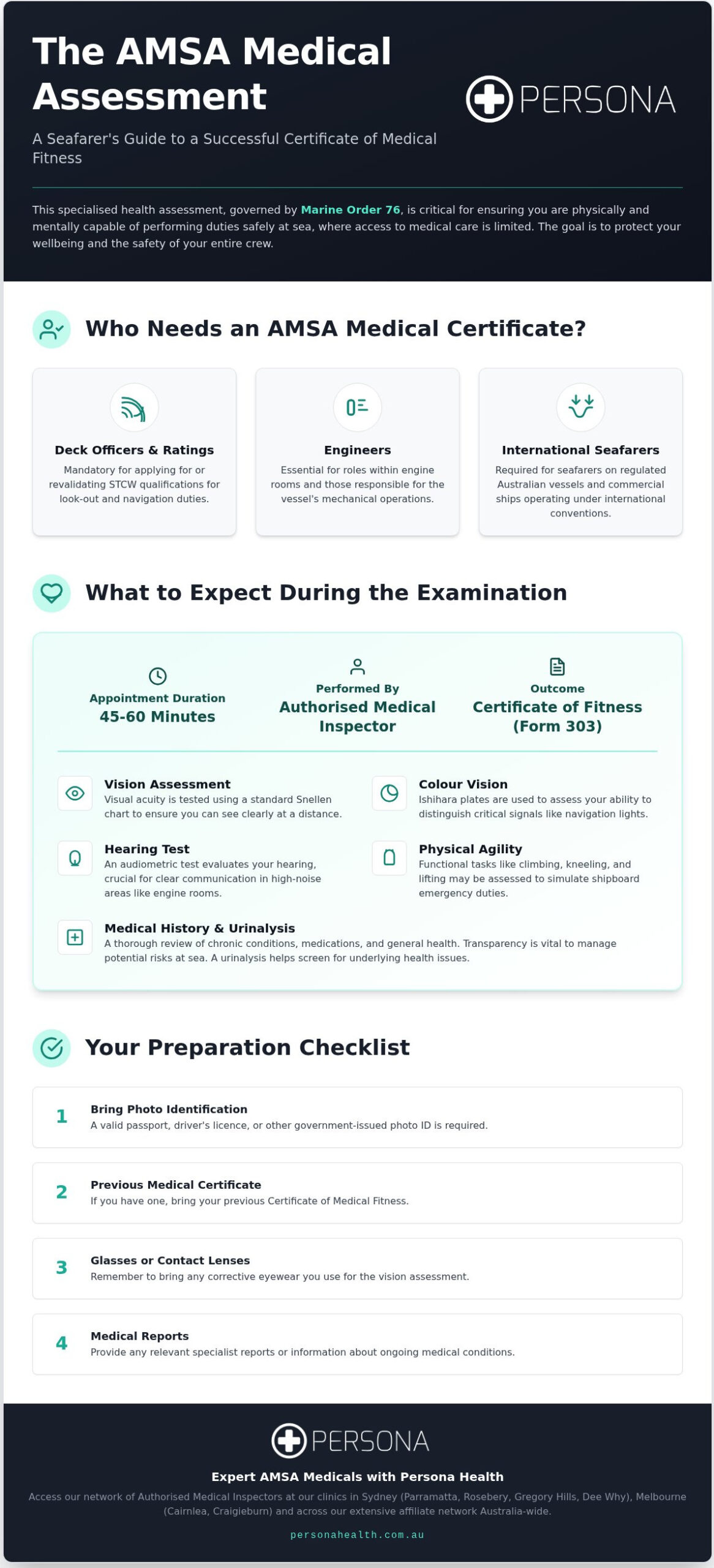
Entering a clinic for an amsa medical shouldn’t be a source of stress. The process is designed to be a thorough yet supportive check of your current health status. Typically, an appointment at a Persona Health clinic lasts between 45 and 60 minutes. During this time, our authorised medical inspectors conduct a series of non-invasive tests to ensure you can safely manage the physical rigours of maritime life. The focus is always on your ability to perform essential duties while keeping yourself and your crew safe in an environment where medical help isn’t always immediately available.
Physical and Sensory Assessments
Sensory acuity is paramount for safety on the water. Your vision is tested using a standard Snellen chart, while colour vision is assessed through Ishihara plates to ensure you can distinguish navigation lights and signals. This is a critical requirement for deck officers and those involved in look-out duties. Hearing is evaluated via an audiometric test in a quiet environment, which is particularly important for those working in high-noise areas like engine rooms where clear communication is vital. Finally, the doctor will observe your physical agility. You might be asked to demonstrate that you can climb a ladder, kneel, or lift moderate weights, simulating the functional tasks required during a shipboard emergency.
Medical History and General Health
Transparency is your greatest ally during the medical history review. We discuss chronic conditions like diabetes or cardiovascular health not to find reasons to disqualify you, but to manage potential risks at sea. For instance, certain medications that cause drowsiness or require specific storage conditions can be problematic in remote maritime environments. A standard urinalysis is also performed to check for underlying issues like glucose or protein, which can indicate undiagnosed health concerns. If you are curious about the specific clinical steps involved, you can learn more about the medical process through our detailed guides.
Being open about your health allows our team to provide the best advice for your long-term wellbeing. If you have an existing condition that is well-managed, it often won’t prevent you from working, though it may result in a restricted certificate. Our goal at clinics like Parramatta or Cairnlea is to ensure you leave with a clear understanding of your health status and a plan to maintain your fitness for duty throughout your career.
Understanding Fitness Categories and Validity
Receiving the results of your amsa medical is a pivotal moment in your maritime career. The assessment doesn’t simply result in a pass or fail. Instead, the Authorised Medical Inspector assigns a category that reflects your current health status and your ability to safely perform duties at sea. These categories are designed to protect you, ensuring that any medical conditions you have are compatible with the specific demands of your role and the vessel’s operating environment. Understanding these outcomes helps you manage your career and health more effectively.
There are three primary outcomes for a seafarer medical examination:
- Fit for duty: You meet all the required health standards without any limitations.
- Fit for restricted duty: You can perform your role, but certain conditions or limitations apply.
- Unfit: You currently do not meet the health standards required for maritime service. This can be temporary, allowing for recovery or treatment, or permanent in more serious cases.
Fit for Duty vs Restricted Duties
A restricted certificate isn’t necessarily a career-ender. Restrictions are practical measures tailored to your individual health needs. For example, a seafarer might be restricted to near-coastal waters only if they require regular access to specialist medical care. Other common restrictions include no night watch for those with specific vision issues or a requirement to wear corrective lenses while on duty. These details are clearly recorded on your Certificate of Medical Fitness (Form 303). We encourage you to discuss these outcomes openly with your employer to ensure your role aligns with your medical clearance. If you need a more general assessment of your capabilities, our fitness for duty medicals can provide additional clarity for both you and your organisation.
Age-Based Validity Rules
The validity of your amsa medical certificate depends largely on your age at the time of the examination. For most seafarers between the ages of 19 and 54, a Certificate of Medical Fitness is typically valid for 24 months. However, the maritime environment is physically demanding, and health can change more rapidly at certain life stages. Consequently, the validity is reduced to 12 months for seafarers who are under 18 or aged 55 and over. This increased frequency of monitoring ensures that any emerging health issues are identified early, allowing for proactive management and continued safety at sea. We recommend booking your renewal appointment at one of our clinics in Sydney or Melbourne at least one month before your current certificate expires to avoid any disruptions to your employment.
Preparing for Your Appointment: Seafarer Checklist
Preparation is the key to a stress-free amsa medical. Arriving at the clinic organised and physically prepared not only speeds up the process but also ensures the most accurate results. Many seafarers feel a flicker of anxiety before their assessment; however, having your documentation ready allows you to focus on the clinical discussion rather than worrying about missing paperwork. Our team at clinics like Parramatta, Gregory Hills, or Cairnlea is here to support you, and following this checklist will help us get you back to sea as quickly as possible.
Essential Documentation and Items
You must bring specific items to verify your identity and provide context for your medical history. Without these, our Authorised Medical Inspectors cannot finalise your Certificate of Medical Fitness (Form 303). Ensure you have the following ready to present upon arrival:
- Photo Identification: A valid passport or your Seafarer Identity Document is mandatory for identity verification.
- Current Medical Certificate: If you are revalidating, bring your most recent or expired certificate to help the doctor track your health over time.
- Vision Aids: Bring your prescription glasses or contact lenses if you use them. It’s also helpful to provide your latest optometry report, especially if you have a complex prescription.
- Medical Records: Provide a clear list of any current medications, including dosages. If you’ve recently seen a specialist or undergone surgery, bring the relevant discharge summaries or reports.
Health Tips for the Day
Your lifestyle choices in the 24 hours leading up to the exam can influence your clinical results. For instance, temporary hearing shifts are common after exposure to loud environments, which could skew your audiometry results. To ensure your assessment reflects your true health status, consider these practical tips:
- Protect Your Hearing: Avoid loud noises, heavy machinery, or using headphones at high volumes for at least 16 hours before your appointment.
- Hydrate Wisely: Drink plenty of water to assist with the urinalysis, but try to avoid excessive caffeine or energy drinks, as these can temporarily raise your blood pressure or heart rate.
- Dress for Movement: Wear comfortable, loose-fitting clothing. You’ll need to perform basic physical tasks, such as bending or reaching, and the doctor will need easy access to check your blood pressure.
We recommend arriving at least 15 minutes early to complete the necessary registration forms. This buffer time allows you to settle in and ensures the appointment begins on schedule. If you’re ready to book your assessment, you can easily find your nearest authorised inspector through our extensive network of Persona Health affiliated clinics located across Australia.
Expert AMSA Medicals with Persona Health
Choosing the right provider for your amsa medical is about more than just checking a box. It’s about partnering with a team that respects your time and understands the high stakes of maritime compliance. We’ve built our service model around the specific needs of seafarers and their employers, focusing on clinical excellence and efficiency. Our goal is to provide a supportive environment where you feel heard and valued, ensuring that your fitness for work journey is as smooth as possible.
We recognise that every seafarer is unique. Our approach isn’t built on template processes; instead, we focus on your individual health needs and career goals. This commitment to personalised care is what sets us apart as a trusted partner in the Australian maritime industry. Whether you’re a deck officer or an engineer, you can rely on us for thorough assessments and clear, actionable advice.
Our Clinics in Sydney and Melbourne
Finding an authorised medical inspector shouldn’t be a logistical headache. We’ve strategically placed our clinics in major maritime and transport hubs to ensure easy access for busy workers. In Sydney, you can visit us in Parramatta, Rosebery, Gregory Hills, or Dee Why. For those in Melbourne, we have modern facilities in Cairnlea and Craigieburn. Each location is staffed by professionals who are deeply versed in maritime legislation and the specific requirements of Form 303.
If you’re operating closer to the coast, we also provide comprehensive Seafarer Medicals in Sydney for domestic duties. For those outside these metropolitan areas, our extensive network of 100 affiliate clinics and Australia-wide mobile services ensures that expert care is never far away. We pride ourselves on fast turnaround times, helping you get back to sea without unnecessary delays.
Proactive Safety with InjuryQR
Safety at sea doesn’t end when you leave the clinic. We believe in providing tools that protect seafarers in real-time, which is why we’ve integrated InjuryQR into our occupational health framework. It’s a free, AI-powered triage service designed for Australian businesses that requires no app installation. If an injury occurs on-board or at the wharf, a worker simply scans a QR code and describes the incident by voice.
The AI then asks follow-up questions to determine the best course of action, ranging from self-care and telehealth to emergency intervention. This immediate response leads to faster issuance of Certificates of Capacity and significantly reduces Lost Time Injuries (LTIs). It’s a practical, modern solution that keeps our maritime workforce safe and operational while providing employers with immediate visibility of workplace incidents.
Comprehensive Occupational Health Support
Our commitment to the Australian maritime sector goes beyond the initial amsa medical assessment. We offer a full suite of services to support long-term workforce health and compliance. This includes tailored Fitness for Duty assessments and ongoing health surveillance to monitor the effects of the maritime environment on your wellbeing. We also provide drug and alcohol testing to ensure safety standards are maintained across the fleet.
By choosing Persona Health, you’re gaining a modern professional partner dedicated to the health and stability of the maritime workforce. We combine clinical authority with a user-centred approach, ensuring you stay compliant with all relevant WHS legislation and Australian Standards. Your health is your most valuable asset at sea, and we’re here to help you protect it.
Secure Your Future at Sea
Maintaining your health is the most critical part of your maritime career. By understanding the rigours of Marine Order 76 and following our practical preparation checklist, you’ve already taken the biggest step toward a successful assessment. Your certificate represents more than just a regulatory requirement; it’s a vital assurance that you are fit to handle the unique and often isolated challenges of life at sea. Choosing an authorised provider ensures your health is evaluated by experts who truly understand the maritime environment.
At Persona Health, our Authorised Medical Inspectors provide a streamlined clinical experience designed around your schedule. With convenient clinics in Parramatta, Rosebery, and Cairnlea, plus a national network of affiliate locations, finding a local expert is simple. We focus on fast certificate turnaround times, ensuring you don’t miss a day of work due to administrative delays. Whether you are revalidating an existing certificate or starting your first contract, we’re here to guide you through every step of your amsa medical with care and expertise.
Book your AMSA Medical Assessment with Persona Health today and take the next step in your career with confidence. We look forward to supporting your continued health and safety on the water.
Frequently Asked Questions
How long is an AMSA medical certificate valid for?
A Certificate of Medical Fitness for international STCW seafarers is typically valid for 24 months. However, if you are under 18 or aged 55 and over, the validity is reduced to 12 months to ensure more frequent health monitoring. For domestic seafarers, the validity period depends on your age, ranging from one year for those over 61 to four years for younger individuals. Always check the specific expiry date on your amsa medical certificate to maintain compliance.
What happens if I do not pass my AMSA medical examination?
If you don’t meet the required health standards, you may be issued a restricted certificate or declared temporarily unfit. A restricted certificate allows you to work with specific limitations, such as staying within near-coastal waters or avoiding night duties. If you are found unfit, our medical inspectors will provide clear guidance on the health improvements or treatments needed for a future reassessment. Our goal is to support your return to sea as safely and quickly as possible.
Can I go to any GP for an AMSA seafarer medical?
You cannot use a standard GP for an international STCW certificate. These assessments must be performed by an Authorised Medical Inspector specifically approved by the maritime authority. While domestic seafarers can sometimes use a registered GP, visiting a specialised occupational health provider like Persona Health ensures your amsa medical is handled by experts who understand the legislative nuances. This prevents administrative errors that could lead to your certificate being rejected by the authority during the application process.
What do I need to bring to my AMSA medical appointment?
You must bring valid photo identification, such as your passport or Seafarer Identity Document, to verify your identity. If you wear prescription glasses or contact lenses, bring them along with your most recent optometry report. It’s also vital to bring a list of current medications and any specialist medical reports relating to existing health conditions. Having these items ready ensures your appointment at our Sydney or Melbourne clinics proceeds smoothly and without unnecessary delays.
Does an AMSA medical include a drug and alcohol test?
A standard seafarer medical focuses on your clinical fitness for duty, but it doesn’t automatically include a drug and alcohol test unless specifically requested. However, many maritime employers mandate these tests as part of their internal safety and compliance policies. At Persona Health, we can perform drug and alcohol screenings during the same appointment as your medical assessment. This integrated approach saves you time and ensures you meet all company and regulatory requirements in one visit.
How much does an AMSA seafarer medical cost in Australia?
The cost of a seafarer medical assessment is not regulated by the maritime authority and varies between different providers. Prices are determined by the individual clinic and may depend on the specific tests required for your role. We suggest contacting the Persona Health team directly to request a tailored quote. We provide transparent pricing for our services across our Sydney and Melbourne clinics, as well as through our extensive national network of affiliate providers.
Is the AMSA 303 certificate the same as an ENG1 medical?
The AMSA 303 certificate is the Australian version of the UK’s ENG1 medical. Both documents are designed to satisfy the international STCW requirements, proving that a seafarer is physically fit to work on commercial vessels. While the forms and specific clinical processes differ slightly between countries, the AMSA 303 is widely recognised by international maritime authorities. It serves as your primary medical clearance if you are working on Australian-flagged ships or seeking Australian maritime qualifications.
What vision standards are required for an AMSA medical?
Seafarers must meet strict vision standards to ensure safety at sea, particularly for navigation and emergency response. You’ll be tested for distance and near vision using standard charts, as well as colour perception using Ishihara plates. If you require glasses or contact lenses to meet these requirements, your certificate will include a restriction stating they must be worn on duty. These standards are essential for accurately identifying navigation lights, signals, and hazards in all maritime conditions.

Article by
Ian Nicholson
Ian is the Business Support Manager at Persona Health, where he plays a key role across IT, sales, marketing and business operations. With a broad skill set and a practical, solutions-focused approach, Ian helps drive the systems, communication and commercial strategy that support Persona Health’s continued growth across Australia.