

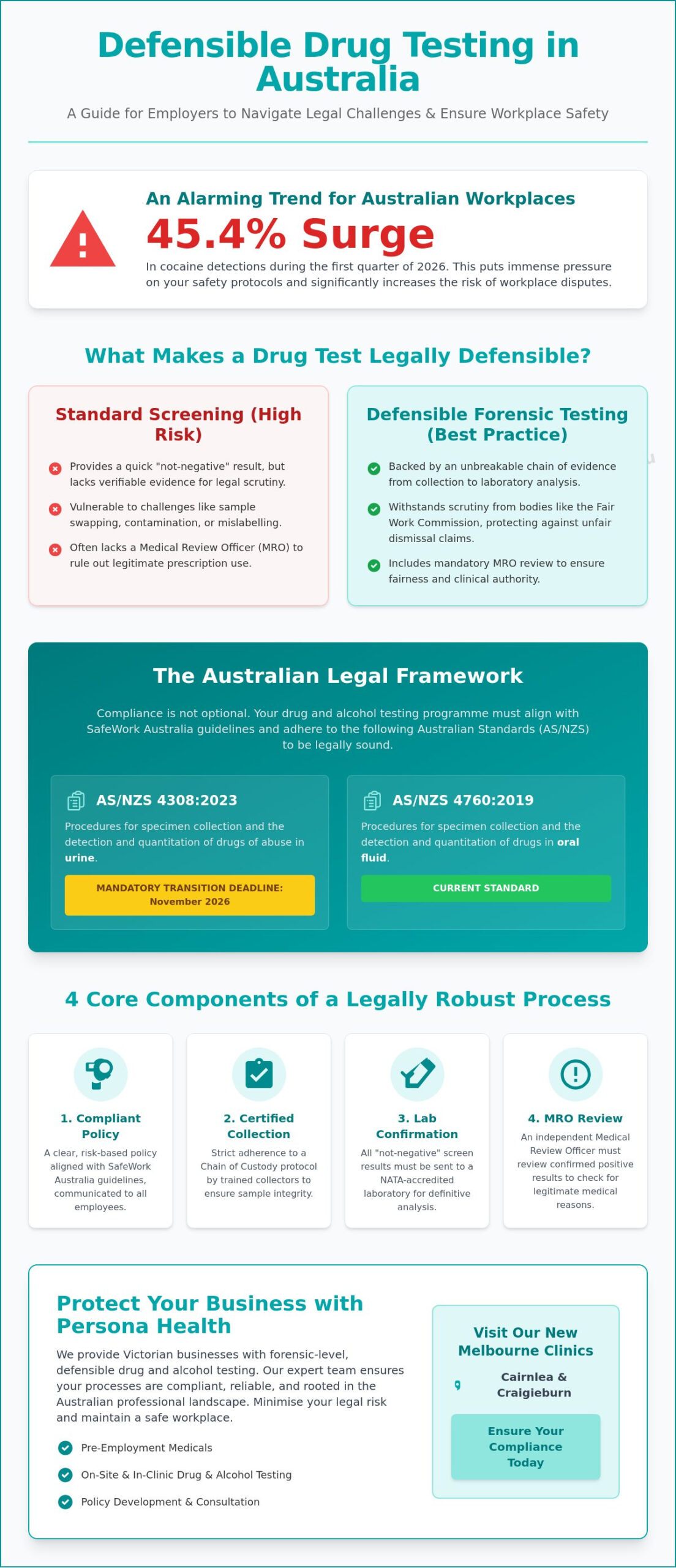
Did you know that cocaine detections in Australian workplaces surged by 45.4% in the first quarter of 2026? This sharp rise puts immense pressure on your safety protocols and increases the likelihood of complex workplace disputes. To protect your team and your reputation, you need more than just a positive result; you need defensible drug testing for legal challenges that adheres strictly to the latest Australian standards.
We understand the anxiety that comes with managing safety-sensitive roles, particularly when a single procedural error can lead to a costly unfair dismissal claim. It is a heavy responsibility to balance employee rights with rigorous workplace safety. This guide will help you implement a testing programme that remains airtight under the scrutiny of the Fair Work Commission and aligns with SafeWork Australia guidelines. You will learn how to transition to the mandatory AS/NZS 4308:2023 urine testing standards before the November 2026 deadline.
At Persona Health, we support Victorian businesses through this complex landscape at our brand new clinics in Cairnlea and Craigieburn. Our expert team provides the clinical precision and empathetic support your organisation needs. From Drug and Alcohol Testing to Pre-Employment Medicals, we ensure your processes are compliant, reliable, and deeply rooted in the Australian professional landscape.
Key Takeaways
- Understand how to align your workplace policies with the updated AS/NZS 4308:2023 and AS/NZS 4760:2019 standards to ensure every result is legally sound.
- Discover the essential components of defensible drug testing for legal challenges, including a robust Chain of Custody that protects your business from unfair dismissal claims.
- Learn to apply SafeWork Australia guidelines to create a risk-based drug and alcohol policy that prioritises both safety and procedural fairness.
- Identify common legal pitfalls, such as inconsistent policy enforcement, and learn how professional Drug and Alcohol Testing minimises these liability risks.
- Explore how Persona Health supports Victorian employers with forensic-level testing and NATA-accredited laboratory confirmation at our new Cairnlea and Craigieburn clinics.
What is Defensible Drug Testing for Legal Challenges?
Many employers believe that a positive result on a testing kit is the end of the story. In reality, it’s just the beginning. Defensible drug testing for legal challenges refers to a rigorous process where the result is backed by an unbreakable chain of evidence. It’s not just about the chemistry. It’s about the paperwork, the person who collected the sample, and the environment where the test occurred.
While standard screenings provide a quick “yes or no” answer, forensic-level testing ensures that every step can be verified under cross-examination. Understanding various drug testing methodologies is vital, but the technology used is often less important than the documented integrity of the collection. If an employee challenges a termination, your business must prove that the sample was not swapped, contaminated, or mislabelled.
To better understand how these processes protect your organisation, watch this helpful video:
A critical part of this validation is the Medical Review Officer (MRO). This independent physician reviews positive results to determine if there’s a legitimate medical explanation, such as a prescription. This step is essential because it prevents unfair dismissal claims based on lawful medication use. It provides a layer of clinical authority that a simple HR manager cannot offer.
The Burden of Proof in Australian Industrial Law
In Australia, the Fair Work Commission (FWC) holds employers to an incredibly high standard. You cannot simply rely on a “not-negative” result to justify disciplinary action. You must prove the result is accurate and the process was untampered. Legal defensibility is the ability to prove procedural integrity in court. Recent cases, like Glenn Brew v Downer EDI Works in March 2026, show that even a long-term employee can be reinstated if the employer fails to follow their own re-testing procedures. The FWC focuses on whether the process was fair, not just whether the test was positive.
When Defensibility Becomes Critical
There are specific scenarios where your testing process will be tested most severely. These include post-incident investigations where high-value liability or injury is involved, or when a long-term employee disputes a random test result. Challenges also frequently arise during pre-employment medicals for safety-critical roles. In these moments, having a partner like Persona Health ensures your protocols are airtight. Whether you visit our new clinics in Cairnlea or Craigieburn or require on-site health surveillance, we focus on the individual needs of your business to reduce legal exposure.
The Australian Legal Framework: SafeWork Australia and AS/NZS Standards
Establishing a robust framework for defensible drug testing for legal challenges requires more than just a company policy. It requires a deep alignment with the Australian regulatory landscape. In our experience, many employers feel overwhelmed by the technicalities of industrial law, yet these regulations exist to provide a fair, safe, and predictable environment for everyone. Central to this is the Work Health and Safety (WHS) Act 2011, which places a primary duty of care on you to ensure a safe workplace. Implementing Safe Work Australia guidelines is the first step in meeting these obligations, as they advocate for a risk-based approach rather than arbitrary testing.
The legal landscape is currently shifting. The Australian Standard for urine drug testing has been updated from the 2008 version to AS/NZS 4308:2023. This isn’t just a minor tweak; it includes revised cut-off levels for substances like cocaine and benzodiazepines. Workplaces must fully transition to this new standard by 10 November 2026. If you’re still using obsolete 2008-compliant kits after this date, your results may not hold up in the Fair Work Commission. We are here to help you navigate these changes, ensuring your processes remain current and compassionate.
Compliance with AS/NZS 4308 and AS/NZS 4760
To maintain legal standing, your testing must strictly follow the relevant Australian Standards. AS/NZS 4308:2023 governs urine testing, while AS/NZS 4760:2019 covers oral fluid (saliva) testing. These standards dictate everything from the temperature of the sample (which must be between 32°C and 38°C for urine) to the reportable cut-off for THC in saliva, which was lowered to 15 ng/mL in the 2019 update. Any deviation from these procedures, such as using non-compliant collection kits or failing to use a NATA-accredited laboratory for secondary confirmation, can invalidate your evidence during a dispute.
SafeWork Australia and the Duty of Care
Your duty of care involves balancing the physical safety of your team with the individual rights protected under the Privacy Act 1988. SafeWork Australia emphasises that drug testing should be part of a broader health and safety strategy, not a standalone disciplinary tool. In cities like Sydney and Melbourne, state-specific surveillance laws also influence how and when you can monitor staff. For a deeper look at these requirements, you can refer to the Persona Health guide to drug and alcohol testing. We’ve designed our services to respect these nuances, providing support that feels personal rather than clinical.
If you’re operating in Melbourne’s western or northern suburbs, our new clinics in Cairnlea and Craigieburn are specifically equipped to handle these compliance needs. We can help you manage your on-site health surveillance with the authority and reliability your business deserves. By staying proactive, you don’t just reduce legal exposure; you build a culture of trust and safety that benefits every member of your workforce.
Core Components of a Legally Robust Testing Process
A positive test result is merely a data point. To transform that data into evidence, you must ensure the entire collection process is beyond reproach. This is where defensible drug testing for legal challenges proves its worth. While some organisations focus solely on the chemistry of the sample, the Fair Work Commission often scrutinises the human element. If you can’t prove who handled the sample at every second, your case might collapse before it even begins. We believe that true safety is built on a foundation of trust and procedural accuracy.
The Chain of Custody: A Step-by-Step Requirement
The Chain of Custody (CoC) is the chronological paper trail that records the sequence of custody, control, and transfer of a specimen. Without a meticulous CoC, a sample’s integrity is easily questioned. According to the Australian Institute of Criminology on drug detection standards, adhering to recognised procedural standards is non-negotiable for any workplace program. At Persona Health, our collectors are trained to maintain this integrity through a strict process:
- Step 1: Donor identification. We verify the donor’s identity using government-issued photo ID. This ensures the person providing the sample is the person on the record.
- Step 2: Securing the environment. The collection area is inspected for potential adulterants or tampering agents before the donor enters. This prevents the use of “synthetic” or substituted samples.
- Step 3: Sealing and documentation. Specimens are sealed in tamper-evident containers in the donor’s presence. Dual-signature documentation confirms that the sample was handled correctly from the moment of collection.
Laboratory Confirmation and Medical Review
Establishing defensible drug testing for legal challenges relies on moving beyond simple screening. It’s important to understand that instant “point of care” tests are only screens. They indicate a “not-negative” result but don’t provide the definitive proof required for disciplinary action. For a result to be legally final, it must undergo gas chromatography-mass spectrometry (GC-MS) at a NATA-accredited laboratory. This method identifies the specific substance with absolute precision, providing the “gold standard” evidence your business needs.
The Medical Review Officer (MRO) acts as your final safeguard in this journey. They speak with the donor to determine if a positive result is caused by legitimate prescription medication. This protects you from accidentally dismissing someone for using a doctor-approved treatment. If you’re managing teams in Melbourne’s north or west, our new clinics in Cairnlea and Craigieburn offer these comprehensive services. We ensure your fitness for duty medicals are handled with both clinical authority and empathy. By integrating these core components, you aren’t just ticking boxes; you’re protecting your people and your business with a process that is both fair and foolproof.
Avoiding Common Legal Pitfalls in Workplace Testing
Even with the most advanced testing equipment, your organisation remains vulnerable if your administrative and human processes are not equally robust. Legal challenges often succeed not because the test result was wrong, but because the employer’s application of the policy was flawed. Establishing defensible drug testing for legal challenges requires absolute consistency. If you test your frontline workers but never apply the same standards to management, you create a significant risk for discrimination claims during industrial disputes. We believe that a fair process is the only way to build lasting trust within your team.
Training your supervisors is another critical step that many businesses overlook. Managers must be able to identify signs of impairment without being accusatory or biased. Procedural errors during the collection phase, such as failing to properly document a donor’s medication list or missing a signature on the Chain of Custody, can render a positive result useless in court. Recent Fair Work Commission decisions, such as Glenn Brew v Downer EDI Works in March 2026, prove that even a 27-year veteran can be reinstated if the employer fails to follow their own internal re-testing procedures.
Policy Gaps and Unfair Dismissal Risks
Your drug and alcohol policy must be crystal clear. It should explicitly state that testing positive for non-active metabolites can lead to termination, as shown in the Lee Witherden v DP World Sydney Limited case. Without this clarity, employees can argue they were not properly warned of the consequences. A legally sound policy should also include a “right to a split sample,” allowing the employee to have their specimen independently verified. If a breach does occur, our injury management services can provide a structured pathway for return-to-work programmes, ensuring the individual feels supported throughout their recovery.
The Impairment vs. Presence Debate
There is a growing legal distinction between the mere presence of a drug and actual impairment at work. This is especially vital in transport and logistics. In the 2025 Adam Mills v Glamorgan Spring Bay Council case, the commission criticised a zero-tolerance approach that failed to consider the specific circumstances of an employee’s medicinal cannabis prescription. Safety-critical sectors, however, maintain much stricter thresholds. For instance, the Category 3 Rail Medical requirements demand a higher level of scrutiny to ensure public safety. At our new clinics in Cairnlea and Craigieburn, we help Melbourne employers navigate these nuances with clinical precision.
To ensure your organisation meets the highest standards of compliance and safety, you can book your on-site health surveillance with our expert team today.
Professional Drug and Alcohol Testing in Melbourne and Sydney
At Persona Health, we prioritise the documented integrity of every collection. We understand that your business needs a partner who can provide defensible drug testing for legal challenges while treating your employees with the respect they deserve. Our approach balances clinical authority with a deeply empathetic tone, ensuring that the testing process reduces uncertainty rather than creating it. We provide forensic-level oversight for every sample, backed by a network of NATA-accredited laboratories for secondary confirmation. This ensures that every result we provide is accurate, reliable, and capable of withstanding the most rigorous legal examination.
Choosing the right partner means finding a team that understands the local industrial landscape. We don’t just follow a checklist; we tailor our approach to the unique needs of your organisation. Whether you are managing a small team or a large-scale infrastructure project, our focus remains on providing a seamless experience that protects your reputation and your people. By choosing defensible drug testing for legal challenges, you are investing in a process that values both safety and procedural fairness.
Expanding Access in Melbourne and Sydney
We are excited to announce the opening of our two new clinics in Cairnlea and Craigieburn, bringing our specialised expertise to Melbourne’s northern and western suburbs. These facilities are specifically equipped to support local employers in safety-sensitive industries, from construction to logistics. For high-volume needs in New South Wales, our established presence in Sydney and Parramatta continues to deliver reliable on-site health surveillance. Whether you require testing at our modern clinics or prefer our collection team to visit your industrial site, we ensure that the Chain of Custody remains unbroken from the moment of collection to the final laboratory report.
Why Choose Persona Health for Defensible Results?
Our team has extensive experience in sectors with the highest regulatory stakes, including rail, infrastructure, and transport. We understand the specific requirements of Cat 3 Rail Medicals and how they intersect with SafeWork Australia guidelines. This expertise allows us to provide comprehensive reporting that stands up to Fair Work Commission scrutiny, giving you the confidence to make informed decisions about your workforce. We don’t just provide a test result; we provide a verified process that protects your organisation’s future. You can book your defensible drug and alcohol testing today to ensure your workplace remains safe, compliant, and legally secure.
Build a Safer Future for Your Workforce
Managing a safe workplace requires more than just a policy; it requires a commitment to procedural excellence. You’ve learned that the strength of your programme lies in the meticulous details of the Chain of Custody and staying ahead of the November 2026 deadline for the updated urine testing standards. By prioritising defensible drug testing for legal challenges, you ensure that every decision you make is supported by forensic-level evidence and clinical authority.
Our team is here to guide you through these complexities with empathy and professional precision. With specialised Medical Review Officers and NATA-accredited laboratory partnerships, we provide the certainty your business needs to reduce legal exposure. We are proud to support local employers through our established Sydney facilities and our brand new clinics in Cairnlea and Craigieburn. Whether you need on-site surveillance or clinic-based assessments, we are your partners in growth and safety.
Secure your workplace with defensible drug testing at Persona Health today. You don’t have to navigate these industrial challenges alone; we are here to support your success every step of the way.
Frequently Asked Questions
What makes a drug test result legally defensible in Australia?
A result is legally defensible when it is the product of a rigorous, documented process that adheres to Australian Standards. This involves using qualified collectors, maintaining a secure chain of custody, and conducting secondary confirmation at a NATA-accredited laboratory. Every step must be verifiable to prove the sample was not tampered with or mislabelled, providing the clinical authority required to withstand scrutiny in the Fair Work Commission.
Can an employee refuse a drug test based on privacy concerns?
Technically, an employee can refuse a test, but this often carries significant employment consequences if your workplace policy is reasonable and safety-focused. SafeWork Australia guidelines state that employers have a primary duty of care to ensure a safe environment, which generally overrides individual privacy in safety-sensitive roles. If your policy is clearly communicated and applied consistently, a refusal is typically treated as a breach of a lawful and reasonable direction.
What is the difference between AS/NZS 4308 and AS/NZS 4760?
These two standards govern the different biological specimens used for defensible drug testing for legal challenges. AS/NZS 4308:2023 is the current standard for urine testing, which offers a longer detection window for past substance use. In contrast, AS/NZS 4760:2019 covers oral fluid testing, which is better suited for identifying recent use and potential impairment. Choosing the correct standard depends on the specific safety risks within your organisation.
How long does a laboratory confirmation take for a non-negative result?
Laboratory confirmation usually takes between 24 and 72 hours once the specimen arrives at the NATA-accredited facility. This time is required for the laboratory to perform highly accurate gas chromatography-mass spectrometry (GC-MS) testing. We recommend that employers have a clear protocol for this waiting period, such as moving the employee to a non-safety-sensitive role or providing paid leave, to maintain procedural fairness throughout the process.
Does a positive drug test automatically justify an unfair dismissal?
A positive result does not provide an automatic shield against unfair dismissal claims. The Fair Work Commission considers the entire context, including the employee’s length of service, their prior record, and whether the employer followed their own documented procedures. If your policy is ambiguous or if you fail to offer a medical review, a dismissal may be found to be harsh or unjust despite a confirmed positive result.
What is the role of a Medical Review Officer (MRO) in legal challenges?
An MRO provides an independent clinical review of positive laboratory results to determine if there is a legitimate medical explanation, such as a prescription. Their involvement is a cornerstone of defensible drug testing for legal challenges because it adds a layer of expert validation. By speaking with the donor directly, the MRO ensures that your business does not accidentally penalise an employee for lawful medication use, significantly reducing your legal liability.
How often should a workplace drug and alcohol policy be reviewed?
We suggest reviewing your policy every 12 to 24 months to keep pace with legislative changes and evolving industrial standards. For instance, the mandatory requirement to comply with the new AS/NZS 4308:2023 urine standard by 10 November 2026 makes an immediate review essential for many businesses. Regular updates ensure your procedures remain fair, empathetic, and fully aligned with current SafeWork Australia recommendations.
Are instant drug tests admissible in the Fair Work Commission?
Instant tests are generally only admissible as a preliminary “screen” to justify further investigation or temporary removal from safety-sensitive duties. They are not considered definitive proof of drug presence for the purpose of termination. To be legally robust, any “not-negative” result from an instant kit must be confirmed by a NATA-accredited laboratory. Relying solely on a point-of-care test for disciplinary action is a high-risk approach that often leads to successful legal challenges.

Article by
Ian Nicholson
Ian is the Business Support Manager at Persona Health, where he plays a key role across IT, sales, marketing and business operations. With a broad skill set and a practical, solutions-focused approach, Ian helps drive the systems, communication and commercial strategy that support Persona Health’s continued growth across Australia.