

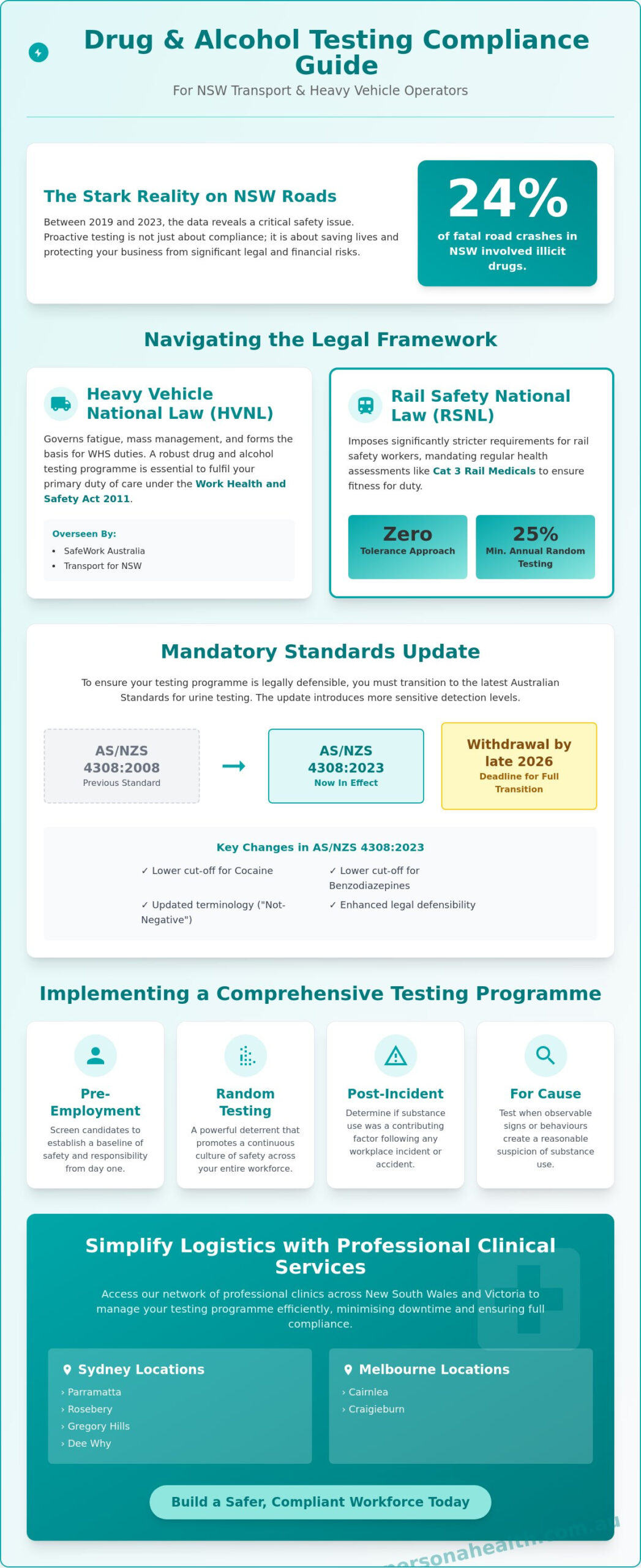
Did you know that illicit drugs were involved in 24% of fatal road crashes in New South Wales between 2019 and 2023? Keeping a fleet moving while ensuring every driver is safe is a significant responsibility, especially when you are balancing the Heavy Vehicle National Law with SafeWork Australia requirements. You want to protect your team and your business from the risk of heavy fines, yet managing the logistics of drug testing for transport workers sydney often feels like an invitation for unwanted downtime. We understand that your priority is a healthy, reliable workforce where safety is a shared value rather than a box-ticking exercise.
This 2026 compliance guide helps you navigate the evolving regulatory landscape with confidence and ease. You will learn how to implement effective programmes that meet the latest AS/NZS 4308:2023 standards and understand why the recent medicinal cannabis exemptions do not apply to commercial drivers. We also provide a clear path to managing your requirements through our professional clinics in Parramatta, Rosebery, Gregory Hills, and Dee Why, ensuring your Sydney workforce remains safe, compliant, and ready for the road ahead.
Key Takeaways
- Understand the critical differences between Rail Safety National Law and heavy vehicle regulations to protect your business from costly non-compliance penalties.
- Navigate the transition to updated Australian Standards for drug testing for transport workers sydney to ensure your programme remains legally defensible.
- Identify the most appropriate screening methods for your unique fleet requirements, from pre-employment medicals to random on-site testing.
- Simplify your logistics by accessing professional clinical services at convenient Sydney hubs including Parramatta, Rosebery, Gregory Hills, and Dee Why.
- Build a supportive culture of safety that goes beyond basic compliance to prioritise the long-term health and resilience of your drivers.
The Legal Framework for Transport Drug Testing in NSW
Operating in the Sydney transport sector requires more than just logistical precision; it demands a deep commitment to safety and legal compliance. The regulatory environment is governed by several overlapping bodies, including Transport for NSW and SafeWork Australia. For businesses managing Australian road transport operations, the Heavy Vehicle National Law (HVNL) sets the standard for fatigue and mass management, but it also creates the foundation for workplace health and safety. Implementing drug testing for transport workers sydney is not just about catching people out; it’s about fulfilling your primary duty of care under the Work Health and Safety Act 2011.
While SafeWork Australia provides the broad guidelines for all workplaces, transport operators face additional layers of scrutiny. Transport for NSW actively oversees drug and alcohol management, ensuring that those behind the wheel of heavy vehicles or operating rail machinery are fit for duty. This oversight helps reduce the risk of catastrophic incidents on our shared roads and tracks. SafeWork guidelines specifically emphasise that employers must eliminate or minimise risks as far as reasonably practicable, which makes a robust testing regime a non-negotiable part of modern business operations.
To better understand how these testing requirements impact the industry, watch this helpful video:
What is a Drug and Alcohol Management Program (DAMP)?
A DAMP is a comprehensive framework designed to manage the risks associated with substance use in the workplace. For Sydney-based transport companies, this programme is the cornerstone of legal protection. It starts with a clearly written policy that defines expectations and consequences. A DAMP goes beyond enforcement. It must include education components to inform workers about the dangers of substance use and support programmes to help those who may be struggling. By focusing on the individual’s well-being and providing clear resources, you create a culture where safety is a collective goal rather than a top-down mandate.
Specific Rules for Rail Safety Workers
The Rail Safety National Law (RSNL) is significantly stricter than road laws, often enforcing a zero-tolerance approach to illicit substances. If you manage rail operations in Sydney, your workers must undergo regular health assessments to confirm their fitness for duty. This is where Cat 3 Rail Medicals become essential, as they ensure workers meet the specific physical and psychological standards required for rail safety work. Random drug testing for transport workers sydney in the rail sector must cover at least 25% of the workforce annually. Our authorised clinicians help you stay compliant by providing these specialised medicals and testing at our local hubs, including Parramatta, Gregory Hills, and Rosebery. We also assist in training authorised persons to conduct on-site testing, ensuring your team has the internal resources to maintain safety standards without unnecessary disruptions.
Testing Methods and Australian Standards (AS/NZS)
To maintain a safe fleet, you must adhere to rigorous technical standards that ensure every result is accurate and legally defensible. In the context of drug testing for transport workers sydney, the industry is currently navigating a transition between urine testing standards. While AS/NZS 4308:2008 has long been the benchmark, the updated AS/NZS 4308:2023 is now in effect, with the older version set for withdrawal by late 2026. This update introduces lower cut-off levels for substances like cocaine and benzodiazepines, making it a more sensitive tool for identifying potential risks. Adherence to these standards, alongside the NSW drug and alcohol testing regulation, ensures your business remains compliant with state laws.
A critical part of this process is the Medical Review Officer (MRO). An MRO is a registered medical practitioner who interprets “not-negative” results, which is the updated terminology for what was previously called a non-negative result. They distinguish between illicit drug use and legitimate prescription medication, providing a layer of protection for both the employer and the employee. This clinical oversight is vital for maintaining trust within your workforce and avoiding unfair dismissals based on misunderstood laboratory data.
Urine vs Saliva Testing: Which is Right for Your Fleet?
Choosing the right method depends on your specific safety goals. Oral fluid testing, governed by AS/NZS 4760:2019, is excellent for detecting recent use, typically within a 12 to 24 hour window. This makes it ideal for random roadside checks or post-incident testing where immediate impairment is the concern. In contrast, urine testing offers a broader detection window, often identifying substances used several days prior. This method remains the gold standard for pre-employment medicals at our clinics in Parramatta and Rosebery, as it provides a more comprehensive view of an applicant’s history.
Targeted Substances in Transport Testing
Most transport testing programmes utilise a 5-panel or 7-panel screen. These tests look for amphetamines (including “ice”), THC (cannabis), cocaine, and opioids. Under the 2019 saliva standard, testing for Oxycodone is now mandatory. If a worker is taking legally prescribed medication, our clinicians at Gregory Hills, Dee Why, or our Melbourne sites in Cairnlea and Craigieburn handle these disclosures with complete confidentiality. We ensure that a driver’s medical privacy is respected while confirming they are genuinely fit for duty. If you need to establish a new screening protocol, our team can help you design on-site health surveillance that fits your operational schedule.
Types of Drug Testing for Sydney Transport Workers
Implementing a comprehensive safety strategy involves knowing exactly when to screen your team. In the busy logistical hubs of New South Wales, drug testing for transport workers sydney takes several forms, each serving a specific purpose in your risk management plan. A layered approach ensures that safety is not a one-time check but a continuous commitment. By using different testing triggers, you create a deterrent against substance use while identifying those who may need professional support before an incident occurs.
The most common types of testing include pre-employment screening, random testing, post-incident assessments, and for-cause investigations. Each of these must be conducted according to the relevant Australian Standard for urine drug testing or oral fluid standards. Random testing is particularly effective in the transport industry because its unpredictability encourages a culture of constant readiness and sobriety. Whether your fleet operates out of Parramatta or Gregory Hills, having a clear schedule for these tests helps maintain high safety standards across the board.
Pre-Employment and Fitness for Duty
Establishing a baseline for new hires is the first step in protecting your business. Integrating drug and alcohol screens into commercial truck and bus driver medicals ensures that every person joining your team meets the rigorous physical and mental requirements of the job. For existing staff, fitness for duty medicals provide an essential check-up after periods of extended leave or illness. These assessments, available at our Rosebery and Dee Why clinics, reduce long-term liability by confirming that your drivers are capable of handling the unique stresses of the Sydney road network.
Managing Post-Incident and Return-to-Work
When an accident occurs, the timeline for testing is critical. Post-incident drug testing for transport workers sydney should ideally happen within two hours of the event to capture the most accurate data regarding potential impairment. If a worker returns a “not-negative” result, our clinical approach focuses on rehabilitation and clear pathways back to the workforce. We support businesses in Melbourne, including those near Cairnlea and Craigieburn, by managing return-to-work programmes that prioritise the individual’s recovery. This empathetic yet professional oversight ensures that when a driver returns to the road, they do so with the resilience and clarity required for safe operation.
Implementing Testing Across Sydney and Melbourne Locations
Making drug testing for transport workers sydney accessible is vital for maintaining a productive fleet. We have strategically placed our clinics in major logistical hubs like Parramatta, Rosebery, and Gregory Hills to ensure your drivers don’t have to travel far from their routes. For those operating in Northern Sydney, our Dee Why location provides a convenient solution that fits into a busy shift. Our commitment to the transport sector extends to Victoria as well, where we support the Melbourne transport network with professional services in Cairnlea and Craigieburn. By offering consistent standards across state lines, we help national operators maintain a unified safety culture.
Clinic-Based vs On-Site Testing Logistics
Clinic visits are often the best choice for individual assessments where a controlled clinical environment is necessary. However, for larger fleets, on-site health surveillance is a game changer. Our mobile teams can visit your Sydney or Melbourne depot, performing bulk testing while maintaining a strict chain of custody. This approach ensures privacy for your workers while significantly reducing the logistical headache of sending multiple staff members off-site simultaneously. It allows your team to stay in their familiar environment, which can often lower the stress associated with clinical testing.
Scheduling Around Transport Peak Hours
We understand that the transport industry never really stops. Scheduling drug testing for transport workers sydney requires a nuanced approach that respects delivery windows and fatigue management. Our booking systems are designed with flexibility in mind, catering to shift workers and long-haul drivers who might arrive at irregular times. By providing rapid results, we help you keep your trucks moving and your drivers safe without the frustration of long waiting times. If you are ready to streamline your compliance and protect your workforce, you can book on-site health surveillance for your depot today.
The Persona Health Approach to Transport Safety
At Persona Health, we believe that effective drug testing for transport workers sydney should be more than a regulatory hurdle. It is an investment in your most valuable asset: your people. Our approach bridges the gap between clinical authority and human empathy, ensuring that safety protocols are implemented with care and precision. We don’t just provide results; we provide the context and support necessary to build a resilient workforce. By tailoring our programmes to the specific needs of your Sydney fleet, we help you foster a culture where every driver feels valued and every journey is safer. This commitment to well-being is what defines our presence across all our hubs, from Parramatta to Gregory Hills.
Beyond the technical requirements, our focus remains on the individual. We recognise that the transport industry presents unique challenges, from long hours to high-pressure delivery windows. Our clinicians are trained to provide a supportive environment that minimises stress during the screening process. This approach doesn’t just benefit the worker; it protects the employer by ensuring the testing process is respected and understood by all staff members. We see ourselves as an extension of your safety team, providing the stability and expertise required to keep your operations moving safely.
Why Clinical Expertise Matters
A basic screening might tell you if a substance is present, but a professional medical assessment explores the broader context of a worker’s health. Our occupational health professionals understand the nuances of the transport industry. They are skilled at managing the human element, which often involves reducing the natural anxiety workers feel during testing. This empathetic approach leads to more honest disclosures and better long-term health outcomes. For HR managers in Rosebery or Dee Why, our detailed reporting provides clear, actionable data. This allows you to make informed decisions that balance operational needs with worker welfare without compromising on safety standards.
Your Partner in NSW Transport Compliance
Meeting the 2026 regulatory updates requires a partner who stays ahead of the curve. We continuously monitor changes from SafeWork Australia and Transport for NSW to ensure your business remains beyond reproach. Our services are designed to be holistic, integrating seamlessly with workplace injury management and on-site health surveillance. This comprehensive view of employee health is what sets us apart in Sydney and our Victorian sites in Cairnlea and Craigieburn. We are here to guide you through every step of the process, from initial policy design to return-to-work rehabilitation. Book your Sydney transport drug testing today to secure your compliance for 2026 and beyond.
Securing Your Fleet’s Future in 2026
The safety landscape for the transport industry is constantly evolving. As we approach the final transition period for updated Australian Standards, ensuring your drug testing for transport workers sydney is fully compliant has never been more important. By integrating professional clinical oversight with a genuine focus on worker well-being, you protect your business from the risk of heavy fines while building a more resilient, reliable team. Whether you are managing rail safety requirements or heavy vehicle fleets, our specialists are here to guide you through every regulatory nuance.
We offer fully accredited services across our hubs in Parramatta, Rosebery, and Gregory Hills, as well as our Melbourne locations. Our team specialises in both rail and heavy vehicle medicals, providing the stability and expertise you need to stay on the road. We understand the unique pressures of the Sydney logistics network and are dedicated to making your compliance journey as smooth as possible.
Book Your Transport Drug Testing in Sydney Today
Safety isn’t just about meeting a standard; it’s about making sure every member of your team returns home safely at the end of every shift. We look forward to being your partner in this journey.
Frequently Asked Questions
Is drug testing mandatory for all transport workers in Sydney?
Drug testing is mandatory for specific roles, particularly those classified as rail safety workers under the Rail Safety National Law or heavy vehicle operators. Employers have a legal duty of care under the Work Health and Safety Act 2011 to ensure a safe workplace. This often requires a formal management programme to mitigate risks associated with impairment on public roads and rail networks across New South Wales.
What happens if a transport worker returns a non-negative drug test result?
If a worker returns a not-negative result, they are immediately stood down from safety-critical duties while the sample undergoes laboratory confirmation. This clinical process ensures accuracy and protects the worker’s rights. At our clinics in Parramatta or Rosebery, a Medical Review Officer (MRO) evaluates the lab findings to determine if the result is due to illicit use or legitimate prescription medication before any final decisions are made.
Can a transport worker refuse a random drug test in NSW?
Refusing a random drug test is typically treated as a breach of the employment contract and the company’s safety policy. Under most industrial frameworks in Sydney, a refusal carries the same weight as a positive result and can lead to disciplinary action or termination. It is essential that your written policy clearly outlines these consequences to ensure every worker understands their obligations before they start their shift.
How long does a drug and alcohol test take at a Sydney clinic?
A standard drug and alcohol test at our Sydney clinics usually takes between 15 and 20 minutes to complete. This includes the initial collection, the screening process, and the recording of results. We prioritise efficiency to minimise workforce downtime, allowing your drivers to return to their routes quickly. For more complex assessments in Gregory Hills, the duration may be slightly longer depending on the additional health checks required.
What are the Australian Standards for workplace drug testing in 2026?
The relevant standards for 2026 are AS/NZS 4308:2023 for urine specimen collection and AS/NZS 4760:2019 for oral fluid testing. The 2023 urine standard replaces the older 2008 version and introduces more stringent cut-off levels for certain substances. Staying updated with these standards is a vital part of drug testing for transport workers sydney, as it ensures your testing programme remains legally defensible and scientifically accurate.
Do transport drug tests include screening for prescription medications?
Yes, many standard testing panels will detect prescription medications such as benzodiazepines or strong opioids. Workers should disclose any legally prescribed medication to the clinician at the time of testing. Our clinical team at Dee Why or our Melbourne sites in Cairnlea and Craigieburn handles these disclosures with strict confidentiality. The MRO then verifies the prescription to ensure the driver is fit for duty without compromising their medical privacy.
How often should random drug testing be conducted for a Sydney fleet?
For rail safety workers, the law requires that at least 25% of the workforce is tested randomly every year. For road transport fleets, the frequency is often determined by your specific risk assessment and safety policy. We recommend a consistent, unpredictable schedule that acts as a genuine deterrent. Regularly scheduled testing helps maintain a high standard of safety across your Sydney operations and reinforces a culture of sobriety.
What is the difference between a DAMP and a standard drug policy?
A Drug and Alcohol Management Program (DAMP) is a structured framework required by the Rail Safety National Law, whereas a standard policy is often simpler. A DAMP must include specific elements like worker education, supervisor training, and access to rehabilitation services. It is a more holistic approach to safety that ensures compliance with Transport for NSW requirements while supporting the long-term health and well-being of your entire workforce.

Article by
Ian Nicholson
Ian is the Business Support Manager at Persona Health, where he plays a key role across IT, sales, marketing and business operations. With a broad skill set and a practical, solutions-focused approach, Ian helps drive the systems, communication and commercial strategy that support Persona Health’s continued growth across Australia.