

Could a single misunderstanding of the 2026 legislative reforms be the difference between a smooth recovery and a spiralling workers compensation claim? With the commencement of the Workers Compensation Legislation Amendment (Reform and Modernisation) Act 2026, mastering nsw workplace injury management has never felt more like decoding a foreign language. It’s completely understandable if the latest SIRA guidelines and shifting thresholds for psychological injuries leave you feeling more anxious than prepared.
You likely agree that the current system often feels designed to confuse, leaving employers fearing heavy fines and workers worried about their long-term health. This guide is here to replace that uncertainty with a clear, clinical, and compassionate roadmap. We’ll show you how to navigate every stage of the NSW system, from the initial incident to a successful return-to-work. You’ll discover how modern triage solutions like InjuryQR can slash your Lost Time Injuries (LTIs) while ensuring every employee receives the individualised care they deserve. We’re going to break down the complex regulations into actionable steps that protect your business and, most importantly, your people.
Key Takeaways
- Understand why the primary goal of nsw workplace injury management is a safe, durable return to work and how coordinated care makes this possible.
- Master the critical first steps of the injury process, ensuring immediate first aid and professional clinical triage are handled correctly from the start.
- Learn how to implement InjuryQR, a free AI-powered triage service, to provide your team with instant medical direction via their mobile devices.
- Discover how to identify “suitable duties” under current NSW legislation to create effective Return to Work (RTW) plans that support worker recovery.
- Gain clarity on the latest 2026 SIRA regulatory changes to ensure your business remains compliant while reducing Lost Time Injuries (LTIs).
What is Workplace Injury Management in NSW?
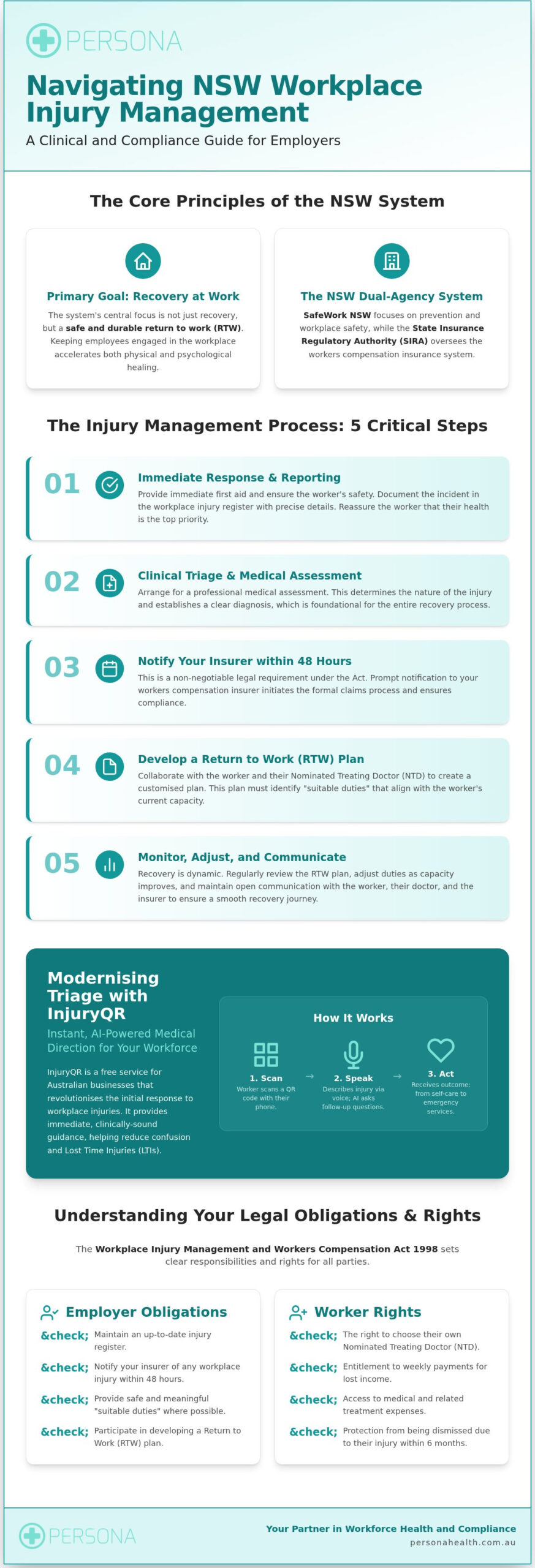
Effective nsw workplace injury management is the clinical and administrative coordination of medical, social, and vocational services. Its heartbeat is the individual worker. The primary goal isn’t just closing a file; it’s ensuring a safe and durable return to work (RTW) for the employee. When we look at the history of NSW workplace injury management, we see a clear shift from the old WorkCover model to the current dual-agency system. SafeWork NSW focuses on workplace safety and prevention, while the State Insurance Regulatory Authority (SIRA) oversees the workers compensation system itself.
Adopting a proactive stance on nsw workplace injury management does more than support recovery. It directly impacts your bottom line by reducing Lost Time Injuries (LTIs) and managing workers compensation premiums. A business that acts quickly when an injury occurs demonstrates that it values its people. This fosters a culture of trust and stability, showing that the individual’s well-being is a clinical priority rather than just a legal obligation.
The Workplace Injury Management and Workers Compensation Act 1998
This specific legislation is the bedrock of the NSW system. It applies to every employer in the state, regardless of size. Under the Act, your obligations are clear and non-negotiable. You must maintain an injury register, notify your insurer of any workplace injury within 48 hours, and provide suitable duties whenever possible. These duties aren’t just “light work”; they’re meaningful tasks that respect the worker’s current capacity while keeping them connected to their professional identity.
Workers also have essential rights that balance the system. Perhaps the most critical is the right to choose their own Nominated Treating Doctor (NTD). This ensures the worker feels supported by a medical professional they trust. For complex cases where the path forward seems unclear, an injury management consultant can bridge the gap between medical advice and workplace reality, ensuring the recovery process remains tailored and effective.
Core Objectives of the NSW System
The NSW framework has evolved to prioritise “recovery at work” rather than “recovery then work.” Research consistently shows that staying active and maintaining social connections at the workplace accelerates physical and psychological healing. The system aims to promote prompt medical treatment and proactive intervention. It’s about activating internal resources and tailoring the recovery journey to the unique needs of the individual, ensuring they don’t feel like just another number in a spreadsheet.
Achieving these objectives ensures financial viability for the employer while maintaining fairness for the worker. By focusing on early intervention and clear communication, businesses can avoid the friction that often leads to disputed claims. It’s a modern approach that recognises that the human body and mind recover best when the environment is supportive, predictable, and focused on potential rather than limitation.
The NSW Injury Management Process: A Step-by-Step Guide
When an incident occurs, the clock starts ticking. A structured response to nsw workplace injury management doesn’t just ensure compliance; it provides the immediate reassurance an injured worker needs. Following a logical, step-by-step process helps remove the guesswork and reduces the friction that often leads to prolonged claims. This methodology ensures that the individual’s recovery remains the central focus while protecting the business from unnecessary complications.
- Step 1: Immediate first aid and incident reporting.
- Step 2: Clinical triage and medical assessment.
- Step 3: Notification to the workers compensation insurer within 48 hours.
- Step 4: Development of a customised Return to Work (RTW) Plan.
- Step 5: Ongoing monitoring and adjustment of suitable duties as capacity improves.
Immediate Actions Following an Incident
The first 24 hours are the most critical period for the trajectory of any claim. During this window, the way you respond sets the tone for the entire recovery. You must document the incident in the workplace injury register immediately, ensuring every detail is captured with precision. This is also the time for deep empathy. Reassure the worker that their health is the priority. A professional, calm approach during these initial hours reduces the anxiety that often fuels long-term incapacity. Research into effective nsw workplace injury management consistently shows that early, supportive contact is one of the strongest predictors of a successful return to work.
Failing to act quickly can lead to a sense of abandonment for the worker, which often results in higher claim costs and extended time off. By treating the incident as a clinical priority rather than an administrative burden, you create a safer environment for everyone. If you’re looking for a way to streamline this initial contact, implementing a tool like InjuryQR can provide your team with instant medical direction the moment an injury occurs.
The Role of the Nominated Treating Doctor (NTD)
The NTD is the clinical lead in the recovery process. They’re responsible for issuing the Certificate of Capacity, a document that focuses on what the worker can do rather than what they can’t. In 2026, the shift toward digital issuance has made this information more accessible for employers and insurers, allowing for faster adjustments to duties. It’s vital to choose a doctor who understands occupational health, as they’re better equipped to collaborate on identifying suitable duties that are both safe and productive.
Collaboration is key. The NTD doesn’t work in a vacuum; they rely on information from the employer about what tasks are available. When the doctor, the employer, and the worker are all aligned, the recovery journey becomes predictable and stable. If you find the medical jargon overwhelming or struggle to bridge the gap between clinical advice and your operational needs, an injury management consultant can provide the expert guidance needed to keep the recovery on track and ensure the worker feels supported throughout every stage.
Modernising Triage with InjuryQR: Instant Medical Direction
Traditional nsw workplace injury management often stumbles at the very first hurdle: the time between an incident occurring and a professional clinical assessment. This delay creates uncertainty for the worker and administrative friction for the employer. InjuryQR changes this dynamic by providing a free, AI-powered triage service designed specifically for Australian workplaces. It acts as a digital first responder, ensuring that no worker is left wondering what to do next in those critical moments following an injury.
The process is intentionally simple to ensure high adoption rates across diverse worksites, from busy construction zones to quiet offices. A worker simply scans a QR code with their mobile phone. There’s no app to download and no complex login required. They describe the injury using their voice, and the AI provides instant, clinical guidance. This might include self-care instructions for minor issues, a referral to a telehealth consultation, or immediate direction to the nearest emergency department for serious incidents. This immediate clarity settles the individual and ensures the recovery journey begins on a stable, professional footing.
Reducing LTIs through Immediate Reporting
Early intervention is the most effective way to reduce Lost Time Injuries (LTIs). By making reporting instantaneous, InjuryQR ensures that HR and safety managers are notified the moment an incident is logged. This speed allows for the immediate implementation of support and the issuance of digital Certificates of Capacity where appropriate, aligning with the latest 2026 SIRA guidelines. To help businesses integrate this into their daily operations, Persona Health provides free physical assets, including high-visibility posters and magnets, ensuring the QR code is always within reach when it’s needed most.
Bridging the Gap to Professional Care
While the AI provides immediate direction, the true power of this technology lies in its seamless integration with Persona Health’s clinical network. It ensures that the data captured at the scene is accurate and comprehensive, which is vital for insurance purposes and long-term recovery planning. This modern approach bridges the gap between the initial shock of an injury and professional medical care. It makes the individual feel seen and supported from the very first second, activating their internal resources for regeneration rather than leaving them to navigate a confusing system alone. By capturing precise incident data early, we ensure that every subsequent step in the nsw workplace injury management process is built on a foundation of clinical truth and empathy.
Developing an Effective Return to Work (RTW) Plan
A Return to Work (RTW) plan is the clinical bridge between an initial injury and a full, durable recovery. Within the framework of nsw workplace injury management, this document serves as a personalised roadmap that outlines how a worker will safely re-integrate into their professional environment. It’s not a static administrative form; it’s a living strategy that evolves as the individual heals. By collaborating closely with the insurer and the worker, you can set realistic recovery milestones that provide a sense of progress and stability. This partnership ensures that every stakeholder is aligned, reducing the friction that often complicates the recovery journey.
“Recovery at Work” is more than just a policy preference. It’s a clinically proven approach that significantly improves long-term mental health outcomes. Staying connected to the workplace prevents the social isolation and loss of identity that often accompany extended time off. It keeps the worker’s internal resources active, fostering a sense of purpose that accelerates physical regeneration. When a worker knows their contribution is still valued despite their current limitations, the psychological barriers to recovery begin to dissolve.
Identifying Suitable Duties
Suitable duties are meaningful tasks that respect a worker’s current capacity while keeping them productive. For someone in a physically demanding role, this might involve transitioning from heavy lifting to performing inventory audits or supervising a junior team. In sedentary environments, modifications might include reduced work hours, ergonomic adjustments, or a temporary shift to project-based tasks that allow for regular breaks. You should modify the work environment to remove physical or psychological triggers that could hinder progress. Regular reviews, ideally conducted every two weeks, are essential to progress these duties as the worker’s strength and confidence return.
The Role of specialised Medical Assessments
While a local GP provides excellent general care, they may lack the specific industry context required for complex nsw workplace injury management cases. This is where an Occupational Physician offers a higher level of clinical authority. They possess a deep understanding of workplace dynamics and physical demands. When there’s uncertainty about a worker’s capacity to return to their original role, it’s often necessary to utilise a Fitness for Duty (FFD) Medical. This specialised assessment provides a definitive view of the worker’s physical and psychological capability, ensuring the proposed duties are safe and sustainable.
If you find that a claim is plateauing or if there’s a disconnect between medical advice and workplace requirements, engaging a SIRA-accredited injury management consultant can provide the expert intervention needed to achieve a safe and durable outcome for everyone involved.
Persona Health: Your Partner in NSW Injury Management
Persona Health acts as the clinical bridge between regulatory compliance and actual employee recovery. While many providers focus solely on the legalistic aspects of a claim, we prioritise the clinical and human elements that drive real outcomes. Our approach to nsw workplace injury management is built on the belief that every worker is unique. Each individual deserves a recovery plan tailored to their specific physiology and professional role. We provide fast turnaround times for medical reports and assessments, removing the administrative delays that often lead to worker frustration and claim escalation.
Transparency is at the core of our partnership. We’ve integrated modern digital reporting tools to ensure employers have real-time visibility into the status of a claim. This clarity builds trust and allows for more agile decision-making when it comes to adjusting suitable duties or implementing new safety protocols. Our team consists of highly experienced Occupational Physicians, Injury Management Consultants (IMCs), and Independent Medical Examiners (IMEs). We act as expert guides through the complexities of the NSW system, ensuring that every step is both clinically sound and compassionate.
Our Clinic Locations and Network
We provide high-quality care through our established physical clinics across two major states. In Sydney, you can access our services at our Parramatta, Rosebery, Gregory Hills, or Dee Why locations. We also support the Melbourne market through our clinics in Cairnlea and Craigieburn. For organisations with a regional presence, we offer a 100-clinic affiliate network across Australia. This ensures that even your most remote workers receive the same high standard of clinical care as those in metropolitan centres, providing a consistent experience for your entire workforce.
Specialised Services for Industry
Effective injury management is most powerful when it’s integrated into a broader health and safety strategy. By linking our recovery services with Pre-Employment Medicals, we help you understand the baseline health of your team and prevent future incidents before they occur. We also possess deep expertise in high-risk sectors, offering specialised assessments such as Cat 3 Rail Medicals and Crystalline Silica Medicals. For businesses dealing with hazardous environments, our customised health surveillance programmes for asbestos ensure that you aren’t just meeting your legal obligations but are actively protecting the long-term well-being of every individual under your care.
Empowering Your Team Through Professional Recovery
Mastering nsw workplace injury management is no longer just about meeting a legal checklist; it’s about fostering a culture where every individual feels supported during their most vulnerable moments. By embracing the “Recovery at Work” philosophy and utilising modern triage tools, you can transform a confusing administrative process into a structured path toward regeneration. The key takeaways are clear: early intervention is paramount, clinical precision in Return to Work plans is essential, and open communication between all parties ensures a durable outcome.
You don’t have to navigate these 2026 regulatory changes alone. Persona Health provides the stability and expertise your business needs. With our specialised Occupational Physicians and a commitment to fast turnaround times on medical assessments, we ensure that your people get back to what they do best, safely. You can also take advantage of our free AI triage via InjuryQR to provide instant medical direction for your team. Contact Persona Health today to discuss your NSW injury management requirements and take the first step toward a safer, more resilient workplace. Your team’s well-being is in expert hands, and a brighter recovery journey starts now.
Frequently Asked Questions
What is the Workplace Injury Management and Workers Compensation Act 1998?
The Workplace Injury Management and Workers Compensation Act 1998 is the primary legislation governing the workers compensation system in New South Wales. It sets the legal framework for how injuries are reported, managed, and compensated. The version updated for July 1, 2026, includes critical reforms regarding psychological injury thresholds and digital certificates. It balances employer obligations with worker rights to ensure a fair, sustainable recovery process for everyone involved.
How soon must I report a workplace injury in NSW?
You must notify your workers compensation insurer within 48 hours of becoming aware of a workplace injury. However, the best practice for nsw workplace injury management is to record the incident in your workplace injury register immediately. Prompt reporting allows for early intervention, which is clinically proven to improve recovery outcomes and reduce the likelihood of a claim becoming complex or prolonged.
Can an employee choose their own doctor for a workplace injury?
Yes, an injured worker has the absolute right to choose their own Nominated Treating Doctor (NTD). This is a fundamental part of the NSW system, ensuring the individual feels supported by a medical professional they trust. While an employer can suggest a doctor with occupational health expertise, the final decision rests with the employee. A strong relationship with an NTD is vital for a stable recovery journey.
What are “suitable duties” in a Return to Work Plan?
Suitable duties are meaningful work tasks that accommodate a worker’s current physical or psychological restrictions. These aren’t just “busy work”; they must be productive and respect the clinical boundaries set by the doctor. Examples include modified physical tasks, administrative duties, or reduced hours. Providing these duties is an employer obligation that keeps the individual connected to their workplace, which is essential for their long-term well-being and regeneration.
How does InjuryQR help with workers compensation claims?
InjuryQR streamlines the initial stages of a claim by providing instant, AI-guided medical direction via a simple QR code scan. It allows workers to report incidents using their voice, ensuring HR and safety managers are notified within seconds. This immediate data capture improves reporting accuracy for insurers and ensures the worker receives professional guidance right away, significantly reducing the risk of Lost Time Injuries (LTIs) and administrative delays.
What happens if an employer cannot provide suitable duties?
If an employer cannot provide suitable duties, they must be able to demonstrate that providing such work is not reasonably practicable. In these cases, the insurer may provide additional support, such as vocational retraining or assistance in finding a placement with a different employer. However, the primary focus of nsw workplace injury management remains finding ways to keep the worker at their original workplace whenever it’s safely possible.
Does Persona Health provide on-site injury management services?
Persona Health provides comprehensive on-site health surveillance and injury management services across Sydney and Melbourne. We understand that some clinical needs are best met directly at the worksite to minimise disruption and observe workplace dynamics firsthand. Our team can assist with on-site assessments and help implement proactive health strategies that protect your workers while ensuring your business remains fully compliant with the latest SIRA and SafeWork NSW regulations.
How do I reduce my workers compensation premiums in NSW?
Reducing your workers compensation premiums is best achieved through proactive injury management and a focus on reducing Lost Time Injuries (LTIs). By implementing early intervention strategies, such as immediate triage via InjuryQR and effective Return to Work plans, you can lower the overall cost of claims. Demonstrating a safe work environment and a commitment to “recovery at work” directly influences the experience rating used by insurers to calculate your premiums.

Article by
Ian Nicholson
Ian is the Business Support Manager at Persona Health, where he plays a key role across IT, sales, marketing and business operations. With a broad skill set and a practical, solutions-focused approach, Ian helps drive the systems, communication and commercial strategy that support Persona Health’s continued growth across Australia.