

Imagine a scenario where a routine safety check suddenly halts your entire production line for several hours. For many Australian managers, the fear of operational disruption is just as stressful as the legal anxiety surrounding non-compliance with updated Australian Standards. You want a drug-free workplace that operates like clockwork, yet determining the best random drug testing provider often feels like a complex balancing act between safety and productivity. It is a challenge that requires a clinical approach rather than a simple administrative one.
At Persona Health, we understand that your business requires a partner that respects the unique rhythm of your operations while prioritising worker wellbeing. This guide provides the essential criteria for selecting a testing partner that ensures total compliance and supports Australian safety standards. We will explore the differences between on-site and clinic-based models, the importance of NATA accreditation, and how fast, digital reporting enables immediate decision-making. By the end, you will have a clear roadmap for maintaining a secure, legally defensible workplace with minimal operational downtime.
Key Takeaways
- Understand why NATA accreditation and adherence to AS/NZS 4308:2023 and AS/NZS 4760:2019 are non-negotiable for legally defensible results in Australian courts.
- Learn how to evaluate which provider is best for random drug testing provider? by looking for clinical expertise that reduces operational downtime and supports worker wellbeing.
- Compare the benefits of on-site sweeps for large teams against clinic-based testing for pre-employment and follow-up assessments.
- Discover the two essential steps for best practice, including the development of a robust Drug and Alcohol Management Plan (DAMP) and proactive employee education.
- Explore how Persona Health’s modern digital reporting and experienced medical team provide a comprehensive, employer-focused approach to workplace safety.
Understanding the Role of a Random Drug Testing Provider
A random drug testing provider isn’t just a technician with a sample cup. They’re a clinical partner in your Workplace Health and Safety (WHS) ecosystem. Choosing which provider is best for random drug testing provider? involves more than just comparing costs; it’s about finding a partner who balances clinical precision with deep empathy. Impartiality is the absolute cornerstone of this relationship. An external provider ensures the selection process is truly random, which removes any perception of bias or favouritism within your workforce. This transparency builds trust, showing your team that the programme is a fair, universal safety standard rather than a tool for targeting individuals.
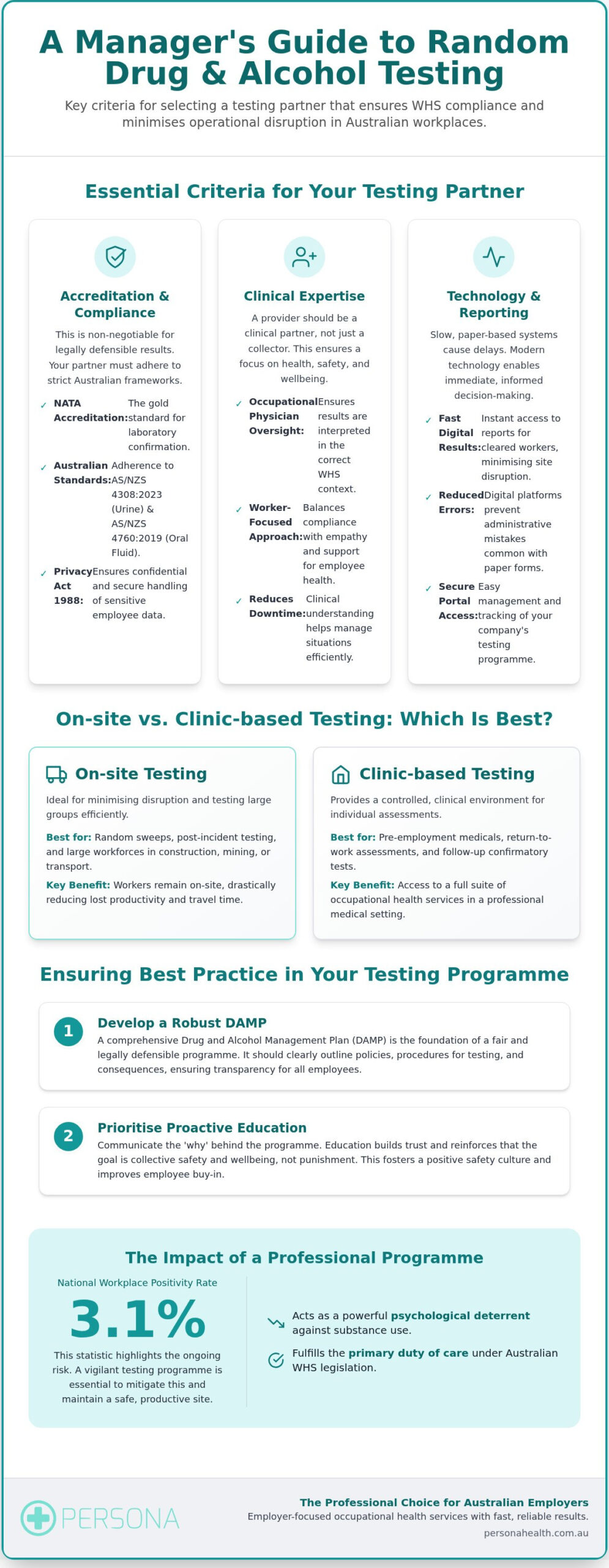
SafeWork Australia guidelines emphasise that testing should be one part of a broader alcohol and other drugs (AOD) policy. The primary goals aren’t punitive. Instead, they focus on deterrence, mitigating risk to life, and supporting the long-term wellbeing of every employee. By utilising various drug testing methods, a professional provider helps maintain a culture where safety remains the priority. With a national workplace drug test positivity rate of 3.1 per cent reported in early 2026, having a vigilant, expert partner is essential for maintaining a secure and productive site.
The Deterrent Effect in Australian Workplaces
The mere presence of a robust testing programme acts as a powerful psychological deterrent. When employees know that unannounced visits can occur at any time, the likelihood of substance use before or during a shift drops significantly. This isn’t about “catching” people; it’s about ensuring everyone gets home safely at the end of the day. Unannounced testing maintains the integrity of your programme because it prevents individuals from attempting to mask substance use. It’s a proactive way to foster a healthy, focused environment where the unique needs of each worker are respected through a commitment to collective safety.
Legal Obligations Under WHS Legislation
Under the Work Health and Safety Act, Australian employers have a primary duty of care to ensure the health and safety of workers so far as is reasonably practicable. Implementing random testing is often a key component of meeting this requirement, especially in high-risk sectors like construction, mining, and manufacturing. For those in the transport or rail industries, the stakes are even higher. Compliance with mandates from bodies like Transport for NSW or the Office of the National Rail Safety Regulator is mandatory. This often involves specific health assessments, such as Cat 3 Rail Medicals, to ensure workers meet stringent national fitness standards. A clinical provider ensures your testing remains legally defensible while fulfilling these heavy regulatory burdens.
Selection Criteria: What to Look for in a Testing Partner
When evaluating which provider is best for random drug testing provider?, your first priority should be their adherence to the latest Australian Standards. For urine testing, the AS/NZS 4308:2023 standard is now the benchmark, with a full transition deadline of November 2026. Oral fluid testing must follow AS/NZS 4760:2019. These frameworks ensure that cut-off levels and collection procedures are consistent across the country. However, technical compliance is only half the battle. A truly professional partner provides clinical oversight through experienced Occupational Physicians, ensuring that every result is interpreted within the context of a worker’s overall health and safety requirements.
Accreditation and Compliance Standards
Legal defensibility hinges on the quality of the laboratory. While a screening test gives you a quick snapshot, any non-negative result must be verified through confirmatory testing. NATA accredited laboratories are the gold standard here. Their rigorous audits ensure that the science behind the result holds up under the scrutiny of Australian courts or Fair Work Commission hearings. Protecting your business also means protecting employee data. Your provider must strictly follow the Privacy Act 1988, treating sensitive medical information with the clinical care and confidentiality it deserves. This empathetic approach builds a culture of trust rather than one of suspicion.
Technology and Reporting Speed
In a fast-paced industrial environment, every hour of downtime carries a cost. Traditional paper-based reporting is often slow and prone to error, leading to unnecessary delays in returning clear workers to their duties. Modern digital reporting systems provide immediate, secure notifications that allow for real-time risk management. Persona Health prioritises these rapid turnaround times, using an employer-focused digital platform that delivers clear, actionable data. This technology ensures you aren’t left waiting for answers when safety is on the line. If you’re ready to modernise your approach, you can learn more about our Drug and Alcohol Testing solutions designed for the Australian market.
On-site vs. Clinic-based Testing: Which is Best for You?
Deciding which delivery model suits your business often comes down to the scale of your operations and the specific timing of your safety checks. When considering which provider is best for random drug testing provider?, the most effective partners offer a flexible, hybrid approach that adapts to your unique workplace needs. Large-scale random sweeps usually demand on-site mobility to protect productivity, while individual assessments are often better handled in a clinical environment where comprehensive medical equipment is readily available. Finding this balance ensures your safety programme remains both thorough and cost-effective.
Mobile On-site Services for High-Volume Testing
Mobile on-site services are designed for convenience and discretion. Having a 24/7 mobile unit visit your depot or construction site ensures that testing occurs within the natural flow of the workday. This approach minimises staff downtime, as workers only need to step away from their duties for a few minutes rather than travelling across town. Persona Health manages this process with clinical sensitivity, ensuring that unannounced visits don’t cause unnecessary alarm among your team. Our Australia-wide mobile services are backed by a massive 100-clinic affiliate network, providing consistent coverage even for regional or remote projects.
The Value of Local Clinics in Sydney and Melbourne
Fixed clinics provide a stable, professional environment for more detailed assessments. Persona Health operates physical clinics in key industrial hubs, including Parramatta, Rosebery, Gregory Hills, and Dee Why in Sydney, as well as Cairnlea and Craigieburn in Melbourne. These locations are ideal for Pre-Employment Medicals, where a new hire’s baseline health can be thoroughly documented before they even step onto your site. They also serve as a reliable resource for Fitness for Duty assessments and return-to-work checks.
Ultimately, the goal is to balance the logistical call-out fee of a mobile unit against the hidden costs of staff downtime. If you have a large team starting a shift at 6:00 AM, an on-site sweep is almost always the more efficient choice. However, for a single follow-up test after an incident, sending the employee to a local clinic is often more practical. By integrating both models, you ensure that your safety protocols are always supported by the right clinical setting, no matter where your team is located.
Ensuring Best Practice in Your Testing Programme
A successful safety programme rests on a solid Drug and Alcohol Management Plan (DAMP). This document shouldn’t just sit on a shelf; it’s a living guide that outlines your organisation’s commitment to a secure environment. When determining which provider is best for random drug testing provider?, look for a partner who helps you build this framework from the ground up rather than just showing up with a testing kit. Best practice involves a methodical approach that prioritises clarity and fairness at every stage.
- Step 1: Develop a robust DAMP that aligns with the Work Health and Safety Act and relevant industry standards.
- Step 2: Conduct comprehensive employee education sessions before any testing begins.
- Step 3: Use a software-driven random selection process to ensure the programme is free from bias or discrimination.
- Step 4: Establish clear, written procedures for managing non-negative results to protect both the business and the worker.
- Step 5: Regularly audit the programme with your clinical partner to ensure it meets evolving Australian Standards.
Managing Non-Negative Results and Laboratory Confirmation
The period following a non-negative screening result is critical. To maintain legal defensibility, a strict chain of custody process must be followed for laboratory transport. This ensures the sample remains untampered with from the point of collection to the NATA accredited lab. During this phase, the role of a Medical Review Officer (MRO) is indispensable. Our Occupational Physicians act as these expert interpreters, determining if legitimate prescription medications caused the result. It’s essential to manage the employee with empathy during the 24 to 48 hour confirmation window. Keeping the individual informed and respecting their privacy reduces legal risk and maintains workplace morale.
Education as a Tool for Culture Building
Education is the most effective way to transition from a culture of compliance to a culture of care. Employees need to understand the “why” behind the policy. When workers realise that substance use is a factor in a significant portion of workplace incidents, the programme is seen as a protective measure rather than a punitive one. Use toolbox talks and visible safety posters to keep these conversations active. Persona Health assists employers by providing the clinical authority and educational resources needed to foster this mindset. If you’re ready to strengthen your workplace safety culture, contact Persona Health to discuss our comprehensive policy development and training services.
Why Persona Health is the Professional Choice for Australian Employers
Choosing a partner for your safety programme is a decision that impacts the wellbeing of your entire workforce. When determining which provider is best for random drug testing provider?, the answer lies in the level of clinical authority and the integration of services. Persona Health is led by experienced medical professionals, including Occupational Physicians, who understand that drug testing is a medical procedure requiring precision and empathy. Unlike simple collection agencies, we provide a medically backed framework that ensures every result is interpreted with professional expertise. This clinical depth allows us to support businesses across diverse sectors, from standard Drug and Alcohol Testing to specialised Rail Medicals.
The InjuryQR Advantage for Workplace Safety
Our commitment to innovation is best demonstrated through InjuryQR, a free AI-powered triage service that transforms how incidents are managed on-site. When an injury occurs, workers simply scan a QR code with their smartphone. No app is required. They describe the injury using their voice, and the AI provides immediate, guided next steps, such as self-care instructions, a telehealth consultation, or emergency direction. This immediate response is vital for reducing Lost Time Injuries (LTIs) and ensuring that Certificates of Capacity are issued promptly when appropriate. Businesses can even order free physical InjuryQR assets, such as posters and magnets, to ensure this support is always visible and accessible at every depot and worksite.
A Partner in Long-term Health Surveillance
We view drug testing as one component of a holistic health strategy. By linking your testing programme to broader On-site Health Surveillance, you create a seamless safety net for your employees. Using a single provider for all your occupational health needs, including crystalline silica medicals or asbestos assessments, ensures that worker health records are centralised and consistently managed. This employer-focused approach combines fast turnaround times with clear, actionable reporting, allowing you to make informed decisions without delay.
Every industry has unique challenges, and our team is ready to help you navigate yours with a tailored approach. Whether you operate out of our clinics in Parramatta, Rosebery, or Craigieburn, or require our Australia-wide mobile services, we provide the stability and expertise you need to thrive. We invite you to speak with the Persona team today to discuss your specific requirements and see how a professional clinical partnership can strengthen your workplace safety culture.
Securing Your Workplace Safety Future
Navigating the complexities of Australian safety standards requires more than just a checklist. It demands a clinical partner who understands the nuance of the law and the unique needs of your workforce. By prioritising NATA accredited laboratory results and the expert oversight of Occupational Physicians, you move beyond mere compliance toward a genuine culture of care. This approach doesn’t just mitigate risk; it protects the people who keep your business running every day.
When you evaluate which provider is best for random drug testing provider?, look for those who offer fast turnaround times and legally defensible reporting. With physical clinics across Sydney and Melbourne and a 100-site affiliate network, Persona Health provides the national reach and clinical authority your organisation deserves. Our team is here to ensure your programme is seamless, supportive, and scientifically sound.
Contact Persona Health today to organise your random drug testing programme and take the next step toward a safer, more productive workplace. We look forward to helping you build a resilient safety framework that supports your team’s long-term health and wellbeing.
Frequently Asked Questions
What is the difference between urine and saliva drug testing for workplaces?
Urine testing typically offers a longer detection window, identifying substance use from days or even weeks prior. It remains the most common method for pre-employment checks. Saliva testing, or oral fluid testing, focuses on very recent use, usually within the last 24 to 48 hours. Many employers prefer saliva testing for random on-site sweeps because it is less invasive and more effective at detecting current impairment.
How often should a business conduct random drug testing?
Testing frequency depends on your specific industry risk profile and the requirements set out in your Drug and Alcohol Management Plan (DAMP). High-risk sectors like mining, transport, or construction often conduct monthly or quarterly sweeps. The most important factor is that the timing remains unpredictable. This ensures the programme maintains a strong deterrent effect and encourages a consistent culture of safety among your team.
What happens if an employee refuses a random drug test?
Refusing a test is generally treated as a non-negative result or a serious breach of company policy, provided your drug and alcohol policy is clearly communicated. Your DAMP should specify the disciplinary consequences for refusal. In most safety-critical roles, a refusal leads to immediate removal from duty until a formal investigation is completed. This helps protect the individual and their colleagues from potential workplace risks.
Is a “non-negative” result the same as a “positive” result?
No, a non-negative result is an initial screening finding that requires further laboratory confirmation. It doesn’t prove substance misuse until a NATA accredited lab verifies the sample. When evaluating which provider is best for random drug testing provider?, ensure they use Medical Review Officers to interpret these results. This clinical oversight is essential for distinguishing between legitimate prescription medication and illicit substance use, protecting the worker’s rights.
How do I ensure our drug testing policy is legally compliant in Australia?
Compliance requires a written policy that aligns with the Work Health and Safety Act and the Privacy Act 1988. You must consult with your employees during the policy development phase and ensure all testing follows the relevant Australian Standards. Professional providers like Persona Health can audit your current documentation to ensure it meets the latest regulatory requirements, providing you with a legally defensible framework for your programme.
Can a random drug testing provider come to a remote worksite?
Yes, mobile on-site services are specifically designed to support remote depots, regional construction projects, and agricultural sites. Persona Health utilises a massive 100-clinic affiliate network alongside mobile units to provide Australia-wide coverage. This ensures that no matter where your project is located, you can maintain the same high standard of clinical testing and safety surveillance without requiring your workers to travel long distances.
Do we need to notify employees before the random testers arrive?
You shouldn’t give employees specific notice of when a random test will occur. While your team must be educated about the policy and know that random testing is a possibility, the element of surprise is what makes the programme an effective deterrent. Providing advanced warning would undermine the integrity of the process. Instead, focus on transparent communication about why the programme exists to support their collective safety.
What are the Australian Standards for workplace drug and alcohol testing?
The two primary standards are AS/NZS 4308:2023 for urine testing and AS/NZS 4760:2019 for oral fluid testing. These standards dictate everything from collection procedures to the cut-off levels for detection. Adhering to these is critical for any business asking which provider is best for random drug testing provider? for their site. Using a provider that strictly follows these standards ensures your results are accurate and legally robust.

Article by
Ian Nicholson
Ian is the Business Support Manager at Persona Health, where he plays a key role across IT, sales, marketing and business operations. With a broad skill set and a practical, solutions-focused approach, Ian helps drive the systems, communication and commercial strategy that support Persona Health’s continued growth across Australia.