
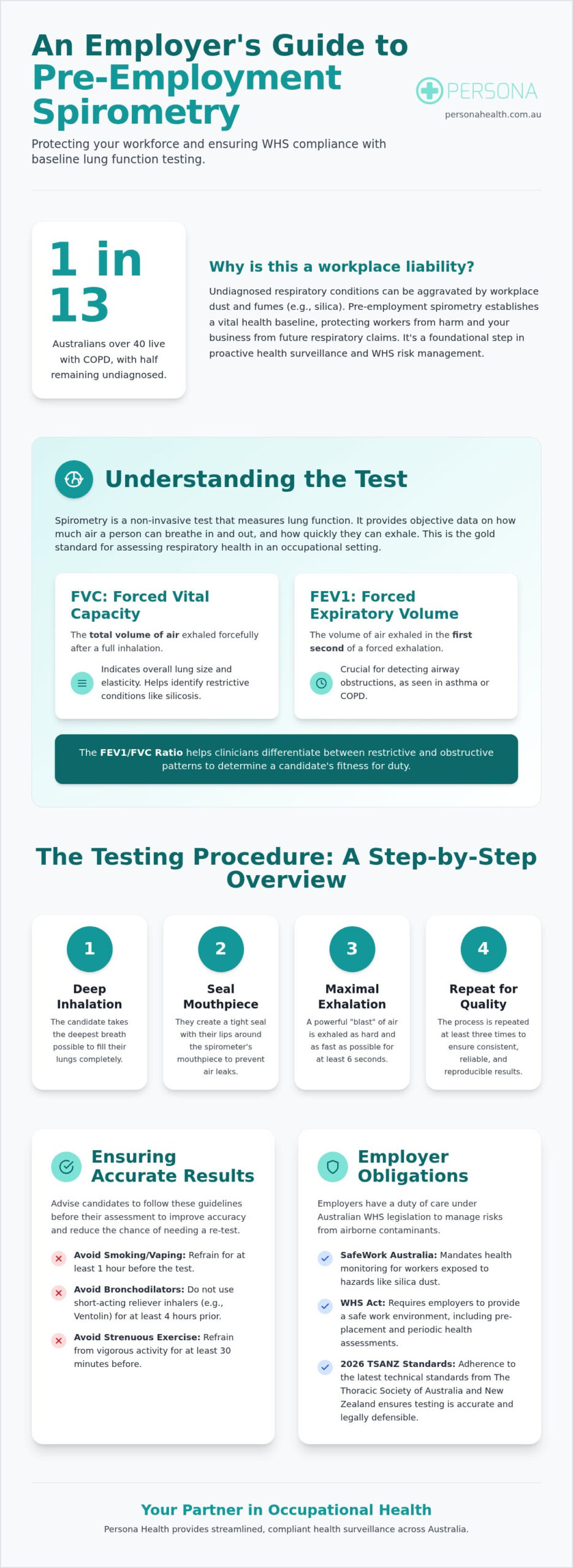
Did you know that approximately 1 in 13 Australians over the age of 40 are living with COPD, yet half of them remain undiagnosed? For employers in high-risk sectors, this isn’t just a clinical statistic; it’s a significant workplace liability. Implementing pre-employment spirometry testing is no longer just about ticking a compliance box. It’s about establishing a vital baseline that protects your workers from long-term harm and your business from future respiratory claims. We understand that managing WHS obligations can feel complex, especially with the transition to Workplace Exposure Limits (WEL) and the updated 2026 TSANZ standards.
You likely want a recruitment process that’s efficient and fair, without the constant anxiety of high candidate failure rates or the looming risks of silica exposure. This guide will help you master the essentials of lung function testing to ensure workplace safety, legislative compliance, and workforce longevity. We’ll preview the technical requirements of the new Australian standards and show you how to build a robust health surveillance strategy. By the end, you’ll have the clarity needed to protect your team’s health while maintaining a productive, compliant operation.
Key Takeaways
- Learn the technical steps of the lung function assessment, including the importance of maximal effort and the correct use of equipment to ensure valid results.
- Stay ahead of your legislative obligations under the WHS Act and SafeWork Australia guidelines, particularly regarding hazardous dust and the updated 2026 TSANZ standards.
- Discover how pre-employment spirometry testing establishes a critical respiratory baseline, protecting your business from future claims while ensuring a healthy workforce.
- Reduce candidate anxiety and improve accuracy by providing clear instructions on avoiding smoking, vaping, and specific medications before their assessment.
- Leverage a national network of clinics and mobile services to streamline your health surveillance and maintain compliance across diverse Australian worksites.
What is Pre-Employment Spirometry Testing?
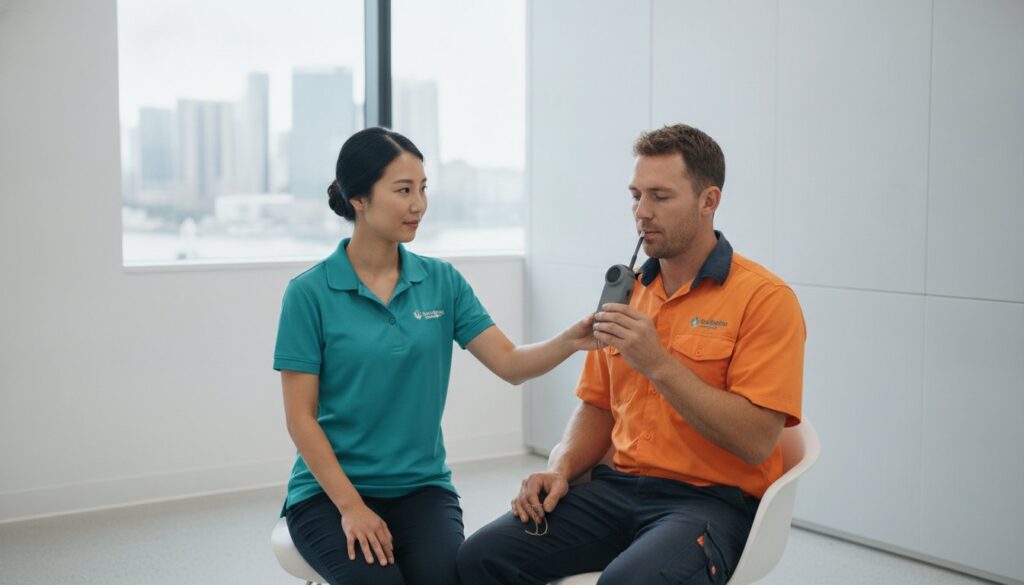
In the context of Australian occupational health, What is spirometry involves a non-invasive but highly precise diagnostic test that measures how well an individual’s lungs function. It’s widely regarded as the gold standard for assessing respiratory health because it provides objective data rather than relying on subjective symptoms. During pre-employment spirometry testing, a candidate breathes into a device called a spirometer, which captures two critical components: the total volume of air they can exhale and the speed at which they can do it.
For employers, this test serves as a foundational health screening tool. It helps identify pre-existing conditions that might be aggravated by workplace environments, such as those involving dust, fumes, or crystalline silica. By establishing a baseline before a worker starts their role, you create a point of comparison for future health surveillance. This is vital for early detection of changes in lung function, ensuring that any work-related impacts are identified long before they become permanent disabilities.
Key Metrics: FVC and FEV1 Explained
To understand the results, we focus on several key measurements. Forced Vital Capacity (FVC) represents the total amount of air a person can forcibly exhale after taking the deepest breath possible. It’s an indicator of overall lung volume. In contrast, Forced Expiratory Volume in one second (FEV1) measures the amount of air exhaled during the first second of that breath. This metric is particularly sensitive to airway obstructions.
- FVC: Helps identify restrictive conditions like silicosis, where lung tissue becomes scarred and less elastic.
- FEV1: Crucial for spotting obstructive issues like asthma or COPD.
- FEV1/FVC Ratio: This calculation determines if the airways are narrowed, helping our clinicians at Persona Health differentiate between various respiratory patterns.
The Clinical vs. Occupational Perspective
While a GP might use spirometry to diagnose a disease, our focus during pre-employment medicals is fitness for duty. We compare a candidate’s results against predicted values tailored to their age, height, and ethnicity. This ensures the assessment is fair and personalised. High-quality results depend on using calibrated equipment and trained technicians who can guide candidates through the specific breathing manoeuvres required. At our clinics in Parramatta and Melbourne, we adhere to the latest 2026 TSANZ standards to ensure every test is accurate and reliable for your compliance needs.
The Procedure: What Happens During a Lung Function Test?
Understanding what happens during the appointment can help ease any candidate nerves. The test is typically performed while seated to ensure safety and stability. A technician provides a disposable mouthpiece connected to the spirometer and a small clip for the nose. This clip ensures that all air being measured passes directly through the mouth and into the device, providing an accurate reading of lung capacity. While the equipment looks technical, the process is straightforward and usually takes about 15 to 20 minutes within a standard occupational health assessment.
Step-by-Step Testing Process
The procedure begins with a brief health questionnaire. The technician will ask about any recent respiratory infections, chest pain, or surgeries that might make the test unsuitable. Once cleared, the active phase begins with three distinct stages:
- The Inhalation: You’ll be asked to take the deepest breath possible, filling your lungs to their absolute limit.
- The Seal: You must place your lips tightly around the mouthpiece to prevent any air leaks.
- The Blast: This is the most critical part. You’ll exhale with maximum force and continue blowing until your lungs are completely empty. This usually requires at least six seconds of continuous effort.
Ensuring Test Quality and Reliability
Consistency is the hallmark of a valid result. Under Australian Standards and the 2026 TSANZ guidelines, a technician looks for “reproducibility.” This means we need at least three acceptable “blows” that show similar results. If the readings vary too much, it suggests the effort wasn’t consistent, and the test may need to be repeated to ensure the data is reliable for your records.
Common errors can occasionally interfere with the data. A candidate might cough during the exhale, fail to take a large enough initial breath, or stop blowing too early. These aren’t “failures” in a medical sense but rather technical issues that need correction. Our technicians are highly trained to coach candidates through these manoeuvres, using encouraging prompts to help them achieve their best possible result. This supportive environment ensures that the pre-employment spirometry testing accurately reflects the individual’s true lung function rather than just their testing technique.
Australian Legislation and Employer Obligations
Under the Work Health and Safety (WHS) Act, Australian employers carry a legal responsibility to eliminate or minimise risks to worker health. This duty becomes particularly acute when your team is exposed to hazardous airborne contaminants. As we approach the 1 December 2026 implementation date for the new Workplace Exposure Limits (WEL), the margin for error has vanished. Transitioning from “standards” to “limits” clarifies that these thresholds must not be exceeded; making pre-employment spirometry testing a vital first step in your risk management strategy. By establishing a clear baseline, you protect the business from liability while ensuring that any future health changes are detected early.
Health Surveillance for Silica and Asbestos
Health monitoring isn’t optional if there’s a significant risk to health from exposure to substances like asbestos or crystalline silica. Under current regulations, including those enforced by SafeWork NSW and WorkSafe Victoria, employers must provide and pay for regular health assessments. This is where crystalline silica medicals become essential. These assessments use spirometry to monitor for early signs of lung scarring or inflammation. If a worker’s results show a significant contraction in lung function, the employer is often required to notify the state regulator and review their current on-site dust control measures immediately.
Privacy and the Privacy Act 1988
Managing the data generated from medical assessments requires a delicate balance of transparency and confidentiality. Respiratory health data is classified as sensitive information under the Privacy Act 1988, meaning it must be handled with the highest level of security. You have a right to know if a candidate is fit for duty, but the specific clinical details of their lung function belong to the individual. Our team helps navigate this by providing clear, actionable fit-for-work certificates that respect candidate privacy while meeting your operational needs.
This process is overseen by an Appointed Medical Practitioner who interprets the data and provides expert guidance on whether a candidate can safely perform their role without risk of further injury. Maintaining these records for the required 30 to 40 years, depending on the specific substance exposure, ensures your business remains compliant and prepared for any future audits or claims. At Persona Health, we manage this documentation meticulously, allowing you to focus on your core operations with total peace of mind.
Candidate Preparation: How to Ensure Accurate Results
Preparing for pre-employment spirometry testing is essential to ensure the data gathered accurately reflects a candidate’s true respiratory health. Small lifestyle choices in the hours leading up to the appointment can significantly alter flow rates and volumes, potentially leading to misleading results. For instance, smoking or vaping within one hour of the test can irritate the airways, causing temporary narrowing that skews the data. Similarly, we recommend avoiding vigorous exercise for at least 30 minutes prior, as physical exhaustion makes it difficult to achieve the required maximal effort during the “blast” phase of the assessment.
The Do’s and Don’ts Before the Appointment
To get the most out of the session, candidates should follow a few practical guidelines. Avoiding alcohol for at least four hours is a standard requirement, as it can affect coordination and the ability to follow the technician’s specific breathing instructions. Clothing choice also plays a vital role; wearing loose-fitting garments around the chest and abdomen allows for unrestricted expansion of the lungs. If a candidate has recently had a chest infection, ear surgery, or abdominal surgery, they must inform our clinic beforehand, as these conditions may require the test to be rescheduled for their safety.
- Medication Use: If a candidate uses a bronchodilator or puffer, they should clarify with the clinic whether to take it. Usually, short-acting inhalers are avoided for several hours before a baseline test to see the lungs’ natural state.
- Dietary Choices: Avoid heavy meals for at least two hours before the test. A full stomach can prevent the diaphragm from moving freely, which limits the volume of air the candidate can inhale.
Reducing Candidate Anxiety
It’s common for candidates to feel a little apprehensive about medical assessments, which can sometimes lead to “white coat syndrome” and shallow breathing. We find that explaining the non-invasive nature of the test helps significantly. There are no needles or uncomfortable procedures involved; it’s simply a series of guided breathing exercises. Our technicians take the time to build rapport and demonstrate the technique first, ensuring the candidate feels supported rather than tested. We always reassure individuals that this baseline is a protective measure, ensuring they aren’t placed in an environment that could compromise their long-term well-being.
If you’re looking to streamline your onboarding process and ensure your team is ready for their assessment, you can find more detail on what happens in a pre-employment medical to help prepare your candidates effectively.
Persona Health: Your Partner in Occupational Health
Choosing a partner for your workforce health needs requires a balance of clinical expertise and operational efficiency. At Persona Health, we’ve designed our pre-employment spirometry testing protocols to be as seamless as possible, ensuring your candidates feel supported while you receive accurate, actionable data. We operate a sophisticated network of clinics across Australia, with primary hubs in Parramatta, Rosebery, Gregory Hills, and Dee Why in Sydney, alongside our Melbourne centres in Cairnlea and Craigieburn. This physical presence, supported by over 100 affiliate clinics and mobile on-site services, ensures we can support your business regardless of where your projects are located.
Our focus is on getting your workforce on-site safely and without unnecessary delay. We pride ourselves on fast turnaround times for medical clearances, understanding that in industries like construction and mining, time is a critical resource. By partnering with us, you’re not just booking a test; you’re accessing a comprehensive system designed to manage the complexities of WHS compliance and worker longevity from day one.
Comprehensive Health Surveillance Solutions
Every industry has its own unique set of risks, which is why we don’t believe in a one-size-fits-all approach. Our pre-employment medicals are highly customisable, allowing you to bundle spirometry with other essential screenings. This is particularly important for high-risk roles where you might need to combine lung function tests with asbestos medicals, hearing assessments, or crystalline silica monitoring. We also provide specialised packages for the rail, transport, and construction sectors, ensuring every legislative requirement is met before the first shift begins.
Innovative Injury Management with InjuryQR
Our commitment to your workforce doesn’t end once the pre-employment phase is complete. We understand that workplace safety is an ongoing journey, which is why we provide all our partners with access to InjuryQR. This is a free, AI-powered triage service designed specifically for Australian businesses. It requires no app installation; workers simply scan a QR code and describe their injury using their voice. The AI then asks follow-up questions to determine the best course of action, whether it’s self-care, a telehealth consultation, or emergency intervention.
This innovative approach offers several tangible benefits for your business:
- Reduced Lost Time Injuries (LTIs): Immediate triage prevents minor issues from escalating into long-term claims.
- Instant Documentation: The system can provide immediate Certificates of Capacity, keeping the return-to-work process moving.
- Data-Driven Safety: Real-time reporting helps you identify injury trends and improve on-site safety protocols.
By integrating these advanced tools with our clinical expertise, we help you build a resilient, healthy, and fully compliant workforce for the long term.
Securing the Future of Your Workforce
Prioritising respiratory health is a long-term investment in both your people and your business stability. By implementing pre-employment spirometry testing, you establish a critical baseline that safeguards against future liability while ensuring every team member is fit for their specific environment. We’ve explored how the 2026 Australian standards and the transition to Workplace Exposure Limits make precise data more important than ever. When you understand the procedure and prepare your candidates correctly, the process becomes a supportive step toward a safer worksite.
Persona Health is ready to be your modern professional partner in this journey. With our core clinics in Sydney and Melbourne, an extensive network of 100 affiliate locations, and our AI-powered InjuryQR triage service, we provide the stability and expertise you need for full SafeWork Australia compliance. Our goal is to make workforce health management simple, reliable, and deeply focused on individual well-being.
Book your pre-employment spirometry testing with Persona Health today and take the next step toward a healthier, more resilient workforce. We look forward to supporting your team’s growth and safety.
Frequently Asked Questions
Can I fail a pre-employment spirometry test?
You don’t “fail” in a traditional sense, but your results might indicate that you aren’t currently fit for a specific high-risk role. Our clinicians assess your lung function against predicted values based on your age and height to determine if the workplace environment poses a risk to your health. If an issue is identified, it’s often a catalyst for further medical investigation rather than an immediate disqualification from all types of work.
How long does a lung function test take to complete?
A standard screening session typically takes between 15 and 20 minutes to complete. This timeframe includes the initial briefing, the respiratory health questionnaire, and the multiple breathing manoeuvres required to ensure we have reproducible, high-quality data. It’s a quick but thorough process that fits easily into a standard pre-employment medical appointment at any of our national clinic locations.
Is spirometry mandatory for all construction workers in Australia?
Spirometry isn’t mandatory for every construction worker, but it is required for those exposed to specific respiratory hazards. Under SafeWork Australia regulations, if your role involves significant exposure to crystalline silica, asbestos, or certain chemical fumes, your employer must provide health monitoring. This includes pre-employment spirometry testing to establish your baseline health before you begin on-site work.
What happens if my results show a reduced lung capacity?
If your results indicate reduced capacity, you’ll be referred for a more detailed clinical review. This might involve a follow-up with your GP or a respiratory specialist to determine the underlying cause of the obstruction or restriction. For the employer, it may trigger a review of workplace dust controls or a temporary adjustment to your duties to ensure your long-term safety.
How often should employees undergo follow-up spirometry testing?
The frequency of follow-up testing depends on the level of risk and the specific hazardous substances involved in your workplace. For workers exposed to crystalline silica, health monitoring is often required annually or every two years depending on state-specific regulations. Your Appointed Medical Practitioner will recommend a schedule that aligns with current WHS legislation and the specific needs of your work environment.
Do I need to stop using my asthma inhaler before the test?
You’ll often be asked to withhold short-acting bronchodilators for several hours before the test. This allows us to measure your natural, baseline lung function without the temporary boost provided by medication. However, you should never stop taking long-term preventer inhalers or other essential medications without first speaking to your doctor or our clinic staff during the booking process.
What is the difference between spirometry and a chest X-ray?
Spirometry measures how well your lungs function, while a chest X-ray looks at the physical structure of your lungs. Think of it as the difference between checking how fast a car can drive versus taking a photo of the engine. Both tools are useful, but spirometry is often better at detecting early changes in airway health before they show up on a physical X-ray scan.
Can a recent cold or flu affect my spirometry results?
Yes, a recent respiratory infection can temporarily lower your results due to lingering inflammation or airway sensitivity. If you’ve had a cold or flu in the last few weeks, it’s best to let the technician know before you begin. In some cases, we may recommend rescheduling the pre-employment spirometry testing to ensure we capture your true, healthy baseline rather than a temporary dip.

Article by
Ian Nicholson
Ian is the Business Support Manager at Persona Health, where he plays a key role across IT, sales, marketing and business operations. With a broad skill set and a practical, solutions-focused approach, Ian helps drive the systems, communication and commercial strategy that support Persona Health’s continued growth across Australia.