

Did you know that over 400 Australian workers suffer a serious injury every single day? It’s a sobering reality for business owners in Sydney and Melbourne, especially as workers’ compensation premiums continue to climb. You likely feel the pressure of keeping your team safe while navigating the complex 2026 legislative landscape, including mandatory New South Wales Codes of Practice and the growing demand for workplace injury prevention services. We understand that managing health and safety isn’t just about ticking boxes; it’s about protecting the unique individuals who make your business thrive.
This guide explores how your organisation can stay ahead of these risks by bridging the gap between clinical data and employee wellbeing. You’ll learn how to reduce Lost Time Injuries through expert-led health surveillance, specialised medicals, and innovative triage technology like InjuryQR. We provide a clear roadmap for achieving full compliance with Australian WHS legislation while building a healthier, more productive workforce for the years ahead. By adopting a proactive, clinical approach to safety, you can ensure your staff are in expert hands where their individual needs are always the priority.
Key Takeaways
- Understand how clinical and consultative workplace injury prevention services identify health risks early to ensure full compliance with evolving 2026 Australian WHS legislation.
- Learn why the recruitment process is the ideal time to start preventing injuries by using specialised medical assessments to match worker capabilities with job demands.
- Discover the critical importance of mandatory health surveillance for managing high-risk exposures to hazardous substances like crystalline silica and asbestos.
- Explore how AI-driven triage tools like InjuryQR provide immediate support for on-site incidents, helping to prevent minor injuries from escalating into costly claims.
- Gain practical advice on implementing a comprehensive prevention program through on-site services and a broad network of clinics across Sydney and Melbourne.
What Are Workplace Injury Prevention Services and Why Do They Matter?
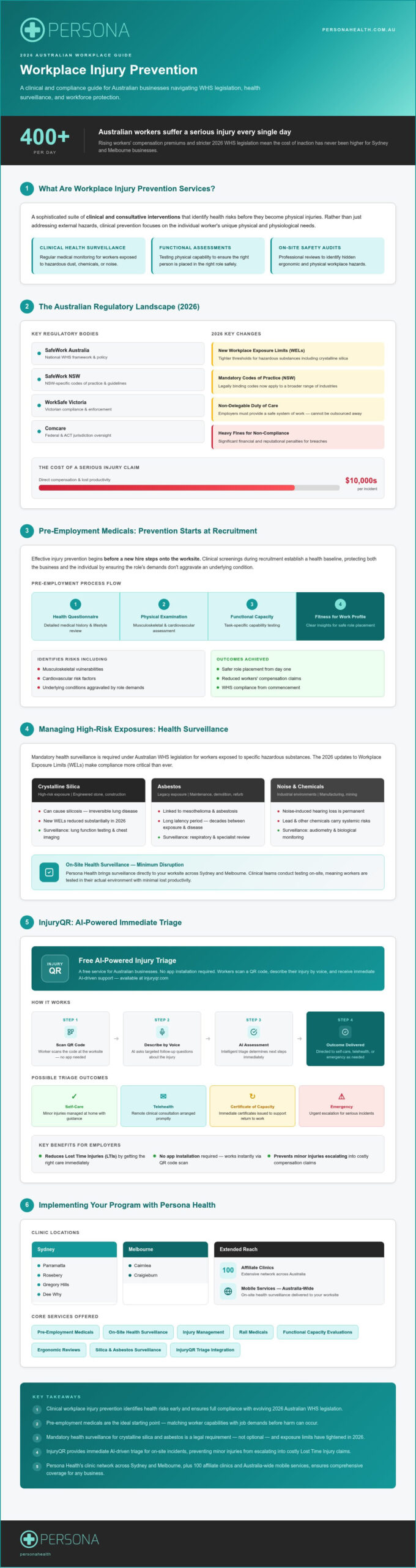
Workplace injury prevention services are more than just a box-ticking exercise for compliance. At their core, these services represent a sophisticated suite of clinical and consultative interventions designed to identify health risks before they manifest as physical injuries. While traditional safety measures often focus on external hazards, clinical prevention looks at the individual worker. It’s about understanding the unique physical and physiological needs of your workforce to ensure they stay safe on the job. We believe that every worker’s body is unique, and our approach reflects this by providing tailored care that goes beyond generic safety posters.
This proactive approach is deeply rooted in the principles of Occupational safety and health (OSH), which prioritises the elimination of risks at the source. In Australia, this isn’t just best practice; it’s a legal necessity. As of 2026, the regulatory environment has become even more stringent. With the transition to new Workplace Exposure Limits (WELs) and mandatory Codes of Practice, businesses in Sydney and Melbourne must adopt a more clinical perspective on safety to remain compliant and protective of their staff.
The Australian Regulatory Landscape
SafeWork Australia sets the national framework, but state bodies like SafeWork NSW and WorkSafe Victoria provide the specific guidelines you must follow. Under current WHS legislation, employers have a non-delegable duty to provide a safe system of work. This includes proactive health monitoring for staff exposed to specific hazards. If you operate in Sydney or Melbourne, you’re expected to meet these standards or prove your methods are superior. Failing to do so doesn’t just risk heavy fines; it leaves your people vulnerable to avoidable harm.
Key Components of a Prevention Strategy
An effective strategy moves beyond basic personal protective equipment (PPE). It integrates clinical data through on-site health surveillance to monitor for exposures like silica or lead. It also includes functional capacity evaluations to ensure a worker is physically capable of the task at hand. By combining these with ergonomic reviews, you create a holistic shield for your team. Key elements include:
- Clinical health surveillance: Regular medical monitoring for workers exposed to hazardous dust, chemicals, or noise.
- Functional assessments: Testing physical capability to ensure the right person is in the right role.
- On-site safety audits: Professional reviews to identify hidden ergonomic and physical hazards.
Reducing the frequency of incidents directly impacts your bottom line. A serious injury claim can cost tens of thousands in compensation and lost productivity. By investing in professional workplace injury prevention services, you aren’t just fulfilling a legal mandate; you’re protecting your most valuable asset and ensuring the long-term viability of your business.
The Foundation: Pre-Employment Medicals as a Prevention Tool
Effective workplace injury prevention services begin long before a new hire steps onto the worksite. By integrating clinical screenings into your recruitment phase, you establish a baseline for health and safety that protects both the business and the individual. It’s not about excluding candidates; it’s about ensuring the role’s physical demands don’t aggravate an underlying condition. We focus on identifying musculoskeletal vulnerabilities or cardiovascular risks that might lead to a serious incident down the line. Following WorkSafe Victoria guidance, these assessments help you build a safe system of work from day one.
The process is methodical and supportive. We start with a detailed health questionnaire followed by comprehensive physical examinations. This data allows us to create a ‘Fitness for Work’ profile for every new hire, giving you clear insights into their capacity to perform specific tasks safely. If you’re ready to secure your next hire with confidence, our team can guide you through the pre-employment medical process at our clinics in Sydney or Melbourne.
Specialised Medical Assessments
Different industries require different clinical lenses to maintain safety. For those in the transport and infrastructure sectors, we provide Cat 3 Rail Medicals to ensure workers meet national safety standards. We also conduct commercial vehicle driver medicals and seafarer medicals for domestic workers. These specialised workplace injury prevention services are tailored to the specific legislative requirements of each industry, ensuring both regulatory compliance and individual safety.
Physical Abilities and Functional Testing
While a standard medical checks general health, functional testing looks at real-world performance. We measure range of motion, grip strength, and lifting capacity to identify potential musculoskeletal risks. This ensures that a worker’s physical attributes align with the actual requirements of their job description, reducing the likelihood of strains or overexertion. The Physical Abilities Test (PAT) is the gold standard for high-risk roles in 2026. By testing real-world movements, we can accurately predict how a body will respond to the rigours of the workplace, allowing for better-informed placement and reduced injury rates.
Managing High-Risk Exposures: Silica and Asbestos Surveillance
For industries dealing with construction, mining, or stone masonry, the most significant threats to worker longevity are often invisible. Hazardous dusts like respirable crystalline silica and asbestos pose long-term respiratory risks that require specialised clinical oversight as part of your broader workplace injury prevention services. Unlike a physical strain that might heal with rest, dust-related diseases are often progressive and irreversible. This makes early detection through rigorous health monitoring not just a legal requirement, but a moral imperative. Employers must provide health monitoring if there’s a significant risk to a worker’s health because of exposure to a scheduled substance, as outlined in the official code of practice for managing WHS risks. Since July 2026, these Codes of Practice have become mandatory in New South Wales, meaning your prevention strategies must meet or exceed these standards to avoid heavy penalties.
Crystalline Silica Monitoring Requirements
The regulatory landscape for silica has tightened significantly. With the 2026 transition to more stringent Workplace Exposure Limits (WELs), businesses must lower their internal thresholds for triggering surveillance. Compliance for Crystalline Silica Medicals involves mandatory lung function testing (spirometry) and, in many cases, high-resolution chest X-rays interpreted by a B-reader. We recommend testing at the commencement of employment and then at regular intervals, typically every 12 to 24 months, depending on the exposure levels. Persona Health manages the complex record-keeping required by SafeWork NSW and WorkSafe Victoria, ensuring your business remains compliant while your workers remain safe. Our approach ensures that every worker receives a personalised assessment that considers their specific role and exposure history.
Asbestos and Hazardous Substance Surveillance
Beyond silica, Asbestos Medicals are vital for workers involved in the repair, removal, or modification of legacy materials installed before the 2024 national ban. Our surveillance programs also cover scheduled chemicals like lead and other hazardous substances found in manufacturing and industrial settings. We believe clinical oversight should always be led by an Occupational Physician to ensure accurate interpretation of results and to provide peace of mind to your team. To strengthen your prevention strategy, we integrate mask fit testing into our on-site health surveillance programs. This ensures that the respiratory protection you provide actually fits the individual’s unique facial structure, providing a complete circle of protection that generic safety measures simply cannot match.
Immediate Triage: The Role of InjuryQR in Modern Workplaces
Even the most robust workplace injury prevention services cannot eliminate every possible risk on a busy worksite. When an incident occurs, the speed and quality of the initial response determine whether a worker returns to duty quickly or enters a long, costly claims cycle. This is where InjuryQR changes the game for Australian businesses. It’s a free, AI-powered triage service that requires no app installation, ensuring that clinical help is available the moment it’s needed. By providing immediate guidance, you can prevent minor strains or scratches from escalating into major workers’ compensation claims.
How InjuryQR Works in the Field
The process is designed for high-pressure moments when every second counts. A worker simply scans a QR code located in the staff room or on their safety equipment and describes their injury using their voice. The AI then asks targeted follow-up questions to assess the severity of the situation. Within seconds, the system provides a clear outcome: immediate self-care advice, a direct link to a telehealth doctor, or a prompt to call emergency services. Simultaneously, the system sends real-time notifications to supervisors and WHS managers. This rapid response is a cornerstone of modern injury management, providing a seamless bridge between the incident and professional care.
Benefits for Employers and HR Managers
For HR professionals, the advantages of instant triage are clear and measurable. You’ll see a significant reduction in Lost Time Injury (LTI) rates because workers receive the right care immediately rather than waiting for an appointment. The system also streamlines the reporting process, ensuring all data collection meets the strict requirements of the Privacy Act 1988. Beyond the numbers, providing your team with instant clinical support builds immense trust. It shows your staff that their health is a genuine priority, which significantly improves workplace morale. Integrating these digital tools into your workplace injury prevention services ensures that your safety net is always active, even when you aren’t physically present on-site.
If you’re looking to modernise your safety protocols and support your workforce more effectively, you can learn more about our injury management solutions today.
Implementing Your Injury Prevention Program with Persona Health
Integrating professional workplace injury prevention services into your daily operations shouldn’t be a source of stress. We’ve designed our processes to be as seamless as possible, allowing you to focus on your core business while we manage the clinical complexities of WHS compliance. Whether you need to book on-site health surveillance for a large construction crew or require a one-off assessment, our team provides the expert oversight needed to protect your workforce. Partnering with an Injury Management Consultant (IMC) can further refine your strategy, offering tailored advice that aligns with your specific industry risks and operational goals.
We understand that in recruitment and safety management, time is of the essence. That’s why we pride ourselves on fast turnaround times for medical reports. You won’t be left waiting for weeks to clear a new starter or review a health surveillance result. Our employer-focused approach ensures that you receive clear, actionable data quickly, keeping your projects moving without compromising on safety standards. We believe that every organisation’s needs are unique, and our reporting reflects this by providing specific insights tailored to your workplace environment.
Our Sydney and Melbourne Clinic Locations
For Sydney-based businesses, we offer convenient access through our clinics in Parramatta, Rosebery, Gregory Hills, and Dee Why. These locations are strategically placed to support key industrial and commercial hubs across the metropolitan area. In Melbourne, our facilities in Cairnlea and Craigieburn provide essential support to the growing industrial sectors in the north and west. If your workforce is spread across the country, you can still access our high standards of care through an extensive network of over 100 affiliate clinics and our Australia-wide mobile services.
Next Steps for Your Business
Taking the first step toward a safer workplace is straightforward. You can start by requesting a quote for a comprehensive injury prevention audit to identify gaps in your current protocols. Setting up your free InjuryQR account is an immediate way to protect your on-site staff from the moment an incident occurs. Finally, booking your next round of pre-employment medicals ensures that every new team member is fit for their unique role. We’re here to guide you through every stage of this journey, ensuring that your workplace injury prevention services are as unique as the people they protect.
Building a Safer Workforce for the Future
Protecting your team in 2026 requires a shift from reactive safety to proactive clinical care. By integrating expert-led health surveillance and specialised medicals into your operations, you ensure that every worker is physically matched to their role and protected from long-term risks. We’ve seen how innovative tools like InjuryQR and targeted workplace injury prevention services can transform safety outcomes, reducing Lost Time Injuries while maintaining strict WHS compliance across Sydney and Melbourne.
Our team of expert Occupational Physicians is dedicated to providing you with the clinical clarity needed to manage complex workforce health requirements. With fast turnaround on all medical reports and our free InjuryQR triage tool available for all clients, you can keep your projects moving without compromising on individual care. It’s about building a foundation of trust and reliability that supports your business goals and your people’s wellbeing.
Secure your workforce and request a quote for injury prevention services today.
You don’t have to navigate these regulatory changes alone; we’re here to support you in creating a healthier, more productive workplace for everyone.
Frequently Asked Questions
What are the most effective workplace injury prevention services for high-risk industries?
Clinical health surveillance and functional capacity assessments are the most effective tools for high-risk sectors like construction and manufacturing. These services identify physiological risks and ensure workers are physically capable of their specific tasks. Combining these clinical measures with AI-driven triage technology ensures that your safety strategy is both proactive and prepared for immediate response when incidents occur.
How do pre-employment medicals help prevent workplace injuries?
Pre-employment medicals prevent injuries by establishing a baseline of health and identifying pre-existing conditions that might be aggravated by job demands. By matching a worker’s physical capacity to the specific requirements of a role, you significantly lower the risk of overexertion and musculoskeletal strains. This clinical matching process is a fundamental step in building a safe and sustainable workforce.
Is health surveillance for silica dust mandatory in Australia?
Yes, health monitoring for silica dust is mandatory across Australia for workers at significant risk of exposure to respirable crystalline silica. Under the 2026 Workplace Exposure Limits, employers must provide regular medical assessments, including lung function testing and chest X-rays. These requirements are strictly enforced by state bodies like SafeWork NSW and WorkSafe Victoria to protect workers from progressive respiratory diseases.
How does the InjuryQR triage system work for injured workers?
InjuryQR works through a simple scan-and-speak process that requires no app installation on the worker’s phone. A worker scans a site-specific code, describes their injury by voice, and follows AI-driven prompts to assess severity. The system then provides immediate care advice, telehealth referrals, or emergency alerts while notifying supervisors and WHS managers in real-time to ensure seamless injury management.
Can workplace injury prevention services reduce our workers’ compensation premiums?
Investing in comprehensive workplace injury prevention services can lead to lower workers’ compensation premiums over time. By reducing the frequency and severity of claims through early intervention and clinical screening, you improve your organisation’s claims history. A better safety record often results in lower insurance costs and a significant increase in overall business productivity and GDP contributions.
What is the difference between a GP and an Occupational Physician for injury management?
While a GP focuses on general community health, an Occupational Physician specialises in the complex relationship between health and the work environment. They provide expert clinical oversight for injury management and surveillance, ensuring that outcomes are tailored to both the worker’s recovery and the employer’s operational needs. Their specialised training allows for a more nuanced approach to fitness-for-duty and workplace accommodations.
How often should employees undergo health monitoring for hazardous substances?
The frequency of health monitoring depends on the specific substance and exposure levels, but it typically occurs every 12 to 24 months. For high-risk exposures like crystalline silica or asbestos, your Occupational Physician will determine the schedule based on clinical data and relevant Australian Standards. Regular monitoring is essential to detect early physiological changes before they develop into serious health conditions.
Does Persona Health provide on-site hearing and lung function testing?
Persona Health provides comprehensive on-site health surveillance, including audiometry and spirometry testing, directly at your workplace. Our mobile services bring these essential workplace injury prevention services to your worksite in Sydney or Melbourne, minimising downtime for your team. This ensures that your workers receive high-quality clinical care without the logistical challenges of visiting an external clinic during work hours.

Article by
Ian Nicholson
Ian is the Business Support Manager at Persona Health, where he plays a key role across IT, sales, marketing and business operations. With a broad skill set and a practical, solutions-focused approach, Ian helps drive the systems, communication and commercial strategy that support Persona Health’s continued growth across Australia.