

A random drug test shouldn’t feel like a police interrogation; it should serve as a supportive safety net for your most valuable assets. Many managers across the state worry that introducing random drug testing programs for workplace nsw might damage team morale or lead to legal repercussions from Fair Work. You want to ensure every person returns home safely, yet the technical shift to the AS/NZS 4308:2023 standard and the transition deadline in November 2026 can feel incredibly daunting. It’s natural to seek a balance between clinical authority and employee wellbeing.
In this guide, you’ll learn how to implement a legally compliant and safety-focused programme that aligns with SafeWork Australia requirements. We’ll provide a clear framework for a robust policy that respects privacy while prioritising clinical accuracy. We’ll also preview how professional drug and alcohol testing can significantly reduce workplace incidents. While we support businesses across the region, those with interstate operations can also find our expert teams at our new Melbourne clinics in Cairnlea and Craigieburn. This guide ensures you have the professional support to lead with confidence, knowing your team is in expert hands.
Key Takeaways
- Understand your legal obligations under the NSW WHS Act 2011 and how following SafeWork Australia guidance protects both your business and your people.
- Learn how to align your random drug testing programs for workplace nsw with the mandatory AS/NZS 4308:2023 urine testing standards before the November 2026 deadline.
- Discover how a professional clinical approach helps bridge the gap between safety obligations and employee privacy concerns to maintain a positive culture.
- Gain a step-by-step framework for consulting with your team and defining clear “Fitness for Work” expectations within your company policy.
- Find out how Persona Health supports your safety goals through expert drug and alcohol testing, including our new clinic locations in Cairnlea and Craigieburn.
The Legal Basis for Random Drug Testing in NSW Workplaces
Under the Work Health and Safety Act 2011, employers in New South Wales carry a primary duty of care to ensure the health and safety of their workers. This legal obligation means you must take all reasonably practicable steps to eliminate or minimise risks in your environment. Implementing random drug testing programs for workplace nsw is a proactive way to meet these requirements, particularly when impairment could lead to serious injury or life-altering accidents. It is a commitment to the collective wellbeing of your team.
As a Person Conducting a Business or Undertaking (PCBU), your responsibility extends to identifying hazards that could compromise site safety. In high-risk sectors such as construction, mining, and transport, the presence of substances is a recognised hazard that requires a structured response. For example, those involved in the rail industry often integrate these checks alongside Cat 3 rail medicals to maintain strict compliance. SafeWork Australia advocates for a risk-based approach, where testing serves as one component of a broader health and safety management system.
To better understand how these safety measures function in an Australian context, watch this helpful video:
Duty of Care vs Individual Privacy
It’s common for employees to worry that testing might infringe upon their private lives. Australian industrial courts have addressed this by ruling that the right to a safe workplace generally outweighs individual privacy concerns in safety-critical roles. The focus remains on whether an individual is fit for duty at the moment they clock in. By utilising professional drug testing methodologies, you can ensure results are accurate and the process is handled with the utmost dignity. You must have a clearly defined written policy established before any testing commences to protect both the business and the individual.
The Role of SafeWork NSW Guidelines
SafeWork NSW provides a clear framework for managing drug and alcohol risks, emphasizing that testing should never be a standalone solution. Their guidelines require you to consult with your workers and any relevant unions during the development of your drug and alcohol policy. This collaborative approach helps demystify the process and reinforces the message that random drug testing programs for workplace nsw are safety tools rather than disciplinary weapons. At Persona Health, we bring this clinical authority to every consultation, whether at your site or our new clinics in Cairnlea and Craigieburn. We help you build a culture where safety is a shared value, ensuring your policy is both legally robust and deeply empathetic to your staff’s needs.
Key Components of a Robust Workplace Testing Programme
A successful programme is built on more than just the tests themselves; it requires a transparent policy that your team understands and trusts. When you design random drug testing programs for workplace nsw, you’re creating a system that balances clinical precision with operational reality. A well-structured approach ensures that every worker feels supported rather than targeted. This starts with a clear Drug and Alcohol Policy that outlines the “why” behind the testing, ensuring everyone is aware of their WHS duties for employers and employees alike.
Choosing Between Saliva and Urine Testing
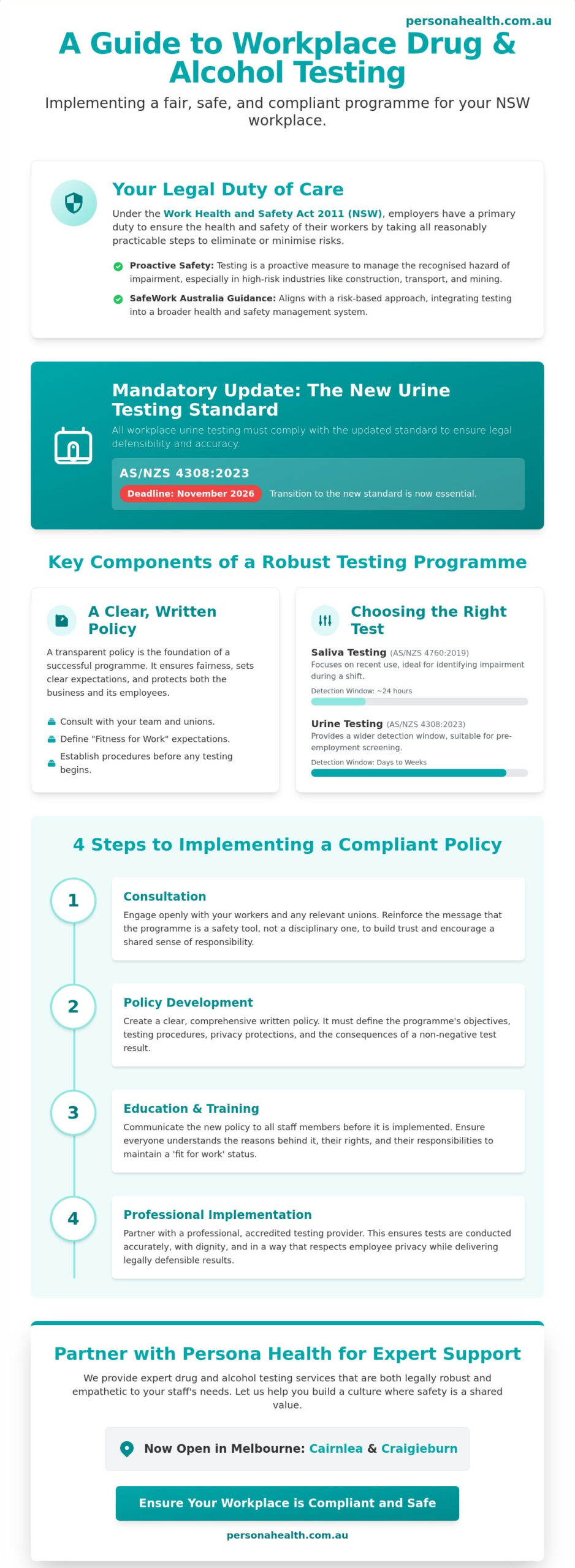
Selecting the right methodology is crucial for the effectiveness of your safety programmes. Saliva testing, governed by AS/NZS 4760:2019, is often preferred for random workplace checks because it focuses on recent use, typically detecting substances consumed within the last 24 hours. This makes it an excellent tool for identifying potential impairment during a shift. Conversely, urine testing provides a wider detection window, making it suitable for pre-employment medicals or return-to-work scenarios. While saliva collection is less invasive and can be done easily on-site, urine testing often requires more controlled facilities to prevent sample tampering.
Compliance with Australian Standards
To ensure your results are legally defensible, your programme must strictly adhere to current Australian Standards. The landscape is currently shifting, as all urine-based testing must transition to the new AS/NZS 4308:2023 standard by November 2026. This update introduces more sensitive cut-off levels and changes the terminology for presumptive positives from “non-negative” to “not-negative”. For saliva testing, the AS/NZS 4760:2019 standard now mandates the inclusion of Oxycodone in the testing panel.
Maintaining a secure chain of custody is non-negotiable. If a screening test returns a not-negative result, the sample must be sent to a NATA-accredited laboratory for confirmatory testing. This is where a Medical Review Officer (MRO) becomes essential. They act as an independent clinical expert who reviews the lab results alongside the individual’s medical history, ensuring that a positive result isn’t actually caused by legitimate prescription medication. This level of professional oversight reduces anxiety for your staff and provides you with absolute certainty. If you’re looking to integrate these checks into a broader health strategy, our team can assist with on-site health surveillance to keep your workforce thriving. Whether you’re based in Sydney or managing sites near our new Melbourne locations in Cairnlea and Craigieburn, clinical consistency is key to a safer workplace.
Balancing Safety Obligations with Employee Privacy Rights
The most common hurdle in launching random drug testing programs for workplace nsw isn’t the logistics; it’s the human element. It is completely natural for employees to feel a sense of unease when their personal privacy is involved. However, the conversation shifts when we frame testing as a collective safety net rather than an intrusive surveillance tool. Every worker has a right to know that the person operating the heavy machinery next to them is fully alert and capable. This balance is achieved by following SafeWork NSW guidelines, which prioritise risk management over punitive action.
Managing the “Privacy” Objection
Communication is your most powerful tool for easing anxiety. When you introduce the programme, lead with the “Safety First” message. Explain that the goal is to prevent accidents and support wellbeing, not to police private lives. Having empathetic clinical staff perform the collections makes a significant difference. Our team approaches every interaction with a calm, professional manner that respects the individual’s dignity. We understand that disclosing prescription medication can feel vulnerable. That’s why we maintain strict clinical confidentiality, ensuring that private medical information is only used to determine if an individual is safe to work. This professional separation helps maintain a positive workplace culture and reduces the fear of unfair judgment.
Fair Work Commission Perspectives
The Fair Work Commission has consistently supported drug testing when it’s deemed a reasonable and proportionate response to workplace risks. The key word here is “reasonable.” To remain compliant, your selection process must be truly random. If employees feel they’re being targeted or that the testing is inconsistent, you risk damaging morale and facing legal challenges. True randomness ensures fairness across all levels of the organisation, from the warehouse floor to the executive suite. For complex cases where an employee’s medical history might intersect with their role’s safety requirements, we recommend a more detailed fitness for duty assessment. This tailored approach ensures that every individual is treated as a unique case rather than a number. Our expertise in these delicate situations is available at our Sydney locations and our expanding network in Melbourne, including our new clinics in Cairnlea and Craigieburn. We’re here to help you lead with empathy while keeping your site secure.
Steps to Implementing a Compliant Testing Policy in NSW
Implementing random drug testing programs for workplace nsw requires a methodical roadmap. It isn’t enough to simply buy kits and start testing. You need a structure that workers understand and respect. This begins with a clear definition of “Fitness for Work.” You must explicitly state what constitutes a breach, such as a confirmed positive result or a refusal to test. This clarity protects the business while giving employees a fair boundary to work within. Your policy should also detail how often tests occur and the specific method used for random selection to ensure no one feels unfairly targeted. Consistency is the foundation of a legally defensible programme.
The Consultation Process
SafeWork NSW mandates that you consult with your team during policy development. This isn’t just a legal checkbox; it’s an opportunity to build trust. When workers feel heard, pushback regarding privacy often diminishes. We recommend running employee awareness sessions that focus on the “why” of the programme. These sessions should explain how testing integrates with your broader on-site health surveillance. It’s about looking after the whole person, not just looking for a reason to discipline. During these sessions, be open to feedback and explain the clinical safeguards in place to protect their personal data. This transparency helps shift the perception of testing from a hurdle to a shared safety benefit.
Responding to Non-Negative Results
Handling a “not-negative” result requires a steady, clinical hand. It’s vital to distinguish between a presumptive result on-site and a confirmed laboratory positive. Under the new AS/NZS 4308:2023 standard, the term “non-negative” has been updated to “not-negative” to reflect the clinical nature of the finding. If a worker returns a not-negative result, they should be safely removed from safety-critical duties immediately. However, this is where empathy must lead. Instead of immediate dismissal, consider a supportive pathway. This is where injury management plays a vital role. By supporting a worker through rehabilitation or counselling, you preserve your investment in that person while maintaining a safe site. This approach ensures that random drug testing programs for workplace nsw serve as a tool for safety and support rather than just punishment.
Whether you’re operating out of Sydney or managing sites near our new Melbourne clinics in Cairnlea and Craigieburn, we provide the professional clinical support to manage these sensitive situations. We help you navigate the complexities of Fair Work compliance while keeping your team’s wellbeing at the forefront. If you need help designing a compliant policy, book a consultation for fitness for duty medicals to ensure your workplace remains secure and supportive.
Professional Drug and Alcohol Testing with Persona Health
Persona Health understands that safety isn’t a one-size-fits-all solution. When you choose us to manage your random drug testing programs for workplace nsw, you aren’t just hiring a testing service. You’re partnering with a clinical team that understands the industrial landscape of New South Wales. We blend rigorous medical standards with a deep sense of empathy, ensuring that every interaction supports the individual while protecting the collective. This clinical authority is balanced by a commitment to your operational needs, making compliance feel like a natural part of your daily workflow. Every test we perform is a step toward a healthier, more sustainable team culture.
Beyond standard checks, we provide specialised assessments that keep high-risk industries moving. For example, our Cat 3 Rail Medicals ensure that transport workers meet the highest safety benchmarks required by law. We don’t just tick boxes; we look for the unique strengths and needs of your workforce, providing a holistic view of health and safety. Our practitioners are trained to handle sensitive disclosures with the professionalism your staff deserves, ensuring that trust remains the foundation of your safety programme.
Melbourne Expansion: Cairnlea and Craigieburn
We are thrilled to announce that our clinical expertise is expanding beyond New South Wales. Our new facilities in Cairnlea and Craigieburn are now open to serve the growing Melbourne region. These sites are strategically located to support the local infrastructure, transport, and logistics sectors that keep Victoria moving. We believe in being where the work happens, providing local businesses with the same high-quality care we’ve delivered in Sydney for years. We invite local managers and safety officers to tour our new Craigieburn and Cairnlea sites to see our clinical standards in person. It is an opportunity to meet the team that will help you maintain a safer, more resilient workforce.
On-Site and Clinic-Based Solutions
Logistics shouldn’t be a barrier to a safer workplace. For businesses with large shifts or remote sites, our on-site testing offers unparalleled convenience. We bring the clinic to you, minimising downtime and ensuring that random drug testing programs for workplace nsw are conducted with minimal disruption to your operations. This is particularly effective for construction or manufacturing sites where stopping work for travel isn’t practical. Our on-site teams follow the same strict chain of custody protocols used in our clinics, ensuring every result is legally defensible and clinically sound.
If your needs are more individualised, our clinics in Parramatta and Sydney provide a controlled, professional environment for assessments. Whether it’s a pre-employment medical or a follow-up after a not-negative result, our clinics offer a supportive space for workers to discuss their health. We encourage you to book a drug and alcohol testing consultation today. Let us help you navigate the 2026 standards with confidence, knowing your team is in expert hands.
Securing Your Workplace Safety for 2026 and Beyond
Building a safer environment starts with a clear policy and a commitment to clinical excellence. You now have the framework to implement random drug testing programs for workplace nsw that function as a supportive safety net rather than a disciplinary measure. By aligning with SafeWork NSW standards and respecting employee privacy, you foster a culture where everyone feels protected. Our expert Medical Review Officer support ensures every result is verified with professional precision, giving you and your team absolute peace of mind.
Whether you’re operating across Sydney or visiting our new Melbourne clinics in Cairnlea and Craigieburn, Persona Health is ready to support your safety journey. We offer the clinical expertise and industrial knowledge required to navigate the complex 2026 regulatory landscape. Don’t leave your compliance to chance when expert guidance is just a conversation away. We invite you to Book a Professional Drug and Alcohol Testing Consultation to secure your facility today. Your team’s wellbeing is our highest priority, and we’re here to lead the way together.
Frequently Asked Questions
Is random drug testing legal in NSW?
Random drug testing is entirely legal in New South Wales when implemented as part of a robust work health and safety strategy. Under the NSW WHS Act 2011, employers have a duty of care to ensure a safe environment, which justifies testing in safety-critical roles. You must have a clear, written policy in place that has been developed in consultation with your workforce. This ensures the process is transparent and respects the rights of every individual on your site.
What industries in NSW are required to have drug testing?
High-risk industries such as mining, rail, transport, and construction often have mandatory requirements or strong industry standards for testing. For instance, the rail sector follows strict protocols that we support through our Cat 3 rail medicals. While not every office-based business requires it, any role involving heavy machinery or public safety should consider random drug testing programs for workplace nsw to maintain site security.
Can an employee refuse a random drug test?
An employee can technically refuse a test, but doing so usually constitutes a breach of their employment contract or the company’s safety policy. If your policy is clearly communicated and reasonable, a refusal is often treated as a “not-negative” result or a disciplinary matter. We recommend a supportive approach where you explain the safety benefits to the individual. This helps encourage participation and reduces the anxiety often associated with clinical procedures.
How much notice must an employer give for a random drug test?
True random testing requires zero prior notice to be effective and fair. If you provide advance warning, it defeats the purpose of assessing “fitness for work” at any given moment. However, the general possibility of testing must be clearly outlined in your initial policy and employee handbook. This ensures that while the specific timing is a surprise, the process itself is expected and follows a predictable clinical framework.
What happens if an employee tests positive during a random screen?
If an initial screen returns a “not-negative” result, the worker should be immediately removed from safety-critical duties for their own protection. The sample is then sent to a NATA-accredited lab for confirmation. We believe in a supportive pathway, often involving professional injury management or counselling, to help the individual return to work safely once they are fit for duty. This approach prioritises recovery over punishment.
Does a random drug test include alcohol testing?
Most random drug testing programs for workplace nsw include alcohol screening as a standard component. This is typically performed using a calibrated breathalyser to provide an immediate result. Since alcohol impairment is a significant risk factor in industrial accidents, including it ensures a holistic approach to workplace safety. Our teams at our Sydney and new Melbourne clinics in Cairnlea and Craigieburn provide integrated testing for both substances to ensure complete site safety.
Are saliva tests as accurate as urine tests for workplace screening?
Saliva tests are highly accurate for detecting recent drug use and potential impairment, which is why they are governed by the AS/NZS 4760:2019 standard. While urine tests have a longer detection window, saliva is often preferred for random checks because it identifies substances consumed shortly before the shift. Both methods are clinically sound when performed by professional collectors and confirmed by laboratory analysis. We help you choose the method that best fits your specific risk profile.
How often should random drug testing occur in a high-risk workplace?
The frequency of testing should be determined by a thorough risk assessment of your specific workplace. SafeWork Australia suggests that testing should be frequent enough to act as a deterrent but not so frequent that it disrupts operations or damages morale. Some high-risk sites choose to test a small percentage of the workforce monthly. This ensures that the selection remains unpredictable and fair for everyone involved while maintaining a constant focus on safety.

Article by
Ian Nicholson
Ian is the Business Support Manager at Persona Health, where he plays a key role across IT, sales, marketing and business operations. With a broad skill set and a practical, solutions-focused approach, Ian helps drive the systems, communication and commercial strategy that support Persona Health’s continued growth across Australia.