
Could your choice of drug testing method be the difference between a safe site and a costly legal oversight? With the national workplace drug test positivity rate reaching 3.0% in the first quarter of 2026, the pressure to maintain a drug-free environment has never been higher. When deciding between urine saliva blood testing, many Australian managers find themselves overwhelmed by technical jargon and the nuances of detection windows. It’s a difficult balance to strike, especially when you’re trying to respect employee privacy while fulfilling your strict duty of care under WHS legislation.
We understand that managing the transition to the new AS/NZS 4308:2023 standard can feel daunting. This article provides the clarity you need to choose the right testing method for your specific operational requirements. You’ll learn the critical differences in detection times, cost-effectiveness, and legal defensibility to ensure your business remains compliant and your people stay safe. We’ll provide a clear framework for selecting a method that reduces workplace incidents and aligns with current Australian Standards for both oral fluid and specimen collection.
Key Takeaways
- Understand the mandatory transition to the AS/NZS 4308:2023 standard for urine testing and how to ensure your workplace remains compliant before the November 2026 deadline.
- Compare the specific detection windows and accuracy of urine saliva blood samples to determine which method best identifies recent impairment versus historical substance use.
- Discover how to align your testing protocols with Australian Standards and WHS legislation to maintain a legally defensible and fair drug and alcohol policy.
- Learn how to select a testing method that balances your safety duty of care with employee privacy, specifically for safety-critical roles in transport and infrastructure.
- Find out how professional on-site testing combined with digital triage tools like InjuryQR can streamline incident management and significantly reduce Lost Time Injuries.
Understanding Workplace Drug Testing in Australia
In a modern Australian workplace, drug and alcohol testing serves as a vital pillar of a robust Work Health and Safety (WHS) management system. It isn’t just about ticking a box for compliance; it’s about fostering a “Fit for Work” culture where every team member feels secure. Whether you’re managing a construction site in Parramatta or a logistics hub in Cairnlea, the primary goal is to identify risks before they lead to tragedy. A comprehensive drug test programme provides the objective evidence needed to manage impairment effectively, ensuring that safety-critical tasks are only performed by those who are mentally and physically capable.
Establishing a clearly defined workplace drug and alcohol policy is the first step toward this goal. This document should outline why testing is conducted, the methods used, and the consequences of a “not-negative” result. By being transparent, you build trust with your workforce, showing them that these measures exist to protect their wellbeing rather than to catch them out. This approach is particularly important in high-risk environments where a single lapse in judgement can have devastating consequences for the entire team.
Duty of Care and SafeWork Guidelines
Under the WHS Act, employers have a non-delegable duty of care to ensure the health and safety of their workers. SafeWork Australia and state regulators like SafeWork NSW or WorkSafe Victoria emphasise that testing should be part of a broader risk management strategy. This involves a delicate balance between fulfilling safety duties and respecting the Privacy Act 1988. A well-defined policy ensures that when you choose between urine saliva blood testing methods, the process remains transparent and fair. Professional medical oversight helps navigate these legal complexities, providing a framework that stands up to scrutiny during an audit or industrial dispute.
The Goal of Testing: Safety vs. Compliance
Effective screening protocols vary depending on the situation, including pre-employment medicals, random, or post-incident testing. Proactive screening is a proven method for reducing Lost Time Injuries (LTIs) and maintaining operational continuity. When an incident does occur, tools like InjuryQR provide immediate, AI-powered triage to support the worker and manage the aftermath. This free service allows workers to scan a QR code and report injuries via voice, facilitating faster outcomes and reducing the administrative burden on managers while ensuring immediate Certificates of Capacity when required.
At Persona Health, we support businesses across Sydney and Melbourne through our clinics in Rosebery, Gregory Hills, Dee Why, and Craigieburn. With a network of over 100 affiliate clinics, we offer on-site health surveillance that aligns with the latest Australian Standards, such as AS/NZS 4308:2023. Our focus is always on providing fast turnaround times and employer-focused results that keep your workforce healthy and your site compliant.
Comparing the Methods: Urine vs. Saliva vs. Blood
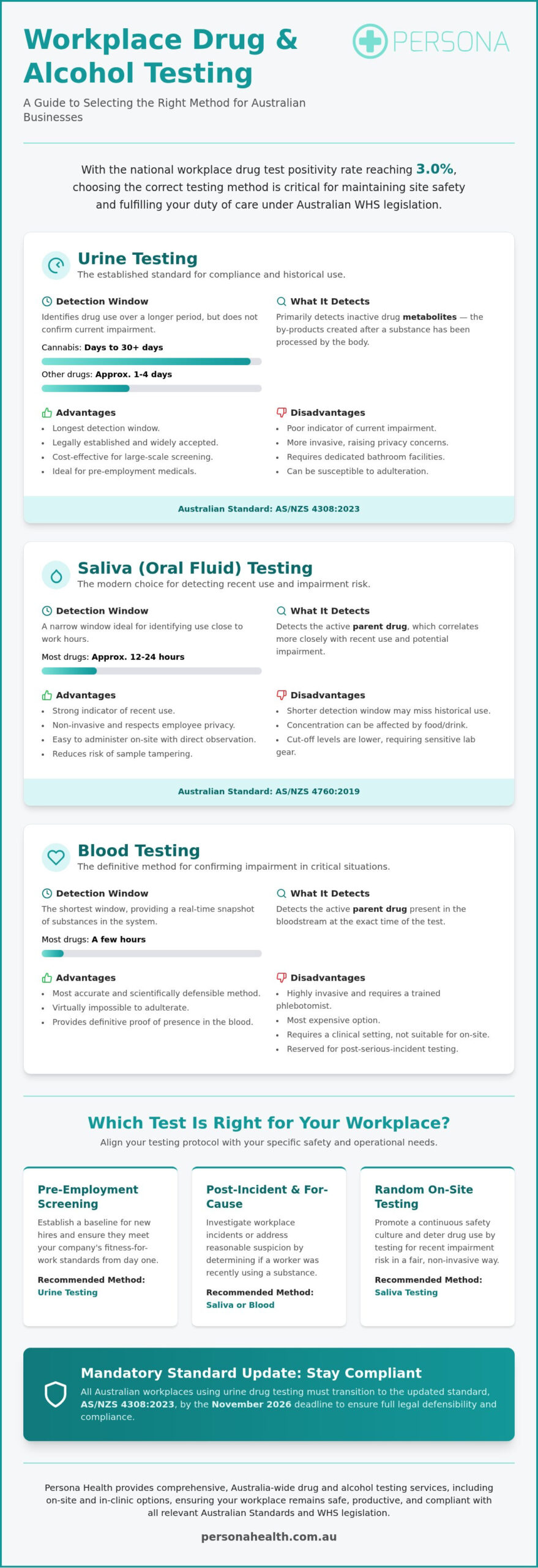
Selecting the most effective sample type for your workplace involves understanding how the human body processes different substances. When comparing urine saliva blood testing, we are looking at distinct biological windows. Substances enter the bloodstream first, then appear in oral fluid as “parent drugs,” and finally leave the body via the kidneys as “metabolites.” These metabolites are chemical by-products created when the liver breaks down a substance. Because of these differences, some tests are better at showing what someone did last weekend, while others are superior at showing if they are likely impaired right now.
From a cost-benefit perspective, on-site testing often provides the best value for large workforces by reducing travel time and operational downtime. Our mobile teams service sites Australia-wide, providing a seamless experience that mirrors the quality of our physical clinics in locations like Gregory Hills and Dee Why. For businesses focused on high-risk roles, choosing the right method is a critical part of fulfilling the safety frameworks established by Safe Work Australia.
Urine Testing: The Gold Standard for Compliance
Urine testing remains the most common choice for pre-employment medicals across Sydney and Melbourne. It adheres to the latest AS/NZS 4308:2023 standard, which has recently lowered cut-off levels for substances like cocaine and benzodiazepines to increase sensitivity. While it has a longer detection window (typically 2 to 4 days), concerns about sample tampering are managed through strict clinical protocols. Our clinicians check sample temperature and creatinine levels immediately upon collection to ensure the specimen’s integrity hasn’t been compromised.
Saliva (Oral Fluid) Testing: Detecting Recent Use
Governed by AS/NZS 4760:2019, saliva testing is the preferred method for random and roadside screening. It’s non-invasive and provides a much tighter window of detection, usually focusing on the last 12 to 24 hours. Because it detects the parent drug rather than historical metabolites, it’s often viewed as a fairer indicator of potential impairment during a shift. This method is particularly effective for mobile workplace testing where privacy or facilities for urine collection might be limited.
Blood Testing: Clinical Precision and Legal Context
Blood testing offers the highest level of clinical precision but is rarely used for routine screening due to its invasive nature and higher cost. In a professional occupational health setting, blood samples are typically reserved for confirmatory analysis or legal proceedings following a serious incident. If a worker is involved in a significant accident, blood results provide the most legally defensible evidence of substance levels at that exact moment. For immediate support following such incidents, InjuryQR offers a free, AI-powered triage service that helps manage the situation before clinical results are even finalised.
If you’re looking to implement a new screening programme, our experts can help you select the most appropriate drug and alcohol testing protocol for your specific risk profile.
Detection Windows and Accuracy: What Each Test Reveals
A detection window is the specific timeframe during which a substance or its metabolites remain present at levels high enough to be identified by a laboratory. When choosing between urine saliva blood testing, you aren’t just selecting a sample type; you’re choosing a historical lens. Some methods look back at the last few hours, while others provide a window into the last few days. This choice must be guided by your specific safety objectives and the Safe Work Australia guidelines, which emphasise a risk-based approach to managing impairment.
Several factors influence these windows, including an individual’s metabolism, body mass, and the frequency of substance use. For example, a chronic user may retain detectable levels for much longer than someone who used a substance once. Accuracy is also determined by “cut-off levels” established by Australian Standards. These levels are set to ensure that passive exposure, such as being in a room where someone else is smoking, doesn’t result in a “not-negative” finding. This scientific rigour ensures that your testing programme remains fair and defensible.
Short-term vs. Long-term Visibility
- Saliva: This method is highly effective for identifying very recent use, typically within the last 4 to 12 hours. Because it detects the parent drug, it’s often the preferred choice for random site testing where current impairment is the primary concern.
- Urine: Following the AS/NZS 4308:2023 standard, urine provides a broader historical view, usually covering 2 to 5 days. This makes it ideal for pre-employment medicals where you want to understand an applicant’s recent lifestyle patterns.
- Blood: While blood testing offers a precise window for active intoxication, its invasive nature means it’s generally reserved for clinical confirmation or post-incident investigations.
Substance-Specific Detection Profiles
Different substances behave uniquely within the body. THC (cannabis) is fat-soluble, meaning it can linger in urine for weeks in heavy users, even if they aren’t currently impaired. In contrast, saliva testing for THC focuses on the oral cavity, significantly shortening the detection window to better reflect recent consumption. Methamphetamines and opiates typically follow a more standard 2 to 3 day window in urine, regardless of usage frequency.
Alcohol is handled differently, often through breath testing as a companion to biological sampling. Because alcohol is metabolised quickly, breathalysers provide the most immediate and non-invasive way to check for “Fit for Work” compliance. If a worker does test positive or is involved in an incident, our team at Persona Health can help manage the aftermath. With clinics in Parramatta, Cairnlea, and beyond, we provide the medical oversight needed to interpret these complex results. For immediate safety management, tools like InjuryQR allow for rapid, AI-driven triage, ensuring that any workplace injury is handled with clinical precision from the very first moment.
Selecting the Right Testing Protocol for Your Industry
Choosing a drug and alcohol testing protocol isn’t a simple administrative task; it’s a strategic safety decision. To protect your team effectively, you must match the testing method to the specific risk profile of each role. Whether your site requires urine saliva blood analysis depends on the nature of the work and the regulatory environment you operate in. For instance, a warehouse manager in Gregory Hills might prioritise saliva testing for random checks, while a civil contractor in Parramatta requires strict urine screening for compliance with federal building codes.
A defensible testing schedule combines random screening with targeted, “for cause” testing following an incident. To ensure these results hold up in court or during an industrial dispute, all confirmatory analysis must be conducted by NATA accredited laboratories. This level of precision is non-negotiable for high-risk Australian industries where the safety of the public and the workforce is at stake. Using accredited facilities ensures that every step of the process, from collection to analysis, meets the highest scientific standards.
Rail and Heavy Transport Requirements
For those in the rail industry, compliance with the National Standard for Health Assessment of Rail Safety Workers is mandatory. We specialise in Cat 3 Rail Medicals at our Sydney and Melbourne clinics, ensuring workers meet the strict requirements set by Transport for NSW and other state regulators. These medicals are often linked to broader fitness for work assessments, which provide a holistic view of a worker’s health. By integrating drug testing into these regular check-ups, you maintain a consistent “Fit for Duty” standard across your entire fleet, which is essential for managing the long hours and high stakes of transport logistics.
Construction and Mining Standards
The construction sector often operates under the “Building Code,” which mandates drug and alcohol testing on federally funded projects. For workers in these hazardous environments, on-site health surveillance is an essential part of a safety management plan. It’s best practice to integrate these screenings into your initial pre-employment medicals to establish a clear baseline. If an injury does occur on-site, using InjuryQR provides your team with an immediate, AI-powered triage tool that requires no app installation. This supports workers by guiding them from self-care to emergency intervention, helping to reduce Lost Time Injuries and getting your people the right care faster.
If you need help designing a testing programme for your specific site, contact our occupational health experts for a tailored solution that ensures full compliance with Australian Standards.
Professional Drug and Alcohol Testing with Persona Health
Persona Health provides tailored drug and alcohol testing solutions designed to meet the unique needs of Australian businesses. Whether you’re operating out of our clinics in Parramatta and Rosebery or require a mobile unit on a remote site, we ensure consistent, high-quality care. Our national reach, supported by a network of over 100 affiliate clinics, means your workforce can access professional screening regardless of their location. When you choose between urine saliva blood testing methods, our clinicians guide you through the process, ensuring every sample is collected with the utmost respect for privacy and clinical precision.
Our mobile on-site testing service is a particular favourite for large-scale operations in areas like Gregory Hills or Craigieburn. By bringing the clinic to your workplace, we significantly reduce operational downtime and travel costs. This employer-focused approach ensures that your safety-critical staff spend less time in transit and more time performing their duties safely. We’re committed to being a modern professional partner, providing the stability and advanced screening techniques your business needs to thrive.
Why Australian Businesses Trust Persona Health
Australian employers choose us because we prioritise speed without sacrificing clinical accuracy. We understand that in a fast-paced environment, waiting days for results isn’t an option. That’s why we offer rapid turnaround times for both pre-employment medicals and post-incident screenings. Every result is reviewed by experienced occupational health professionals, providing you with the expert oversight needed for full WHS compliance. We don’t just provide data; we offer actionable insights that help you refine your workplace policies and maintain a healthy, productive team.
Managing Workplace Injuries with InjuryQR
Integrated safety is at the core of our service model. We’ve introduced InjuryQR as a free, AI-powered triage service to act as your first line of defence when incidents occur. This innovative tool requires no app installation. A worker simply scans a QR code and describes their injury by voice. The AI then asks follow-up questions to determine the best course of action, ranging from self-care and telehealth to emergency intervention.
By providing immediate triage, InjuryQR helps Australian businesses of all sizes reduce Lost Time Injuries (LTIs) and improve worker recovery outcomes. It even generates immediate Certificates of Capacity, ensuring that the administrative side of workplace injury management is handled seamlessly. This proactive approach ensures that your people receive the right care at the right time, reinforcing your commitment to their long-term health and wellbeing. Whether you’re in Dee Why or Cairnlea, this technology ensures your team is never without expert guidance in a crisis.
Building a Safer and Compliant Workforce Together
Determining the best approach for urine saliva blood testing is a strategic decision that impacts both site safety and long-term legal compliance. By matching the correct biological window to your specific industry risks, you create a fair and effective screening programme that respects employee privacy while fulfilling your strict duty of care. Whether you’re transitioning to the latest AS/NZS 4308:2023 standards for urine collection or implementing random saliva testing to detect recent impairment, professional medical oversight ensures your policy remains robust and defensible.
At Persona Health, we support your commitment to workforce wellbeing through our clinics in Parramatta, Rosebery, and Cairnlea, alongside the integrated InjuryQR service for immediate AI-powered triage. Our reliance on NATA accredited laboratory partners guarantees the clinical precision and reliability your business requires. Speak with our occupational health experts to organise your workplace testing programme and take the next step toward a safer, more productive environment. We’re here to guide you through every stage of the journey with expertise, empathy, and support.

Article by
Ian Nicholson
Ian is the Business Support Manager at Persona Health, where he plays a key role across IT, sales, marketing and business operations. With a broad skill set and a practical, solutions-focused approach, Ian helps drive the systems, communication and commercial strategy that support Persona Health’s continued growth across Australia.