

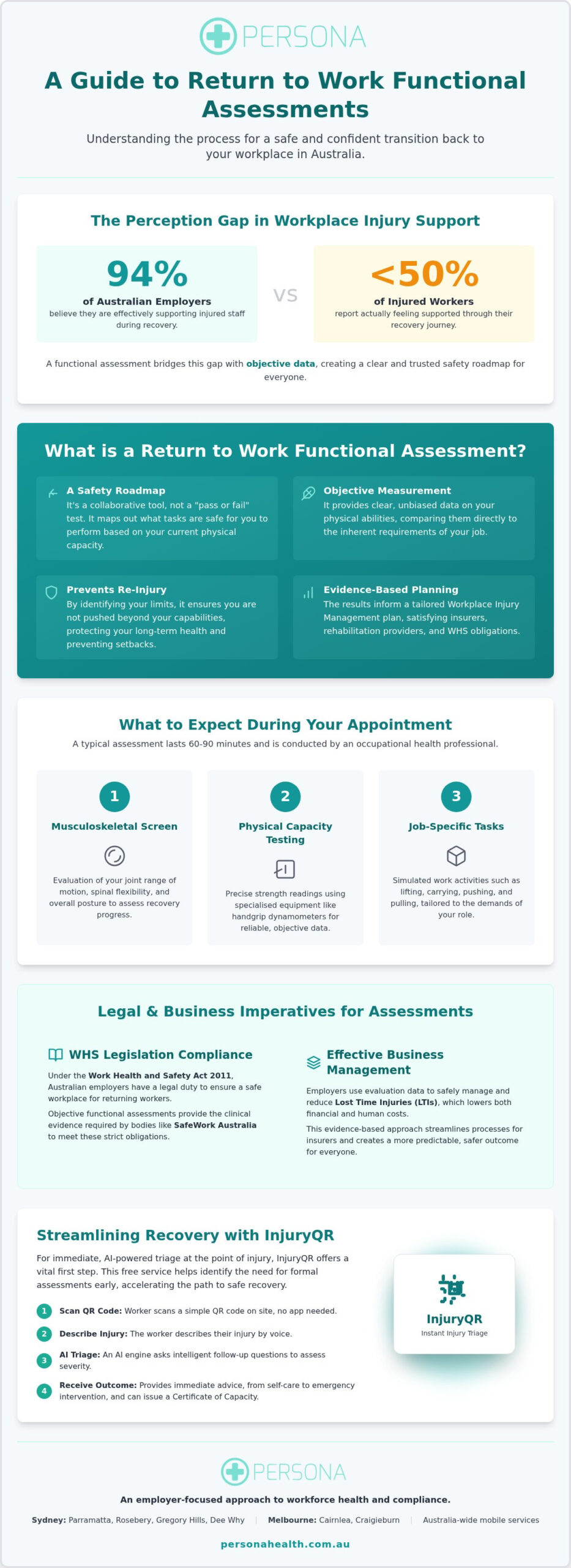
Did you know that while over 94% of Australian employers believe they are supporting their injured staff, fewer than half of workers actually feel supported during their recovery? This significant gap often stems from the uncertainty surrounding the recovery process. It’s completely normal to feel a sense of trepidation when you’re asked to attend a return to work functional assessment. You might worry that the physical tests will trigger a re-injury or fear that the results could impact your job security. We understand these concerns because we see them every day.
The truth is that a professionally conducted return to work functional assessment is a collaborative safety roadmap, not a barrier to your employment. It provides the objective data needed to protect your long-term health and ensures you aren’t pushed beyond your current physical capabilities. In this guide, we’ll explain exactly what happens during the appointment, from the physical tests involved to the latest 2026 WHS requirements from SafeWork Australia. You’ll learn how to prepare effectively and how this process supports a smooth, confident transition back to your workplace.
Key Takeaways
- Understand how a return to work functional assessment acts as a safety roadmap by objectively measuring your physical capacity in alignment with Australian WHS requirements.
- Learn what to expect during your 60 to 90 minute appointment and how our clinicians ensure the evaluation remains safe and supportive.
- Discover the differences between pre-employment screenings and recovery-focused evaluations to better understand the purpose of your specific referral.
- Access practical advice on preparing for your appointment at our Sydney or Melbourne clinics to ensure your results accurately reflect your true capabilities.
- Explore how objective data and tools like InjuryQR support long-term workplace safety and help prevent future injuries through efficient triage and monitoring.
Defining the Return to Work Functional Assessment in Australia
A return to work functional assessment is a clinical tool used to measure a worker’s physical ability to perform specific tasks safely. It isn’t a pass or fail test in the traditional sense. Instead, it provides a clear, objective snapshot of your current capacity, comparing it directly to the inherent requirements of your job. By identifying exactly what your body can handle, we can prevent the risk of re-injury and ensure your recovery stays on the right track. This process is often referred to as a Functional Capacity Evaluation, providing the evidence needed to build a sustainable path back to full duties.
At Persona Health, we prioritise an individualised approach to every assessment. We know that two people with the same injury will recover differently based on their age, fitness levels, and the specific demands of their role. Our clinicians in Sydney and Melbourne focus on your unique physiology. We ensure the assessment reflects your personal progress rather than a generic checklist, which builds trust between you and your employer during a sensitive time.
The Role of WHS Legislation and SafeWork Australia
Under the Work Health and Safety Act 2011, Australian employers have a non-delegable duty to ensure the health and safety of their workers. This includes providing a safe environment for those returning from an injury. SafeWork NSW and WorkSafe Victoria provide strict guidelines on how these transitions should be managed. Using objective data to determine fitness for duty is a legal necessity. It protects the business from liability and, more importantly, protects you from being placed in a situation that could jeopardise your long-term health. Clinical evidence is the only way to satisfy these rigorous WHS obligations.
Why Employers Require Functional Evaluations
The primary goal for any business is a safe, sustainable return to full duties. Employers use these evaluations to manage Lost Time Injuries (LTIs) and reduce the financial and human cost of workplace incidents. By using clear data, we can assist in creating tailored Workplace Injury Management plans that satisfy both insurers and rehabilitation providers. This transparency helps everyone stay on the same page regarding what tasks are safe to perform.
For businesses looking to streamline this process, tools like InjuryQR offer an immediate, AI-powered triage service. This helps identify the need for a formal return to work functional assessment early in the recovery cycle. When we combine early triage with a comprehensive clinical evaluation, the result is a more predictable, safer outcome for everyone involved. This evidence-based approach ensures that when you do step back onto the site or into the office, you’re doing so with the full confidence of your medical team.
What to Expect: The Functional Assessment Process Explained
When you arrive at one of our clinics in Parramatta, Rosebery, or Melbourne, you’ll find that we don’t treat this as a clinical obstacle course. A typical return to work functional assessment lasts between 60 and 90 minutes, depending on the complexity of your role. An occupational health professional will lead the session, focusing on your comfort and safety at all times. If you work in high-risk industries, such as transport or heavy construction, the tests are tailored to ensure you can handle the unique physical stresses of those environments without risk. Our goal is to ensure you feel informed and supported throughout the entire clinical process, removing the guesswork from your recovery.
Musculoskeletal and Physical Capacity Testing
We begin with a detailed musculoskeletal screen. This involves evaluating your joint range of motion, spinal flexibility, and overall posture to see how your body has recovered since the injury. We use specialised equipment like handgrip dynamometers to get precise strength readings, which provide much more reliable data than simple manual tests. For many roles, we also assess cardiovascular fitness through standardised tests like the step test. The clinician will monitor your heart rate and perceived exertion levels throughout, ensuring you never feel pushed beyond your limits. This data-driven approach removes the anxiety often associated with returning to work after a long absence.
Job-Specific Functional Task Simulations
The second phase moves into job-specific functional task simulations. Here, we look at manual handling techniques including lifting, carrying, and reaching. We don’t just ask you to lift a weight; we observe your technique and posture to ensure you’re working safely. If your job description requires squatting, kneeling, or climbing ladders, we’ll simulate those exact movements in a controlled setting. We also evaluate positional tolerances, such as how long you can comfortably stand or sit, which is vital for office-based roles and field work alike.
This level of detail helps employers make reasonable adjustments to your duties if required. If you’re currently navigating a recovery, you can learn more about how we support this through our Workplace Injury Management services. By matching your current abilities to your actual job description, we create a path forward that is both safe and sustainable for the long term.
PAT vs FCE: Understanding the Different Assessment Types
It’s common to feel confused by the various acronyms used in occupational health. A return to work functional assessment is often used interchangeably with a Functional Capacity Evaluation (FCE), but it serves a very different purpose to a Physical Abilities Test (PAT). While a PAT is a pre-employment screening tool designed to ensure a new hire can meet the physical demands of a role from day one, an FCE is a recovery-focused instrument. Both assessments are essential for maintaining a healthy Australian workforce, but they apply at different stages of the employee lifecycle.
Sometimes, an employer might request a specialised Fitness for Duty medical. This usually happens when there’s a specific concern about a worker’s ability to perform their tasks safely, perhaps due to a non-work-related illness or a noticeable change in performance. These evaluations provide a baseline of health that protects both the individual and the organisation, ensuring that everyone on site is physically capable of the tasks at hand.
Pre-Employment Screening vs Recovery Monitoring
The primary difference lies in the objective. We use PATs to ensure that new hires in demanding sectors, such as rail or mining, are physically suited for their roles before they start. This is a preventive measure that reduces the likelihood of future injuries. Conversely, an FCE tracks your progress during a rehabilitation programme after an injury has occurred. It’s a dynamic tool that helps us manage the transition from restricted duties back to full operational capacity. By comparing your recovery data against your initial baseline, we can see exactly how much progress you’ve made.
Using FCE Data to Create Graduated Return to Work Plans
The data we collect during an evaluation isn’t just for a report; it’s a blueprint for your recovery. We often collaborate with Injury Management Consultants to design suitable duties that align with your current capacity. This allows us to set realistic timeframes for increasing your work hours and physical demands. A graduated plan is the safest way to return to work because it prevents the “all or nothing” approach that often leads to setbacks.
Regular monitoring is a vital part of this process. In 2025, the national return-to-work rate was 88.9%, which highlights the importance of staying engaged with your recovery plan. Whether you’re visiting our clinics in Parramatta, Rosebery, or Melbourne, our focus is on ensuring your return to full duties is permanent. By using objective FCE data, we can adjust your plan in real-time, ensuring you’re always working within a safe and productive range.
Practical Preparation for Your Functional Assessment Appointment
Preparing for your return to work functional assessment starts well before you walk through the clinic doors. Booking your appointment is a straightforward process at our clinics in Parramatta, Rosebery, Gregory Hills, or Dee Why in Sydney, as well as Cairnlea and Craigieburn in Melbourne. For those outside these metropolitan hubs, we provide an extensive network of 100 affiliate clinics across Australia. To ensure the most accurate results, it’s vital to arrive well-rested and properly hydrated. Physical fatigue or dehydration can negatively impact your cardiovascular readings and strength tests, which might not reflect your true capacity for work.
We understand that sharing health data can feel sensitive. Persona Health is strictly committed to your privacy and data security, adhering to all requirements under the Privacy Act 1988. Your information is handled with the highest clinical standards. We ensure that only the relevant functional data required to support your safe return to duties is shared with the necessary parties. This professional approach builds a foundation of trust, allowing you to focus entirely on your physical performance during the evaluation.
Essential Clothing and Physical Preparation
Since the evaluation involves a series of physical tasks, you should wear comfortable exercise attire that allows for a full range of movement. Sturdy, enclosed footwear such as sneakers is mandatory for your safety during lifting and balance tests. We recommend avoiding heavy meals or excessive caffeine intake at least two hours before your appointment. These can artificially elevate your heart rate and blood pressure, potentially skewing the results of your cardiovascular fitness screen. Please ensure you bring the following items to your appointment:
- A current list of any prescribed medications.
- Relevant medical reports or imaging results, such as X-rays or MRI scans.
- Any assistive devices you normally use, such as prescription glasses or joint braces.
Disclosing Medical History and Previous Injuries
Being honest about your injury history is the most important step in ensuring a safe assessment. Our clinicians use this information to tailor the functional tasks to your specific needs, avoiding any movements that could cause pain or risk. It’s a common misconception that a previous injury will automatically disqualify you from your role. In reality, knowing your history allows us to identify where you might need specific support or workplace adjustments to perform your duties safely. Transparency ensures the assessment is a helpful tool for your recovery rather than a source of stress.
If you are an employer looking to schedule an evaluation for a staff member, you can find your nearest Persona Health clinic and book a session today. Our team provides fast turnaround times and clear, actionable reports that help you meet your WHS obligations while supporting your workforce’s health.
Beyond the Assessment: Long-Term Injury Management and Safety
The completion of a return to work functional assessment is just the beginning of a safe, long-term career. The data gathered during your evaluation serves as a foundation for ongoing on-site health surveillance. By monitoring physical capacity over time, businesses can identify potential risks before they lead to another incident. This proactive approach ensures that your workplace remains compliant with the latest WHS standards while prioritising your individual well-being. It’s about moving away from reactive measures and toward a culture of permanent health and stability.
For corporate clients, managing a large workforce requires a scalable, reliable solution. Persona Health operates a national network of over 100 affiliate clinics alongside our primary locations in Sydney and Melbourne. This ensures that whether your team is based in Parramatta or a remote site, they have access to the same high standard of clinical care. Our mobile services further extend this reach, allowing us to bring specialised occupational health expertise directly to your site, reducing downtime and ensuring consistent compliance across the entire organisation.
Streamlining Triage with InjuryQR Technology
One of the most effective ways to maintain a healthy workforce is through immediate reporting and triage. We’ve introduced InjuryQR, a free, AI-powered triage service designed specifically for Australian businesses. It requires no app installation, making it incredibly accessible for workers on the go. When an incident occurs, workers simply scan a QR code and describe their injury using their voice. The AI then asks follow-up questions to determine the severity and provides immediate outcomes. These range from self-care instructions and telehealth referrals to emergency intervention. This system significantly reduces Lost Time Injuries (LTIs) by providing immediate Certificates of Capacity and ensuring every worker gets the right level of care fast.
Professional Support Across Sydney and Melbourne Clinics
Navigating industry-specific requirements is another area where we provide expert guidance. For those in the transport sector, we offer specialised Cat 3 Rail Medicals at our Sydney clinics. Our employer-focused approach to Workplace Injury Management in Melbourne ensures that every step of the recovery process is handled with professional authority and deep empathy. We understand the pressure of getting a team back to full capacity, and we’re here to manage that transition safely.
If you’re looking to build a safer workforce from the ground up, you can book a comprehensive pre-employment medical today. By integrating these services with a return to work functional assessment and digital triage tools, we help Australian businesses move beyond simple compliance. We help you create a workplace where every individual is valued, and every injury is managed with precision and care.
Securing Your Future with Objective Health Data
Navigating the path back to full duties doesn’t have to be a source of anxiety. By understanding that a return to work functional assessment is a collaborative tool designed to protect your physical well-being, you can approach your appointment with confidence. We’ve explored how objective data ensures you aren’t pushed beyond your current limits and how simple preparation, like staying hydrated and wearing the right gear, helps produce the most accurate results for your recovery plan.
Our clinics in Parramatta, Rosebery, Cairnlea, and Craigieburn are staffed by experts who specialise in everything from Cat 3 Rail Medicals to hazardous substance surveillance. We prioritise fast turnaround times for employer reports, ensuring that your transition remains efficient and compliant with all Australian WHS standards. Whether you’re a worker looking to return safely or an employer seeking to support your team, we’re here to guide you through every step of the process with clinical precision and empathy.
Contact Persona Health to book your Return to Work Functional Assessment today and take the next step toward a sustainable, injury-free career. You’re in expert hands, and we look forward to supporting your progress and long-term health.
Frequently Asked Questions
What is the main purpose of a return to work functional assessment?
The main purpose of a return to work functional assessment is to objectively measure your physical capacity against the specific demands of your job. It ensures you can perform your duties safely without risking re-injury. By identifying your current strengths and limitations, we can help your employer make necessary adjustments to your role. This process supports a sustainable recovery and provides a clear, evidence-based roadmap for your transition back to full operational capacity.
How long does a typical functional capacity evaluation take to complete?
A typical functional capacity evaluation generally takes between 60 and 90 minutes to complete. This duration allows our clinicians to conduct a thorough musculoskeletal screen and observe you performing various task simulations relevant to your role. The timeframe ensures we gather enough data for an accurate report without causing you unnecessary physical strain. We always prioritise your comfort, and the session is paced to match your current energy levels and physical abilities.
What should I wear to my functional assessment appointment?
You should wear comfortable, loose-fitting exercise attire that allows for a full range of movement during your return to work functional assessment. Sturdy, enclosed footwear like sneakers is essential for safety during lifting and balance tasks. We also recommend avoiding heavy meals or excessive caffeine for at least two hours before your appointment. This preparation ensures your heart rate and blood pressure readings remain stable, providing the most accurate reflection of your true physical capacity.
Can I fail a functional assessment and what happens if I do?
You cannot fail this assessment because it isn’t a traditional pass or fail test. Instead, it’s a measurement of what you can currently do safely. If the results show you aren’t yet ready for full duties, the data is used to create a graduated return to work plan. This might include restricted hours or modified tasks. Our goal is to find a safe starting point that allows you to rebuild your strength without risking further injury.
Do I need a referral from my GP to attend a functional assessment?
You typically don’t need a referral from your GP to attend an assessment at our clinics. These appointments are usually requested directly by your employer or an insurance provider as part of an injury management programme. However, we strongly recommend bringing any relevant medical reports or lists of current medications from your doctor. This information helps our clinicians tailor the evaluation to your specific recovery needs and ensures all physical tests are conducted with your full history in mind.
Will the results of my assessment be shared with my employer?
Yes, a functional report is provided to your employer or insurer, but it is limited to information regarding your capacity to work. Under the Privacy Act 1988, we only share data that is relevant to your job requirements and safety. We don’t disclose private medical details that are unrelated to your ability to perform your duties. This transparency ensures that your workplace can provide the right support while keeping your sensitive health information secure and confidential.
Is a functional assessment the same as a standard medical check?
A functional assessment is quite different from a standard medical check. While a general check-up focuses on vitals like blood pressure or heart health, a functional evaluation specifically tests your ability to perform physical tasks. We simulate movements such as lifting, carrying, and climbing to see how your body handles workplace stresses. It’s a targeted evaluation designed to match your physical capabilities to the inherent requirements of your role, rather than assessing your overall general health.
What happens if I feel pain during one of the physical tests?
If you feel pain during any part of the evaluation, you must stop immediately and inform the clinician. We never want you to push through pain or risk a re-injury during the test. Our assessors are trained to monitor your movements closely and will end a specific task if they notice you are struggling. Identifying the point where pain begins is actually a vital piece of data that helps us set safe limits for your return.

Article by
Ian Nicholson
Ian is the Business Support Manager at Persona Health, where he plays a key role across IT, sales, marketing and business operations. With a broad skill set and a practical, solutions-focused approach, Ian helps drive the systems, communication and commercial strategy that support Persona Health’s continued growth across Australia.