

You are sitting in a quiet waiting room, nursing a persistent injury from a workplace incident, and feeling a knot of anxiety tighten in your stomach. It is not just the physical pain that is weighing on you; it is the looming appointment with a specialist you have never met. It is entirely natural to feel apprehensive when you are told you need an independent medical examination for work injury. Many workers worry the process is a hurdle designed to “catch them out” or disrupt their recovery, especially when faced with the complexities of Australian WHS legislation and strict reporting timelines.
At Persona Health, we believe this clinical milestone should be a source of clarity rather than stress. Whether you are visiting our clinics in Parramatta or Gregory Hills, or accessing our national network of affiliate sites, our goal is to ensure your capacity is assessed fairly. This guide will help you understand the purpose of an IME and how to navigate the 30 day reporting rules with confidence. We will explore how expert clinical guidance and tools like InjuryQR can streamline your path to wellness, ensuring a supportive transition back to the duties that define your professional life.
Key Takeaways
- Learn the critical immediate steps to take after a workplace incident, including how to notify your supervisor to ensure compliance with Australian WHS legislation.
- Understand the specific role of an independent medical examination for work injury as an impartial clinical assessment designed to provide clarity on your recovery and work capacity.
- Discover your rights regarding the Certificate of Capacity and your employer’s legal obligation to provide suitable duties where reasonably practicable.
- Explore how InjuryQR provides a free, AI-powered triage solution for immediate reporting and faster access to support without the need for app installations.
- Gain insights into the functional recovery process and what to expect during evaluations to ensure your return to the workplace is both safe and sustainable.
Immediate Steps: What to Do After a Workplace Injury
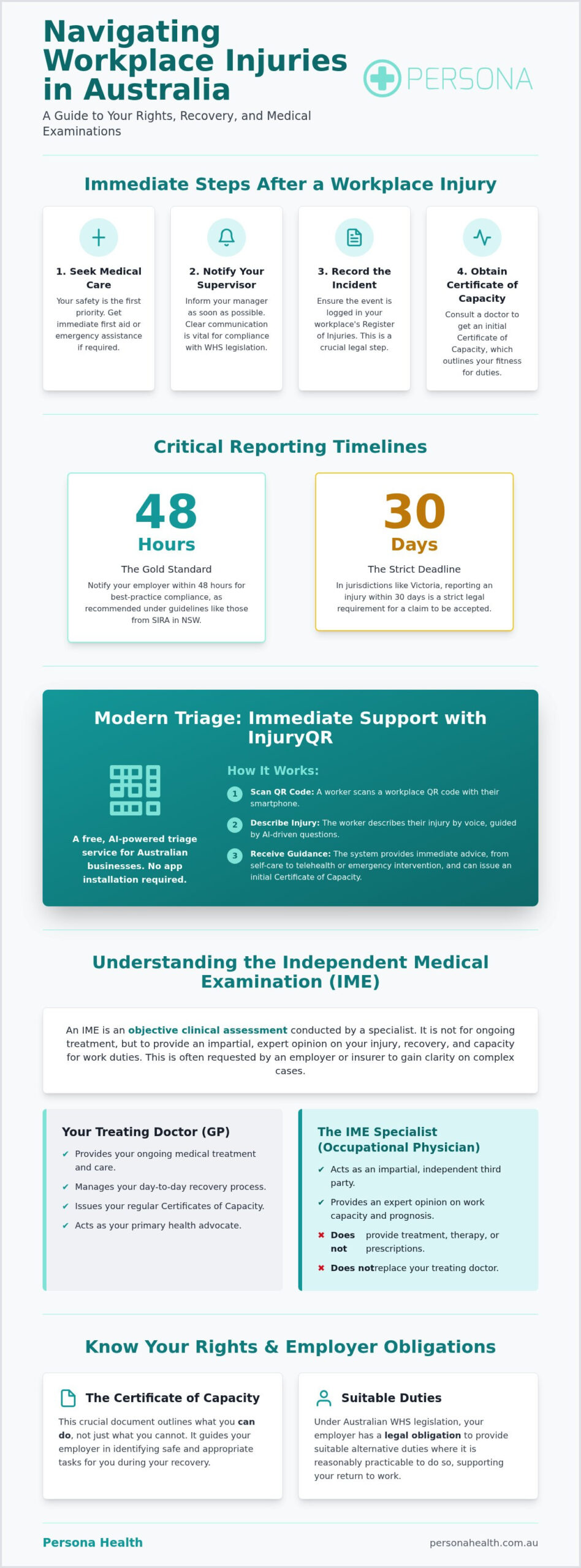
The moments following a workplace incident are often a blur of adrenaline and concern. Your first priority must always be your physical safety. If you have been hurt, seek immediate first aid or emergency care. Once the immediate danger has passed, you need to notify your supervisor or manager as soon as possible. Clear communication is the foundation of a successful Workplace Injury Management plan; it ensures your employer can fulfill their duty of care under Australian WHS legislation.
Ensuring the incident is recorded in your workplace Register of Injuries is a vital step that shouldn’t be overlooked. This document serves as an official record of what happened and when. Following this, you must consult a medical professional to obtain an initial Certificate of Capacity. This document is the primary tool used by your doctor to communicate your current abilities to your employer and insurer. While your treating doctor manages your daily recovery, you might later be required to attend an Independent Medical Examination (IME) to provide an objective clinical overview of your progress.
The Critical 30-Day Reporting Rule
In many Australian jurisdictions, such as Victoria, reporting an injury within 30 days is a strict legal requirement. Even in New South Wales, where SIRA guidelines provide more time for formal claims, notifying your employer within 48 hours is the gold standard for compliance. Delaying this report can lead to complications with your workers’ compensation claim and may even result in a rejection of benefits. It’s wise to keep a written paper trail of all injury reports and correspondence. Having a clear, dated record protects your rights and ensures that if an independent medical examination for work injury is required later, there’s a consistent history of the incident.
Seeking the Right Medical Attention Early
Early medical intervention is not just about paperwork; it leads to significantly better long-term recovery outcomes. When you attend your first consultation, be honest and detailed about your symptoms. Modern businesses are increasingly using tools like InjuryQR to speed up this process. It is a free, AI-powered triage service that requires no app installation. A worker simply scans a QR code and describes their injury by voice, allowing for immediate guidance that ranges from self-care to emergency intervention. This immediate triage reduces anxiety for everyone involved and helps establish a clear recovery path from day one. By taking these steps early, you’re better prepared if you eventually need to undergo an independent medical examination for work injury to assess your long-term capacity.
The Role of an Independent Medical Examination (IME)
An independent medical examination for work injury is an objective clinical assessment conducted by a specialist medical practitioner. Unlike your regular treating doctor, the examiner’s role isn’t to provide ongoing treatment, surgery, or prescriptions. Instead, they act as an impartial third party to provide a professional opinion on your injury, recovery progress, and future work capacity. This assessment is typically requested by an insurer or employer when they require specific clarity that your primary care provider might not be able to offer, particularly regarding complex return to work scenarios.
The primary goal of this examination is to determine your capacity for suitable duties. This helps ensure that any plan to get you back into the workplace is safe, sustainable, and aligned with your current physical or psychological state. It provides a clinical roadmap for your recovery journey, ensuring that the expectations placed upon you by an employer or insurer are realistic and medically sound. By providing an unbiased view, the examiner helps move the recovery process forward when it may have reached a standstill.
Occupational Physicians vs General Practitioners
While your local GP is excellent for managing your general wellbeing, an independent medical examination is often performed by an Occupational Physician. These specialists have undergone years of additional training to understand the intricate relationship between health and the workplace. They possess a deep understanding of industry specific risks, such as the unique safety requirements for those needing Cat 3 Rail Medicals or the long term health monitoring required for silica exposure. This specialised knowledge allows them to provide a more nuanced assessment of how an injury impacts your specific job role compared to a general practitioner who may not be familiar with your daily work environment.
What to Expect During Your Appointment
Walking into an appointment can feel daunting, but knowing the process can help ease your mind. The examiner will begin with a detailed discussion of your medical history and the specific circumstances of your injury. This is followed by a physical assessment focused on the affected areas. It’s vital to remember that you have the right to be treated with dignity and respect throughout this process. To ensure the most accurate assessment, you should bring any relevant clinical records, such as specialist reports or imaging results like X-rays or MRIs. Being prepared helps the doctor form a complete picture of your health.
At Persona Health, our Occupational Physicians take an empathetic approach to every independent medical examination for work injury, ensuring you feel heard while providing the clinical clarity needed for your recovery. If you are looking for a fair and professional assessment, you can speak with our team about our network of clinics across Sydney and Melbourne.
Navigating Your Rights and the Certificate of Capacity
Understanding your rights is a vital part of the recovery process. One of the most important things to remember is that you have the legal right to choose your own treating doctor for your ongoing care. While an insurer might request an independent medical examination for work injury to gain an objective clinical perspective, they cannot dictate who manages your day to day treatment. This ensures you maintain a relationship with a practitioner you trust. Conversely, your employer has a legal obligation to provide suitable duties where it is reasonably practicable to do so, supporting your stay at work or return to work journey.
Rights come with responsibilities. As a worker, you’re expected to participate in a reasonable injury management plan and cooperate with the return to work process. This partnership is protected by the Privacy Act 1988, which ensures your sensitive medical information is handled with the utmost care. Your employer and insurer only have access to information that is directly relevant to your work capacity and injury management; your broader medical history remains confidential. This balance of transparency and privacy is designed to build trust between all parties involved in your recovery.
Understanding the Certificate of Capacity
The Certificate of Capacity is the primary communication tool between your doctor and your employer. It doesn’t just list your injuries; it clearly outlines what you can safely do in the workplace. There is a significant difference between being fit for pre-injury duties, which means returning to your exact old role, and being fit for suitable duties, which might involve modified tasks or reduced hours. Regular updates to this certificate are essential. Without a current certificate, your ongoing support and weekly payments can be delayed, so ensuring your treating doctor provides frequent, accurate assessments is a top priority for a smooth recovery.
The Role of an Injury Management Consultant (IMC)
Sometimes, the path back to work becomes complicated or stalled. In these instances, an Injury Management Consultant (IMC) can be engaged as a facilitator. An IMC is a registered medical practitioner who works to resolve disagreements or barriers between the worker, the employer, and the insurer. They focus on clinical solutions to help you progress when your recovery has plateaued. At Persona Health, we provide expert IMC services through our clinics in Parramatta and across our Melbourne locations in Cairnlea and Craigieburn. Our consultants take an empathetic approach to help you navigate the complexities that might arise after an independent medical examination for work injury, ensuring your individual needs remain the focus of the return to work plan.
Modern Triage: Using InjuryQR for Immediate Reporting
The traditional paper based reporting system is often slow and prone to delays, which can exacerbate a worker’s anxiety during the first few hours of an injury. InjuryQR addresses this gap by offering a free, AI powered triage service for Australian businesses that requires no app installation. When an incident occurs, the worker simply scans a QR code and describes their injury using their voice. This immediate interaction allows the AI to ask targeted follow up questions, leading to a range of outcomes from self care and telehealth to emergency intervention.
By providing immediate clinical direction, employers can significantly reduce Lost Time Injuries (LTIs). This proactive approach ensures that the recovery journey starts within minutes of the injury occurring, rather than days later. It creates a clear, objective record that can be invaluable if a formal independent medical examination for work injury is required further down the track to assess long term capacity. This digital trail ensures that the specialists have a consistent history of the incident from the very beginning.
How AI Streamlines the Recovery Journey
The platform’s ability to generate an immediate digital Certificate of Capacity is a game changer for the Australian workforce. It removes the uncertainty that often follows a workplace accident, providing both the worker and the employer with instant guidance on what happens next. Voice to text reporting is inherently more accurate than paper forms filled out hours or days after the event, as it captures the details while they are fresh. This early clarity helps to lower stress levels and ensures that the initial clinical assessment is based on precise, real time data, which is essential for a fair recovery process.
Integration with Persona Health Clinics
One of the greatest advantages of this technology is how it connects workers directly to our specialist clinic network. Whether you are located near our Parramatta, Rosebery, or Gregory Hills sites in Sydney, or our Cairnlea and Craigieburn clinics in Melbourne, the digital record created by InjuryQR is ready and waiting for your clinical appointment. This seamless flow of information means our Occupational Physicians can spend more time on your physical assessment and less time on administrative data entry. It ensures your follow up care is informed by the exact details of the incident.
Having a comprehensive digital history from the moment of injury ensures that any future independent medical examination for work injury is supported by a robust and consistent set of clinical facts. This joined up approach to care is central to our commitment to workforce health and compliance. To see how this technology can transform your workplace safety and support your team, you can learn more about our workplace injury management services today.
The Path Back: Functional Recovery and Return to Work
Recovery is rarely a linear process. It’s a journey that moves from initial clinical treatment toward restoring your full physical and psychological function. A gradual return to work is a cornerstone of this process, as jumping back into full duties too quickly significantly increases the risk of chronic re-injury. By implementing a staged approach, you allow your body to adapt to the physical demands of your role through a process known as work-hardening. This involves using modified duties to build strength and stamina in a controlled environment, ensuring your healing phase is supported rather than hindered by your professional responsibilities.
Successful reintegration requires active collaboration between you and your employer. This might involve an ergonomic assessment to ensure your workspace is safe or adjusting your shift patterns to manage fatigue. When an independent medical examination for work injury is conducted, the resulting report often provides the specific clinical parameters needed to design these modifications. It ensures that the return to work plan is not based on guesswork but on a clear understanding of your current physical thresholds.
Functional Capacity Evaluations (FCE)
An FCE is a comprehensive set of tests used to objectively measure your ability to perform specific work related tasks. Unlike a standard consultation, this evaluation involves physical activities like lifting, carrying, and reaching to determine exactly what your body can handle. These assessments are particularly crucial for high risk roles in the rail or transport sectors, where safety is paramount. If you are preparing to return to a safety critical position, you can find more detail on our Fitness for Duty Medicals page, which explains how we ensure workers are physically equipped for the demands of their specific industry.
Ongoing Support and Surveillance
The journey doesn’t end the moment you walk back through the office or site gates. Maintaining long term health requires ongoing support and, in many specialised industries, regular monitoring. Our on-site health surveillance services play a vital role in preventing future workplace injuries by identifying potential health risks before they become serious issues. This proactive approach is especially important for workers who have previously undergone an independent medical examination for work injury, as it provides a framework for continued wellness and compliance.
At Persona Health, we are committed to being your professional partner throughout every stage of your recovery. From the initial triage to the final functional assessment, our Occupational Physicians provide the empathetic, expert guidance needed to navigate the Australian workers’ compensation system. We encourage both workers and employers to engage with professional injury management early in the process to ensure the best possible outcomes for everyone involved.
Securing Your Sustainable Return to Work
Navigating the recovery process requires a balance of clinical expertise and a clear understanding of your rights. Prioritising immediate reporting through tools like InjuryQR and ensuring your Certificate of Capacity accurately reflects your current function sets the stage for a sustainable recovery. An independent medical examination for work injury serves as a vital clinical milestone; it provides the objective clarity needed to transition back to the workplace safely while ensuring your employer provides the necessary support.
Our specialist Occupational Physicians at Persona Health take an empathetic, individualised approach to every case. Whether you visit our clinics in Parramatta and Rosebery or our Melbourne sites in Cairnlea and Craigieburn, you can trust in our commitment to workforce health and compliance. We also offer a vast network of 100 affiliate clinics to support you wherever you are in Australia. Our goal is to replace uncertainty with a clear, professional roadmap for your unique recovery journey.
Contact Persona Health for professional injury management and speak with our team about your specific requirements today. You don’t have to navigate this journey alone; expert support is always within reach to help you regain your strength and professional focus.
Frequently Asked Questions
What is the first thing I should do if I am injured at work?
The first thing you should do is prioritise your immediate safety and seek medical attention or first aid. Once you are safe, you must notify your supervisor or manager about the incident as soon as possible. Prompt notification ensures your employer can fulfil their duty of care and helps secure your rights under Australian WHS legislation. Using a tool like InjuryQR can help you report the incident accurately via voice in just a few minutes.
Do I have to see the doctor my employer recommends for an IME?
Yes, you generally must attend an independent medical examination for work injury if it is reasonably requested by your employer or their insurer. While you have the right to choose your own treating doctor for ongoing care, the IME is a separate, impartial assessment required to progress your claim. Failing to attend a scheduled appointment can lead to the suspension of your weekly payments or a delay in medical treatment approvals.
How long do I have to report a workplace injury in Australia?
Reporting timeframes vary across Australia, but you should always report an injury as soon as it happens. In Victoria, you must notify your employer within 30 days to remain eligible for compensation. In New South Wales, employers must notify their insurer within 48 hours of becoming aware of an injury. Delaying your report can complicate your recovery journey and may result in your claim being contested or rejected by the insurer.
What is a Certificate of Capacity and why is it important?
A Certificate of Capacity is a legal document provided by your treating doctor that outlines your current ability to work. It is important because it tells your employer what tasks you can safely perform and whether you require modified duties or reduced hours. This document is the primary trigger for your weekly compensation payments, so keeping it updated during every medical consultation is essential for maintaining your financial and clinical support.
Can I be fired if I make a workers compensation claim?
No, it is generally illegal under Australian law to dismiss an employee simply because they have lodged a workers compensation claim or are away from work due to a workplace injury. Protections exist under the Fair Work Act and various state based legislations for a specific period, often up to 12 months. If you feel your employment is being unfairly targeted, you should seek advice from a legal professional or your relevant state regulator like SIRA or WorkSafe.
What happens if my injury prevents me from doing my old job?
If your injury prevents you from performing your pre-injury duties, your employer is legally obligated to provide suitable duties where reasonably practicable. This means they should look for alternative roles or modify your current tasks to fit your capacity. If a permanent change is required, you may be eligible for vocational rehabilitation services to help you transition into a new career path that aligns with your physical and psychological health.
Is InjuryQR free for workers to use after an incident?
Yes, InjuryQR is a free, AI powered triage service designed for Australian businesses and their workers. It requires no app installation and can be accessed by simply scanning a QR code at your workplace. By describing your injury by voice, you receive immediate clinical guidance and a digital record of the incident. This service helps reduce workplace anxiety and ensures that your recovery journey starts with the right level of care from the very first moment.
How does an Occupational Physician differ from my local GP?
An Occupational Physician is a specialist doctor who has completed years of advanced training specifically focused on the relationship between health and work. While your local GP manages your general health, an Occupational Physician understands the specific demands of high risk industries like rail or construction. They are often the ones who conduct an independent medical examination for work injury, providing a deep level of clinical expertise regarding workplace risks and long term functional capacity.

Article by
Ian Nicholson
Ian is the Business Support Manager at Persona Health, where he plays a key role across IT, sales, marketing and business operations. With a broad skill set and a practical, solutions-focused approach, Ian helps drive the systems, communication and commercial strategy that support Persona Health’s continued growth across Australia.